10 minutes free every day
Continue audio lessons in the app
Word explanations appear automatically in sync with the audio.
No login required · synced translations · playback with the screen locked
Choose your learning language and open this lesson in the app.

About This Lesson
Use Planning dinner timing when hosting guests to practice German conversation, pronunciation, vocabulary, grammar, and quizzes.
Dialogue
Die Gäste kommen vielleicht an, während das Hauptgericht noch kocht.
dee GEH-stuh KOM-uhn fee-LYKHT ahn, VAIR-unt dahs HOWPT-guh-RIKHT nokh kokht. The guests may arrive while the main course is still cooking.Dann serviere eine einfache Vorspeise, damit alle erst einmal ankommen können.
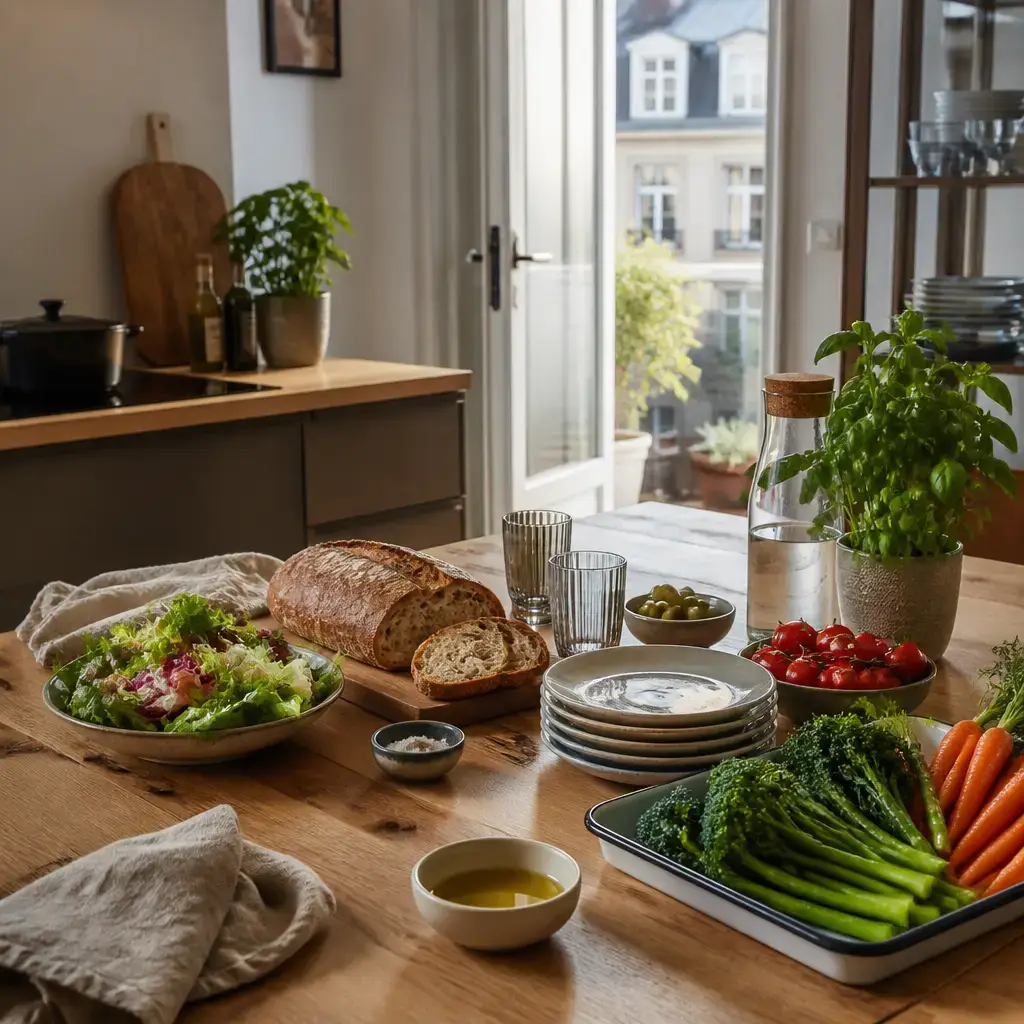
dahn zair-VEE-ruh EYE-nuh EYE-nfakh-uh FOR-shpy-zuh, dah-MIT AH-luh air-st eye-n-MAHL AHN-kom-uhn KUR-nuhn. Then serve a simple starter so people can settle in.Ich kann Salat und Brot fertig haben, bevor sie kommen.
ikh kahn sah-LAHT oont broht FAIR-tikh HAH-buhn, beh-FOR zee KOM-uhn. I can have salad and bread ready before they get here.Das gibt dem Hauptgericht etwas mehr Zeit, ohne dass das Abendessen verspätet wirkt.
dahs geept dame HOWPT-guh-RIKHT ET-vahs mare tsyte, OH-nuh dahs dahs AH-bunt-ess-un fair-SHPEH-tet virkt. That gives the main course a little extra time without making dinner seem delayed.Soll ich das Gemüse kochen, sobald alle angekommen sind?
zohl ikh dahs guh-MYOO-zuh KOKH-uhn, zo-BAHLT AH-luh AHN-guh-kom-uhn zint. Should I cook the vegetables once everyone has arrived?Sie schmecken frisch gekocht besser, also warte, bis du kurz davor bist, sie zu servieren.
zee SHMEK-uhn frish guh-KOKHT BET-suh, AHL-zoh VAHR-tuh, bis doo koorts dah-FOR bist, zee tsoo zair-VEE-run. They taste better freshly cooked, so wait until you are close to serving.Gäste zu bewirten ist stressig, weil es schwieriger ist, alles zeitlich zu planen, als zu kochen.
GEH-stuh tsoo beh-VIR-ten ist SHTRES-ikh, vyle es SHVEE-ree-guh ist, AH-luhs TSYTE-likh tsoo PLAH-nuhn, ahls tsoo KOKH-uhn. Hosting feels stressful because timing everything is harder than cooking.Mach einen einfachen Plan fürs Servieren: Getränke, Vorspeise und dann das Hauptgericht.
makh EYE-nun EYE-nfakh-un plahn fyoors zair-VEE-run: guh-TRENK-uh, FOR-shpy-zuh oont dahn dahs HOWPT-guh-RIKHT. Make a simple serving plan: drinks, starter, then the main course.Ich kann diese Checkliste neben dem Herd aufbewahren.
ikh kahn DEE-zuh CHEK-lis-tuh NAY-bun dame HAIRT OWF-beh-VAHR-un. I can keep that checklist near the stove.Das sollte dir helfen, konzentriert zu bleiben, während die Leute ankommen.
dahs ZOHL-tuh deer HEL-fun, kon-tsen-TREET tsoo BLY-bun, VAIR-unt dee LOY-tuh AHN-kom-uhn. It should help you stay focused while people arrive.Sentence explanations
Die Gäste kommen vielleicht an, während das Hauptgericht noch kocht.
The guests may arrive while the main course is still cooking.
- Gäste
- guests
- kommen … an
- arrive
- vielleicht
- perhaps
- während
- while
- Hauptgericht
- main course
- noch
- still
- kocht
- is cooking
More detail
Gäste means “guests” here. It is the plural of Gast (“guest”); the plural changes the vowel and adds -e: der Gast → die Gäste. Because the subject is plural, the verb uses a plural form. kommen ... an is the separable verb ankommen, “to arrive.” In the present tense, kommen appears near the subject and the prefix an moves to the end of the main clause: Die Gäste kommen an. (“The guests arrive.”) With a plural subject, kommen is the form used here. In a subordinate clause, the finite verb goes to the end and the prefix is attached again: ..., während die Gäste ankommen (“..., while the guests arrive”). vielleicht means “perhaps” here. It marks the arrival as possible rather than certain. Example: Vielleicht kommen sie morgen an. — “They may arrive tomorrow.” während introduces a time relation meaning “while.” It starts a subordinate clause, whose finite verb goes to the end. Example: Ich lese, während er kocht. — “I read while he cooks.” Hauptgericht means “main course.” It is a neuter compound noun: das Hauptgericht. In this context, Gericht means a dish or course, while Haupt- identifies it as the main one. Example: Das Hauptgericht ist fertig. — “The main course is ready.” noch means “still” here: the cooking is continuing at the relevant time. It does not by itself state how long the cooking has lasted. Example: Das Essen kocht noch. — “The food is still cooking.” kocht comes from kochen, “to cook.” It is the present-tense third-person singular form, agreeing with the singular subject das Hauptgericht: das Hauptgericht kocht. Depending on its subject and context, kochen can describe a person cooking or food cooking/boiling. Here the main course is the thing cooking. Example: Die Suppe kocht. — “The soup is cooking.” Together, Die Gäste kommen vielleicht an says that the guests may arrive. während das Hauptgericht noch kocht places that possible arrival during the continuing cooking of the main course. The comma separates the main clause from the subordinate während clause. Thus the whole utterance means: “The guests may arrive while the main course is still cooking.”
Dann serviere eine einfache Vorspeise, damit alle erst einmal ankommen können.
Then serve a simple starter so people can settle in.
- Dann
- then
- serviere
- serve
- einfache
- simple
- Vorspeise
- starter
- damit
- so that
- alle
- everyone
- erst einmal
- first of all
- ankommen
- settle in
- können
- can
More detail
Dann means “then” here, linking this instruction to what comes before in the sequence. It is an adverb and does not change the verb’s form. Example: Dann essen wir. — “Then we’ll eat.” serviere is the second-person singular informal imperative of servieren (“to serve”). The ending shows that the instruction is addressed to one person using informal du; it is not the formal imperative Servieren Sie. Example: Serviere das Brot. — “Serve the bread.” einfache is the adjective einfach (“simple”) in its inflected form. It describes Vorspeise, which is feminine and is the accusative object of serviere; after eine, the adjective takes the ending in eine einfache Vorspeise. The adjective, not the noun, has the form einfache. Example: Ich kaufe eine einfache Mahlzeit. — “I’m buying a simple meal.” Vorspeise means “starter” or “appetizer,” the first course of a meal. Its plural is Vorspeisen. In this sentence it is the thing being served, so it appears as an accusative object; its feminine gender is also relevant to the form eine einfache. Example: Die Vorspeise ist fertig. — “The starter is ready.” damit introduces a subordinate clause expressing the intended purpose: “so that …”. The clause after it explains the aim of serving the starter. This is different from weil (“because”), which introduces a reason rather than an intended result. Example: Ich koche, damit alle essen können. — “I’m cooking so that everyone can eat.” alle is the subject of the damit clause and means “everyone” or “all [the relevant people]” here. The fixed translation identifies those people generally, while it does not specify their individual identities. As a pronoun, it stands for the relevant group rather than naming a particular person. Example: Alle sind bereit. — “Everyone is ready.” erst einmal is a reusable adverbial expression meaning “first” or “for now.” Here it presents settling in as an initial step; it does not by itself assert a specific numerical count. Example: Warte erst einmal. — “Wait for now.” ankommen is the infinitive of ankommen, literally “to arrive.” In this context, supported by the translation, it has the extended meaning “to settle in” or become comfortably situated. It is a separable verb: in a main clause, alle kommen an, but its infinitive remains ankommen here. Example: Die Gäste kommen langsam an. — “The guests are gradually settling in.” können is the infinitive of the modal verb können, “can” or “be able to.” Its subject here is alle, so the finite form would be alle können; because it is in a subordinate clause with damit, können comes at the end, after the other infinitive ankommen. Compare Ich kann kommen — “I can come” — with alle können ankommen — “everyone can arrive/settle in.” Together, eine einfache Vorspeise is the accusative object of the imperative serviere: “serve a simple starter.” damit alle erst einmal ankommen können gives the purpose: “so that everyone can settle in for now/first.” The complete utterance therefore means: “Then serve a simple starter so people can settle in.”
Ich kann Salat und Brot fertig haben, bevor sie kommen.
I can have salad and bread ready before they get here.
- Ich kann
- I can
- Salat
- salad
- Brot
- bread
- fertig haben
- have ready
- bevor
- before
- sie
- they
- kommen
- come / get here
More detail
Ich kann combines ich (“I”) with kann, the first-person singular present form of können (“can; be able to”). A modal verb such as können is followed by an infinitive, which appears later here as fertig haben. Compare ich kann (“I can”) with du kannst (“you can”) and sie können (“they can” or “you can,” formal/plural). Salat means “salad.” Its common dictionary form is der Salat; here it is an object of haben, so it is in the accusative, although the form Salat itself does not visibly change. Example: Ich kaufe einen Salat. — “I am buying a salad.” Brot means “bread.” Its dictionary form is das Brot; like Salat, it is an object here, and its accusative form remains Brot. The two objects are joined by und (“and”): Salat und Brot means “salad and bread.” fertig haben is a reusable German pattern meaning “to have something ready” or “to have finished preparing something.” fertig describes the state of the object, while haben expresses possession of that ready state. With a modal verb, haben stays in the infinitive: Ich kann das Essen fertig haben. — “I can have the food ready.” This is different from fertig sein (“to be ready”), which uses sein rather than haben. bevor introduces a time clause meaning “before.” The clause after it is subordinate, so its finite verb goes to the end: bevor sie kommen (“before they come/get here”). In this sentence, sie means “they,” as established by the fixed translation. It is the third-person plural personal pronoun, written lowercase here because it is not the formal “you” pronoun Sie. Its form does not identify which people they are; the sentence itself simply refers to them as a plural group. kommen means “come” or, in this context, “get here.” It is the infinitive/base form and also the present-tense form used with sie (“they”): sie kommen. Example: Sie kommen um acht. — “They are coming at eight.” Together, Ich kann + Salat und Brot + fertig haben gives “I can have salad and bread ready.” The subordinate time clause bevor sie kommen adds “before they get here,” so the complete utterance is: “I can have salad and bread ready before they get here.”
Das gibt dem Hauptgericht etwas mehr Zeit, ohne dass das Abendessen verspätet wirkt.
That gives the main course a little extra time without making dinner seem delayed.
- Das
- That
- gibt
- gives
- Hauptgericht
- main course
- etwas
- a little
- mehr
- more
- Zeit
- time
- ohne dass
- without ...
- Abendessen
- dinner
- verspätet
- delayed
- wirkt
- seems
More detail
Das is a demonstrative pronoun meaning “that” here. It points to an already established situation or action rather than naming a noun in this sentence. German demonstratives can refer back to discourse: Das hilft. — “That helps.” gibt is the third-person singular present form of geben (“to give”). The pattern etwas gibt jemandem etwas means “something gives someone something”: Der Plan gibt uns Zeit. — “The plan gives us time.” dem Hauptgericht is the recipient, marked by the dative; Hauptgericht means “main course.” etwas means “some” or “a little” in this context. It indicates an unspecified small amount here, not an exact numerical count. mehr means “more” and is the comparative form related to viel (“much/many”): mehr Zeit — “more time.” Zeit is the noun “time.” The phrase etwas mehr Zeit therefore means “a little more time.” ohne dass introduces a subordinate clause meaning “without ...”. In this construction, the finite verb comes at the end of the subordinate clause: ohne dass es schwierig wird — “without it becoming difficult.” Abendessen is the noun “dinner.” In das Abendessen, das is the neuter singular definite article. The article belongs with the noun; the earlier Das is a separate demonstrative pronoun functioning as the main-clause subject. verspätet means “delayed” or “late” here. It is a predicative adjective after wirken, so it describes how dinner appears; it does not take an ending in this position. verspätet can also describe a noun attributively, as in ein verspäteter Zug — “a delayed train,” where the adjective has an ending. wirkt is the third-person singular present form of wirken. With an adjective, wirken means “to seem” or “to appear”: Das Essen wirkt fertig. — “The food seems ready.” Here it combines with verspätet to mean “seem delayed.” Together, Das gibt dem Hauptgericht etwas mehr Zeit says that the situation referred to by Das gives the main course a little more time. ohne dass das Abendessen verspätet wirkt adds the condition avoided: dinner does not appear delayed. The whole utterance means: “That gives the main course a little extra time without making dinner seem delayed.”
Soll ich das Gemüse kochen, sobald alle angekommen sind?
Should I cook the vegetables once everyone has arrived?
- Soll ich
- should I
- Gemüse
- vegetables
- kochen
- cook
- sobald
- once; as soon as
- alle
- everyone
- angekommen
- arrived
More detail
Soll ich begins a yes/no question. soll is the present-tense form of sollen for ich; here it asks whether the speaker ought to or is expected to do something. In a main question with a modal verb, the finite modal comes first, while the other verb stays in the infinitive at the end: Soll ich warten? — “Should I wait?” Gemüse means vegetables as food. It is a neuter noun, and this form is unchanged between nominative and accusative: Das Gemüse ist frisch — “The vegetables are fresh”; Ich kaufe das Gemüse — “I am buying the vegetables.” In the utterance, it is the object of kochen. kochen is the infinitive “to cook.” With sollen, it remains an infinitive rather than taking a personal ending. Example: Wir sollen das Gemüse kochen. — “We are supposed to cook the vegetables.” sobald introduces a time clause meaning “as soon as” or “once.” It places the event in that clause at the point when the other event becomes possible or appropriate. A clause introduced by sobald sends its finite verb to the end: Ich rufe dich an, sobald ich angekommen bin. — “I’ll call you as soon as I have arrived.” alle means “everyone” here, referring to all relevant people in the situation. Grammatically, it is plural, so the following verb is also plural. Its exact individual referents are not specified by the sentence. angekommen is the past participle of ankommen, “to arrive.” It combines with the auxiliary sein to form the perfect: alle sind angekommen — “everyone has arrived.” In the subordinate clause, the finite auxiliary sind comes last: sobald alle angekommen sind. The participle itself does not carry the person or number here; sind shows the plural subject alle. The structure is Soll ich + object das Gemüse + infinitive kochen + time clause sobald alle angekommen sind. The main question asks whether the speaker should cook the vegetables, and the time clause sets the condition: the cooking should happen once everyone has arrived. Thus the whole utterance means, “Should I cook the vegetables once everyone has arrived?”
Sie schmecken frisch gekocht besser, also warte, bis du kurz davor bist, sie zu servieren.
They taste better freshly cooked, so wait until you are close to serving.
- Sie schmecken
- they taste
- frisch gekocht
- freshly cooked
- besser
- better
- warte
- wait
- bis
- until
- du … bist
- you are
- kurz davor
- shortly before that
- sie zu servieren
- to serve them
More detail
Sie schmecken means “they taste” here. Sie is the third-person plural pronoun, and schmecken is the present-tense form for “they” of schmecken (“to taste”). In this context, the referent is the food being cooked, supported by the preceding mention of the vegetables. German can use schmecken to describe how food tastes: Die Suppe schmeckt gut. — “The soup tastes good.” frisch gekocht means “freshly cooked.” gekocht is the past participle of kochen (“to cook”), used here descriptively with frisch (“fresh”). The phrase describes food that has just been cooked; it does not say who cooked it. Example: Wir essen frisch gekochte Nudeln. — “We are eating freshly cooked noodles.” besser is the comparative form of gut (“good”): gut → besser (“better”) → am besten (“best”). It compares the taste in the freshly cooked condition with another possible time or condition. With schmecken, besser means that the food tastes better. warte is the informal singular imperative of warten (“to wait”). The subject du is understood in this command, so Warte! means “Wait!” The formal command for one person would use a different construction: Warten Sie! — “Please wait.” bis introduces a time limit: “until.” It begins the subordinate clause that states when the waiting should stop. In a German clause introduced by bis, the finite verb normally goes to the end, as in Warte, bis du fertig bist. — “Wait until you are finished.” du bist means “you are.” du is the informal singular “you,” and bist is the second-person singular present form of sein (“to be”): ich bin, du bist, sie ist. In this subordinate clause, bist appears at the end because bis has introduced the clause. kurz davor literally combines kurz (“shortly/just”) with davor (“before that”). Together, in this pattern, it means “shortly before it” or “close to doing it.” Here davor points forward to the action expressed by sie zu servieren, so kurz davor sein, etwas zu tun is a reusable pattern meaning “to be close to doing something.” so before the waiting instruction is expressed by also in the source: it links the better taste to the resulting advice. Also warte ... means “so wait ...”. sie zu servieren means “to serve them.” sie is the accusative plural pronoun “them,” referring here to the food, and servieren is the infinitive “to serve.” The word zu marks this infinitive in the construction etwas zu servieren (“to serve something”). Example: Ich bin bereit, das Essen zu servieren. — “I am ready to serve the food.” The whole utterance is assembled as follows: the food tastes better when freshly cooked, also (“so”) introduces the consequence, and warte (“wait”) gives the instruction. bis du kurz davor bist, sie zu servieren means “until you are close to serving them.” Thus the complete meaning is: “They taste better freshly cooked, so wait until you are close to serving them.”
Gäste zu bewirten ist stressig, weil es schwieriger ist, alles zeitlich zu planen, als zu kochen.
Hosting feels stressful because timing everything is harder than cooking.
- Gäste
- guests
- zu bewirten
- to host
- stressig
- stressful
- schwieriger
- more difficult
- alles
- everything
- zeitlich
- in terms of timing
- zu planen
- to plan
- als
- than
- zu kochen
- to cook
More detail
Gäste means people who are being hosted. It is the plural form of Gast (“guest”); in this sentence it is the object of bewirten. Example: Wir erwarten Gäste. — “We are expecting guests.” zu bewirten means “to host” or “to entertain” guests. The base verb is bewirten; zu bewirten is its infinitive with zu. Here, the whole infinitive group Gäste zu bewirten functions as the subject: “hosting guests.” Example: Es ist schön, Freunde zu bewirten. — “It is nice to host friends.” stressig describes something that causes stress. It is an adjective and does not itself show whether the subject is singular or plural here, because it follows ist as a predicate adjective. Example: Der Abend ist stressig. — “The evening is stressful.” schwieriger is the comparative form of schwierig (“difficult”): schwierig → schwieriger (“more difficult”) → am schwierigsten (“the most difficult”). The comparative appears with als when two activities are compared. alles means “everything” in this sentence. It is an indefinite pronoun referring collectively to all the things that need to be timed or organized; the sentence does not specify those things individually. Example: Ich habe alles vorbereitet. — “I prepared everything.” zeitlich relates to time, especially timing or scheduling. In alles zeitlich zu planen, it specifies that everything is being planned with regard to when it happens, not merely that a general plan exists. Example: Wir müssen den Tag zeitlich gut planen. — “We have to plan the timing of the day well.” zu planen means “to plan.” Its base verb is planen; with zu, it forms an infinitive. Together with alles zeitlich, alles zeitlich zu planen means “to plan the timing of everything.” als introduces the second part of a comparative: schwieriger als ... means “more difficult than ...”. It is not the same construction as a conditional als meaning “when,” which occurs in a different context. zu kochen means “to cook.” The base verb is kochen, and zu kochen is its infinitive with zu. Here it names the activity used as the comparison point. The sentence begins with the subject-like infinitive group Gäste zu bewirten, “hosting guests.” ist stressig says that this activity is stressful. The clause beginning with weil gives the reason: es is the formal subject of ist, while schwieriger compares two activities. alles zeitlich zu planen is said to be more difficult als zu kochen, so the complete meaning is: “Hosting feels stressful because timing everything is harder than cooking.”
Mach einen einfachen Plan fürs Servieren: Getränke, Vorspeise und dann das Hauptgericht.
Make a simple serving plan: drinks, starter, then the main course.
- Mach
- make
- einfachen
- simple
- Plan
- plan
- fürs Servieren
- for serving
- Getränke
- drinks
- Vorspeise
- starter
- dann
- then
- Hauptgericht
- main course
More detail
Mach is the singular informal imperative of machen (“to make/do”). It addresses one person directly and does not state an explicit subject. Compare Mach einen Plan! (“Make a plan!”) with the polite or plural command Macht einen Plan!; the form must match the intended addressee. einfachen means “simple” here. It is the adjective einfach with an ending added because it describes Plan, a masculine noun in the accusative after einen: ein einfacher Plan (a simple plan, nominative) but Mach einen einfachen Plan (make a simple plan, accusative). The adjective’s base form is einfach, not Plan. Plan is a masculine noun meaning “plan.” Its plural is Pläne. In this sentence, einen Plan is the object being made. fürs Servieren means “for serving.” fürs is the contraction of für das; für requires the accusative, and das Servieren is a nominalized form of servieren (“to serve”). The phrase therefore describes the plan’s purpose. In writing, für das Servieren is also possible, while fürs Servieren is the contracted form. Getränke means “drinks” and is the plural of Getränk. As a list item after the colon, it names the first category in the plan. The plural form is the same in the nominative and accusative: Getränke. Vorspeise means “starter” or “appetizer.” It is a feminine noun; its plural is Vorspeisen. Here it names the second item in the sequence, not an action. dann means “then” and marks the next step or item in time or order. For example, Zuerst trinken wir Kaffee, dann essen wir. means “First we drink coffee, then we eat.” Hauptgericht means “main course” or “main dish.” It is a neuter noun, and das Hauptgericht is the form used here. Its plural is Hauptgerichte. The article is part of this noun phrase and identifies the listed dish category; it does not itself state a numerical quantity. Together, the imperative Mach and the object phrase einen einfachen Plan give the instruction “Make a simple plan.” fürs Servieren specifies that the plan is intended for serving, and the colon introduces its ordered contents: Getränke, Vorspeise, and then das Hauptgericht. Thus the whole utterance means: “Make a simple serving plan: drinks, starter, then the main course.”
Ich kann diese Checkliste neben dem Herd aufbewahren.
I can keep that checklist near the stove.
- Ich kann
- I can
- diese
- that
- Checkliste
- checklist
- neben
- near
- Herd
- stove
- aufbewahren
- keep
More detail
Ich kann means “I can” here. kann is the first-person singular present form of können; with Ich, it expresses the speaker’s ability or possibility. In a main clause with a modal verb, the other verb stays in the infinitive and goes to the end: Ich kann ... aufbewahren. diese means “that” in the fixed translation. It is the demonstrative form agreeing with Checkliste: feminine, singular, accusative. The accusative marks the checklist as the thing being stored. German diese can correspond to “this” or “that”; the intended meaning here is supplied by the fixed translation rather than by a different form. Compare the reusable pattern diese + feminine noun, for example diese Tasche (“this/that bag”). Checkliste means “checklist.” It is a feminine noun, shown by the form diese Checkliste in the accusative singular. Its plural is Checklisten: eine Checkliste (“a checklist”), zwei Checklisten (“two checklists”). neben means “near/beside.” It is a two-way preposition: for a fixed location, it takes the dative, while movement to a location commonly takes the accusative. Here the checklist is kept in a location, so neben is followed by dative dem Herd. Herd means “stove.” It is masculine, and its dative singular form is dem Herd; the noun itself does not visibly change here. The phrase neben dem Herd therefore means “near the stove.” aufbewahren means “to keep/store” something for later use. It is a separable verb in finite forms: Ich bewahre die Checkliste auf (“I keep/store the checklist”). After the modal kann, it remains the infinitive aufbewahren and appears at the end of the clause. Together, Ich kann diese Checkliste neben dem Herd aufbewahren says: “I can keep that checklist near the stove.” The speaker expresses the ability or possibility of storing the checklist there; diese Checkliste is the object, and neben dem Herd gives its storage location.
Das sollte dir helfen, konzentriert zu bleiben, während die Leute ankommen.
It should help you stay focused while people arrive.
- Das
- it
- sollte
- should
- dir
- you
- helfen
- help
- konzentriert
- focused
- zu bleiben
- to stay
- während
- while
- Leute
- people
- ankommen
- arrive
More detail
Das is the subject pronoun here, meaning “it” as identified by the English translation. German das can also be a demonstrative or an article, but here it stands alone as the subject and does not identify a person. Sollte is the form of sollen used here for “should.” The form is identical to the simple past form and to the Konjunktiv II form; in this sentence, the intended meaning is the modal expectation or helpful potential expressed by “should help,” not a command. The present-tense form is soll. Dir is the informal singular “you” in the dative case. Helfen governs a dative person: Das hilft mir means “That helps me,” while Das hilft dir means “That helps you.” The infinitive is helfen; its present-tense third-person singular form is hilft. Konzentriert means “focused” here. It describes the state that the person is to maintain. The same adjective can also be used with a noun, for example: ein konzentrierter Schüler — “a focused student.” Zu bleiben means “to stay” or “to remain.” Bleiben is the base form, and zu bleiben is an infinitive construction. After verbs such as helfen, German can use zu plus an infinitive to express the action that is helped: Das hilft mir, ruhig zu bleiben — “That helps me stay calm.” Während introduces the time clause “while.” In the clause it introduces, the finite verb comes at the end: während die Leute ankommen — “while people arrive.” It can also introduce a contrast in other contexts, but the time meaning is the one used here. Leute is the plural noun “people.” Its singular counterpart is Person (“person”); Leute is a plural-only noun in ordinary use and normally refers to people rather than things. Ankommen means “to arrive.” It is a separable verb, built from an- and kommen, but in this subordinate clause its finite form remains together at the end: die Leute kommen an in a main clause, but während die Leute ankommen in a subordinate clause. The plural subject die Leute gives the present-tense form ankommen here. Together, Das sollte dir helfen means “It should help you.” The following konzentriert zu bleiben states what staying focused is the helped action: “to stay focused.” Finally, während die Leute ankommen adds the time condition “while people arrive.” The complete utterance therefore means: “It should help you stay focused while people arrive.”
Grammar Points
sobald + Nebensatz (Verb am Ende)
Sobald Gäste ankommen, servieren wir das Hauptgericht.
zo-BAHLT GEH-stuh AHN-kom-uhn, zair-VEE-run veer dahs HOWPT-guh-RIKHT.As soon as guests arrive, we serve the main course.
After sobald, the conjugated verb goes to the end of the subordinate clause.
ohne dass + Nebensatz (Verb am Ende)
Wir kochen, ohne dass Gäste ankommen.
veer KOKH-uhn, OH-nuh dahs GEH-stuh AHN-kom-uhn.We cook without the guests arriving.
ohne dass introduces a subordinate clause; its conjugated verb comes at the end.
German Vocabulary
damit alle erst einmal ankommen können
Salat und Brot
eine einfache Vorspeise
damit alle erst einmal ankommen können
Salat und Brot fertig haben
Die Gäste kommen vielleicht an.
dem Hauptgericht
das Gemüse kochen
Salat und Brot
sie zu servieren
eine einfache Vorspeise
während das Hauptgericht noch kocht
Quiz
Spelling
Tap the letters to spell the word.
to serve
Show Answer
servierensimple
Show Answer
einfacheto cook; to boil
Show Answer
kochenmain course