10 minutes free every day
Continue audio lessons in the app
Word explanations appear automatically in sync with the audio.
No login required · synced translations · playback with the screen locked
Choose your learning language and open this lesson in the app.

About This Lesson
Use Borrowing a Drill Safely to practice German conversation, pronunciation, vocabulary, grammar, and quizzes.
Dialogue
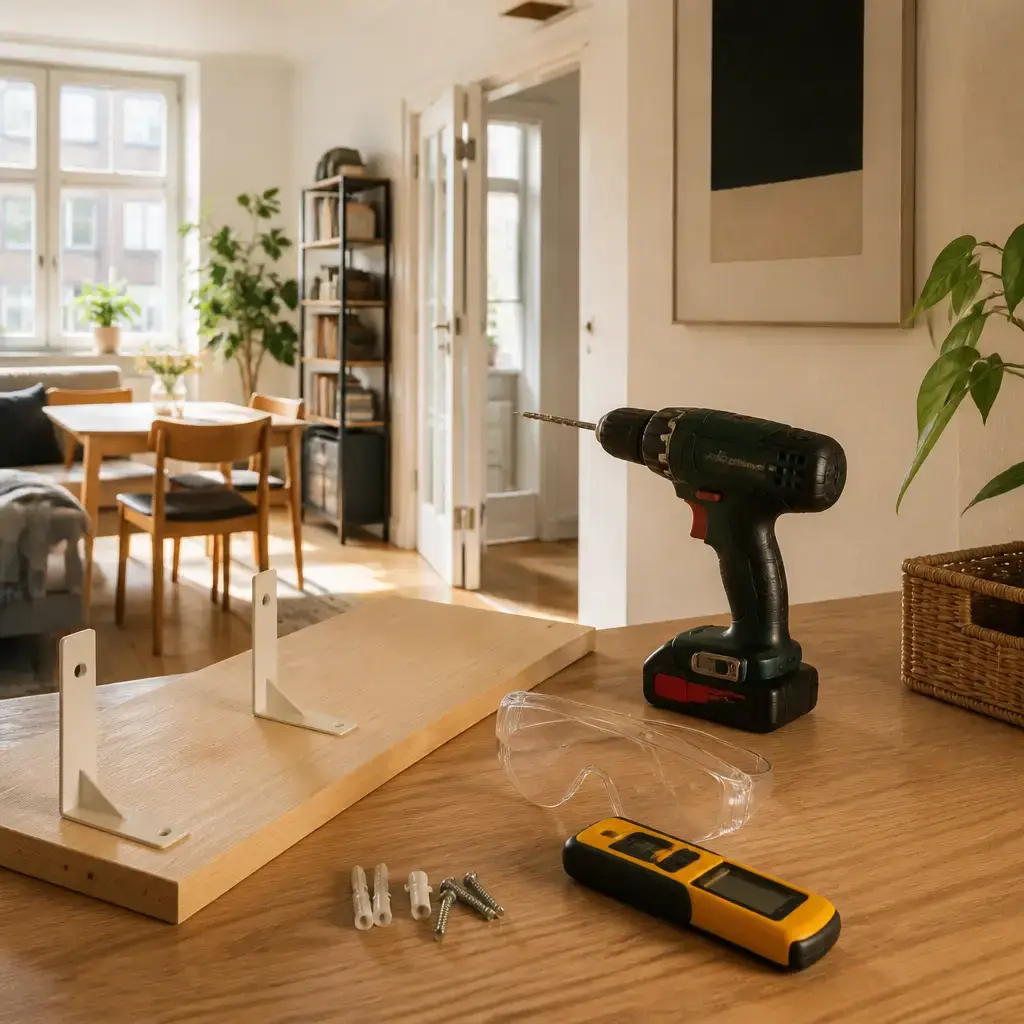
Kann ich mir deine Bohrmaschine leihen, um ein kleines Regal anzubringen?
Kahn ikh meer DYE-nuh BOHR-mah-shee-nuh LYE-en, oom ayn KLY-nus reh-GAHL ahn-tsuh-BRING-en? Could I borrow your drill to put up a small shelf?Das kannst du. Hast du schon einmal mit einer Bohrmaschine gearbeitet?
Dahs kahnst doo. Hahst doo shohn EYN-mahl mit EYE-ner BOHR-mah-shee-nuh geh-AHR-bye-tet? You can. Have you used a drill before?Nur einmal, daher würden mir grundlegende Anweisungen helfen.
Noor EYN-mahl, dah-HARE VUR-den meer GROONT-lay-gen-deh AHN-vye-zhoon-gen HEL-fen. Only once, so basic instructions would help.Prüfe zuerst, um was für eine Wand es sich handelt, und trage eine Schutzbrille.
PRUE-fuh tsoo-AIRST, oom vahs fyoor EYE-nuh vahnt es zikh HAHN-delt, oont TRAH-guh EYE-nuh SHOOTZ-bril-luh. Check what kind of wall it is first, and wear safety glasses.Ich mache mir auch Sorgen, dass ich elektrische Leitungen treffe.
Ikh MAH-khuh meer owkh ZOR-gen, dahss ikh eh-lek-TRISH-uh LYTE-oong-en TREF-fuh. I'm also worried about hitting electrical wires.Verwende diesen Detektor, bevor du irgendwo bohrst.
fer-VEN-duh DEE-zen deh-TEK-tor, beh-FOHR doo EER-gent-voh BOHRST. Use this detector before you drill anywhere.Ich werde die Stelle überprüfen, bevor ich die Löcher markiere.
Ikh VAIR-duh dee SHTEL-luh oo-ber-PROO-fen, beh-FOHR ikh dee LUR-kher mar-KEER-uh. I'll scan the spot before I mark the holes.Bring die Bohrmaschine bitte zusammen mit dem Ladegerät und den Bohrern zurück.
bring dee BOHR-mah-shee-nuh BIT-tuh tsoo-ZAHM-men mit daym LAH-duh-guh-RATE oont dayn BOHR-ern tsoo-ROOK. Please bring the drill back with the charger and bits together.Ich werde den Staub abwischen, bevor ich sie zurückgebe.
Ikh VAIR-duh dehn SHTOWP AHP-vish-en, beh-FOHR ikh zee tsoo-ROOK-gay-buh. I'll clean off the dust before I return it.Lass dir damit Zeit; Sicherheit ist wichtiger als Schnelligkeit.
Lahss deer dah-MIT tsite; ZIKH-er-hite ist VIKH-ti-ger ahls SHNEL-likh-kite. Take your time with it; safety matters more than speed.Sentence explanations
Kann ich mir deine Bohrmaschine leihen, um ein kleines Regal anzubringen?
Could I borrow your drill to put up a small shelf?
- Kann ich
- Could I…?
- mir
- for myself
- deine
- your
- Bohrmaschine
- drill
- leihen
- borrow
- um … anzubringen
- in order to put up
- kleines
- small
- Regal
- shelf
More detail
Kann ich is a question pattern meaning “Could I …?” Here kann is the first-person singular present form of können (“can, be able to”). German yes/no questions commonly place the conjugated verb before the subject: Kann ich ...? The English “could” is a natural polite translation in this request; the German form itself is present tense. mir is the dative reflexive pronoun meaning “for myself” in this construction. German uses sich etwas leihen for borrowing something for oneself: Ich leihe mir ein Buch. — “I borrow a book for myself.” The dative form agrees with the first-person subject ich; it is not the object being borrowed. deine is the possessive determiner meaning “your.” Its ending is selected by the noun phrase it introduces: Bohrmaschine is feminine singular, and here that noun phrase is the accusative object of leihen, giving feminine singular accusative deine. This is not a statement about the owner’s gender. Bohrmaschine means “drill.” It is a feminine noun, so its dictionary form is written with a capital letter: die Bohrmaschine. The compound combines bohren (“to drill”) with Maschine (“machine”), but it is best learned as the established noun for a drill. leihen is the infinitive “to borrow” here. With the modal verb kann, the lexical verb remains in the infinitive at the end of the question: Kann ich mir ... leihen? The same verb can also mean “lend” in another construction, so the participants and context determine which role is intended; here ich is the person borrowing the drill. um ... anzubringen introduces a purpose: “in order to put up.” The infinitive verb is anbringen, meaning to attach, put up, or install something. Because anbringen is separable, zu appears inside the infinitive form: anzubringen. The um ... zu construction normally has the same understood subject as the main clause here, so the purpose is what the speaker intends to do with the borrowed drill. kleines means “small” in this noun phrase. Its base form is klein; kleines is the form used with the neuter singular noun Regal in the accusative phrase ein kleines Regal. The ending -es reflects the noun phrase’s grammatical form, not a change in the adjective’s basic meaning. Regal means “shelf” or “shelving unit.” It is a neuter noun: das Regal. In ein kleines Regal, it is the accusative object of anzubringen, the thing being put up. The indefinite article and adjective together mark the relevant noun-phrase form; ein by itself does not assert a numerical count. Together, Kann ich mir deine Bohrmaschine leihen asks whether the speaker may borrow the listener’s drill. um ein kleines Regal anzubringen gives the purpose: putting up a small shelf. The complete utterance therefore means, “Could I borrow your drill to put up a small shelf?”
Das kannst du. Hast du schon einmal mit einer Bohrmaschine gearbeitet?
You can. Have you used a drill before?
- Das
- that / it
- kannst du
- you can
- Hast du
- have you
- schon einmal
- before / ever
- mit
- with
- Bohrmaschine
- drill
- gearbeitet
- worked / used
More detail
Das means “that” here and points to the action under discussion. In the preceding context, that is supported by the request involving the drill; German can use das as a demonstrative pronoun for an understood situation or action. It is different from the neuter definite article das, which appears before a noun. kannst du combines du (“you,” singular informal) with kannst, the second-person singular present form of können (“can; be able to”). The verb is inflected for the subject: ich kann, du kannst, sie können. German normally places the finite verb in the second position in a statement, giving Das kannst du = “You can do that.” Hast du begins a yes/no question. hast is the second-person singular present form of haben (“have”): ich habe, du hast. In this perfect-tense question, the finite auxiliary comes first, followed by the subject: Hast du ...? Compare the statement order Du hast .... schon einmal is a common combination meaning “ever” or “before” in a question about a past experience. schon contributes the sense “already,” while einmal literally means “once”; together here they ask whether the experience has happened at any time before. For example, Hast du schon einmal gekocht? means “Have you cooked before?” mit means “with.” When it introduces the thing someone works with or uses, it takes the dative case. The useful pattern is mit + dative noun, as in mit einer Bohrmaschine (“with a drill”). Bohrmaschine means “drill,” specifically a drilling machine or power drill. Its dictionary form is feminine: die Bohrmaschine. In this sentence, the noun itself has no visible ending; the dative feminine form is shown by the preceding article einer: mit einer Bohrmaschine. The compound contains bohren (“to drill”) and Maschine (“machine”), but the complete noun is the reusable word for the tool. gearbeitet is the past participle of arbeiten (“to work”). With haben, it forms the German perfect: hat gearbeitet = “has worked.” Here, mit etwas arbeiten means “to work with or use something,” so mit einer Bohrmaschine gearbeitet means “used a drill” in the fixed translation. In a statement, the participle is commonly final: Ich habe mit einer Bohrmaschine gearbeitet. — “I have used a drill.” Together, Hast du schon einmal mit einer Bohrmaschine gearbeitet? asks whether the addressee has ever used a drill before. The perfect construction uses hast as the finite auxiliary and places gearbeitet at the end. The preceding Das kannst du affirms that the addressee can carry out the action being discussed, producing the full meaning: “You can. Have you used a drill before?”
Nur einmal, daher würden mir grundlegende Anweisungen helfen.
Only once, so basic instructions would help.
- Nur einmal
- only once
- daher
- therefore
- würden
- would
- mir
- to me
- grundlegende
- basic
- Anweisungen
- instructions
- helfen
- help
More detail
Nur einmal means “only once” here. einmal refers to one occurrence, and nur restricts it. Together, this states that the speaker has done the relevant activity only once. Example: Ich war nur einmal dort. — “I was there only once.” daher means “therefore” or “so.” It links the limited experience to the helpful consequence that follows. Example: Ich kenne den Weg nicht; daher brauche ich eine Karte. — “I don’t know the way; therefore I need a map.” würden is the form of werden used here in the Konjunktiv II. With the plural subject grundlegende Anweisungen, it expresses a hypothetical or softened result: the instructions would help. The infinitive after this form comes at the end of the clause. Compare Anweisungen helfen — “Instructions help” with Anweisungen würden helfen — “Instructions would help.” mir is the first-person singular dative pronoun, “to me” or “me” in this construction. The verb helfen normally takes the person helped in the dative: Das hilft mir. — “That helps me.” The dative form for “me” is mir; the corresponding accusative form is mich, used with verbs that take a direct object instead. grundlegende means “basic” or “fundamental” here. Its base form is the adjective grundlegend. It describes Anweisungen, which is plural and has no preceding article, so the adjective has the ending -e in this nominative plural noun phrase. Example: Wir brauchen grundlegende Informationen. — “We need basic information.” Anweisungen means “instructions.” It is the plural of the feminine noun die Anweisung; the singular is eine Anweisung, and the plural is Anweisungen. The noun is the subject of helfen, so it is in the nominative here. Example: Die Anweisungen sind klar. — “The instructions are clear.” helfen means “to help.” It is the infinitive placed at the end because würden carries the modal-like hypothetical construction. In the present tense, Anweisungen helfen mir means “Instructions help me”; with würden, Anweisungen würden mir helfen presents the help as a hypothetical or polite expectation. Together, Nur einmal, daher gives the reason: the speaker has done the relevant activity only once. grundlegende Anweisungen is the plural subject, mir identifies the person who would benefit, and würden ... helfen expresses the result. The complete meaning is: “Only once, so basic instructions would help me.”
Prüfe zuerst, um was für eine Wand es sich handelt, und trage eine Schutzbrille.
Check what kind of wall it is first, and wear safety glasses.
- Prüfe
- check
- zuerst
- first
- um was für eine
- what kind of
- Wand
- wall
- es sich handelt
- it is / it concerns
- trage
- wear
- Schutzbrille
- safety glasses
More detail
Prüfe is the informal singular imperative of prüfen (“to check”): it addresses one person using du. The same verb appears as prüfst with du in a present-tense statement, for example: Du prüfst die Wand. — “You check the wall.” zuerst means “first” and places this check before the other instruction. It is an adverb, so it does not change for person or number. um was für eine is a reusable way to ask what type or kind of something is involved. The pattern is was für ein/eine + noun; eine agrees with the feminine noun Wand here. The article is grammatical agreement, not by itself a statement that there is a particular numerical count. Wand means “wall.” Its base singular form is die Wand; the plural is die Wände. In this sentence, Wand is feminine, which is why the phrase uses eine Wand. es sich handelt belongs with the preceding um in the construction es handelt sich um ..., meaning that something is a particular kind or matter. Inside the indirect question, the finite verb comes at the end: um was für eine Wand es sich handelt — “what kind of wall it is.” This is not the ordinary standalone question order; compare Um was für eine Wand handelt es sich? — “What kind of wall is it?” trage is the informal singular imperative of tragen, “to wear” in this context. The same verb can mean “to carry” in other contexts, but clothing or equipment makes “wear” the intended meaning here. Trag eine Schutzbrille. is also a common shortened imperative form. Schutzbrille means “safety glasses” here. German uses the singular compound noun die Schutzbrille for this piece of protective eyewear; its plural is die Schutzbrillen. Therefore, eine Schutzbrille does not need to be translated with an English singular noun. Together, Prüfe zuerst says “check first.” The indirect question um was für eine Wand es sich handelt specifies what must be checked: the wall’s type. The coordinated instruction trage eine Schutzbrille then says to wear safety glasses. The complete meaning is: “Check what kind of wall it is first, and wear safety glasses.”
Ich mache mir auch Sorgen, dass ich elektrische Leitungen treffe.
I'm also worried about hitting electrical wires.
- Ich mache mir auch Sorgen
- I’m also worried
- elektrische
- electrical
- Leitungen
- wires
- treffe
- hit
More detail
Ich mache mir auch Sorgen is a reusable German pattern meaning “I am also worried.” Here mir is the first-person dative reflexive pronoun, and sich Sorgen machen is the expression for being worried. The form changes with the person: Ich mache mir Sorgen = “I am worried,” while Du machst dir Sorgen = “You are worried.” Auch means “also” here and adds this concern to another concern or consideration. elektrische describes Leitungen as electrical. Its base form is the adjective elektrisch. In elektrische Leitungen, the adjective has the ending -e because this is a plural accusative noun phrase with no article; the ending reflects the noun phrase’s grammatical features, not the speaker. Example: elektrische Geräte means “electrical devices.” Leitungen is the plural of Leitung, meaning “wires” in this context. Leitung can refer to a cable, wire, or another line that carries something, depending on context; the drilling context supports “electrical wires.” Example: Die Leitungen liegen in der Wand. — “The wires are in the wall.” treffe is the first-person singular present form of treffen (“to hit” or “to meet”). Here it means hitting the wires in the drilling situation, not meeting people. The present forms include ich treffe and du triffst. Example: Ich treffe die Leitung nicht. — “I do not hit the wire.” The clause beginning with dass expresses the content of the worry: dass ich elektrische Leitungen treffe = “that I hit electrical wires.” In a German dass subordinate clause, the finite verb goes to the end, so treffe follows the object elektrische Leitungen. Putting the parts together, Ich mache mir auch Sorgen, dass ich elektrische Leitungen treffe. means “I’m also worried about hitting electrical wires.”
Verwende diesen Detektor, bevor du irgendwo bohrst.
Use this detector before you drill anywhere.
- Verwende
- use
- diesen
- this
- Detektor
- detector
- bevor
- before
- du
- you
- irgendwo
- anywhere
- bohrst
- drill
More detail
Verwende is the singular informal imperative of verwenden (“to use”). It gives a direct instruction to one person. The polite/formal instruction is Verwenden Sie .... Example: Verwende dieses Werkzeug. — “Use this tool.” diesen means “this” here and is the form used with the masculine accusative noun Detektor because the detector is the object being used. The demonstrative changes with the noun’s grammatical gender, number, and case: dieser Detektor (subject), diesen Detektor (object). The form diese is used with feminine singular nouns and plural nouns in the relevant basic patterns. Detektor is a masculine noun meaning “detector.” Its plural is Detektoren: ein Detektor — “a detector”; zwei Detektoren — “two detectors.” bevor introduces a subordinate time clause meaning “before.” German normally places the conjugated verb at the end of this clause. Pattern: bevor + subject + other information + verb. Example: Warte, bevor du gehst. — “Wait before you leave.” du is the informal singular “you” used as the subject of the subordinate clause. It identifies the person who performs the drilling in this sentence. German distinguishes du for one familiar person from ihr for multiple familiar people and Sie for formal address. irgendwo is an indeclinable adverb meaning “anywhere” in this context. It describes an unspecified place and does not change for gender, number, or case. Example: Kann ich hier irgendwo sitzen? — “Can I sit somewhere here?” bohrst comes from bohren, “to drill.” It is the present-tense second-person singular form: du bohrst. In the bevor clause, the verb is at the end. Example: Du bohrst ein Loch. — “You drill a hole.” Together, Verwende diesen Detektor gives the instruction “Use this detector.” The time clause bevor du irgendwo bohrst adds the temporal relation “before you drill anywhere.” Thus the complete utterance means: “Use this detector before you drill anywhere.”
Ich werde die Stelle überprüfen, bevor ich die Löcher markiere.
I'll scan the spot before I mark the holes.
- Ich werde
- I will
- Stelle
- spot
- überprüfen
- check; scan
- bevor
- before
- Löcher
- holes
- markiere
- mark
More detail
Ich werde combines ich (“I”) with werde, the first-person singular form of werden. With a following infinitive, werden forms the German future: Ich werde ... überprüfen = “I will check/scan ...”. The infinitive stays at the end of the clause. In everyday German, the present tense can also express a planned future, but this sentence explicitly uses werden. Stelle means “spot” or “place” here. Its base form is die Stelle; in this sentence it is singular and accusative because it is the object being checked. The article and noun together are die Stelle. Do not confuse it with Stellen, which can be a plural or another inflected form depending on context. überprüfen means to check, inspect, or scan something carefully. It is a separable-looking but actually inseparable-prefix verb: the prefix über- remains attached in the infinitive and does not split here. Its present-tense first-person form is ich überprüfe; the infinitive used after werde is überprüfen. Example: Ich überprüfe den Plan. — “I check the plan.” bevor introduces a time clause meaning “before”. In a clause introduced by bevor, the finite verb goes to the end: bevor ich ... markiere = “before I mark ...”. The clause states the order of the two actions; it does not by itself state how much time separates them. Löcher is the plural of das Loch, “hole”. The plural form is irregular in its vowel: Loch → Löcher. Here, die Löcher is the object of markiere, meaning the holes that will be marked. Example: Ich sehe zwei Löcher. — “I see two holes.” markiere is the first-person singular present form of markieren, “to mark”. The subject is ich, and the present form is used inside the bevor clause even though the marking is understood as a later action: German commonly uses the present tense in such time clauses. Example: Ich markiere die Stelle. — “I mark the spot.” Together, Ich werde die Stelle überprüfen gives “I will scan/check the spot”, and bevor ich die Löcher markiere gives “before I mark the holes”. The complete utterance means: “I’ll scan the spot before I mark the holes.”
Bring die Bohrmaschine bitte zusammen mit dem Ladegerät und den Bohrern zurück.
Please bring the drill back with the charger and bits together.
- Bring … zurück
- bring back
- Bohrmaschine
- drill
- bitte
- please
- zusammen mit
- together with
- Ladegerät
- charger
- Bohrern
- drill bits
More detail
Bring ... zurück is the informal singular imperative of the separable verb zurückbringen (“to bring back”): bringen becomes Bring at the beginning, while zurück appears at the end. Example: Bring das Buch zurück. — “Bring the book back.” Bohrmaschine means “drill.” It is a feminine noun: die Bohrmaschine. Here it is the object being brought back, so the noun phrase is in the accusative. The form die does not by itself distinguish accusative feminine from nominative feminine; the accusative is established by the verb’s object role. The noun itself does not change here. bitte adds the polite word “please.” Its position can vary: Bitte bring die Bohrmaschine zurück. also means “Please bring the drill back.” zusammen mit introduces something accompanying the main object; the preposition mit governs the dative case. Thus dem Ladegerät is dative singular of das Ladegerät (“charger”), and den Bohrern is dative plural of der Bohrer (“drill bit”). The plural dative form has -n: Bohrer becomes Bohrern; this ending belongs to the noun, not to den. The construction zusammen mit dem Ladegerät und den Bohrern means “together with the charger and drill bits.” Combined in source order, the utterance is an informal request to bring the drill back, bringing the charger and drill bits along with it. The imperative addresses one person informally. The forms show one drill and one charger grammatically, while the plural Bohrern does not state the exact number of bits.
Ich werde den Staub abwischen, bevor ich sie zurückgebe.
I'll clean off the dust before I return it.
- Ich werde
- I will
- Staub
- dust
- abwischen
- wipe off
- bevor
- before
- sie
- it
- zurückgebe
- return / give back
More detail
Ich werde combines the first-person pronoun ich with the future auxiliary werde, the first-person singular form of werden. In this sentence, werden places the wiping in the future. A reusable pattern is Ich werde + infinitive: Ich werde morgen kommen. — “I will come tomorrow.” Staub means dust here. It is a masculine noun: the accusative article in the sentence is den Staub, while the nominative form is der Staub. The noun itself does not change between these forms. abwischen is the separable verb ab|wischen, meaning to wipe something off. wischen means “wipe,” and the prefix ab- adds the idea of removing something from a surface. After the future auxiliary, the infinitive stays together at the end of the main clause: Ich werde den Tisch abwischen. — “I will wipe the table.” bevor introduces a clause meaning “before.” In a German subordinate clause introduced by bevor, the conjugated verb goes to the end. The sentence therefore has the reusable pattern ..., bevor + subject + ... + conjugated verb. sie means “it” here. It is the singular feminine accusative form, referring in this context to the item being returned; the preceding context identifies that item as the feminine noun Bohrmaschine. The same written form can also have other grammatical uses in German, including plural forms, so its role here comes from the sentence and context. zurückgebe is the first-person singular present form of the separable verb zurückgeben, “to return” or “give back.” In the bevor clause, the conjugated form appears at the end, and the prefix remains attached: bevor ich sie zurückgebe. Compare the infinitive zurückgeben with ich gebe ... zurück in a main clause: Ich gebe das Werkzeug zurück. — “I return the tool.” Together, Ich werde den Staub abwischen means “I will wipe off the dust.” The subordinate clause bevor ich sie zurückgebe means “before I return it.” Combined, the utterance means: “I’ll clean off the dust before I return it.”
Lass dir damit Zeit; Sicherheit ist wichtiger als Schnelligkeit.
Take your time with it; safety matters more than speed.
- Lass
- take (imperative)
- dir
- to you
- damit
- with it
- Zeit
- time
- Sicherheit
- safety
- wichtiger
- more important
- Schnelligkeit
- speed
More detail
Lass is the singular informal imperative of lassen (“to let; to leave”). In the reusable pattern sich Zeit lassen, it means “to take time” rather than “to let” something go. The imperative addresses one person informally: Lass dir Zeit. — “Take your time.” dir is the dative form of the second-person singular pronoun du. Its basic meaning is “to you”; in sich Zeit lassen, it is the dative reflexive form referring back to the person addressed, so the construction means taking time for oneself. With du, the form is dir: Lass dir Zeit. — “Take your time.” damit is a pronominal adverb meaning “with it” here. da- refers to something already understood, while mit contributes “with.” Its exact referent is not identified in the supplied sentence, so it is best learned as the reusable pattern mit etwas → damit when referring back to that thing. Lass dir damit Zeit. means “Take your time with it.” Zeit means “time.” In sich Zeit lassen, it is used without an article as part of a fixed, highly reusable expression: Ich lasse mir Zeit. — “I take my time.” The form mir is the dative first-person singular counterpart of dir. Sicherheit means “safety.” It is a feminine noun; German nouns are capitalized, but capitalization does not indicate grammatical gender. Its article is die: die Sicherheit. In this sentence it is the subject of the second clause: “Safety …”. wichtiger is the comparative form of the adjective wichtig (“important”): wichtig → wichtiger (“more important”) → am wichtigsten (“most important”). The comparative is followed by als when two things are compared: Sicherheit ist wichtiger als ... — “Safety is more important than …”. Schnelligkeit means “speed” or “quickness.” It is a feminine noun, with the article die: die Schnelligkeit. Here it is the thing used as the comparison standard after als; it is not the adjective being compared. Together, Lass dir damit Zeit uses the informal singular imperative of sich Zeit lassen and adds damit, “with it.” Sicherheit ist wichtiger als Schnelligkeit states the comparison “Safety is more important than speed.” The complete utterance is therefore: “Take your time with it; safety matters more than speed.”
Grammar Points
zu + Infinitiv bei trennbaren Verben
um das Regal anzubringen
oom dahs reh-GAHL ahn-tsuh-BRING-ento put up the shelf
Bei trennbaren Verben steht zu zwischen Präfix und Verbstamm: anbringen → anzubringen.
sich Sorgen machen
Ich mache mir Sorgen.
Ikh MAH-khuh meer ZOR-gen.I am worried.
Deutsch verwendet machen mit dem Dativpronomen mir; das entspricht nicht direkt dem englischen Verb worry.
German Vocabulary
Quiz
Spelling
Tap the letters to spell the word.
drill
Show Answer
Bohrmaschineto check
Show Answer
Prüfeinstruction
Show Answer
Anweisungenwall