10 minutes free every day
Continue audio lessons in the app
Word explanations appear automatically in sync with the audio.
No login required · synced translations · playback with the screen locked
Choose your learning language and open this lesson in the app.

About This Lesson
Use Borrowing a laptop adapter before a presentation to practice German conversation, pronunciation, vocabulary, grammar, and quizzes.
Dialogue
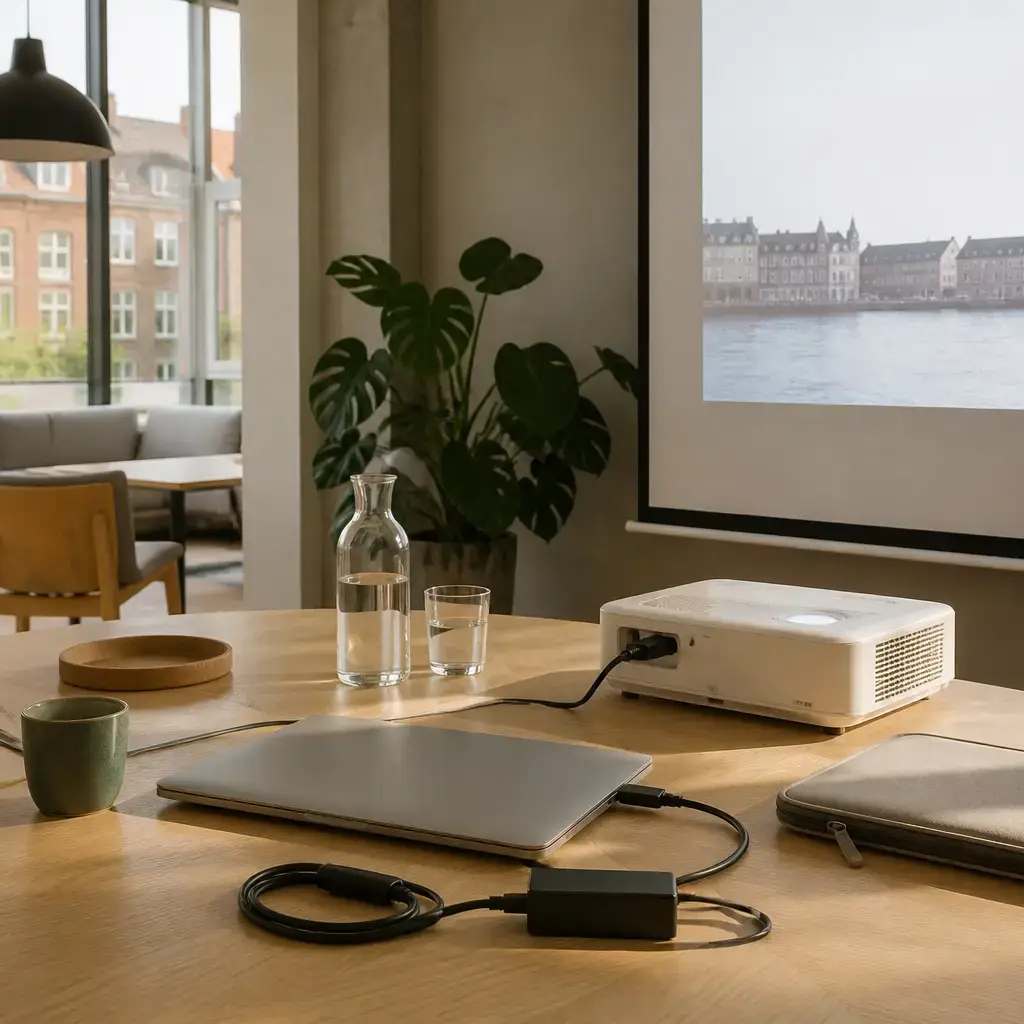
Mein Laptop-Adapter fehlt, und meine Präsentation beginnt bald.
MYN LEHP-top ah-DAP-ter faylt, oont MY-nuh preh-zen-tah-TSYOHN beh-GINNT bahlt. My laptop adapter is missing, and my presentation starts soon.Ich habe einen, den du benutzen kannst.
ikh HAH-buh EYE-nen, dayn doo beh-NOOT-tsen KAHNST. I have one you can use.Aber lass uns prüfen, ob er mit deinem Laptop funktioniert.
AH-ber lahss oons PROO-fen, op air mitt DYE-nem LEHP-top foonk-tsyoh-NEERT. But let's check that it works with your laptop.Er passt in den Anschluss. Ich muss den Projektor noch testen.
air pahst in dayn AHN-shloos. ikh mooss den proh-YEK-tohr nokh TES-ten. It fits the port. I still need to test the projector.Mach das jetzt; kleine Probleme werden unter Druck schwieriger.
MAKH dahss yetst; KLY-nuh proh-BLAY-muh VAYR-den OON-ter droogk SHVEE-ree-ger. Do it now; small problems get harder under pressure.Das Bild wird richtig angezeigt, also sind wir startklar.
dahss BILT veert RIKH-tikh AHN-guh-tsaykht, AHL-zoh zint veer SHTAHRT-klahr. The screen is showing correctly, so we're set.Speichere sicherheitshalber eine Kopie deiner Folien auf einem zweiten Gerät.
SHPY-khuh-ruh zikh-er-HYTS-hahl-ber EYE-nuh KOH-pee DYE-ner FOH-lee-en owf EYE-nem TSVY-ten guh-RAYT. Keep a backup copy of your slides on a second device, just in case.Ich werde eine Kopie auf einem anderen Gerät speichern, bevor ich anfange.
ikh VAYR-duh EYE-nuh KOH-pee owf EYE-nem AHN-deh-ren guh-RAYT SHPY-khern, beh-FOHR ikh AHN-fahn-guh. I'll put one on another device before I start.Könntest du den Adapter nach der Sitzung zurückbringen? Ich brauche ihn später.
KURN-test doo dayn ah-DAP-ter nahkh dayr ZIT-soong tsoo-ROOK-bring-en? ikh BROW-khuh een SHPAY-ter. Could you bring the adapter back after the session? I need it later.Ich gebe ihn zurück, sobald die Sitzung endet.
ikh GAY-buh een tsoo-ROOK, zoh-BAHLT dee ZIT-soong EN-det. I'll return it as soon as the session ends.Dann musst du dir um eine Sache weniger Gedanken machen.
dahn moost doo deer oom EYE-nuh ZAH-khuh VAY-nee-ger guh-DAHN-ken MAKH-en. That should give you one less thing to worry about.Sentence explanations
Mein Laptop-Adapter fehlt, und meine Präsentation beginnt bald.
My laptop adapter is missing, and my presentation starts soon.
- Mein
- my
- Laptop-Adapter
- laptop adapter
- fehlt
- is missing
- meine
- my
- Präsentation
- presentation
- beginnt
- starts
- bald
- soon
More detail
Mein means “my” here and modifies the singular noun Laptop-Adapter. German possessive forms agree with the noun they modify: mein is used with a singular masculine or neuter noun in this form, while meine is used with a feminine singular noun or a plural noun in the corresponding basic form. The possessive form itself indicates the possessor; it does not by itself identify the possessor beyond the intended first-person meaning. Laptop-Adapter is a compound noun meaning “laptop adapter.” German commonly combines nouns into compounds, and the final noun determines the compound's grammatical gender. Here the final element Adapter is masculine, so the compound is masculine: der Laptop-Adapter. The hyphen is part of the observed spelling and is retained here. fehlt comes from the base form fehlen, “to be missing” or “to be absent.” In this sentence, fehlt is the third-person singular present form: “is missing.” The subject is Laptop-Adapter, so the verb is singular. Compare the reusable pattern Der Schlüssel fehlt. — “The key is missing.” meine means “my” here and modifies the singular feminine noun Präsentation. Unlike Mein, this form is selected because Präsentation is feminine in German: die Präsentation. For example, Meine Tasche ist hier. means “My bag is here.” Präsentation means “presentation.” It is a feminine noun, so its basic singular article is die: die Präsentation. The noun remains singular in this sentence; the possessive form meine agrees with that noun in the relevant grammatical form. beginnt comes from beginnen, “to begin” or “to start.” It is the third-person singular present form, agreeing with the singular subject Präsentation: “starts” or “begins.” The related form beginne is first-person singular present, as in Ich beginne jetzt. — “I am starting now.” bald means “soon.” It is an adverb describing when the presentation begins. It does not change form for the subject or for grammatical gender. For example, Der Film beginnt bald. means “The film starts soon.” The first clause combines Mein Laptop-Adapter (“my laptop adapter”) with fehlt (“is missing”), giving “My laptop adapter is missing.” Und connects this clause to the second one. Meine Präsentation beginnt bald combines “my presentation,” “starts,” and “soon,” giving “my presentation starts soon.” Together, the utterance means: “My laptop adapter is missing, and my presentation starts soon.”
Ich habe einen, den du benutzen kannst.
I have one you can use.
- habe
- have
- einen
- one
- benutzen
- use
- kannst
- can
More detail
habe is the first-person singular present form of haben (“to have”): ich habe. German uses haben here for possession or availability. Example: Ich habe Zeit. — “I have time.” einen means “one” here, referring to the available masculine item—the adapter in the supplied context. It is the masculine accusative form of the indefinite article/pronoun pattern: ein (nominative), einen (accusative). In this sentence it is not necessarily stating a numeric count; it stands for “one [such item]”. benutzen is the infinitive “to use”. It is a regular verb; for example, Ich benutze den Adapter. means “I use the adapter.” In the relative clause, it describes what can be done with the item. kannst is the second-person singular present form of können (“can, be able to”): du kannst. With a second verb, können is a modal verb and the other verb remains in the infinitive. Example: Du kannst den Adapter benutzen. — “You can use the adapter.” The words den du benutzen kannst form a relative clause modifying einen: den refers back to the masculine item, and as the object of benutzen it is in the masculine accusative form. In this clause, du is the subject, kannst is the finite verb, and the infinitive benutzen comes before the finite verb at the end of the clause. Thus Ich habe einen gives “I have one,” and den du benutzen kannst specifies “that you can use.” Together, the utterance means “I have one you can use.”
Aber lass uns prüfen, ob er mit deinem Laptop funktioniert.
But let's check that it works with your laptop.
- Aber
- but
- lass uns
- let’s
- prüfen
- check; test
- er
- it
- deinem
- your
- Laptop
- laptop
- funktioniert
- works; functions
More detail
Aber means “but” and links this utterance to something earlier with a contrast. It is a coordinating conjunction and does not change the word order of the clause that follows here. lass uns is a reusable way to say “let’s …”. lass is the second-person singular imperative of lassen, used here with uns (“us”) to make a suggestion involving the speaker and the listener. The infinitive that names the suggested action comes after it: Lass uns warten. — “Let’s wait.” prüfen is the infinitive “to check” or “to test”. After lass uns, it states the action being proposed. The construction Lass uns + infinitive is therefore a practical pattern for suggesting a joint action. er is a third-person singular pronoun. In this sentence, the fixed translation identifies its intended meaning as “it”; its masculine form reflects the grammatical gender of the understood German referent, not necessarily a male person. Its exact noun referent is not stated in this sentence. Because er is the subject of the subordinate clause, the verb later appears in the third-person singular form. deinem belongs to the possessive determiner dein, “your”. Here it is dative masculine singular: mit requires the dative when it means “with”, and Laptop is masculine in German. Compare dein Laptop in the nominative and mit deinem Laptop after mit. The form marks the grammatical relationship; it does not assert a numerical quantity. Laptop is the masculine noun “laptop”. With mit, the phrase is mit deinem Laptop, “with your laptop”. funktioniert is the third-person singular present form of funktionieren, “to work” or “to function”: funktionieren → er funktioniert. The subject is er, so the verb agrees with that singular subject. Das Gerät funktioniert. — “The device works.” The clause ob er mit deinem Laptop funktioniert means “whether/that it works with your laptop” in the fixed translation. ob introduces the checked proposition, and German places the finite verb funktioniert at the end of this subordinate clause. The full utterance combines Aber + lass uns prüfen + ob ...: “But let’s check that it works with your laptop.”
Er passt in den Anschluss. Ich muss den Projektor noch testen.
It fits the port. I still need to test the projector.
- Er
- it
- passt
- fits
- Anschluss
- port
- Ich muss
- I need to / I have to
- Projektor
- projector
- noch
- still
- testen
- test
More detail
Er is a third-person singular masculine pronoun in the nominative case. Here the fixed translation uses it for the thing that fits; the supplied texts do not uniquely identify that thing by name. German pronouns must match the grammatical features of their referent, but the pronoun itself does not identify the referent. passt is the present-tense, third-person singular form of passen. In this sentence, passen means “to fit” or “to fit into,” not “to pass.” Its basic pattern is etwas passt in + accusative: Der Stecker passt in die Buchse. — “The plug fits into the socket.” Anschluss is a masculine noun: der Anschluss. After in with a destination or direction into something, it appears in the accusative: in den Anschluss. Anschluss can refer to a connection or port; the fixed translation selects “port” here. The form den marks the masculine accusative noun phrase. Ich muss is the first-person singular present form of the modal verb müssen with its subject. müssen expresses necessity or obligation; with ich, the form is muss. In a main clause, the other verb normally goes to the end in its infinitive form: Ich muss warten. — “I have to wait.” Projektor is a masculine noun: der Projektor. Here it is the object of testen, so it has the accusative form den Projektor. The article changes from nominative der Projektor to accusative den Projektor; the noun itself does not change. noch means “still” here. It presents the testing as something that remains to be done at this point. For example, Ich muss noch arbeiten. means “I still have to work.” testen is the infinitive “to test.” It follows the modal verb muss, while muss carries the person and tense marking. Ich muss den Projektor noch testen. means “I still need to test the projector.” Taken together, Er passt in den Anschluss says that the intended “it” fits into the port. Ich muss den Projektor noch testen says that the speaker still has to test the projector. The two sentences therefore combine a statement about fit with a remaining task. The word order places the modal verb in the main-clause second position and the infinitive testen at the end.
Mach das jetzt; kleine Probleme werden unter Druck schwieriger.
Do it now; small problems get harder under pressure.
- Mach
- do! / make!
- das
- it / that
- jetzt
- now
- kleine
- small
- Probleme
- problems
- werden
- become / get
- unter Druck
- under pressure
- schwieriger
- harder / more difficult
More detail
Mach is the singular informal imperative of machen (“to do” or “to make”). It addresses one person informally. The plural informal form is Macht, while the formal form is Machen Sie. Example: Mach die Tür zu! — “Close the door!” das means “it” here and is the object of machen: “do it.” In this use, it is a neuter accusative pronoun; das can also be the neuter nominative form in other contexts. The fixed sentence does not identify a more precise referent for “it.” jetzt means “now” and places the action at the present time. Mach das jetzt gives a reusable pattern: Mach + object + time expression — “Do [something] now.” kleine is the attributive form of the adjective klein (“small”). It describes Probleme, which is plural and appears without an article here, so the adjective has the ending -e: kleine Probleme. The ending reflects the noun phrase’s grammatical form; klein is the adjective’s base form. Probleme is the plural of Problem (“problem”). It is the subject of the second clause, and its plural number corresponds to the plural verb form werden. Example: Kleine Probleme wachsen. — “Small problems grow.” werden means “become” or “get” here. It is the present-tense plural form of the verb werden; the infinitive is also werden. With an adjective, werden + adjective describes a change of state: Die Probleme werden schwierig means “The problems become difficult.” Here, werden agrees with plural Probleme. unter Druck is a prepositional phrase meaning “under pressure.” Here it describes the condition in which the problems become harder. Example: Menschen arbeiten unter Druck. — “People work under pressure.” schwieriger is the comparative form of schwierig (“difficult,” “hard”): schwierig → schwieriger. As a predicate adjective after werden, it has no attributive ending. The comparative presents the problems as harder than before or than an understood comparison point; it does not specify that point. Together, kleine Probleme is the plural subject, werden expresses a change, schwieriger describes the resulting state, and unter Druck gives the condition. The complete utterance is: “Do it now; small problems get harder under pressure.” The semicolon links the immediate instruction with the following general statement.
Das Bild wird richtig angezeigt, also sind wir startklar.
The screen is showing correctly, so we're set.
- Bild
- screen; display
- wird … angezeigt
- is displayed
- richtig
- correctly; properly
- also
- so
- sind wir
- we are
- startklar
- ready to go
More detail
Bild means “picture” or “image” in many contexts, but here the fixed translation identifies it as a screen/display. It is the singular subject: das Bild; its plural is die Bilder. Example: Das Bild ist klar. — “The screen is clear.” wird angezeigt means “is displayed.” The underlying verb is the separable verb anzeigen, whose past participle is angezeigt. This is the present passive, formed here with wird plus the past participle. Because Bild is singular, wird is used; with a plural subject, use werden: Die Bilder werden angezeigt. — “The images are displayed.” richtig means “correct” or “proper.” Here it is used adverbially, so it means “correctly” or “properly” and has no adjective ending. Before a noun, the adjective can take an ending: ein richtiges Bild — “a correct/proper image.” also means “so” or “therefore.” It connects the displayed screen's condition to the conclusion that follows. In also sind wir, the finite verb sind comes before the subject wir, as required by the verb-second clause pattern after also in this sentence. sind wir means “we are.” sind is the present-tense form of sein for wir: ich bin, du bist, wir sind. The order after also does not change wir’s role as the subject. startklar is a predicative adjective meaning “ready to go” or “ready.” After sein, it has no adjective ending: Wir sind startklar. — “We are ready to go.” Together, Das Bild wird richtig angezeigt says that the screen is displaying correctly. also links this situation to sind wir startklar, “we are ready to go.” The complete utterance means: “The screen is showing correctly, so we’re set.”
Speichere sicherheitshalber eine Kopie deiner Folien auf einem zweiten Gerät.
Keep a backup copy of your slides on a second device, just in case.
- Speichere
- save; store
- sicherheitshalber
- just in case
- Kopie
- copy
- Folien
- slides
- zweiten
- second
- Gerät
- device
More detail
Speichere is the imperative singular form of speichern (“to save/store”), addressing one person informally with du. The imperative gives a direct instruction. Compare Speicher die Datei! — “Save the file!” sicherheitshalber is an adverb meaning “as a precaution” or “just in case.” It explains the reason for saving the copy, but it does not itself mean “copy” or “backup.” The ending -halber is part of this established adverbial expression. Kopie is a feminine noun meaning “copy.” Here, eine Kopie means “a copy”; the indefinite article introduces an unspecified copy, not a stated numerical count beyond the ordinary meaning of choosing one copy. The plural is Kopien. Folien is the plural of Folie, “slide” in a presentation context. deiner Folien means “of your slides”: deiner is the possessive form used with the plural noun in this genitive phrase. Folie can have other meanings in other contexts, but here the fixed translation identifies presentation slides. zweiten is the inflected form of the ordinal adjective zweite, “second.” It describes Gerät; it is not a form of the noun. The ending -en is required here because the phrase has einem, a dative neuter article, after the location preposition auf. Compare auf einem zweiten Gerät — “on a second device.” Gerät is a neuter noun meaning “device” here. Its plural is Geräte. With a location, auf takes the dative: auf einem Gerät means “on a device.” The phrase auf einem zweiten Gerät therefore specifies where the copy should be stored. The sentence combines the imperative Speichere with the object eine Kopie deiner Folien (“a copy of your slides”), followed by the location auf einem zweiten Gerät (“on a second device”). Sicherheitshalber adds the precautionary purpose. Together, the utterance means: “Keep a backup copy of your slides on a second device, just in case.”
Ich werde eine Kopie auf einem anderen Gerät speichern, bevor ich anfange.
I'll put one on another device before I start.
- Ich werde
- I will
- Kopie
- copy
- auf
- on
- anderen
- other; another
- Gerät
- device
- speichern
- save; store
- bevor
- before
- anfange
- start; begin
More detail
Ich werde expresses future time with werden plus an infinitive. werde is the first-person singular present form of werden; the lexical verb stays in the infinitive later in the clause. This is a reusable pattern: Ich werde ... = “I will ...”. Kopie means “copy.” Its base noun form is die Kopie, so eine Kopie uses the feminine indefinite article. Here, “one” in the translation refers to a copy; the article itself does not independently assert a numerical count. auf means “on” here in the sense of storing something on a device. With the static storage location auf einem anderen Gerät, it takes the dative: einem and Gerät show that case. The same preposition can occur with the accusative for a destination or movement, so the case reflects the relation being expressed. anderen means “other” or “another” here. It is an inflected attributive form of the adjective ander-, not a form derived from anders. In einem anderen Gerät, Gerät is neuter (das Gerät), and the dative indefinite article einem is followed by the adjective ending -en. The adjective carries this ending to mark the phrase’s case, number, and gender agreement. Gerät means “device.” Its base form is das Gerät, and its plural is die Geräte. Thus auf einem anderen Gerät means “on another device.” speichern means “to save” or “store.” It is the infinitive used with werde: Ich werde ... speichern = “I will save ...”. Example: Ich speichere die Datei. — “I save the file.” bevor introduces a clause meaning “before.” In the clause it introduces, the finite verb goes to the end. The reusable pattern is bevor + subject + ... + finite verb. anfange means “I start” or “I begin” here. Its base form is the separable verb anfangen. In an ordinary main clause, its first-person singular present form is Ich fange an; after bevor, the prefix and verb appear together at the end: bevor ich anfange. The form anfange identifies first-person singular present and matches ich. Together, Ich werde eine Kopie ... speichern means “I will save a copy ...”. auf einem anderen Gerät specifies where it will be stored, and bevor ich anfange places that saving earlier than the speaker’s starting point. The complete meaning is: “I’ll put one on another device before I start.”
Könntest du den Adapter nach der Sitzung zurückbringen? Ich brauche ihn später.
Could you bring the adapter back after the session? I need it later.
- Könntest du
- Could you…?
- Adapter
- adapter
- nach
- after
- Sitzung
- session
- zurückbringen
- bring back; return
- Ich brauche
- I need
- ihn
- it; him
- später
- later
More detail
Könntest du is a reusable polite request pattern: “Could you …?” Könntest is the second-person singular form of können in the Konjunktiv II, which makes the request less direct than Kannst du …? The subject is du; the requested action appears later as an infinitive. Adapter means “adapter.” Its base form is der Adapter; here it appears as den Adapter because it is the accusative object of zurückbringen. The masculine article changes from nominative der to accusative den. nach means “after” here and introduces a time expression with the dative: nach der Sitzung. In this use, nach identifies the time after an event, not movement toward a place. Sitzung means “session.” The base noun is feminine, die Sitzung; after nach, it is dative: der Sitzung. A useful pattern is nach der Sitzung = “after the session.” zurückbringen means “bring back” or “return.” It is a separable verb: zurück + bringen, but the infinitive remains together after the modal verb: Könntest du den Adapter … zurückbringen? In a main clause without a modal, the parts separate: Du bringst den Adapter zurück. Ich brauche means “I need.” brauche is the first-person singular present form of brauchen: ich brauche, du brauchst, er/sie braucht. For example, Ich brauche Zeit. means “I need time.” ihn means “it” here and refers to the adapter identified in the fixed translation and surrounding context. It is the masculine singular accusative form of er; the form used for a feminine or neuter referent would be different. Here ihn is the object of brauche. später means “later.” It is the comparative form of spät (“late”) and is commonly used as an adverb meaning “at a later time.” For example, Ich komme später. means “I’ll come later.” Together, Könntest du den Adapter nach der Sitzung zurückbringen? asks politely whether the listener can return the adapter after the session. Ich brauche ihn später. adds that the speaker needs the adapter at a later time. The two sentences therefore mean: “Could you bring the adapter back after the session? I need it later.”
Ich gebe ihn zurück, sobald die Sitzung endet.
I'll return it as soon as the session ends.
- gebe … zurück
- return / give back
- ihn
- it / him
- sobald
- as soon as
- Sitzung
- session
- endet
- ends
More detail
gebe ... zurück is the separable verb zurückgeben, “to give back” or “to return.” In the sentence, gebe is the first-person singular present form of geben, while the separable prefix zurück appears at the end of the main clause. The present tense here expresses a planned future action. Example: Ich gebe das Buch morgen zurück. — “I’ll return the book tomorrow.” ihn is an accusative personal pronoun meaning “it” here, referring to the adapter identified in the preceding context. Its masculine singular form matches the grammatical gender of der Adapter; the accusative marks the thing being returned. The English translation uses “it” because English does not preserve this grammatical gender distinction in this context. Example: Ich sehe ihn. — “I see him/it,” with the exact English choice depending on the established referent. sobald introduces a time clause meaning “as soon as.” It connects an action to the earliest point when another event is completed. In a clause introduced by sobald, the finite verb goes to the end: sobald die Sitzung endet. Sitzung means “session.” It is a feminine noun, shown here by die; in this clause, die Sitzung is the subject of endet. Example: Die Sitzung beginnt um neun. — “The session begins at nine.” endet is the third-person singular present form of enden, “to end.” Its subject is die Sitzung, so the form agrees with a singular third-person subject. Example: Der Film endet spät. — “The film ends late.” Together, Ich gebe ihn zurück means “I’ll return it,” and sobald die Sitzung endet specifies when: “as soon as the session ends.” The complete utterance is therefore: “I’ll return it as soon as the session ends.”
Dann musst du dir um eine Sache weniger Gedanken machen.
That should give you one less thing to worry about.
- Dann
- then
- musst du
- you have to; you need to
- dir … Gedanken machen
- worry; give thought
- Sache
- thing; matter
- weniger
- less; fewer
More detail
Dann means “then” here. It presents the following statement as a consequence of the situation already mentioned. It can also mean “in that case” in a conditional result. musst du combines müssen with du. Musst is the present-tense form of müssen for du; müssen ordinarily expresses necessity. Here, Dann frames the reduced worry as the resulting situation, so the fixed translation naturally uses “should give you” rather than a strong literal “must.” German main clauses normally put the finite verb in second position: Dann musst du .... Example: Du musst warten. — “You have to wait.” dir ... Gedanken machen is a discontinuous form of sich Gedanken machen, a construction meaning “to worry” or “to give thought.” Dir is the dative reflexive form used with du; the corresponding forms include mir with ich and sich with er/sie/es or sie/Sie. The phrase sich um etwas Gedanken machen means “to worry about something,” while sich über etwas Gedanken machen can mean “to think or worry about something.” Here, um eine Sache supplies the object of concern. Example: Ich mache mir Gedanken um den Termin. — “I’m worrying about the appointment.” Sache is a feminine noun meaning “thing” or “matter.” Its plural is Sachen. In eine Sache weniger, the combination means “one thing less.” The article eine alone does not function as a general numerical gloss; the “one less” reading comes from the complete construction with Sache and weniger. weniger is the comparative form of wenig: wenig means “little” or “few,” and weniger means “less” or “fewer.” It can compare amounts or counts. Example: Heute habe ich weniger Arbeit. — “Today I have less work.” Together, Dann marks a consequence, musst du introduces what you need to do in that resulting situation, and dir um eine Sache weniger Gedanken machen means “worry about one thing less.” The whole utterance therefore means: “That should give you one less thing to worry about.”
Grammar Points
sobald + Nebensatz: Verb am Ende
Sobald die Sitzung endet, gebe ich das Gerät zurück.
zoh-BAHLT dee ZIT-soong EN-det, GAY-buh ikh dahss guh-RAYT tsoo-ROOK.As soon as the meeting ends, I return the device.
After sobald, the conjugated verb goes to the end of the subordinate clause.
Trennbares Verb: zurückgeben → gebe ... zurück
Ich gebe das Gerät später zurück.
ikh GAY-buh dahss guh-RAYT SHPAY-ter tsoo-ROOK.I return the device later.
In a main clause, the prefix zurück moves to the end; the verb is conjugated as gebe.
German Vocabulary
Quiz
Spelling
Tap the letters to spell the word.
to fit
Show Answer
passtto be missing
Show Answer
fehltpresentation
Show Answer
Präsentationto begin