10 minutes free every day
Continue audio lessons in the app
Word explanations appear automatically in sync with the audio.
No login required · synced translations · playback with the screen locked
Choose your learning language and open this lesson in the app.

About This Lesson
Use Dealing with a Cracked Phone Screen to practice German conversation, pronunciation, vocabulary, grammar, and quizzes.
Dialogue
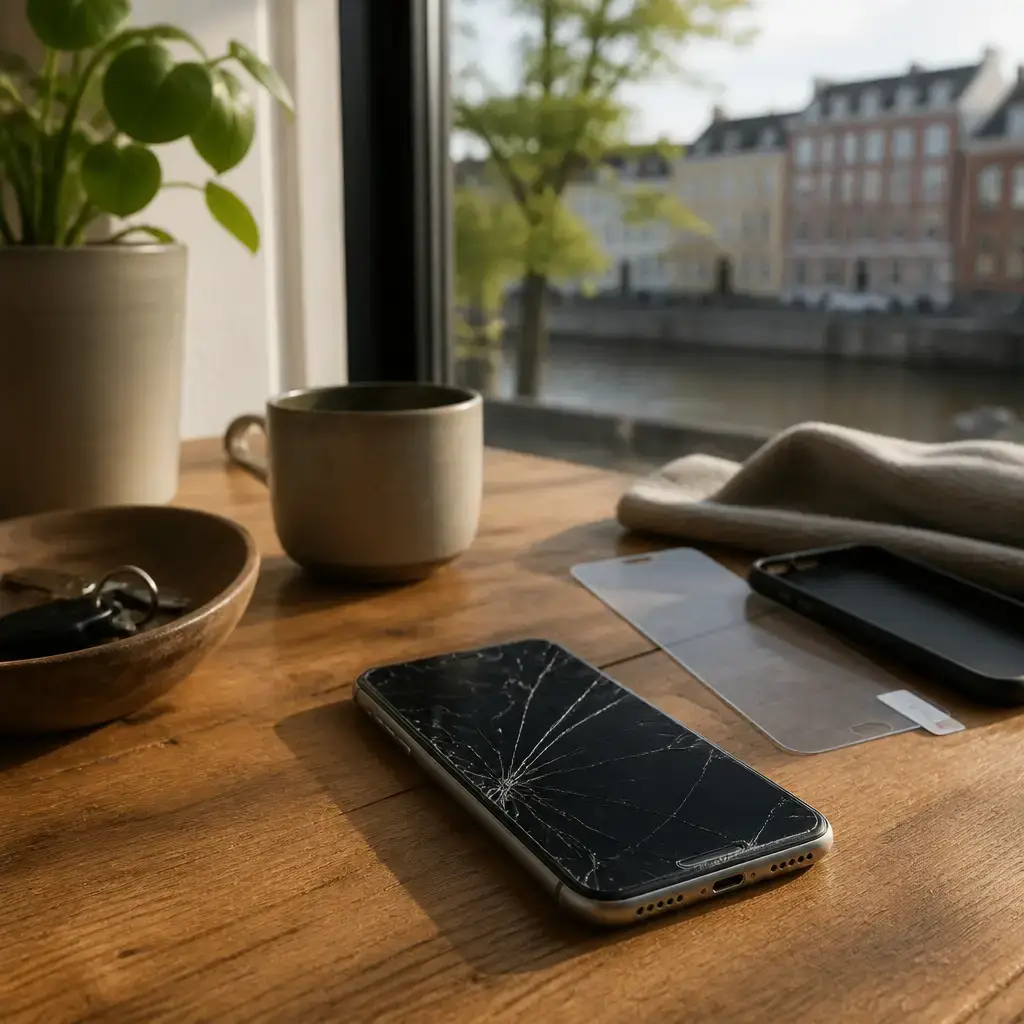
Ich habe mein Handy fallen lassen, und der Bildschirm ist gesprungen, funktioniert aber noch.
ikh HAH-buh mine HEN-dee FAH-len LAHS-sen, oont dair BILT-shirm ist guh-SHPROONG-en, foonk-tsee-oh-NEERT AH-bair nokh. I dropped my phone, and the screen is cracked but still works.Sichere deine Daten, bevor der Schaden schlimmer wird.
ZIKH-uh-ruh DYE-nuh DAH-ten, beh-FOHR dair SHAH-den SHLIM-er veert. Back up your data before the damage gets worse.Das mache ich jetzt. Das kaputte Glas macht mich nervös.
dahs MAH-khuh ikh yetst. dahs kah-POOT-tuh glahs makht mikh nair-VOOS. I will do that now. The broken glass is making me nervous.Bringe eine vorübergehende Schutzfolie an und drücke nicht stark darauf.
BRING-uh EYE-nuh fohr-UE-ber-GAY-en-duh SHOOTS-foh-lee ahn oont DREW-kuh nikht shtahrk dah-ROWF. Put on a temporary screen protector and avoid pressing hard on it.Soll ich es weiter benutzen, bis ein Reparaturdienst es überprüft?
zohl ikh ess VYE-ter beh-NOOT-tsen, biss eye-n reh-pah-rah-TOOR-deenst ess ue-ber-PREWFT? Should I keep using it until a repair service checks it?Benutze es nur für einfache Aufgaben, weil loses Glas deinen Finger schneiden kann.
beh-NOOT-tsuh ess noor fewr EYE-nfakh-uh OWF-gah-ben, vyle LOH-zes glahs DOY-nen FING-er SHNY-den kahn. Use it only for simple tasks, because loose glass can cut your finger.Ich kann es in einer Hülle aufbewahren und vorsichtig tragen.
ikh kahn ess in EYE-nuh HUE-luh OWF-buh-vahr-en oont FOHR-zikh-tikh TAH-gen. I can keep it in a case and carry it carefully.Das sollte das Risiko senken, während du die Reparatur organisierst.
dahs ZOHL-tuh dahs ree-ZEE-koh ZEN-ken, VAY-rent doo dee reh-pah-rah-TOOR or-gah-NEEZ-eerst. That should lower the risk while you arrange the repair.Ich werde eine Reparatur vereinbaren, statt zu warten.
ikh VAIR-duh EYE-nuh reh-pah-rah-TOOR fair-EYE-n-bah-ren, shtat tsoo VAHR-ten. I will book a repair instead of waiting.Kleine Risse können sich ausbreiten, wenn du das Handy weiter benutzt.
KLIN-uh RIS-suh KUR-nen zikh OWS-brigh-ten, venn doo dahs HEN-dee VYE-ter beh-NOOTST. Small cracks can spread if you keep using the phone.Sentence explanations
Ich habe mein Handy fallen lassen, und der Bildschirm ist gesprungen, funktioniert aber noch.
I dropped my phone, and the screen is cracked but still works.
- Handy
- mobile phone
- fallen … lassen
- drop; let fall
- Bildschirm
- screen
- gesprungen
- cracked
- funktioniert
- works
- aber
- but
- noch
- still
More detail
Handy means “mobile phone” here. It is a colloquial German neuter noun: das Handy, plural die Handys. Example: Mein Handy ist neu. — “My mobile phone is new.” fallen lassen is the reusable causative expression “let something fall” or “drop something.” In the sentence, fallen and lassen are separated because the object mein Handy stands between them. The perfect is formed with haben plus the infinitive construction: Ich habe mein Handy fallen lassen. Unlike ordinary perfect constructions, lassen remains an infinitive at the end. Example: Sie lässt den Ball fallen. — “She drops the ball.” Bildschirm means “screen.” It is a masculine noun: der Bildschirm; in the sentence, der marks the subject. Example: Der Bildschirm ist groß. — “The screen is large.” gesprungen is the past participle of springen (“jump”); with a screen, springen means to crack or split. The perfect form here is ist gesprungen, using sein: Der Bildschirm ist gesprungen. This describes the screen’s resulting cracked state, not a person jumping. Example: Das Glas ist gesprungen. — “The glass has cracked.” funktioniert is the third-person singular present form of funktionieren (“to work” or “to function”). Its subject is der Bildschirm, so the sentence says that the screen still works. Example: Mein Wecker funktioniert. — “My alarm clock works.” aber connects a contrast and means “but.” It introduces information that contrasts with the cracked screen: despite that condition, it works. noch means “still” here, indicating that the functioning continues after the damage. Example: Das Gerät ist alt, funktioniert aber noch. — “The device is old, but it still works.” Together, Ich habe mein Handy fallen lassen says “I dropped my phone.” Der Bildschirm ist gesprungen says that the screen cracked, and funktioniert aber noch adds the contrast that it still works. The complete meaning is: “I dropped my phone, and the screen is cracked but still works.”
Sichere deine Daten, bevor der Schaden schlimmer wird.
Back up your data before the damage gets worse.
- Sichere
- back up
- deine
- your
- Daten
- data
- bevor
- before
- Schaden
- damage
- schlimmer
- worse
- wird
- gets
More detail
Sichere is the informal singular imperative of sichern, meaning “back up” here. The verb is regular; its present forms include ich sichere and du sicherst. For a formal command, German uses Sichern Sie .... deine is the informal singular possessive determiner, “your,” addressing one person. It agrees with the possessed noun, not with the owner: deine Daten has a plural noun, and deine is the form used here for accusative plural as well as nominative plural. Daten means “data.” It is the plural of Datum; in this sentence it is the direct object of sichere, so it is accusative. Example: Ich sichere meine Daten. — “I back up my data.” bevor introduces a subordinate clause meaning “before.” In a clause introduced by bevor, the finite verb normally goes to the end: bevor der Schaden schlimmer wird. Schaden means “damage” here. The form der Schaden is singular masculine nominative because it is the subject of wird. The related plural is die Schäden, with an umlaut. schlimmer is the comparative of the adjective schlimm, “bad” or “severe.” schlimm – schlimmer – am schlimmsten corresponds to “bad/severe – worse/more severe – worst/most severe.” Here it describes a worsening condition: the damage becomes more severe. wird is the third-person singular present form of werden. Here werden is a lexical verb meaning “become/get,” not a future auxiliary: Der Schaden wird schlimmer means “The damage gets worse.” Its subject is der Schaden, which is why the form is third-person singular. Together, Sichere deine Daten is a direct informal command to back up the listener’s data. bevor der Schaden schlimmer wird adds the time condition “before the damage gets worse.” The complete utterance means: “Back up your data before the damage gets worse.”
Das mache ich jetzt. Das kaputte Glas macht mich nervös.
I will do that now. The broken glass is making me nervous.
- Das
- that
- mache
- do
- ich
- I
- jetzt
- now
- Das
- the
- kaputte
- broken
- Glas
- glass
- macht
- makes
- mich
- me
- nervös
- nervous
More detail
Das at the start is a demonstrative pronoun meaning “that.” Its neuter form can point to an understood thing or action; here the fixed translation supports an understood action. Compare das as a pronoun (“that”) with dieses (“this”) when distance or contrast matters. mache is the first-person singular present form of machen, “to do” or “to make.” The subject is ich, so the verb has the ending -e: ich mache, du machst, er/sie/es macht. German present tense can refer to an immediate future, so jetzt makes the intended time “now.” Example: Ich mache das morgen. — “I’ll do that tomorrow.” ich is the first-person singular subject pronoun, “I.” It identifies the person carrying out the action expressed by mache. jetzt means “now” and places the action at the present time. It can also occur in other positions for emphasis, but here it follows the verb and completes the time information of the first statement. The second Das is a definite article, “the,” not the demonstrative pronoun from the first statement. It is the neuter nominative singular form, agreeing with Glas: das Glas. German articles change with grammatical gender, number, and case; this form is not itself a numeric count. kaputte is the adjective kaputt, “broken.” In das kaputte Glas, the adjective describes Glas and takes the ending -e after the definite article in the nominative singular neuter phrase. The base form is kaputt; the observed form is not a different verb or noun. Example: Das kaputte Fenster ist offen. — “The broken window is open.” Glas means “glass.” It is a neuter noun: das Glas. It can refer to glass as a material or to a glass object; here, the fixed translation supports the meaning “glass.” Its plural is Gläser. macht is the third-person singular present form of machen. Here das kaputte Glas is the subject, so the form is macht, and the construction jemanden nervös machen means “to make someone nervous.” In this context, the present form is naturally translated as “is making.” mich is the first-person singular accusative pronoun, “me.” It is the person affected by macht; compare subject ich (“I”) with object mich (“me”). Example: Der Lärm stört mich. — “The noise bothers me.” nervös is an adjective meaning “nervous.” In mich nervös machen, it describes the state caused in the object mich; it does not take an ending here because it follows machen as a predicative adjective. Example: Die Prüfung macht ihn nervös. — “The exam makes him nervous.” Together, Das mache ich jetzt means “I will do that now”: the demonstrative points to the intended action, ich is the doer, and the present-tense verb plus jetzt expresses an action carried out immediately. Das kaputte Glas macht mich nervös means “The broken glass is making me nervous”: the broken glass is the cause, mich is the affected person, and nervös names the resulting state.
Bringe eine vorübergehende Schutzfolie an und drücke nicht stark darauf.
Put on a temporary screen protector and avoid pressing hard on it.
- Bringe … an
- put on; apply
- vorübergehende
- temporary
- Schutzfolie
- screen protector
- drücke
- press
- stark
- hard; strongly
- darauf
- on it
More detail
Bringe … an is the split informal singular imperative of anbringen, meaning “put on” or “apply.” The separable particle an- appears at the end in this main-clause command: Bringe die Folie an. = “Apply the film.” The form Bringe addresses one person informally; a polite command uses Bringen Sie … an. vorübergehende means “temporary” here. Its base form is the adjective vorübergehend. In eine vorübergehende Schutzfolie, the adjective has the ending -e because it describes the feminine singular noun Schutzfolie in the accusative after eine. This adjective describes duration, not the quality of the protection itself. Schutzfolie is a compound noun: Schutz means protection and Folie means film or sheet. In this sentence, the compound means a protective screen film or screen protector. German nouns are capitalized, and the noun is feminine: die Schutzfolie, eine Schutzfolie. drücke is the informal singular imperative of drücken, “to press.” The command Drücke nicht … means “Do not press …” A related form is du drückst = “you press”; the imperative removes the subject pronoun. stark means “hard” in this context, describing the force of pressing. The same adjective can also mean “strong,” but “hard” is the natural meaning with drücken. Example: Drück nicht so stark. = “Don’t press so hard.” darauf means “on it” here. It is a pronominal adverb formed with da- and auf, and the fixed translation supports its reference to the screen protector. This form can refer back to an inanimate object without repeating its noun. Example: Der Knopf ist empfindlich; drücke nicht darauf. = “The button is sensitive; don’t press it.” Together, Bringe eine vorübergehende Schutzfolie an gives the command “Put on a temporary screen protector,” and drücke nicht stark darauf adds the second command “and avoid pressing hard on it.” The two commands address one person informally and use und to connect the actions.
Soll ich es weiter benutzen, bis ein Reparaturdienst es überprüft?
Should I keep using it until a repair service checks it?
- Soll ich
- Should I
- es
- it
- weiter benutzen
- keep using
- bis
- until
- Reparaturdienst
- repair service
- überprüft
- checks
More detail
Soll ich is a reusable yes/no-question pattern. soll is the first-person singular present form of sollen; with ich, it asks whether the speaker ought to do something, here roughly “Should I …?” In a main-clause question, the modal verb comes first and the subject follows. The lexical infinitive appears later: Soll ich das tun? — “Should I do that?” es is an accusative object pronoun meaning “it” here. Its form is the same in the nominative and accusative, so its role comes from the sentence: it is the thing being used and later checked. The fixed translation supports the general referent “it” but does not identify it more specifically. weiter benutzen combines weiter (“further/continuing”) with the infinitive benutzen (“to use”). Together they mean “to keep using” or “to continue to use.” With the modal soll, benutzen stays in the infinitive: Soll ich es weiter benutzen? — “Should I keep using it?” bis introduces a time boundary, “until.” It begins the subordinate clause bis ein Reparaturdienst es überprüft; in this clause, the finite verb moves to the end. bis describes when the continuing use should stop or reach its stated limit; it does not itself state how long that period is. Reparaturdienst is a masculine noun: der Reparaturdienst, “the repair service.” In this clause, ein Reparaturdienst is the subject, and the indefinite article marks an unspecified repair service rather than a stated numerical count. The compound is built from Reparatur (“repair”) and Dienst (“service”), a useful pattern for recognizing service-related compounds. überprüft is the third-person singular present form of überprüfen, “to check” or “to inspect.” Its subject is ein Reparaturdienst, which is grammatically singular. In the subordinate clause, the finite verb is final: ..., bis ein Reparaturdienst es überprüft. — “..., until a repair service checks it.” The whole utterance combines the modal question Soll ich ...? with the continuing-use expression es weiter benutzen and the time clause bis .... It asks whether the speaker should continue using the object until a repair service checks it.
Benutze es nur für einfache Aufgaben, weil loses Glas deinen Finger schneiden kann.
Use it only for simple tasks, because loose glass can cut your finger.
- Benutze
- use
- es
- it
- nur
- only
- für
- for
- einfache
- simple
- Aufgaben
- tasks
- weil
- because
- loses
- loose
- Glas
- glass
- deinen
- your
- Finger
- finger
- schneiden
- cut
- kann
- can
More detail
Benutze is the informal singular imperative of benutzen (“to use”), addressed to one person. The imperative form is Benutze!, while the present-tense form with du is du benutzt. Example: Benutze das Werkzeug vorsichtig. — “Use the tool carefully.” es is an accusative neuter personal pronoun meaning “it.” Here it refers to the item being discussed, whose use and possible storage are also mentioned in the surrounding context. German object pronouns commonly stand before an adverb such as nur: Ich benutze es. — “I use it.” nur limits the instruction to the stated purpose: “only.” für introduces the purpose or intended use here and takes the accusative. einfache describes Aufgaben; it is the adjective einfach (“simple, easy”) with the ending used before this unaccompanied plural noun in the accusative phrase. Aufgaben is the plural of Aufgabe (“task”). The singular/plural contrast is die Aufgabe / die Aufgaben. weil introduces a reason clause. In a German weil clause, the finite verb normally goes to the end, so the sequence ... Finger schneiden kann ends with kann. loses is the adjective los (“loose, unattached”), describing Glas. Here the form is loses: the ending -es marks a neuter singular nominative adjective after no article, as in loses Glas. Glas is a neuter noun: das Glas. In this sentence it means the glass material, not a drinking glass as an object. The material sense fits the warning that it can injure someone. deinen is the accusative masculine form of the possessive determiner dein (“your,” addressing one person). It belongs to Finger, not to the verb: dein Finger is nominative, while deinen Finger is accusative. The accusative marks the person affected by the cutting. Finger means “finger.” It is masculine: der Finger; its plural is also Finger, so the article or determiner shows the case and number more clearly: ein Finger / zwei Finger. schneiden is the infinitive “to cut.” With a modal verb, the infinitive stays unchanged at the end of the clause: Glas kann schneiden means that glass is capable of cutting. The related noun is der Schnitt (“cut”), but it is not interchangeable with the verb. kann is the third-person singular present form of the modal verb können (“can, be able to”). Its subject here is loses Glas, and it expresses possibility or capability. The useful contrast is ich kann (“I can”) versus es kann (“it can”); the infinitive after it is schneiden. Together, Benutze es nur für einfache Aufgaben means “Use it only for simple tasks.” The reason clause weil loses Glas deinen Finger schneiden kann means “because loose glass can cut your finger.” The complete utterance therefore tells one person to restrict the item's use to simple tasks because loose glass may injure that person's finger.
Ich kann es in einer Hülle aufbewahren und vorsichtig tragen.
I can keep it in a case and carry it carefully.
- Ich kann
- I can
- Hülle
- case; cover
- aufbewahren
- keep; store
- vorsichtig
- carefully
- tragen
- carry
More detail
Ich kann combines the first-person singular pronoun ich (“I”) with the present-tense form kann of können (“can; be able to”). können is a modal verb: in a main clause, the modal is conjugated and the other verb normally goes to the end in the infinitive. The subject is ich, so the form is kann; compare du kannst (“you can”) and sie können (“they can” or formal “you can”). Hülle is a feminine noun meaning a case, cover, or casing. Its base dictionary form is die Hülle. Here it appears in in einer Hülle: in takes the dative for a stationary location, so the feminine indefinite article is einer. The sentence does not specify what kind of case it is; that is supplied by the context of the item being protected. aufbewahren means “to keep” or “store” something. It is a separable-prefix verb, but after the modal kann it remains as the full infinitive at the end of its clause: Ich kann es aufbewahren (“I can keep it”). In a simple present-tense main clause without a modal, the prefix separates: Ich bewahre es auf (“I keep it”). vorsichtig means “careful” as an adjective and “carefully” when it describes an action, as here. The form itself does not change because it is being used adverbially. For example, Sie öffnet die Schachtel vorsichtig. means “She opens the box carefully.” tragen means “carry” in this sentence. It is the infinitive required after kann; its present-tense first-person form is irregular: ich trage (“I carry”), while du trägst is “you carry.” Depending on context, tragen can also mean “wear,” but the fixed translation selects the carrying meaning here. The pronoun es is the singular object “it”; the supplied texts do not identify the item more specifically. in einer Hülle aufbewahren means “keep it in a case,” and vorsichtig tragen means “carry it carefully.” The modal applies to both coordinated actions: Ich kann es in einer Hülle aufbewahren und vorsichtig tragen. means “I can keep it in a case and carry it carefully.”
Das sollte das Risiko senken, während du die Reparatur organisierst.
That should lower the risk while you arrange the repair.
- Das
- that
- sollte
- should
- Risiko
- risk
- senken
- lower; reduce
- während du
- while you
- Reparatur
- repair
- organisierst
- arrange; organize
More detail
Das means “that” here as a demonstrative pronoun referring to the relevant situation or measure already understood from context. It is not modifying the following noun Risiko; German demonstratives can refer back to an idea or situation as a whole. At the beginning of a sentence, it is capitalized. Sollte is the form of sollen used here with a third-person singular subject. In this sentence, sollte corresponds to “should” and presents lowering the risk as an expected or advisable result. After a modal verb such as sollte, the other verb stays in the infinitive: sollte ... senken. Risiko means “risk” here. Its base form is das Risiko; the plural is die Risiken. The article das belongs to this noun, while the earlier Das is a separate demonstrative pronoun. Senken is the infinitive “to lower” or “to reduce.” With sollte, it remains in the infinitive. A useful contrast is sinken, “to sink” or “to decrease,” which describes something becoming lower, whereas senken means that someone or something lowers it. Example: Diese Maßnahme senkt die Kosten. — “This measure lowers the costs.” Während du introduces a clause meaning “while you.” Während links the two events in time, and du is the second-person singular subject, “you.” In the clause introduced by während, the finite verb goes to the end: während du ... organisierst. Reparatur means “repair” here. Its base form is die Reparatur, and it is feminine in German. The noun can refer either to the repair work or, depending on context, the service arranged for repairing something. Example: Die Reparatur dauert zwei Tage. — “The repair takes two days.” Organisierst is the second-person singular present form of organisieren, “to arrange” or “to organize.” The ending -st marks du: du organisierst. Here it means arranging the repair, not merely organizing objects. Because this verb is inside the während clause, it appears at the end of that clause. Together, Das sollte das Risiko senken means “That should lower the risk.” The comma separates the main clause from the time clause während du die Reparatur organisierst, “while you arrange the repair.” The full utterance therefore means: “That should lower the risk while you arrange the repair.”
Ich werde eine Reparatur vereinbaren, statt zu warten.
I will book a repair instead of waiting.
- Ich werde
- I will
- Reparatur
- repair
- vereinbaren
- book; arrange
- statt
- instead of
- warten
- wait
More detail
Ich werde: Ich is the first-person singular subject, “I.” werde is the first-person singular present form of werden; with an infinitive later in the clause, werden forms the future: Ich werde ... vereinbaren = “I will ... arrange/book.” The future auxiliary changes with the subject: ich werde, but du wirst. The main lexical verb remains in the infinitive at the end of the clause. Example: Ich werde morgen anrufen. — “I will call tomorrow.” Reparatur: This feminine noun means “repair” here, referring to the repair being arranged. The phrase eine Reparatur uses the feminine indefinite article eine; in this sentence it introduces a repair, but the article by itself does not assert a numerical count. The noun is capitalized because German nouns are capitalized. Example: Die Reparatur ist teuer. — “The repair is expensive.” vereinbaren: The infinitive means “to arrange” or “to book” something. With eine Reparatur, it means arranging or booking the repair, matching the fixed translation. Its base form is vereinbaren; the future construction keeps this infinitive unchanged after werde. Example: Wir vereinbaren einen Termin. — “We arrange an appointment.” statt: This introduces an alternative that is not chosen: “instead of.” Here it contrasts booking the repair with waiting. statt can be followed by an infinitive clause with zu, as in statt zu warten. warten: This is the infinitive “to wait.” After statt, the infinitive construction is statt zu warten, literally an “instead-of waiting” alternative. The zu belongs to the infinitive construction; it is not part of the verb’s base form, which is warten. Example: Sie geht, statt zu warten. — “She leaves instead of waiting.” Together, Ich werde eine Reparatur vereinbaren says “I will book a repair.” statt zu warten gives the rejected alternative, “instead of waiting.” The complete utterance therefore means: “I will book a repair instead of waiting.”
Kleine Risse können sich ausbreiten, wenn du das Handy weiter benutzt.
Small cracks can spread if you keep using the phone.
- Kleine
- small
- Risse
- cracks
- können
- can
- sich ausbreiten
- spread
- wenn du
- if you
- Handy
- phone
- weiter
- continuing
- benutzt
- use
More detail
Kleine means “small” here and describes Risse. It is the adjective form used with a plural noun in this noun phrase. The base form is klein; for example, kleine Fehler means “small mistakes.” Risse means “cracks.” Its singular is der Riss, and its plural is die Risse. The plural form identifies more than one crack; the sentence does not specify how many. können is the form of können used with the plural subject Risse. It expresses ability or possibility: “can.” With a modal verb such as können, the other verb normally goes to the end of the clause in its infinitive form: Risse können sich ausbreiten — “Cracks can spread.” sich ausbreiten means “to spread” in this sentence. This is a reflexive verb construction: sich belongs with the verb, rather than meaning a separate participant. The infinitive is sich ausbreiten; in the present tense, the form changes with the subject, for example Der Riss breitet sich aus — “The crack is spreading.” wenn du begins a conditional clause meaning “if you.” du is the informal singular “you.” In a German wenn clause, the conjugated verb usually comes at the end: wenn du das Handy weiter benutzt — “if you keep using the phone.” Handy means “mobile phone” or “cell phone” in German. The noun is neuter: das Handy. In this sentence, das marks the specific phone being used; Handy itself is the noun. German nouns are capitalized. weiter means “continuing” or “on.” With an activity, it indicates continuation: weiter lernen means “continue studying.” Here it combines with benutzt to express continuing to use the phone. benutzt is the second-person singular present form of benutzen, “to use,” agreeing with du: du benutzt. The related form benutze is used with ich, as in Ich benutze das Handy — “I use the phone.” In the conditional clause, benutzt is placed at the end because of wenn. Together, Kleine Risse können sich ausbreiten says “Small cracks can spread.” The conditional part wenn du das Handy weiter benutzt adds the condition “if you keep using the phone.” The complete utterance is therefore: “Small cracks can spread if you keep using the phone.”
Grammar Points
statt zu + Infinitiv
Statt zu warten, überprüfst du das Handy.
shtat tsoo VAHR-ten, ue-ber-PREWFT doo dahs HEN-dee.Instead of waiting, you check the mobile phone.
Use statt zu + infinitive to say that one action happens instead of another.
anbringen → Bringe ... an
Bringe eine Schutzfolie vorsichtig an.
BRING-uh EYE-nuh SHOOTS-foh-lee FOHR-zikh-tikh ahn.Carefully put on a screen protector.
The separable prefix an moves to the end in the imperative.
German Vocabulary
Quiz
Spelling
Tap the letters to spell the word.
to back up, secure
Show Answer
Sicherestill
Show Answer
nochmobile phone
Show Answer
Handydamage