10 minutes free every day
Continue audio lessons in the app
Word explanations appear automatically in sync with the audio.
No login required · synced translations · playback with the screen locked
Choose your learning language and open this lesson in the app.

About This Lesson
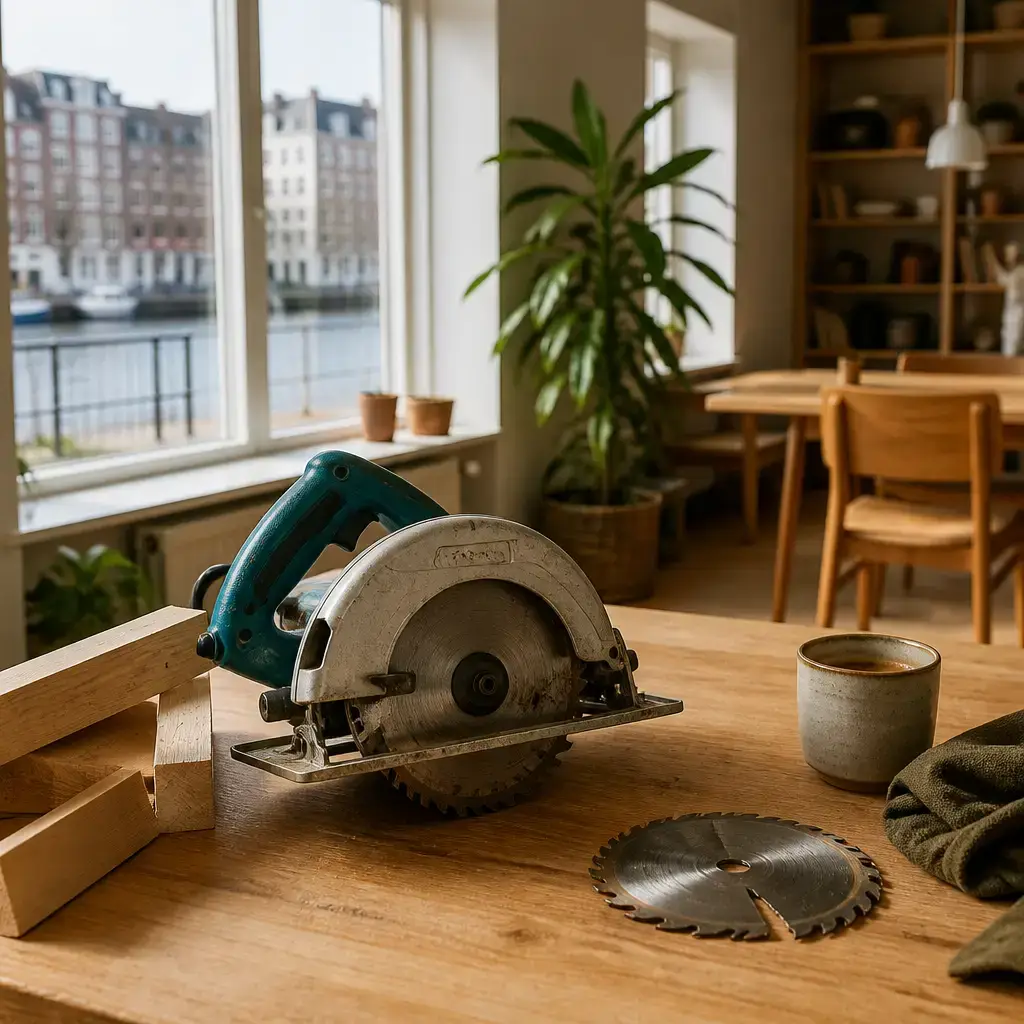
Use Taking responsibility for a damaged borrowed tool to practice German conversation, pronunciation, vocabulary, grammar, and quizzes.
Dialogue
Ich muss ehrlich über die Säge sprechen, die ich ausgeliehen habe.
ikh moos AIR-likh UE-ber dee ZEH-guh SHPREKH-en, dee OWS-guh-LEE-en HAH-buh. I need to be honest about the saw I borrowed.Kannst du erklären, was passiert ist?
kahnst doo air-KLEH-ren, vahs pah-SEERT ist? Can you explain what happened?Das Sägeblatt wurde beschädigt, während ich dickes Holz geschnitten habe.
dahs ZEH-guh-blaht VOOR-duh buh-SHAY-dikht, VEH-rent ikh DIK-uhs HOHLTS guh-SHNI-tun HAH-buh. The blade got damaged while I was cutting thick wood.War das Holz zu dick für diese Säge?
vahr dahs HOHLTS tsoo dik fyoor DEE-zuh ZEH-guh? Was the wood too thick for that saw?Wahrscheinlich, und ich hätte vorher fragen sollen.
vah-SHYNE-likh, oont ikh HET-tuh FOHR-hair FRAH-gen ZOL-len. Probably, and I should have asked before trying.Ich weiß es zu schätzen, dass du offen damit umgehst, statt es zu verheimlichen.
ikh vice ess tsoo SHET-sen, dahss doo OFF-en dah-MIT oom-GAYST, shtatt ess tsoo fer-HYME-likh-en. I appreciate you being upfront instead of hiding it.Ich kann eine Reparatur organisieren oder das Sägeblatt ersetzen.
ikh kahn EYE-nuh reh-pah-rah-TOOR or-gah-nee-ZEER-en OH-der dahs ZEH-guh-blaht air-SET-sen. I can arrange a repair or replace the blade.Das Ersetzen des Sägeblatts sollte ausreichen.
dahs air-SET-sen dess ZEH-guh-blahts ZOL-tuh OWS-rye-khen. Replacing the blade should be enough.Ich kümmere mich heute darum.
ikh KUE-muh-ruh mikh HOY-tuh dah-ROOM. I will take care of that today.Sag mir Bescheid, wenn das Sägeblatt ersetzt ist, bevor du die Säge zurückbringst.
zahk meer buh-SHYT, venn dahs ZEH-guh-blaht air-SETST ist, buh-FOHR doo dee ZEH-guh tsoo-ROOK-bringst. Tell me when it is replaced before you bring the saw back.Sentence explanations
Ich muss ehrlich über die Säge sprechen, die ich ausgeliehen habe.
I need to be honest about the saw I borrowed.
- Ich muss
- I need to
- ehrlich
- honest; honestly
- über
- about
- Säge
- saw
- sprechen
- speak; talk
- ausgeliehen
- borrowed
More detail
Ich muss uses müssen in the first-person singular present: ich muss. It expresses necessity or strong need, and the following verb stays in the infinitive. Compare ich muss sprechen (“I need to speak”) with ich kann sprechen (“I can speak”); kann expresses ability or possibility, not necessity. ehrlich means “honest” here and describes the manner or attitude of speaking. German uses the same form ehrlich as an adjective and as an adverb: eine ehrliche Antwort means “an honest answer,” while ehrlich sprechen means “to speak honestly.” In this sentence, it contributes to the meaning “be honest.” über introduces the topic of speaking here and takes the accusative in this use: über etwas sprechen means “to speak about something.” This is different from über in a location or movement expression, where its case can depend on the meaning. Säge is the noun “saw.” Its base form is feminine: die Säge; its plural is Sägen. In the sentence, die Säge is the specific saw being discussed. sprechen is the infinitive “to speak” or “to talk.” It is an irregular verb: ich spreche (present), ich sprach (simple past), ich habe gesprochen (perfect). The reusable pattern here is über etwas sprechen (“to talk about something”). ausgeliehen is the past participle of the separable verb ausleihen. With the fixed translation, it means “borrowed” here. For the borrowing sense, German commonly uses the reflexive construction sich etwas ausleihen, for example: Ich leihe mir ein Buch aus. — “I borrow a book.” The same verb can also be used for lending something out, depending on its construction and context, so the surrounding sentence establishes the intended sense here. In a perfect construction, the auxiliary carries the person and tense while ausgeliehen remains the participle. The words die ich ausgeliehen habe form a relative clause modifying die Säge. Here die refers to the saw and functions as the feminine singular accusative object of ausgeliehen; ich is the borrower. In a German relative clause, the conjugated verb goes to the end, so habe follows the participle ausgeliehen. Together, Ich muss ehrlich über die Säge sprechen means “I need to be honest about the saw,” and the relative clause specifies which saw: die ich ausgeliehen habe, “that I borrowed.” The complete utterance therefore means “I need to be honest about the saw I borrowed.”
Kannst du erklären, was passiert ist?
Can you explain what happened?
- Kannst du
- Can you…?
- erklären
- explain
- was passiert ist
- what happened
More detail
Kannst du is a reusable way to ask one person whether they are able or willing to do something: Kannst du ...? means “Can you ...?” Here kannst is the second-person singular form of können, and du is the informal singular “you.” The following lexical verb stays in the infinitive and moves to the end of the question: Kannst du warten? — “Can you wait?” erklären means “to explain.” It is the infinitive used after kannst; the modal verb carries the tense and person marking, while erklären remains unchanged. The same infinitive can be used in other patterns, for example: Ich möchte es erklären. — “I would like to explain it.” was passiert ist is a subordinate question meaning “what happened.” was asks about an unspecified thing or event. passiert is the present-tense form of passieren (“to happen”); in this expression, the completed event is expressed with ist passiert, the perfect form using sein as the auxiliary. In the subordinate clause, the finite auxiliary ist comes at the end: Ich weiß, was passiert ist. — “I know what happened.” Together, Kannst du erklären asks whether the listener can explain something, and was passiert ist specifies that the thing to be explained is the completed event. The full utterance therefore means, “Can you explain what happened?” It is a direct, neutral request for an explanation.
Das Sägeblatt wurde beschädigt, während ich dickes Holz geschnitten habe.
The blade got damaged while I was cutting thick wood.
- Sägeblatt
- saw blade
- wurde beschädigt
- was damaged / got damaged
- während
- while
- ich
- I
- dickes
- thick
- Holz
- wood
- geschnitten habe
- have cut; here, was cutting
More detail
Sägeblatt means “saw blade” here. It is a neuter compound noun: das Sägeblatt; its plural is die Sägeblätter. The compound combines Säge (“saw”) and Blatt (“blade” or “leaf”), but the complete noun is the reusable unit. wurde beschädigt describes the blade as receiving the damage: “was damaged” or “got damaged.” wurde is the third-person singular past form of werden, used here as the passive auxiliary, and beschädigt is the past participle of beschädigen (“to damage”). In this passive, the person or thing causing the damage is not stated. Compare active Jemand beschädigte das Sägeblatt (“Someone damaged the saw blade”) with passive Das Sägeblatt wurde beschädigt. während means “while” and introduces a subordinate clause whose event is presented as simultaneous with the main event. In German, the finite verb of this subordinate clause goes to the end: während ... habe. It can also be used as a preposition in other constructions, but here it connects two clauses. ich is the first-person singular subject pronoun, “I.” Its form marks the speaker as the subject; the verb form in the subordinate clause agrees with it. dickes means “thick” in dickes Holz. The adjective is dick, and dickes is its attributive form here. Holz is singular neuter, and it is the direct object of geschnitten in this clause. Because there is no article or other determiner before this neuter singular accusative noun, the adjective takes the ending -es: dickes Holz. With a definite article, the form would be das dicke Holz. Holz means “wood.” It is a mass noun in this use, so the sentence does not specify a number of separate pieces. The same form serves as nominative and accusative in the singular; its object role here is shown by the verb relationship rather than by a visible noun ending. geschnitten habe expresses the cutting event in the subordinate clause. geschnitten is the past participle of schneiden (“to cut”); this verb has the irregular form schneiden – schnitt – geschnitten. habe is the first-person singular present form of haben, the auxiliary used to form the perfect: ich habe geschnitten (“I have cut”). Because the clause follows während, the auxiliary appears at the end. In this sentence, the fixed translation presents that cutting as an ongoing background activity: “while I was cutting.” Together, Das Sägeblatt wurde beschädigt says that the saw blade was damaged, without naming the agent. während ich dickes Holz geschnitten habe places the speaker’s cutting of thick wood at the same time as that damage. Thus the complete utterance means: “The blade got damaged while I was cutting thick wood.”
War das Holz zu dick für diese Säge?
Was the wood too thick for that saw?
- War
- was
- Holz
- wood
- zu dick
- too thick
- für
- for
- diese
- that
- Säge
- saw
More detail
War is the past-tense singular form of sein (“to be”). Here it agrees with the singular subject das Holz and appears before the subject because this is a yes/no question: War ...? means “Was ...?” In a statement, the same idea could be Das Holz war .... Holz means “wood.” It is a neuter noun, so the definite article is das: das Holz. German often uses this noun for wood as a material; the form is not marked as plural here. Example: Das Holz ist trocken. — “The wood is dry.” zu dick describes something as excessively thick: zu + adjective means “too ...,” not merely “very ... .” The adjective is dick (“thick”); its base form is already used here because the question uses the predicate construction sein + adjective. Example: Das Brett ist zu dick. — “The board is too thick.” für means “for” and introduces an accusative phrase in German. This preposition expresses the relevant suitability or intended use here: the wood was too thick for the saw. diese means “that” in the supplied translation and is the feminine singular accusative form of the demonstrative dies-. It agrees with Säge, not with Holz: diese Säge. The same demonstrative family can also mean “this,” with the precise English choice supplied by context. Example: Ich nehme diese Säge. — “I’ll take this saw.” Säge means “saw.” It is a feminine noun: die Säge. After für, it appears as accusative singular, but the feminine singular form has the same visible shape as nominative singular: die/diese Säge. Example: Die Säge ist scharf. — “The saw is sharp.” Together, War das Holz zu dick asks whether the wood had excessive thickness, and für diese Säge specifies the saw for which that thickness was unsuitable. The complete utterance therefore means: “Was the wood too thick for that saw?”
Wahrscheinlich, und ich hätte vorher fragen sollen.
Probably, and I should have asked before trying.
- Wahrscheinlich
- probably
- ich hätte
- I would have
- vorher
- beforehand
- fragen
- ask
- sollen
- should
More detail
Wahrscheinlich means “probably” here. It is an adverb expressing uncertainty about the preceding situation; it does not itself identify what is probable. The same word can also appear inside a fuller sentence, for example: Wahrscheinlich kommt er später. — “He will probably come later.” ich hätte contains ich (“I”) and hätte, the first-person singular form of haben in Konjunktiv II. In this utterance, hätte helps form a past, unrealized or retrospective construction with the modal verb sollen; it is not by itself the complete meaning “I should have.” vorher is an adverb meaning “beforehand” or “earlier,” relative to an understood event. Here, the supplied translation identifies that event as trying, so the intended sense is “before trying.” The German sentence leaves the action after vorher implicit rather than stating a separate verb for “try.” fragen is the infinitive of fragen, “to ask.” In the fixed utterance it is the action that should have happened. A useful present-tense contrast is Ich frage. — “I ask” or “I am asking.” sollen is the infinitive of the modal verb sollen, which commonly expresses what someone is supposed or expected to do; in this construction, ich hätte ... fragen sollen means “I should have asked.” With a modal verb in this retrospective construction, German uses hätte together with the infinitive of the main verb and the infinitive sollen: Ich hätte vorher fragen sollen. — “I should have asked beforehand.” The conjunction und links the initial assessment to the speaker’s retrospective admission. Together, Wahrscheinlich and und ich hätte vorher fragen sollen produce: “Probably, and I should have asked before trying.” The first part gives a probable assessment, while the second says that asking earlier was the appropriate action but did not happen.
Ich weiß es zu schätzen, dass du offen damit umgehst, statt es zu verheimlichen.
I appreciate you being upfront instead of hiding it.
- Ich weiß es zu schätzen
- I appreciate it
- offen
- openly; upfront
- damit umgehst
- deal with it
- statt
- instead of
- es zu verheimlichen
- hiding it
More detail
Ich weiß es zu schätzen is a reusable German construction meaning “I appreciate it” or “I appreciate ...”. In this sentence, weiß is the first-person singular present form of wissen; the appreciative meaning comes from the full construction, not from wissen alone. The zu belongs to the infinitive schätzen (“appreciate, value”). Example: Ich weiß deine Hilfe zu schätzen. — “I appreciate your help.” offen describes the manner of dealing with the matter here: openly or upfront. It is the same form as the adjective “open,” but here it functions adverbially, describing how the action is carried out. Example: Sie spricht offen darüber. — “She speaks openly about it.” damit umgehst means “deal with it” in this sentence. The base verb is the separable verb umgehen, in the sense “deal with” or “handle.” With du in the present tense, it appears as du gehst ... um in a main clause, but the prefix and verb are joined in this subordinate clause: dass du damit umgehst. The ending in umgehst marks second-person singular present tense. damit is a da-compound meaning “with it” here; the specific matter is not named in this sentence. Example: Wie gehst du damit um? — “How do you deal with it?” statt introduces an alternative and means “instead of” here. A common reusable pattern is statt ... zu + infinitive, meaning “instead of doing ...”. In this sentence, the pattern contrasts dealing with the matter openly with concealing it. es zu verheimlichen means “hiding it.” verheimlichen is the base verb meaning “conceal” or “keep secret,” and zu verheimlichen is its infinitive with zu. The pronoun es is the object translated as “it”; it is not part of the verb’s base form. Example: Sie versucht, den Fehler nicht zu verheimlichen. — “She tries not to hide the mistake.” Together, Ich weiß es zu schätzen expresses appreciation, dass du offen damit umgehst specifies what is appreciated—your dealing with it openly—and statt es zu verheimlichen contrasts that behavior with hiding it. The whole utterance therefore means: “I appreciate you being upfront instead of hiding it.”
Ich kann eine Reparatur organisieren oder das Sägeblatt ersetzen.
I can arrange a repair or replace the blade.
- Ich kann
- I can
- eine Reparatur
- a repair
- organisieren
- arrange
- oder
- or
- das Sägeblatt
- the blade
- ersetzen
- replace
More detail
Ich kann means “I can” here: können is the base form, and kann is its present-tense form for ich. As a modal verb, it expresses ability or possibility. In this sentence, the following lexical verb stays in the infinitive and goes to the end of its clause. Example: Ich kann warten. — “I can wait.” eine Reparatur means “a repair.” Reparatur is a feminine noun: die Reparatur; in this sentence, eine marks the accusative object after organisieren. The indefinite article does not by itself state a numerical count; it presents a repair as an unspecified option or task. Example: Wir brauchen eine Reparatur. — “We need a repair.” organisieren is the infinitive “to arrange” or “to organize.” With Ich kann, it remains an infinitive rather than taking a personal ending: Ich kann eine Reparatur organisieren. — “I can arrange a repair.” oder connects alternatives and means “or.” It links the two possible actions here: arranging a repair and replacing the blade. das Sägeblatt means “the blade,” specifically a saw blade. Sägeblatt is a neuter compound noun, so its definite article is das: das Sägeblatt. The form is also accusative here because it is the object of ersetzen. In the following context, the related nominalized form das Ersetzen des Sägeblatts means “replacing the blade”; the noun inside the genitive phrase appears as des Sägeblatts. ersetzen is the infinitive “to replace.” Its present-tense first-person form is ich ersetze, but after the modal kann the infinitive is used: Ich kann das Sägeblatt ersetzen. — “I can replace the blade.” Together, Ich kann eine Reparatur organisieren says “I can arrange a repair,” while das Sägeblatt ersetzen says “replace the blade.” oder joins them as alternatives, producing the complete meaning: “I can arrange a repair or replace the blade.”
Das Ersetzen des Sägeblatts sollte ausreichen.
Replacing the blade should be enough.
- Das Ersetzen
- replacing
- Sägeblatts
- blade
- sollte
- should
- ausreichen
- be enough
More detail
Das Ersetzen means “replacing” here. It is the infinitive ersetzen used as a noun, so it is capitalized. As a noun, it takes an article: das Ersetzen. Compare the ordinary verb in the previous sentence: das Sägeblatt ersetzen = “replace the blade.” Sägeblatts means “of the blade” in this sentence. Its base noun is das Sägeblatt (“the blade”); the ending -s marks the singular genitive after des: des Sägeblatts. The compound noun is written as one word. Example: die Farbe des Sägeblatts = “the color of the blade.” Sollte is the form of sollen used with the third-person singular subject das Ersetzen. In this sentence, sollte expresses an expected or recommended result: replacing it is expected to be sufficient. The useful contrast is soll (“is supposed to / should”) versus sollte (“should,” often less forceful or more tentative). Example: Das sollte funktionieren. = “That should work.” Ausreichen means “to be enough” or “to suffice.” It is an infinitive here because it follows the modal verb sollte; the finite verb carries the tense and person, while ausreichen stays in the infinitive. Example: Eine Stunde sollte ausreichen. = “One hour should be enough.” Together, Das Ersetzen des Sägeblatts is the subject: “replacing the blade.” sollte ausreichen says that this action is expected to be sufficient. The complete utterance therefore means: “Replacing the blade should be enough.”
Ich kümmere mich heute darum.
I will take care of that today.
- Ich
- I
- kümmere mich … darum
- take care of that
- heute
- today
More detail
Ich is the first-person singular pronoun, meaning “I.” It identifies the speaker as the person responsible for the action. A contrasting form is du (“you,” singular informal), as in Du kümmerst dich darum. — “You take care of that.” kümmere mich is the first-person singular present form of the expression sich um etwas kümmern, “to take care of something” or “to deal with something.” The verb’s base form is kümmern; in this expression, the reflexive pronoun changes with the subject: ich kümmere mich, du kümmerst dich, sie kümmert sich. The mich belongs to the reflexive construction and refers back to Ich; it is not the object being taken care of. darum is a da-compound meaning “about that” or, with sich um etwas kümmern, “about that matter.” Here it points to the matter under discussion, supported by the surrounding context: replacing the saw blade. The reusable pattern is sich um etwas kümmern → sich darum kümmern when etwas is replaced by “that matter.” Example: Wir kümmern uns darum. — “We’ll take care of that.” heute means “today.” German present tense can describe a planned or expected action when a time expression such as heute makes the future time clear; the sentence therefore corresponds to “I will take care of that today,” without using a separate future form. Together, Ich kümmere mich darum says that the speaker will handle the matter referred to by darum; adding heute places that action today. The complete utterance means: “I will take care of that today.”
Sag mir Bescheid, wenn das Sägeblatt ersetzt ist, bevor du die Säge zurückbringst.
Tell me when it is replaced before you bring the saw back.
- Sag mir Bescheid
- let me know
- wenn
- when
- das Sägeblatt
- the saw blade
- ersetzt
- replaced
- bevor
- before
- die Säge
- the saw
- zurückbringst
- bring back
More detail
Sag mir Bescheid is a reusable German way to say “let me know” or “inform me.” Sag is the informal singular imperative of sagen (“to say”); the subject du is understood. mir is the first-person singular dative pronoun, “to me.” In this idiom, Bescheid sagen means giving someone information, not simply saying any words. Example: Sag mir Bescheid, wenn du Zeit hast. — “Let me know when you have time.” wenn introduces the condition or time point “when.” In the fixed sentence it starts a subordinate clause, so the finite verb comes at the end: wenn das Sägeblatt ersetzt ist. das Sägeblatt means “the saw blade.” Sägeblatt is a compound noun: Säge is “saw” and Blatt is “blade” in this compound. The article das belongs to the neuter grammatical gender of Sägeblatt; it does not indicate a number by itself. Example: Das Sägeblatt ist scharf. — “The saw blade is sharp.” ersetzt is the past participle of ersetzen, “to replace.” Here it appears with ist: ist ersetzt describes the blade as having been replaced, using a passive construction. The person who performed the replacement is not stated. In the subordinate clause, ist is at the end: wenn das Sägeblatt ersetzt ist. bevor means “before” and introduces the event that must occur earlier in the comparison. It also begins a subordinate clause, so its finite verb comes at the end. die Säge means “the saw.” Säge is feminine, which is reflected in the definite article die here. Example: Die Säge ist im Schrank. — “The saw is in the cupboard.” zurückbringst comes from the separable verb zurückbringen, “to bring back” or “to return.” It is the present-tense second-person singular form for du: du bringst ... zurück in a main clause, but in the subordinate clause after bevor, the parts appear together at the end as zurückbringst. Example: Du bringst das Buch zurück. — “You bring the book back.” Together, Sag mir Bescheid gives the request “let me know.” The wenn clause specifies the time: the saw blade is replaced. The bevor clause sets the ordering: this notification is connected with the time before you bring the saw back. The whole utterance is: “Tell me when the saw blade has been replaced before you bring the saw back.”
Grammar Points
über etwas sprechen: über + Akkusativ
über die Säge sprechen
UE-ber dee ZEH-guh SHPREKH-ento talk about the saw
In this expression, über takes the accusative to introduce the topic.
sich um etwas kümmern → sich darum kümmern
Ich kümmere mich heute darum.
ikh KUE-muh-ruh mikh HOY-tuh dah-ROOMI’ll take care of it today.
The verb is reflexive: with ich, use mich. darum replaces um etwas when the thing is already known.
German Vocabulary
Quiz
Word Order
Arrange the words in the correct order.
Can you explain what happened?
Show Answer
Kannst du erklären, was passiert ist?Replacing the blade should be enough.
Show Answer
Das Ersetzen des Sägeblatts sollte ausreichen.I will take care of that today.
Show Answer
Ich kümmere mich heute darum.Spelling
Tap the letters to spell the word.
saw
Show Answer
Sägeto happen
Show Answer
passiertto explain
Show Answer
erklärensaw blade