10 minutes free every day
Continue audio lessons in the app
Word explanations appear automatically in sync with the audio.
No login required · synced translations · playback with the screen locked
Choose your learning language and open this lesson in the app.

About This Lesson
Use Checking Travel Bags Before Leaving to practice German conversation, pronunciation, vocabulary, grammar, and quizzes.
Dialogue
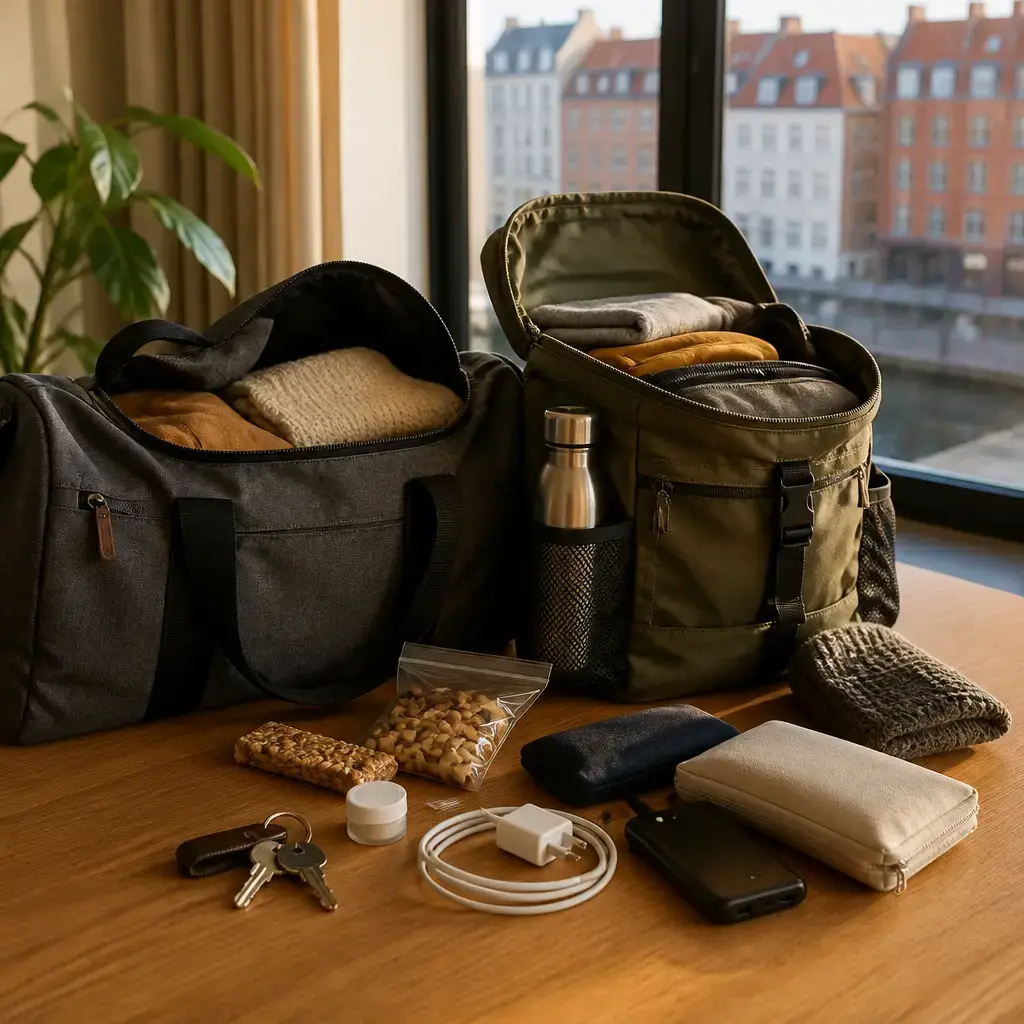
Unsere Reisetaschen müssen vor der Abfahrt noch einmal überprüft werden.
OON-zuh-ruh RYE-zuh-tah-shun MURSS-un fohr dair AHP-fahrt nokh EYE-nahl YOO-buh-PRURFT VAIR-dun. Our travel bags need a final check before we go.Beginne mit den Sachen, die du während der Reise brauchst.
buh-GIN-uh mit dayn ZAH-khun dee doo VAY-runt dair RYE-zuh browkhst. Start with the items you need during the journey.Ich habe meine Schlüssel, meine Medikamente und eine warme Schicht dabei.
ikh HAH-buh MY-nuh SHLUR-suhl, MY-nuh may-dee-kah-MEN-tuh oont EYE-nuh VAR-muh SHIKHT dah-BYE. I have my keys, medicine, and a warm layer.Sind Snacks und Wasser leicht zu erreichen?
zint SNACKS oont VAHSS-er lykht tsoo air-RYE-khun? Are snacks and water easy to reach?Sie sind in der Seitentasche.
zee zint in dair ZYE-tun-tah-shuh. They are in the side pocket.Wie sieht es mit Ladegeräten und kleinen Dingen für mehr Komfort aus?
vee zeet ess mit LAH-duh-guh-RAY-tun oont KLY-nun DING-un fyoor mair kom-FORT ows? What about chargers and small comfort items?Ich habe sie zusammen eingepackt, damit sie leicht zu finden sind.
ikh HAH-buh zee tsoo-ZAH-mun EYE-nuh-PAHKT, dah-MIT zee lykht tsoo FIN-dun zint. I packed them together so they are easy to find.Das sollte die Reise entspannter machen, falls sich die Pläne ändern.
dahs ZOL-tuh dee RYE-zuh ent-SHPAN-tuh MAH-khun, fahls zikh dee PLAY-nuh AIRN-dun. That should make the trip calmer if plans change.Ich habe außerdem noch etwas Platz für alles gelassen, was wir unterwegs mitnehmen.
ikh HAH-buh ow-suh-DAIM nokh ET-vahs PLAHTS fyoor AH-luhs guh-LAHSS-un, vahs veer OON-tair-VAYKS MIT-nay-mun. I also left extra space for anything we pick up.Dann sollten wir am Bahnhof losgehen können, ohne noch einmal umzupacken.
dahn ZOL-tun veer ahm BAHN-hohf LOHSS-gay-un KUR-nun, OH-nuh nokh EYE-nahl OOM-tsoo-PAH-kun. Then we should be able to leave without repacking at the station.Sentence explanations
Unsere Reisetaschen müssen vor der Abfahrt noch einmal überprüft werden.
Our travel bags need a final check before we go.
- Unsere
- our
- Reisetaschen
- travel bags
- müssen
- need to
- vor der Abfahrt
- before departure
- noch einmal
- once again
- überprüft werden
- be checked
More detail
Unsere is the possessive determiner meaning “our.” Here it is the nominative plural form agreeing with Reisetaschen, the subject. The form changes with the noun phrase’s grammatical features: for example, unser Koffer means “our suitcase,” while unsere Taschen means “our bags.” Reisetaschen means “travel bags.” It is the plural of Reisetasche; the plural ending is -n. German nouns are capitalized. Example: Die Reisetaschen sind schwer. — “The travel bags are heavy.” müssen is the present-tense form of the modal verb müssen for a plural subject: “must” or “need to.” With a modal verb, the other verb normally goes to the end in its infinitive or participle form. Example: Wir müssen gehen. — “We need to go.” vor der Abfahrt is a temporal phrase meaning “before departure.” In this use, vor takes the dative, so feminine singular die Abfahrt becomes der Abfahrt. The phrase identifies the time limit for the checking; it does not itself name who is departing. noch einmal means “once again” or “one more time.” It shows that the checking is to happen again. Example: Lies den Satz noch einmal. — “Read the sentence once again.” überprüft werden is a passive construction meaning “be checked.” überprüft is the past participle of überprüfen, “to check,” and werden is the passive auxiliary. The bags are presented as receiving the checking, while the person doing it is not stated. Here werden forms the passive, not the future: Die Taschen werden überprüft. means “The bags are being checked.” Together, Unsere Reisetaschen is the subject, müssen expresses necessity, and überprüft werden says that the bags must receive the checking. vor der Abfahrt places it before departure, and noch einmal adds that it should happen one more time. The whole utterance means: “Our travel bags need to be checked once more before departure,” matching the fixed translation “Our travel bags need a final check before we go.”
Beginne mit den Sachen, die du während der Reise brauchst.
Start with the items you need during the journey.
- Beginne
- start
- mit
- with
- Sachen
- items; things
- während
- during
- Reise
- journey
- brauchst
- need
More detail
Beginne is the informal singular imperative of beginnen (“to begin/start”). It addresses one person: Beginne! For a group or formal addressee, German uses different forms, such as Beginnt! or Beginnen Sie!. mit means “with” and requires the dative case. The reusable pattern is mit + dative: Ich beginne mit der Arbeit. — “I start with the work.” Here, mit introduces what should be started first. Sachen is the plural of the noun Sache (“thing” or “item”). In mit den Sachen, the article den marks plural dative after mit, while the noun itself has the plural form Sachen. während means “during” and introduces a time period. In standard German, it commonly takes the genitive: während der Reise — “during the journey.” With the feminine singular noun Reise, the genitive article is der; this happens to look the same as the dative article. Reise is the feminine noun for a journey or trip. Its plural is Reisen. In this sentence, während der Reise identifies the period in which the items are needed. brauchst is the second-person singular present form of brauchen (“to need”): du brauchst. It agrees with du in the relative clause. Example: Du brauchst Wasser. — “You need water.” The words die du während der Reise brauchst form a relative clause modifying Sachen: “that you need during the journey.” die refers back to the plural noun Sachen and functions as the object of brauchst; du is the person who needs the items. The relative clause places its finite verb brauchst at the end. Together, Beginne mit den Sachen gives “Start with the items,” and die du während der Reise brauchst specifies which items. The complete utterance means: “Start with the items you need during the journey.”
Ich habe meine Schlüssel, meine Medikamente und eine warme Schicht dabei.
I have my keys, medicine, and a warm layer.
- Ich habe
- I have
- Schlüssel
- keys
- Medikamente
- medicine
- warme
- warm
- Schicht
- layer
- dabei
- with me
More detail
Ich habe uses the first-person singular present form of haben ("to have"). The subject is Ich ("I"), and habe agrees with it. The pattern Ich habe ... is reusable for saying that you possess or have something with you. meine Schlüssel means "my keys." Schlüssel is plural here; its singular form is also Schlüssel, so the number is shown by the determiner and context rather than by a changed noun form. meine is the possessive determiner for "my" with a plural noun. In this sentence, meine Schlüssel is the object of habe. meine Medikamente means "my medicine" here. Medikamente is the plural of Medikament; German uses the plural form even though English can use the uncountable word "medicine" for the same intended meaning. The second meine likewise marks possession of a plural noun. eine warme Schicht means "a warm layer." Schicht is a feminine noun. Because it is the object of habe, this noun phrase is in the accusative, but the feminine forms of eine and warme look the same here as in the nominative: eine warme Schicht. warme is the adjective form of warm; the ending -e is used after eine with this feminine singular noun. A clothing layer can be called eine warme Schicht when it provides extra warmth. dabei adds the meaning "with me" or "on hand" in this sentence. Together with habe, etwas dabei haben is a useful German pattern for having something available or carrying it with you. It is a separate adverb, not a form of haben. The sentence assembles as Ich habe + the things possessed: meine Schlüssel, meine Medikamente and eine warme Schicht, followed by dabei to clarify that these items are with the speaker. The complete meaning is: "I have my keys, medicine, and a warm layer."
Sind Snacks und Wasser leicht zu erreichen?
Are snacks and water easy to reach?
- Sind
- are
- Snacks
- snacks
- Wasser
- water
- leicht
- easy
- zu erreichen
- to reach
More detail
Sind is the present-tense form of sein (“to be”) for sie (“they”), Sie (“you” formal), or plural nouns. Here it agrees with the coordinated subject Snacks und Wasser: “are.” In a yes/no question, the finite verb comes first: Sind ...? means “Are ...?” Snacks is the plural of der Snack, “snack.” The plural ending here is -s; the form does not change for case in this subject position. Example: Die Snacks sind hier. — “The snacks are here.” Wasser means “water.” It is a mass noun and normally has no plural when referring to water as a substance. Its grammatical gender is neuter: das Wasser. Example: Das Wasser ist kalt. — “The water is cold.” leicht means “easy” here. Its opposite is schwierig or schwer, depending on the intended contrast. In leicht zu erreichen, it describes how easy an action is, rather than describing the physical weight of something. Example: Der Knopf ist leicht zu drücken. — “The button is easy to press.” zu erreichen combines the particle zu with the infinitive erreichen, “to reach” or “to access.” In the pattern leicht zu + infinitive, the meaning is “easy to ...”. Erreichen is an inseparable verb, so its infinitive remains erreichen; zu is written as a separate word before it: zu erreichen. Example: Der Eingang ist leicht zu finden. — “The entrance is easy to find.” Together, Snacks und Wasser is a coordinated subject joined by und, so sein appears as Sind. The pattern Ist/Sind + [thing] + leicht zu + infinitive? asks whether something is easy to do or access. Thus Sind Snacks und Wasser leicht zu erreichen? means “Are snacks and water easy to reach?” The question concerns the accessibility of both items, without asserting where they are or who will reach them.
Sie sind in der Seitentasche.
They are in the side pocket.
- Sie sind
- they are
- in der
- in the
- Seitentasche
- side pocket
More detail
Sie sind means “they are” here. The fixed translation identifies Sie as a plural pronoun referring to an unspecified group of things or people; the sentence itself does not identify exactly what they are. sind is the present-tense form of sein (“to be”) for sie meaning “they”: sie sind. The same written form Sie can also be a formal singular or plural “you” in other contexts, but that is not the intended reading here. in der expresses a stationary location: “in the.” With in for a location, the following noun phrase takes the dative case. der is the dative singular feminine form of the definite article; die Seitentasche becomes in der Seitentasche. This is different from movement into a place, which commonly uses the accusative: in die Seitentasche = “into the side pocket.” Seitentasche means “side pocket.” It is a feminine noun: die Seitentasche; its plural is die Seitentaschen. The compound combines the idea of a side with a pocket, but the complete noun is the reusable form for this type of pocket. Example: Die Schlüssel sind in der Seitentasche. — “The keys are in the side pocket.” Here sind still marks a plural subject, and in der Seitentasche still describes a fixed location. Together, Sie sind + in der Seitentasche gives: “They are in the side pocket.”
Wie sieht es mit Ladegeräten und kleinen Dingen für mehr Komfort aus?
What about chargers and small comfort items?
- Wie sieht es mit … aus
- What about …?
- Ladegeräten
- chargers
- kleinen
- small
- Dingen
- things
- mehr
- more
- Komfort
- comfort
More detail
Wie sieht es mit … aus is a reusable German construction meaning “What about …?” or “How about …?” The words are separated because aus belongs to the separable verb aussehen; in this question, sieht appears near the beginning and aus at the end. The es is a formal subject here, not a specifically identified thing. The preposition mit takes the dative: Wie sieht es mit dem Plan aus? — “What about the plan?” Ladegeräten means “chargers” here. Its base noun is das Ladegerät; the plural is die Ladegeräte, and the dative plural adds -n: mit Ladegeräten. This ending is on the noun, not on mit. kleinen means “small” and describes Dingen. Its base form is klein; in this phrase it has the dative-plural ending -en, because mit governs the coordinated plural items: mit kleinen Dingen — “with small things.” For example, mit kleinen Taschen means “with small bags.” Dingen means “things” here. Its base noun is das Ding, with plural Dinge; the dative plural is Dingen. Thus mit kleinen Dingen means “with small things.” mehr means “more” in mehr Komfort, referring to a greater amount or degree of comfort. It is the comparison form associated with viel: viel — “much/a lot,” mehr — “more,” am meisten — “the most.” Here mehr does not state a precise quantity. Komfort means “comfort.” It is the noun in mehr Komfort, and für introduces the purpose or benefit: für mehr Komfort — “for more comfort.” The noun is used without an article in this general, uncounted expression. For example, ein Kissen für mehr Komfort means “a cushion for more comfort.” Together, mit Ladegeräten und kleinen Dingen für mehr Komfort names chargers and small things intended to provide greater comfort. The frame Wie sieht es mit … aus? then asks about including or considering those items, giving the whole utterance: “What about chargers and small comfort items?”
Ich habe sie zusammen eingepackt, damit sie leicht zu finden sind.
I packed them together so they are easy to find.
- Ich habe
- I have
- sie
- them
- zusammen
- together
- eingepackt
- packed
- damit
- so that
- sie
- they
- leicht
- easy
- zu finden
- to find
- sind
- are
More detail
Ich habe combines the subject ich (“I”) with the present-tense auxiliary habe, the first-person singular form of haben. With a past participle later in the clause, this forms the German perfect tense: Ich habe ... eingepackt = “I packed ...” / “I have packed ...”. Example: Ich habe die Sachen eingepackt. — “I packed the things.” The first sie is the object of eingepackt and means “them” here. Its plural form is the same in this context whether the group is grammatically masculine, feminine, or mixed; the sentence does not identify the group’s composition. The translation establishes that it refers to the items being packed. zusammen means “together” and modifies the packing: the items were packed together rather than separately. Example: Wir reisen zusammen. — “We are travelling together.” eingepackt is the past participle of the separable verb einpacken, “to pack.” The useful chain is einpacken → packte ein → eingepackt; in the perfect, the participle appears with an auxiliary such as haben. Here, zusammen eingepackt means “packed together.” damit introduces a purpose clause, meaning “so that” or “so.” It connects the packing with the intended result expressed in the following clause. Unlike the main clause, this subordinate clause places its finite verb at the end. The second sie is the subject of the purpose clause and means “they” here. It is plural, matching the plural form of sind; the translation identifies it with the packed items. The two occurrences of sie have different roles: the first is “them,” while the second is “they.” leicht is the adjective “easy” in the expression leicht zu finden, literally “easy to find.” It is a predicate adjective here, so it has no adjective ending. Example: Die Lösung ist leicht zu verstehen. — “The solution is easy to understand.” zu finden is the infinitive phrase “to find,” from finden. The pattern leicht zu + infinitive describes something that can be found or done easily. Example: Der Schlüssel ist leicht zu finden. — “The key is easy to find.” sind is the present-tense plural form of sein, “to be.” It appears at the end because it is the finite verb of the subordinate damit clause. Together, sie leicht zu finden sind means “they are easy to find.” As a whole, Ich habe sie zusammen eingepackt says “I packed them together.” The purpose clause damit sie leicht zu finden sind adds the goal: “so they are easy to find.” Combined, the utterance means “I packed them together so they are easy to find.”
Das sollte die Reise entspannter machen, falls sich die Pläne ändern.
That should make the trip calmer if plans change.
- Das
- that
- sollte
- should
- Reise
- trip
- entspannter
- calmer; more relaxed
- machen
- make
- falls
- if
- sich
- reflexive element
- Pläne
- plans
- ändern
- change
More detail
Das means “that” here and functions independently as the subject. Its specific referent is not identified by the fixed sentence. German das can also be the neuter definite article, but here it is a pronoun. sollte is the form used here for the modal verb sollen, with the meaning “should.” In this sentence it expresses an expectation or prediction, supported by the fixed translation. The form is identical to the simple-past form of sollen and also to its Konjunktiv II form, so the surrounding meaning identifies the intended present-oriented “should” reading here. The present indicative form is soll. Reise is the feminine noun die Reise, “trip” or “journey.” Its plural is Reisen. The article in die Reise marks this noun phrase as definite; the noun itself names the trip. entspannter is the comparative of entspannt, “relaxed.” The useful form chain is entspannt → entspannter → am entspanntesten (“relaxed” → “more relaxed” → “the most relaxed”). Here it describes the resulting state of the trip, so the phrase means “make the trip more relaxed.” machen is the infinitive “to make.” After the modal verb sollte, the infinitive remains at the end of the main clause: Das sollte ... machen. The pattern etwas ... machen can mean “make something ...” when the following adjective describes the result. falls introduces a condition meaning “if” or “in case.” It begins a subordinate clause, in which German places the finite verb at the end. sich is the reflexive element used with the verb sich ändern. It does not identify a separate participant here; it belongs to that verb construction. Pläne is the plural of der Plan, “plan.” In this clause it is the plural subject of ändern. The definite article die before it marks the plans as definite, but it does not specify how many plans there are. ändern is both the infinitive of ändern, “to change,” and the present-tense finite form used with a plural subject. Here it is the finite verb with die Pläne as subject. Together with sich, it forms sich ändern, “to change.” For example, Die Situation ändert sich. means “The situation is changing.” Putting the parts together: Das sollte expresses an expectation, die Reise entspannter machen says that the trip will become more relaxed, and falls sich die Pläne ändern gives the condition. The whole utterance means: “That should make the trip calmer if plans change.”
Ich habe außerdem noch etwas Platz für alles gelassen, was wir unterwegs mitnehmen.
I also left extra space for anything we pick up.
- Ich habe
- I have
- außerdem
- also; in addition
- noch
- additional; extra
- etwas
- some; a little
- Platz
- space; room
- gelassen
- left
- alles
- anything covered by the clause
- unterwegs
- on the way
- mitnehmen
- pick up; take along
More detail
Ich habe combines the first-person singular pronoun ich (“I”) with present-tense habe, the first-person singular form of haben. Here habe is an auxiliary, not a possession verb by itself: together with the later participle gelassen, it forms the German perfect, referring to a completed act. Example: Ich habe Zeit. = “I have time.” außerdem adds another point: “also” or “in addition.” It is useful for linking an extra fact to what has already been said. Example: Außerdem ist es günstig. = “It is also inexpensive.” noch here adds an additional amount: “extra.” Together, außerdem noch emphasizes that the speaker left additional space as well. In this sentence, it does not assert that the space is necessarily still present at a later time. etwas means “some” or “a little” when it indicates an unspecified amount. It is indeclinable in this use. In etwas Platz, it specifies an unspecified amount of Platz rather than naming a count of separate objects. Example: Ich brauche etwas Wasser. = “I need some water.” Platz means “space” or “room.” It is a masculine noun, so its dictionary form is der Platz; in this sentence, the amount phrase etwas Platz refers to available room. Do not confuse this meaning with the related use “place” in other contexts: the sentence specifically concerns room left available. gelassen is the past participle of lassen. The useful chain is lassen → ließ (simple past) → hat gelassen (perfect). In this sentence, gelassen means “left” in the sense of keeping or leaving space available, not “let” in one of the other common uses of lassen. Example: Sie hat die Tür offen gelassen. = “She left the door open.” alles is the neuter singular form of the totalizing pronoun meaning “everything.” With the following relative clause, it refers to anything that satisfies that clause, matching the fixed translation “anything.” The clause limits what is included, so this does not mean every possible thing without qualification. unterwegs is an adverb meaning “on the way” or “while travelling.” It describes the situation or route in which the taking occurs and does not itself identify a particular destination. Example: Wir kaufen unterwegs Brot. = “We buy bread on the way.” mitnehmen is a separable verb meaning “to take along” or, in this context, “to pick up and take with us.” In the observed sentence, mitnehmen is the first-person plural present form agreeing with wir; it happens to have the same spelling as the infinitive. Because it is in a relative clause, the separable prefix remains attached and the finite verb stands at the end: was wir unterwegs mitnehmen = “that we pick up on the way.” In a main clause, the finite form separates: Wir nehmen das Paket mit. = “We take the package along.” The structure is Ich habe ... gelassen (“I left ...”), with etwas Platz as the amount of room left. außerdem noch marks that this is additional room. für alles, was wir unterwegs mitnehmen identifies what that room is intended for: anything the group picks up and takes along while on the way. Together, the utterance means: “I also left extra space for anything we pick up.”
Dann sollten wir am Bahnhof losgehen können, ohne noch einmal umzupacken.
Then we should be able to leave without repacking at the station.
- Dann
- then
- sollten wir
- we should
- Bahnhof
- train station
- losgehen
- leave; set off
- können
- be able to
- ohne
- without
- noch einmal
- again; once more
- umzupacken
- repack
More detail
Dann places the action after an earlier point or event: “then.” It can introduce a consequence or a next step. Example: Dann gehen wir. — “Then we’ll go.” sollten wir combines sollten, the Konjunktiv II form of sollen used here for an expectation or tentative “should,” with wir, “we.” Together with können, it gives the reusable pattern sollten ... können: “should be able to.” The form sollten agrees with wir in this construction. Do not confuse it with indicative sollen, “are supposed to/should”; sollte is the corresponding Konjunktiv II form with ich or a singular third-person subject, while sollten is also used with plural subjects and formal Sie. Bahnhof means “train station.” In am Bahnhof, am is the contraction of an dem, used here for a location. Bahnhof is a masculine noun, which is reflected in the underlying form dem. Example: Wir warten am Bahnhof. — “We are waiting at the train station.” losgehen means “to set off” or “to leave.” It is a separable verb: its parts can separate in some finite clauses, as in Wir gehen los. — “We’re setting off.” Here it remains the infinitive losgehen because it follows the modal können. können means “to be able to” or “can.” Here it follows another modal form, so losgehen können means “be able to set off.” Example: Wir können jetzt losgehen. — “We can set off now.” ohne means “without.” With an infinitive clause, the reusable pattern is ohne ... zu + infinitive, meaning “without doing ...”; the infinitive clause here is completed by umzupacken. noch einmal means “once more” or “again.” It modifies the repacking action, so the meaning here is “repack again,” not simply “pack.” einmal alone means “once”; noch einmal adds repetition. umzupacken is the infinitive with zu of umpacken, “to repack,” used after ohne. With this separable verb, zu is inserted between the prefix and the remaining verb: umpacken becomes umzupacken. Example: Sie fährt, ohne umzupacken. — “She travels without repacking.” Together, Dann sollten wir ... können means “Then we should be able to ...”; am Bahnhof losgehen means “set off at the train station”; and ohne noch einmal umzupacken means “without repacking again.” The complete utterance therefore means: “Then we should be able to leave without repacking at the station.”
Grammar Points
sieht ... aus
Die Reisetasche sieht leicht aus.
dee RYE-zuh-tah-shuh zeet lykht ows.The travel bag looks light.
Bei trennbaren Verben steht die Vorsilbe im Hauptsatz am Satzende: sieht ... aus.
damit + Verb am Ende
Ich packe alles ein, damit ich entspannt losgehe.
ikh PAH-kuh AH-luhs EYE-n, dah-MIT ikh ent-SHPANT LOHSS-gay-uh.I pack everything so that I leave relaxed.
Nach „damit“ steht das konjugierte Verb am Ende des Nebensatzes.
German Vocabulary
Quiz
Word Order
Arrange the words in the correct order.
They are in the side pocket.
Show Answer
Sie sind in der Seitentasche.Spelling
Tap the letters to spell the word.
thing; item
Show Answer
Sachentravel bag
Show Answer
Reisetaschenmedicine; medication
Show Answer
Medikamentelayer