10 minutes free every day
Continue audio lessons in the app
Word explanations appear automatically in sync with the audio.
No login required · synced translations · playback with the screen locked
Choose your learning language and open this lesson in the app.

About This Lesson
Use Checking presentation equipment to practice German conversation, pronunciation, vocabulary, grammar, and quizzes.
Dialogue
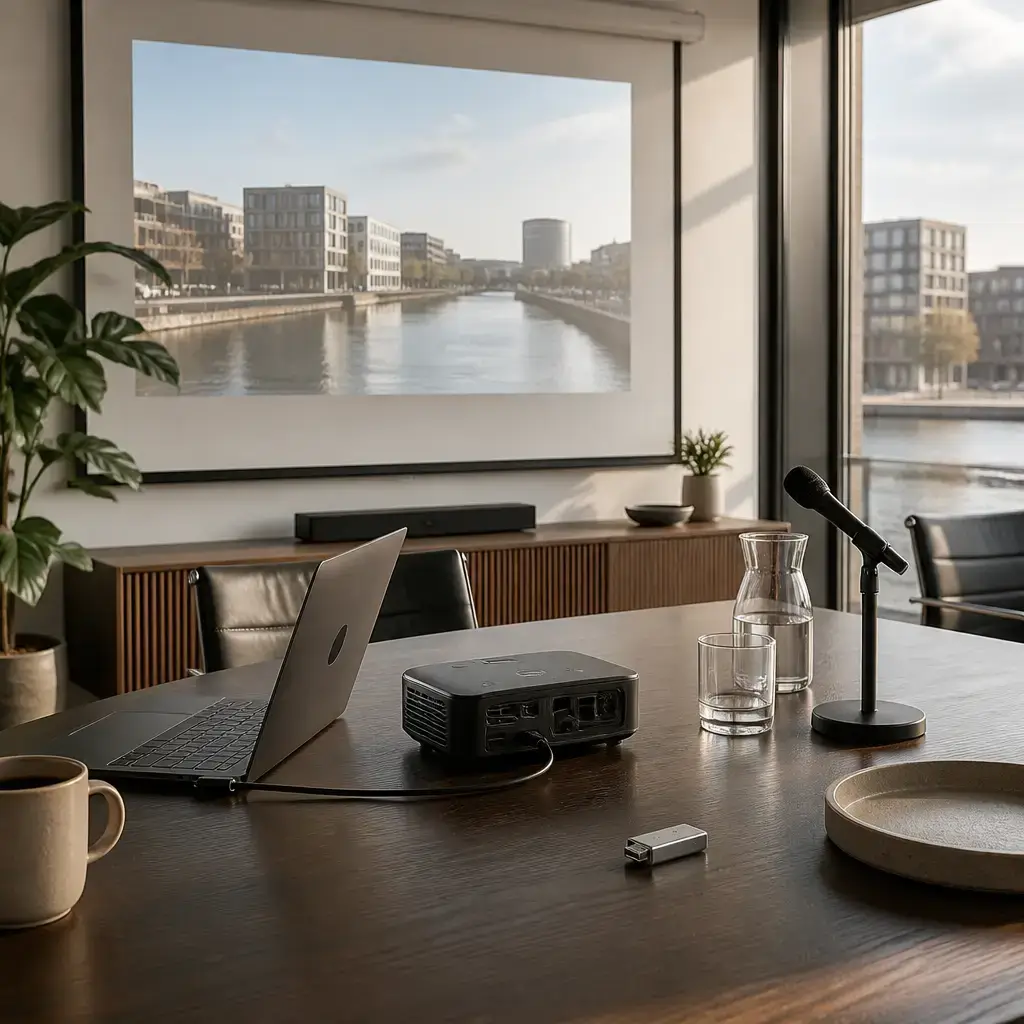
Wir sollten die Präsentationstechnik prüfen, bevor die Kunden ankommen.
veer SHULL-ten dee pray-zen-tah-TSYOHNS-tekh-NEEK PROO-fen, beh-FOHR dee KOON-den AHN-koh-men. We should check the presentation equipment before the clients arrive.Ich kann zuerst den Laptop mit dem Beamer verbinden.
ikh kahn tsoo-AYRST den LAP-top mit dehm BAY-mer fer-BIN-den. I can connect the laptop to the projector first.Das Bild wird angezeigt, aber es wirkt etwas gestreckt.
dahs bilt veert AHN-guh-TSYEKHT, AH-ber ess virkt ET-vahs guh-SHTREKT. The image is showing, but it looks a little stretched.Ich kann die Anzeigeeinstellungen anpassen und die Folien noch einmal testen.
ikh kahn dee AHN-tsye-guh-EYE-nshtel-loong-en AHN-pahs-en oont dee FOH-lee-en nokh ayn-MAHL TES-ten. I can adjust the display settings and test the slides again.Könntest du auch die Mikrofonlautstärke prüfen?
KURNT-est doo owkh dee mee-kroh-FOHN-lowt-SHTAIR-kuh PROO-fen? Could you also check the microphone volume?Es klingt klar, aber die hintere Reihe braucht vielleicht mehr Lautstärke.
ess klinkt klahr, AH-ber dee HIN-ter-uh RYE-uh browkht fee-LYKHT mair LOWT-shtair-kuh. It sounds clear, but the back row may need more volume.Ich habe die Folien auf einem Sicherungslaufwerk mitgebracht.
ikh HAH-buh dee FOH-lee-en owf EYE-num ZIKH-er-oongz-lowf-vairk mit-guh-BRAKHT. I brought the slides on a backup drive.Machen wir eine kurze Probe mit der ersten Folie.
MAKH-en veer EYE-nuh KOORTS-uh PROH-buh mit dair AIR-sten FOH-lee-uh. Let's do a quick rehearsal with the opening slide.Die erste Folie hat funktioniert, also scheint jetzt alles bereit zu sein.
dee AIR-stuh FOH-lee-uh hat foonk-tsyoh-NEERT, AHL-zoh shynt yetst AH-les beh-RYTE tsoo zyn. The opening slide worked, so everything seems ready now.Dieser Technikcheck nimmt uns eine Sorge ab.
DEE-zer TEKH-nik-chek nimt oons EYE-nuh ZOR-guh ahp. This tech check gives us one less thing to worry about.Sentence explanations
Wir sollten die Präsentationstechnik prüfen, bevor die Kunden ankommen.
We should check the presentation equipment before the clients arrive.
- Wir sollten
- we should
- Präsentationstechnik
- presentation equipment
- prüfen
- check
- bevor
- before
- Kunden
- clients
- ankommen
- arrive
More detail
Wir sollten combines wir (“we”) with sollten, the first-person plural form used here to express a recommendation: “should.” sollten is the Konjunktiv II form of sollen; in this sentence it is not a past-tense statement. A reusable pattern is Wir sollten + infinitive: Wir sollten anfangen. — “We should start.” Präsentationstechnik means presentation equipment or technology. It is a singular compound noun: die Präsentationstechnik. The final part, Technik, is the head of the compound and determines its grammatical gender. In the supplied context, equipment such as a laptop and projector fits this meaning. Example: Die Präsentationstechnik funktioniert. — “The presentation equipment works.” prüfen is the infinitive “to check” or “to inspect.” After the modal construction sollten, the lexical verb remains in the infinitive: Wir sollten die Technik prüfen. — “We should check the equipment.” bevor introduces a subordinate clause meaning “before.” The clause that follows gives the event that must happen later relative to the checking. German places the finite verb at the end of a bevor clause. Kunden is the plural form of der Kunde (“client” or “customer”). In die Kunden, it is the plural subject of the subordinate clause; the noun’s plural form is Kunden, while the article die also marks this plural noun phrase in context. Example: Die Kunden warten. — “The clients are waiting.” ankommen means “to arrive.” In this sentence it is the finite present-tense form for the plural subject die Kunden, and it appears at the end because it is in a subordinate clause. Its spelling is identical to the infinitive: Die Kunden kommen an. — “The clients arrive,” but bevor die Kunden ankommen — “before the clients arrive.” Together, Wir sollten ... prüfen expresses the recommendation to check something, and bevor die Kunden ankommen sets the time condition for that action. The complete meaning is: “We should check the presentation equipment before the clients arrive.”
Ich kann zuerst den Laptop mit dem Beamer verbinden.
I can connect the laptop to the projector first.
- Ich kann
- I can
- zuerst
- first
- Laptop
- laptop
- Beamer
- projector
- verbinden
- connect
More detail
Ich kann means “I can” here: kann is the first-person singular present form of können, followed by the infinitive verbinden. With a modal verb, the main verb normally stays in the infinitive and moves to the end of the clause. Example: Ich kann helfen. — “I can help.” zuerst means “first” and marks the order of this action. It can also occur in another position when the speaker wants a different emphasis; here it comes after the modal phrase and before the objects and infinitive. Laptop is the noun “laptop.” In the sentence it appears as den Laptop: the masculine singular accusative article den marks it as the direct object of verbinden. The noun itself does not show this case change. Example: Ich starte den Laptop. — “I start the laptop.” Beamer is the noun commonly used in German for a projector. It appears inside mit dem Beamer. The preposition mit requires the dative, so the masculine singular article is dem; Beamer itself keeps the same form. Example: Ich arbeite mit dem Beamer. — “I work with the projector.” verbinden means “to connect.” It is the infinitive of the verb; useful forms include verbindet for “connects” with a third-person singular subject and hat verbunden for the perfect tense. In this sentence, verbinden takes the direct object den Laptop and the mit phrase naming what it is connected to. Example: Wir verbinden den Computer mit dem Bildschirm. — “We connect the computer to the screen.” Together, Ich kann expresses ability, zuerst sets the order, den Laptop is the item being connected, and mit dem Beamer identifies the connection partner. The final infinitive verbinden completes the modal construction: “I can connect the laptop to the projector first.”
Das Bild wird angezeigt, aber es wirkt etwas gestreckt.
The image is showing, but it looks a little stretched.
- Bild
- image
- wird angezeigt
- is displayed
- wirkt
- looks
- etwas
- a little
- gestreckt
- stretched
More detail
Bild means “image” or “picture.” Its plural is Bilder. In this sentence, Das Bild is the subject, and das belongs to the neuter noun Bild. wird angezeigt is a present passive construction from anzeigen (“to display”): wird is the third-person singular present form of werden, and angezeigt is the past participle. It describes the image as being displayed without saying who displays it. A reusable pattern is Das Bild wird angezeigt — “The image is displayed.” wirkt is the third-person singular present form of wirken. Here it means “looks” or “seems,” describing the impression the image gives. Unlike wird angezeigt, which states that the image is displayed, wirkt introduces an assessment of its appearance. etwas means “a little” or “somewhat” here. It reduces the strength of the following description: etwas gestreckt means “a little stretched.” gestreckt means “stretched.” It is the past participle of strecken, and it is used here as a predicative adjective after wirkt. In this position it does not take an agreement ending: Das Bild wirkt gestreckt, but Die Bilder wirken gestreckt also has gestreckt unchanged. This sentence does not use a comparative form. Together, Das Bild wird angezeigt says that the image is displayed, while aber es wirkt etwas gestreckt adds the contrast that it looks slightly stretched. aber means “but,” and es is the neuter pronoun referring to the image here. The whole utterance means: “The image is showing, but it looks a little stretched.”
Ich kann die Anzeigeeinstellungen anpassen und die Folien noch einmal testen.
I can adjust the display settings and test the slides again.
- Ich kann
- I can
- Anzeigeeinstellungen
- display settings
- anpassen
- adjust
- Folien
- slides
- noch einmal
- again
- testen
- test
More detail
Ich kann means “I can” here. kann is the first-person singular present form of können, expressing ability or possibility. In a main clause with this modal verb, the other verb stays in the infinitive and goes to the end: Ich kann ... anpassen = “I can adjust ...”. Anzeigeeinstellungen is the plural of Anzeigeeinstellung, “display setting.” The compound combines Anzeige (“display”) with Einstellung (“setting”); its plural ending is -en: eine Anzeigeeinstellung → Anzeigeeinstellungen. In die Anzeigeeinstellungen, die is the definite article, and it agrees with the plural noun phrase; the noun form shows the plural. anpassen means “to adjust” or “to adapt.” It is a regular infinitive here. Because kann is the modal verb, anpassen remains uninflected and appears at the end of the first coordinated action: Ich kann die Anzeigeeinstellungen anpassen = “I can adjust the display settings.” Folien means “slides.” It is the plural of Folie; the singular is die Folie, and the plural is die Folien. The phrase die Folien therefore refers to the slides being tested, without stating how many slides there are. noch einmal is a reusable time expression meaning “again” or “once more.” It indicates that the testing will happen another time, without specifying exactly when the earlier test occurred. testen means “to test.” It is the infinitive of the regular verb testen. With kann, it also stays in the infinitive. The conjunction und coordinates the two actions, so the modal applies to both: Ich kann ... anpassen und ... testen = “I can adjust ... and test ...”. Together, Ich kann die Anzeigeeinstellungen anpassen und die Folien noch einmal testen. means “I can adjust the display settings and test the slides again.” The sentence presents both actions as possible for the speaker.
Könntest du auch die Mikrofonlautstärke prüfen?
Could you also check the microphone volume?
- Könntest du
- Could you
- auch
- also
- Mikrofonlautstärke
- microphone volume
- prüfen
- check
More detail
Könntest du means “could you” here: könntest is the second-person singular form of the Konjunktiv II of können (“can, be able to”), used for a polite request. The pattern is Könntest du + infinitive ...? The form du is the informal singular “you”; a formal request uses Könnten Sie ...? auch means “also” and adds this task to something already mentioned or understood. Its position can vary, but here it appears directly after the subject phrase and before the object. Mikrofonlautstärke is a compound noun meaning “microphone volume.” Its head is Lautstärke (“volume”), while Mikrofon specifies what the volume belongs to. The noun is feminine, as shown by die: die Mikrofonlautstärke. In German, compound nouns take their grammatical gender from their final component. prüfen means “to check” or “to inspect.” It is the infinitive of the regular verb prüfen; useful forms include prüft (“checks”), prüfte (“checked”), and hat geprüft (“has checked”). After the modal verb könntest, the infinitive goes to the end of the clause. For example: Könntest du die Einstellungen prüfen? — “Could you check the settings?” Together, Könntest du frames a polite request, auch adds this task, die Mikrofonlautstärke is the thing being checked, and final prüfen supplies the requested action. The whole utterance therefore means: “Could you also check the microphone volume?”
Es klingt klar, aber die hintere Reihe braucht vielleicht mehr Lautstärke.
It sounds clear, but the back row may need more volume.
- klingt
- sounds
- klar
- clear
- hintere
- back
- Reihe
- row
- braucht
- needs
- vielleicht
- perhaps
- mehr
- more
- Lautstärke
- volume
More detail
klingt is the third-person singular present form of klingen (“to sound”). In Es klingt klar, German uses klingen to describe how something sounds. Other present forms include ich klinge and sie klingen. klar means “clear” here and describes the sound. It is a predicative adjective after klingt, so it has no adjective ending: Der Ton klingt klar (“The sound sounds clear”). hintere is the inflected adjective form meaning “back” or “rear”. In die hintere Reihe, it is feminine singular nominative and agrees with Reihe; the definite article and grammatical case determine the adjective ending. The phrase identifies the row at the back of the relevant arrangement. Reihe is a feminine noun meaning “row” here. Its singular form is die Reihe, and its plural is die Reihen. It can refer to an arranged line of people or objects; here it means a back row. braucht is the third-person singular present form of brauchen (“to need”). The subject is die hintere Reihe, so the singular form is used: Die Reihe braucht ... (“The row needs ...”). vielleicht means “perhaps” or “maybe”. It makes the need uncertain: the sentence says that more volume may be needed, not that this is definite. mehr means “more” and is the comparative form associated with quantity: viel (“much/a lot”) → mehr (“more”) → am meisten (“the most”). Here it modifies the amount of Lautstärke, not the row itself. Lautstärke is a feminine noun meaning “volume” or “sound level”. mehr Lautstärke means a greater volume level; the noun remains singular because the phrase describes an amount of volume, not separate countable items. Together, Es klingt klar says that the sound is perceived as clear. aber introduces a contrast, and die hintere Reihe braucht vielleicht mehr Lautstärke says that the back row may nevertheless need a higher volume level. The whole utterance therefore means: “It sounds clear, but the back row may need more volume.” This is a neutral way to discuss whether the sound is loud enough for the back row.
Ich habe die Folien auf einem Sicherungslaufwerk mitgebracht.
I brought the slides on a backup drive.
- Ich habe
- I have
- Folien
- slides
- auf einem
- on a
- Sicherungslaufwerk
- backup drive
- mitgebracht
- brought along
More detail
Ich habe contains haben in the present tense, first-person singular: “I have.” Here it is the auxiliary for the perfect tense, together with the later participle mitgebracht; it does not by itself mean that the speaker currently possesses something. The reusable pattern is ich habe + past participle for a completed action: Ich habe gearbeitet. — “I worked / I have worked.” Folien is the plural of Folie, “slide” in a presentation context. The form is plural, while the article before it, die, also marks the definite plural here. Compare eine Folie — “one slide” — and mehrere Folien — “several slides.” auf einem means “on a” here. The preposition auf takes the dative when it describes a fixed location or medium rather than movement toward a destination. einem is the dative form of the indefinite article for the neuter noun Sicherungslaufwerk; the article does not by itself state a numerical count. A useful contrast is auf einem Laufwerk — “on a drive” — versus auf ein Laufwerk kopieren — “copy onto a drive,” where the destination is expressed with the accusative. Sicherungslaufwerk is a neuter compound noun meaning “backup drive.” Its parts combine the idea of a backup with a drive, but the complete compound is the noun used here. Its plural is Sicherungslaufwerke. mitgebracht is the past participle of the separable verb mitbringen, “to bring along.” Its parts are not an independent new verb in this sentence: mitbringen forms the participle mitgebracht. In the perfect, the finite auxiliary carries the person and tense, while mitgebracht stays at the end: Ich habe die Unterlagen mitgebracht. — “I brought the documents along.” Together, Ich habe + die Folien + auf einem Sicherungslaufwerk + mitgebracht means “I brought the slides on a backup drive.” The speaker presents bringing the slides as a completed action, with the slides carried or supplied on that drive.
Machen wir eine kurze Probe mit der ersten Folie.
Let's do a quick rehearsal with the opening slide.
- Machen wir
- let’s do
- kurze
- short; quick
- Probe
- rehearsal
- mit
- with
- ersten
- first
- Folie
- slide
More detail
Machen wir is a reusable way to suggest an action: “let’s do …”. machen is the base form “to do/make”; here it is in the imperative-like first-person plural pattern with wir (“we”). In German, this suggestion pattern places the verb before the subject: Machen wir .... kurze describes the rehearsal as brief or quick. Its base form is kurz (“short”). The ending -e appears here because the adjective accompanies feminine Probe after the indefinite article eine: eine kurze Probe. The adjective agrees with the noun phrase; it is not an inflection of Probe. Probe means “rehearsal” here. Its base form is already Probe; it is a feminine noun, as shown by eine in this phrase. A useful related use is eine Probe machen, “to do a rehearsal” or “to rehearse.” mit means “with” and introduces something accompanying the action. It is a preposition that takes the dative case in this use. The following phrase, der ersten Folie, therefore has dative marking. ersten means “first” here. Its base form is erste, and it is the ordinal corresponding to “one.” The ending -en reflects its position after dative der in mit der ersten Folie; it is the adjective-like ordinal, not an inflection of Folie. Folie means “slide” in a presentation. It is a feminine noun: die Folie. In the fixed translation, der ersten Folie is rendered as “the opening slide”; the German wording literally identifies it as the first slide, and the supplied context supports that presentation-related reading. Together, eine kurze Probe means “a quick rehearsal,” and mit der ersten Folie means “with the first/opening slide.” The whole utterance is a suggestion: “Let’s do a quick rehearsal with the opening slide.”
Die erste Folie hat funktioniert, also scheint jetzt alles bereit zu sein.
The opening slide worked, so everything seems ready now.
- erste
- first; opening
- Folie
- slide
- funktioniert
- worked; functioned
- also
- so; therefore
- scheint
- seems
- jetzt
- now
- alles
- everything
- bereit
- ready
- zu sein
- to be
More detail
erste describes Folie and means “first” here, giving the intended sense “opening.” Its ending is -e because it is an attributive adjective before the feminine singular noun Folie with the definite article die. Other forms include erster, erstes, and erste, depending on the noun phrase. Folie means “slide” in this context. It is a feminine noun: die Folie; its plural is die Folien. The context confirms that this is a presentation slide, not another possible meaning of the noun. funktioniert comes from funktionieren, “to function” or “to work.” Here it is the past participle in hat funktioniert, the German perfect construction, which describes the slide as having worked. The same spelling can also be the third-person singular present form: Die Folie funktioniert = “The slide works.” also connects the result to what came before: “so” or “therefore.” It introduces the conclusion drawn from the slide having worked. scheint is the third-person singular present form of scheinen, “to seem.” With an infinitive clause, scheint ... zu sein means “seems to be.” The form agrees with the subject alles, not with bereit. jetzt means “now.” It places the situation at the current point in time: everything seems ready now. alles means “everything” and functions here as the subject of scheint. It is an indefinite pronoun referring to the relevant things as a whole; the sentence does not need to list them individually. bereit is an adjective meaning “ready” or “prepared.” In bereit zu sein, it is the predicate adjective after sein, so it does not take an attributive ending. Compare ein bereiter Teilnehmer (“a ready participant”), where the same adjective is placed before a noun. zu sein is the infinitive of sein, “to be,” marked with zu. In the pattern scheinen, ... zu sein, the infinitive clause completes the meaning of “seems”: Alles scheint bereit zu sein = “Everything seems to be ready.” Together, Die erste Folie hat funktioniert says “The opening slide worked.” also draws a conclusion, and scheint jetzt alles bereit zu sein says that everything seems to be ready now. The complete utterance therefore means: “The opening slide worked, so everything seems ready now.”
Dieser Technikcheck nimmt uns eine Sorge ab.
This tech check gives us one less thing to worry about.
- Dieser
- this
- Technikcheck
- tech check
- nimmt … ab
- takes ... off; relieves
- uns
- us
- Sorge
- worry; concern
More detail
Dieser means “this” here and is the demonstrative determiner for the subject Technikcheck. Its masculine singular nominative form agrees with that noun: dieser (masculine nominative), diese (feminine nominative or plural), and dieses (neuter nominative/accusative). The form itself identifies something as near or relevant; it does not identify a person. Technikcheck is a compound noun meaning a check of technical equipment or arrangements: Technik + Check. It is masculine, so it appears here as the subject with the masculine form dieser. German compounds are written as one word, and their grammatical gender is the gender of the compound as a whole. nimmt ... ab is the separable verb abnehmen, used here in the sense “take away” or “relieve,” not its other possible senses such as “decrease” or “lose weight.” In the present tense, the third-person singular form is nimmt; the separable particle ab moves to the end of the clause: Der Check nimmt ... ab. With a plural subject, the form is nehmen ... ab. A useful reusable pattern is jemandem eine Sorge abnehmen: “to relieve someone of a worry.” For example, Die Kontrolle nimmt ihr eine Sorge ab. — “The check relieves her of one worry.” The person being relieved is expressed in the dative, while the thing removed is expressed as the object. uns is the first-person plural pronoun wir in the dative here, meaning “to us.” German uses uns for both dative and accusative, so the surrounding construction shows its role. In this sentence, it is the people who are relieved, not the subject performing the relieving. Sorge means “worry” or “concern” here. It is a feminine noun; the indefinite noun phrase is eine Sorge. The indefinite article does not by itself assert a numerical count; in this construction it introduces the concern being removed. The plural is Sorgen, as in Viele Sorgen belasten sie. — “Many worries weigh on her.” Together, Dieser Technikcheck is the subject, nimmt ... ab expresses the relieving action, uns names the people who benefit, and eine Sorge names what is removed. Thus Dieser Technikcheck nimmt uns eine Sorge ab. means “This tech check gives us one less thing to worry about.”
Grammar Points
bevor + Nebensatz: Verb am Ende
Bevor du ankommst, prüfe die Präsentationstechnik.
beh-FOHR doo AHN-kohmpst, PROO-fuh dee pray-zen-tah-TSYOHNS-tekh-NEEK.Before you arrive, check the presentation equipment.
Nach „bevor“ steht das konjugierte Verb im Nebensatz am Ende.
abnehmen: nimmt ... ab
Das nimmt mir die Sorge ab.
dahs nimt meer dee ZOR-guh ahp.That takes the worry off my mind.
„Abnehmen“ ist trennbar: Im Hauptsatz steht „nimmt“ an Position zwei und „ab“ am Ende.
German Vocabulary
Quiz
Word Order
Arrange the words in the correct order.
Could you also check the microphone volume?
Show Answer
Könntest du auch die Mikrofonlautstärke prüfen?Spelling
Tap the letters to spell the word.
image
Show Answer
Bildprojector
Show Answer
Beamerbefore
Show Answer
bevorto connect