10 minutes free every day
Continue audio lessons in the app
Word explanations appear automatically in sync with the audio.
No login required · synced translations · playback with the screen locked
Choose your learning language and open this lesson in the app.

About This Lesson
Use Checking ingredients and allergy-safe substitutions to practice German conversation, pronunciation, vocabulary, grammar, and quizzes.
Dialogue
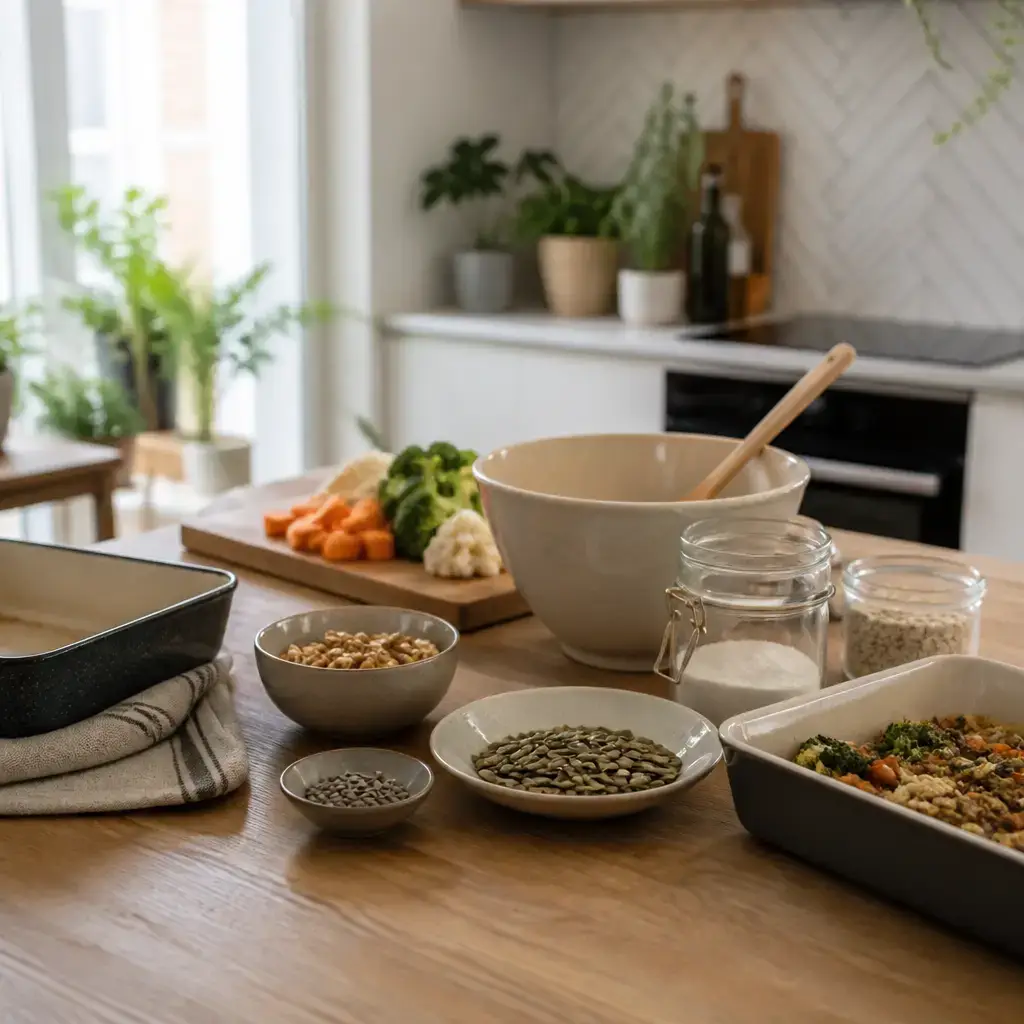
Bevor wir mit dem Kochen anfangen, sollten wir die Zutaten und mögliche Ersatzprodukte prüfen.
beh-FOHR veer mit daym KOH-khen AHN-fahng-en, SHULL-ten veer dee TSOO-tah-ten oont MURR-glikh-uh ehr-ZAHTS-proh-DOOK-tuh PRU-fen. Before we start cooking, let's check the ingredients and any substitutions.Das Rezept sieht Walnüsse vor, und ein Gast hat eine Nussallergie.
dahs reh-TSEPT zeet VAHL-nuess-uh fohr, oont ine gahst haht EYE-nuh NOOSS-ah-ler-GEE. The recipe calls for walnuts, and one guest has a nut allergy.Dann sollten wir die Walnüsse vollständig weglassen.
dahn SHULL-ten veer dee VAHL-nuess-uh FOHL-shten-dikh VEG-lahs-en. Then we should leave the walnuts out completely.Geröstete Samen würden dem Gericht trotzdem etwas Biss geben.
geh-ROESH-tuh ZAH-men VUR-den daym geh-RIKHT TROHTS-daym EHT-vahs biss GAY-ben. Toasted seeds would still give the dish some crunch.Lass uns stattdessen Samen verwenden und den Hinweis auf die Allergie beim Kochen sichtbar lassen.
lahss oonss shtaht-DESS-en ZAH-men fehr-VEN-den oont dayn HIN-vise owf dee ah-ler-GEE beim KOH-khen ZIKHT-bahr LAHS-en. Let's use seeds instead, and keep the allergy note visible while we cook.Da es sich um ein gebackenes Gericht handelt, sollten wir uns trotzdem genau an die Mengenangaben halten.
dah ess zikh oom ine geh-BAHK-eh-nes geh-RIKHT HAHN-delt, SHULL-ten veer oonss TROHTS-daym geh-NOW ahn dee MEN-gen-ahn-gah-ben HAHL-ten. Since this is a baked dish, we should still follow the measurements closely.Haben wir genug Milch, oder soll ich mehr kaufen?
HAH-ben veer geh-NOOK milkh, OH-der zohl ikh mehr KOW-fen? Do we have enough milk, or should I buy more?Wir haben genug, aber prüf vor der Verwendung das Datum.
veer HAH-ben geh-NOOK, AH-ber PRUEF fohr dehr fehr-VEN-doong dahs DAH-toom. We have enough, but check the date before using it.Die Zutaten wirken jetzt sicher und sind bereit.
dee TSOO-tah-ten VEER-ken yetst ZIKH-er oont zint beh-RITE. The ingredients look safe and ready now.Diese Kontrolle sollte uns helfen, Allergierisiken zu vermeiden und dafür zu sorgen, dass das Gericht richtig schmeckt.
DEE-zuh kohn-TROHL-uh SHOHL-tuh oonss HEL-fen, ah-ler-GEE-ree-ZEE-ken tsoo fehr-MY-den oont dah-FUER tsoo ZOR-gen, dahs dahs geh-RIKHT RIKH-tikh shmaykt. This check should help us avoid allergy risks and keep the dish tasting right.Sentence explanations
Bevor wir mit dem Kochen anfangen, sollten wir die Zutaten und mögliche Ersatzprodukte prüfen.
Before we start cooking, let's check the ingredients and any substitutions.
- Bevor
- before
- Kochen
- cooking
- anfangen
- start; begin
- sollten wir
- we should
- Zutaten
- ingredients
- mögliche
- possible
- Ersatzprodukte
- substitutions
- prüfen
- check
More detail
Bevor means “before” and introduces a subordinate clause for an event that is earlier than the main-clause event. Here, checking is recommended to happen before the speakers start cooking. In a German subordinate clause, the finite verb normally appears at the end. In this sentence, however, the clause contains the infinitive anfangen after the modal verb sollten; anfangen is the lexical verb at the clause end, while sollten is finite in the following main clause. Example: Bevor wir gehen, schließen wir die Tür. — “Before we leave, we close the door.” Kochen is the capitalized nominalized infinitive of kochen, “to cook.” With mit, it appears in the dative phrase mit dem Kochen, meaning “with cooking” or, more naturally here, “cooking.” Nominalized infinitives are written with a capital letter. Example: Beim Kochen höre ich Musik. — “While cooking, I listen to music.” anfangen means “to start” or “to begin.” It is a separable verb: in a simple finite main clause, Wir fangen an means “We start.” Here it remains an infinitive after sollten, and it stands at the end of the subordinate clause: wir mit dem Kochen anfangen. sollten wir expresses a recommendation: “we should.” sollten is the form of sollen used here for this suggestion, and wir means “we.” Example: Wir sollten jetzt beginnen. — “We should begin now.” Zutaten means “ingredients.” It is the plural of Zutat, “ingredient,” and is one of the coordinated objects of prüfen here. mögliche means “possible” in this sentence. It is the adjective möglich, with the ending -e used before the plural noun Ersatzprodukte in this accusative object phrase. The adjective carries this visible ending; Ersatzprodukte itself is not changed here to show the accusative. Ersatzprodukte means “substitute products” and, in this context, “substitutions.” It is the plural of Ersatzprodukt, a compound of Ersatz (“replacement”) and Produkt (“product”). It refers to products that could replace ingredients. prüfen means “to check” or “to examine.” It is the infinitive governed by sollten; wir is the subject understood as doing the checking. Example: Wir prüfen die Liste. — “We check the list.” Together, Bevor wir mit dem Kochen anfangen means “Before we start cooking.” sollten wir adds the recommendation “we should,” and die Zutaten und mögliche Ersatzprodukte prüfen means “check the ingredients and possible substitutions.” The complete meaning is: “Before we start cooking, we should check the ingredients and any substitutions.”
Das Rezept sieht Walnüsse vor, und ein Gast hat eine Nussallergie.
The recipe calls for walnuts, and one guest has a nut allergy.
- Rezept
- recipe
- sieht … vor
- calls for
- Walnüsse
- walnuts
- Gast
- guest
- hat
- has
- Nussallergie
- nut allergy
More detail
Rezept means “recipe” here. It is the singular noun das Rezept; its plural is die Rezepte. In this sentence, it is the subject of the first clause, the thing that specifies the required ingredients. sieht ... vor is the separable-verb construction from vorsehen. In this use, vorsehen means “to call for” or “to provide for,” not simply “to see.” In a main clause, the conjugated part is in the usual second position and vor moves to the end: Das Rezept sieht Walnüsse vor. Example: Der Plan sieht eine Pause vor. — “The plan calls for a break.” Walnüsse means “walnuts” here. It is the plural of die Walnuss; the singular is eine Walnuss. The plural form is also used for accusative plural, which is required because the walnuts are what the recipe calls for. Example: Wir kaufen Walnüsse. — “We are buying walnuts.” Gast means “guest.” The form here is singular masculine: ein Gast; its plural is Gäste. In ein Gast hat ..., it is the subject of the second clause. Example: Ein Gast wartet. — “A guest is waiting.” hat is the third-person singular present form of haben (“to have”): ich habe, du hast, er/sie/es hat. Here it states that the guest has an allergy. Example: Sie hat Zeit. — “She has time.” Nussallergie means “nut allergy.” It is a feminine compound noun: die Nussallergie, with the plural Nussallergien. The article eine marks it as an indefinite singular noun phrase; it does not by itself state a numerical count. Example: Er hat eine Milchallergie. — “He has a milk allergy.” The first clause, Das Rezept sieht Walnüsse vor, says that the recipe calls for walnuts. The conjunction und links it to the second clause, ein Gast hat eine Nussallergie, which says that one guest has a nut allergy. Together: “The recipe calls for walnuts, and one guest has a nut allergy.”
Dann sollten wir die Walnüsse vollständig weglassen.
Then we should leave the walnuts out completely.
- Dann
- then
- sollten wir
- we should
- die … Walnüsse
- the walnuts
- vollständig
- completely
- weglassen
- leave out
More detail
Dann means “then” here: it links this suggestion to what has just been established. It can also introduce a consequence in other sentences, for example: Dann gehen wir nach Hause. — “Then we’ll go home.” sollten wir expresses “we should.” sollten is the form of the modal verb sollen used here for a recommendation; wir is the first-person plural subject, “we.” Compare wir sollen — “we are supposed to / we should” — with wir sollten — “we should,” often presenting advice more gently or tentatively. In a German main clause, the finite modal verb is in second position, while the other verb goes to the end. die Walnüsse means “the walnuts.” Walnüsse is the plural of die Walnuss; the umlaut and ending belong to the noun, not to the article. The definite article die is the plural form here and does not itself state a numerical count. In this sentence, the noun phrase is the object of weglassen, so it is accusative; for this plural, die looks the same in the nominative and accusative. vollständig means “completely” and specifies the extent of leaving something out. It is related in meaning to ganz in some contexts, but vollständig emphasizes that nothing of the relevant item is retained. Example: Bitte füllen Sie das Formular vollständig aus. — “Please fill out the form completely.” weglassen means “to leave out” or “to omit.” It is a separable verb: the base form is written together, but in a present-tense main clause its parts separate, as in Wir lassen die Walnüsse weg. — “We leave the walnuts out.” With the modal sollten, the infinitive remains together at the end: Wir sollten die Walnüsse weglassen. Together, Dann sets the suggestion as the next step, sollten wir makes it a recommendation by the speaker and the other participant(s), die Walnüsse identifies what is affected, and vollständig weglassen says to omit them entirely. The whole utterance therefore means: “Then we should leave the walnuts out completely.” In the supplied situation, this is a practical recommendation because a guest has a nut allergy.
Geröstete Samen würden dem Gericht trotzdem etwas Biss geben.
Toasted seeds would still give the dish some crunch.
- Geröstete
- toasted
- Samen
- seeds
- würden
- would
- dem Gericht
- the dish
- trotzdem
- still
- etwas
- some
- Biss
- crunch
- geben
- give
More detail
Geröstete means “toasted” here and describes Samen. It is the adjective form of geröstet, related to the verb rösten (“to toast/roast”). In Geröstete Samen, the adjective has the ending -e because it modifies a plural noun with no determiner: geröstete Samen. Example: Geröstete Nüsse schmecken gut. — “Toasted nuts taste good.” Samen means “seeds.” It is the plural of der Samen; the same form can also be used for the singular in some contexts, so the plural meaning here is supported by the wording and translation. Example: Die Samen sind trocken. — “The seeds are dry.” würden is the third-person plural form of werden in the subjunctive II, used here with geben to express “would give.” The construction würden ... geben is a reusable way to describe a hypothetical or conditional result. Example: Die Kräuter würden mehr Geschmack geben. — “The herbs would give more flavor.” dem Gericht means “the dish.” Gericht is a neuter noun, das Gericht; here dem marks dative singular. The dative marks the recipient or entity to which something is given: etwas dem Gericht geben means “give something to the dish.” Example: Ich gebe der Suppe Salz. — “I add salt to the soup.” trotzdem means “still” or “nevertheless.” It marks a result that holds despite an earlier condition or consideration. Here it says that the seeds would provide crunch even so, following the decision to leave out the walnuts. etwas means “some” in this sentence. It indicates an unspecified amount, not a stated numerical quantity. It can also mean “something” in other contexts, but its meaning here is the unspecified amount of Biss. Biss literally refers to a bite or the quality of being firm when bitten. In this food context, it means “crunch” or “bite,” the texture that the seeds add. Example: Die Croutons geben dem Salat Biss. — “The croutons give the salad some crunch.” geben is the base form of the verb meaning “to give.” With würden, it remains an infinitive and appears at the end of this clause: würden ... geben. Its object is etwas Biss, while dem Gericht identifies what receives that added quality. Together, Geröstete Samen is the subject, würden ... geben expresses the hypothetical result, dem Gericht identifies the dish receiving the addition, and etwas Biss identifies what is added. trotzdem marks the result as holding nevertheless. The whole utterance therefore means: “Toasted seeds would still give the dish some crunch.”
Lass uns stattdessen Samen verwenden und den Hinweis auf die Allergie beim Kochen sichtbar lassen.
Let's use seeds instead, and keep the allergy note visible while we cook.
- Lass uns
- let's
- stattdessen
- instead
- Samen
- seeds
- verwenden
- use
- Hinweis
- note
- Allergie
- allergy
- beim Kochen
- while cooking
- sichtbar
- visible
- lassen
- keep; leave
More detail
Lass uns is the fixed German pattern for proposing a joint action: “let’s …”. Lass is the informal singular imperative of lassen, addressed to one person; uns means “us” and includes the speaker. The following verbs stay in the infinitive. Example: Lass uns anfangen. — “Let’s start.” stattdessen is an adverb meaning “instead” or “instead of that”. It contrasts the proposed choice with an earlier or understood alternative without changing the form of the nearby noun. Samen means “seeds” here. It is the plural of der Same; the plural form is die Samen. In this sentence it is the object of verwenden, so it has no visible plural ending beyond the form itself. Example: Die Samen sind geröstet. — “The seeds are toasted.” verwenden is the infinitive “to use”. With the proposal pattern, Lass uns Samen verwenden means “Let’s use seeds”. verwenden is a somewhat neutral or purposeful word for using something; benutzen is a common nearby alternative, especially for tools or objects. Hinweis means “note” or “notice”. It is masculine: der Hinweis; here den Hinweis is accusative because it is the object being kept visible. Its plural is die Hinweise. Example: Der Hinweis ist wichtig. — “The note is important.” Allergie means “allergy”. The phrase ein Hinweis auf ... uses auf with the accusative when it identifies what the note refers to: auf die Allergie, “about the allergy”. die Allergie is feminine; in this phrase the feminine article looks the same in nominative and accusative. beim Kochen means “while cooking” or “during cooking”. beim is the contraction of bei dem; Kochen is the capitalized noun made from the verb kochen, “to cook”. This phrase supplies the time or activity setting for keeping the note visible. Example: Beim Kochen lese ich das Rezept. — “While cooking, I read the recipe.” sichtbar means “visible”. It is an uninflected adjective here, used after lassen to describe the state in which the object remains. Example: Bitte lass die Tür sichtbar. — “Please leave the door visible.” lassen means “let; leave; keep” in this construction. The pattern etwas sichtbar lassen means “keep or leave something visible”: etwas is the object, and sichtbar describes its resulting state. Here, den Hinweis is the object and sichtbar is the state. Because this lassen is coordinated with verwenden after Lass uns, it appears as an infinitive. Example: Wir lassen das Schild sichtbar. — “We leave the sign visible.” Together, Lass uns ... verwenden proposes a shared action: using seeds instead. The coordinated second action is den Hinweis auf die Allergie sichtbar lassen: keep the note about the allergy visible while cooking. Thus the whole utterance means, “Let’s use seeds instead, and keep the allergy note visible while we cook.”
Da es sich um ein gebackenes Gericht handelt, sollten wir uns trotzdem genau an die Mengenangaben halten.
Since this is a baked dish, we should still follow the measurements closely.
- Da
- since
- es sich um … handelt
- it is a matter of
- gebackenes
- baked
- Gericht
- dish
- sollten wir
- we should
- uns … an die Mengenangaben halten
- stick to the measurements
- trotzdem
- still
- genau
- closely
- Mengenangaben
- measurements
More detail
Da introduces a subordinate clause giving a reason: “since/because.” The finite verb comes at the end of this clause, as in Da ... handelt. Example: Da es regnet, bleiben wir hier. — “Since it is raining, we are staying here.” es sich um ... handelt is the impersonal construction es handelt sich um + accusative, meaning “it is a matter of” or, in this sentence, “this is.” Here, it identifies the subject matter as a baked dish. handelt is the present-tense third-person singular form of handeln, and sich belongs to the construction. Example: Es handelt sich um einen Fehler. — “It is a mistake.” gebackenes comes from backen (“to bake”). gebacken is the past participle, used here adjectivally with the meaning “baked.” It has the ending -es because it modifies the neuter noun Gericht in ein gebackenes Gericht. Gericht means “dish” here. It is a neuter noun: das Gericht; its plural is die Gerichte. In other contexts, the same noun can mean “court,” but the fixed translation establishes the food meaning here. sollten wir expresses a recommendation: “we should.” sollten is the first-person plural form of sollen; in this context it is the Konjunktiv II form used for advice. wir is the first-person plural subject. Example: Wir sollten früher anfangen. — “We should start earlier.” The discontinuous pattern sich an etwas halten means “to stick to” or “to follow something.” In this sentence, the first-person plural reflexive form is uns, and the rest of the pattern is an die Mengenangaben halten: wir halten uns an .... The reflexive pronoun agrees with the subject: ich halte mich ..., wir halten uns .... Example: Wir halten uns an den Plan. — “We stick to the plan.” trotzdem means “still” or “nevertheless.” Here it marks that following the measurements remains advisable while the reason in the subordinate clause is being given. genau means “closely” or “precisely” here and describes how the measurements are followed. Example: Lies die Anleitung genau. — “Read the instructions carefully.” Mengenangaben is the plural of Mengenangabe, meaning “measurements” or “quantity specifications.” Here it refers to the recipe’s quantity specifications. Example: Bitte beachte die Mengenangaben. — “Please observe the measurements.” Together, Da es sich um ein gebackenes Gericht handelt means “Since this is a baked dish.” The main clause sollten wir uns trotzdem genau an die Mengenangaben halten means “we should still follow the measurements closely.” The complete utterance is therefore: “Since this is a baked dish, we should still follow the measurements closely.”
Haben wir genug Milch, oder soll ich mehr kaufen?
Do we have enough milk, or should I buy more?
- Haben
- have
- genug
- enough
- Milch
- milk
- soll ich
- should I
- mehr
- more
- kaufen
- buy
More detail
Haben is the present-tense form of haben for wir (“we”): wir haben = “we have.” In Haben wir ...?, the verb comes before the subject to form a yes/no question. Example: Haben wir Wasser? — “Do we have water?” genug means “enough” and does not change its form here. It states that the available amount meets the relevant need. Example: Wir haben genug. — “We have enough.” Milch means “milk.” It is a mass noun, so this sentence refers to an amount of milk rather than counting individual items. The noun is feminine: die Milch; the article is omitted here after genug. soll ich combines the modal verb sollen with the subject ich (“I”). soll is the present-tense first-person singular form. In this question, it asks whether buying more is the appropriate action: “should I ...?” The infinitive belonging to the modal comes later: Soll ich warten? — “Should I wait?” mehr means “more” and refers here to a greater amount of milk. It is an amount word and does not change to agree with Milch. Example: Ich brauche mehr Wasser. — “I need more water.” kaufen is the infinitive “to buy.” After a modal verb such as sollen, the infinitive normally goes to the end of the clause: Soll ich mehr kaufen? — “Should I buy more?” The first clause, Haben wir genug Milch, asks whether the available milk is sufficient. oder connects it to an alternative question. The second clause, soll ich mehr kaufen, asks whether the speaker should buy a greater amount. Together, Haben wir genug Milch, oder soll ich mehr kaufen? means “Do we have enough milk, or should I buy more?”
Wir haben genug, aber prüf vor der Verwendung das Datum.
We have enough, but check the date before using it.
- Wir
- we
- haben
- have
- genug
- enough
- aber
- but
- prüf
- check
- vor
- before
- Verwendung
- use
- Datum
- date
More detail
Wir means “we.” It is the first-person plural personal pronoun. The form is the same whether the group is masculine, feminine, or mixed; the verb carries the plural agreement here. haben means “have” here. Its base form is haben; wir haben is the present-tense first-person plural form. Compare ich habe (“I have”) and sie haben (“they have” or formal “you have,” depending on context). Example: Wir haben Zeit. — “We have time.” genug means “enough.” It indicates a sufficient amount or degree without stating an exact quantity. It can stand on its own, as here, or come before a noun: genug Wasser — “enough water.” The earlier question confirms the same general idea of having a sufficient supply, but this sentence does not specify what the supply is. aber means “but.” It links the statement about having enough with a contrasting instruction. It does not itself express the reason for checking. prüf means “check.” It is the informal singular imperative of prüfen (“to check, examine”), addressed to one person using du. The imperative addresses the listener directly, so the subject is normally omitted. Compare the formal imperative Prüfen Sie ... and the plural informal form Prüft .... Example: Prüf die Liste. — “Check the list.” vor means “before” in this time expression. With a following noun phrase referring to an event or activity, temporal vor takes the dative: vor der Verwendung means “before the use” or, naturally here, “before using it.” This is distinct from nach (“after”). Verwendung means “use” or “usage” here, referring to the act of using something. It is a feminine noun, so after vor it appears as der Verwendung, the dative form of the feminine article. Its related verb is verwenden (“to use”), but Verwendung itself is the noun in the sentence. Example: Vor der Verwendung schütteln. — “Shake before use.” Datum means “date.” It is a neuter noun: das Datum in the nominative or accusative singular. Here das Datum is the direct object of prüf, the thing to be checked. Its plural is Daten (“dates”); this plural should not be confused with the separate meaning “data,” which is also commonly written Daten. Together, Wir haben genug says “We have enough.” aber introduces a contrasting instruction, and prüf vor der Verwendung das Datum means “check the date before using it.” The complete utterance therefore means: “We have enough, but check the date before using it.”
Die Zutaten wirken jetzt sicher und sind bereit.
The ingredients look safe and ready now.
- Zutaten
- ingredients
- wirken
- seem; look
- jetzt
- now
- sicher
- safe
- bereit
- ready
More detail
Zutaten means ingredients here. Its base form is die Zutat (one ingredient); Zutaten is the plural. German uses the plural form when referring to more than one ingredient, as in the source sentence. Example: Die Zutaten sind frisch. — “The ingredients are fresh.” wirken means “to seem” or “to look” here: it describes an impression based on how something appears, not a proven fact. The form wirken is the present-tense form for sie when the subject is plural. Compare Die Zutat wirkt sicher. — “The ingredient looks safe.” The singular form is wirkt, while the plural form in the source is wirken. jetzt means “now” and places the assessment in the present situation. It modifies the statement about how the ingredients appear, so the sentence says that they look safe and ready at this point. sicher means “safe” in this sentence. It is a predicate adjective after wirken: etwas wirkt sicher means “something looks safe.” It does not itself guarantee that the ingredients are safe; it reports their apparent condition. Example: Der Behälter wirkt sicher. — “The container looks safe.” bereit means “ready.” In the source, it is paired with sind: sie sind bereit — “they are ready.” sind is the present-tense form of sein used with a plural subject such as die Zutaten; bereit describes the subject and does not take a plural ending here. Example: Die Zutaten sind bereit. — “The ingredients are ready.” The sentence begins with the plural subject Die Zutaten. wirken ... sicher says that they appear safe, and jetzt locates that impression in the present. The coordinated clause und sind bereit adds a second predicate: the same ingredients are ready. Together, Die Zutaten wirken jetzt sicher und sind bereit. means “The ingredients look safe and ready now.”
Diese Kontrolle sollte uns helfen, Allergierisiken zu vermeiden und dafür zu sorgen, dass das Gericht richtig schmeckt.
This check should help us avoid allergy risks and keep the dish tasting right.
- Diese
- this
- Kontrolle
- check
- sollte
- should
- uns
- us
- helfen
- help
- Allergierisiken
- allergy risks
- vermeiden
- avoid
- dafür zu sorgen
- make sure
- Gericht
- dish
- richtig
- properly
- schmeckt
- tastes
More detail
Diese means “this” here and is the feminine singular form of the demonstrative determiner, agreeing with Kontrolle (die Kontrolle). German demonstratives change for gender, number, and case; this form is not simply a marker of proximity in every context. Kontrolle means “check” here: an inspection or checking procedure. Its plural is Kontrollen. The noun is feminine: die Kontrolle. sollte is the third-person singular form of sollen used here with the singular subject Diese Kontrolle. In this sentence it expresses an expected or intended result: “should help,” rather than necessarily locating the action in the past. Compare soll (“is supposed to/should”) with sollte (“should/was expected to,” depending on context). uns is the first-person plural pronoun meaning “us.” It is the dative form of wir (wir as subject, uns as dative object). Here helfen takes the people being helped in the dative: the check helps us. helfen means “to help.” Its base form is the infinitive helfen; present forms include ich helfe, du hilfst, and er/sie/es hilft. German commonly uses jemandem helfen, etwas zu tun for “help someone do something”: Die Kontrolle hilft uns, Fehler zu vermeiden. — “The check helps us avoid mistakes.” Allergierisiken means “allergy risks.” It is the plural of das Allergierisiko; the compound combines Allergie (“allergy”) and Risiko (“risk”). The plural ending is visible on the second component: Allergierisiko → Allergierisiken. vermeiden means “to avoid.” It is an infinitive here, following zu: zu vermeiden. Its present-tense forms include ich vermeide, du vermeidest, and er/sie/es vermeidet; the stem vowel remains ei. Fehler vermeiden means “avoid mistakes.” dafür zu sorgen is a reusable expression meaning “to make sure” or “to ensure.” Its lexical verb is sorgen, and zu sorgen is the infinitive with zu; dafür points to the result being ensured. In this sentence it introduces the goal that the dish should taste right. For example, Sie sorgt dafür, dass alles bereit ist. — “She makes sure that everything is ready.” Gericht means “dish” here, referring to prepared food. It is neuter: das Gericht; its plural is die Gerichte. The word can have other meanings in other contexts, but the food meaning is fixed by the translation here. richtig means “right” or “properly” here. It describes how the dish tastes, rather than modifying the noun Gericht. In other contexts it can be an adjective meaning “correct,” as in die richtige Antwort (“the correct answer”); here it functions adverbially. schmeckt means “tastes.” It is the third-person singular present form of schmecken, agreeing with das Gericht: Das Gericht schmeckt. — “The dish tastes.” In the clause introduced by dass, the finite verb appears at the end: dass das Gericht richtig schmeckt (“that the dish tastes right”). Together, Diese Kontrolle sollte uns helfen gives “This check should help us.” The two infinitive goals are coordinated: Allergierisiken zu vermeiden (“to avoid allergy risks”) and dafür zu sorgen, dass das Gericht richtig schmeckt (“to make sure that the dish tastes right”). The complete utterance therefore means: “This check should help us avoid allergy risks and keep the dish tasting right.”
Grammar Points
Bevor + Nebensatz: Das Verb steht am Ende.
Bevor wir kochen, prüfen wir das Rezept.
beh-FOHR veer KOH-khen, PRUE-fen veer dahs reh-TSEPT.Before we cook, we check the recipe.
Nach „bevor“ steht ein Nebensatz; das konjugierte Verb steht am Ende.
sich an + Akkusativ halten
Wir halten uns an die Mengenangaben.
veer HAHL-ten oonss ahn dee MEN-gen-ahn-gah-ben.We follow the measurements closely.
„sich an etwas halten“ bedeutet, eine Regel oder Vorgabe genau zu befolgen.
German Vocabulary
Quiz
Spelling
Tap the letters to spell the word.
walnuts
Show Answer
Walnüssebefore
Show Answer
Bevorguest
Show Answer
Gastingredients