10 minutes free every day
Continue audio lessons in the app
Word explanations appear automatically in sync with the audio.
No login required · synced translations · playback with the screen locked
Choose your learning language and open this lesson in the app.

About This Lesson
Use Checking an Apartment Before a Long Trip to practice German conversation, pronunciation, vocabulary, grammar, and quizzes.
Dialogue
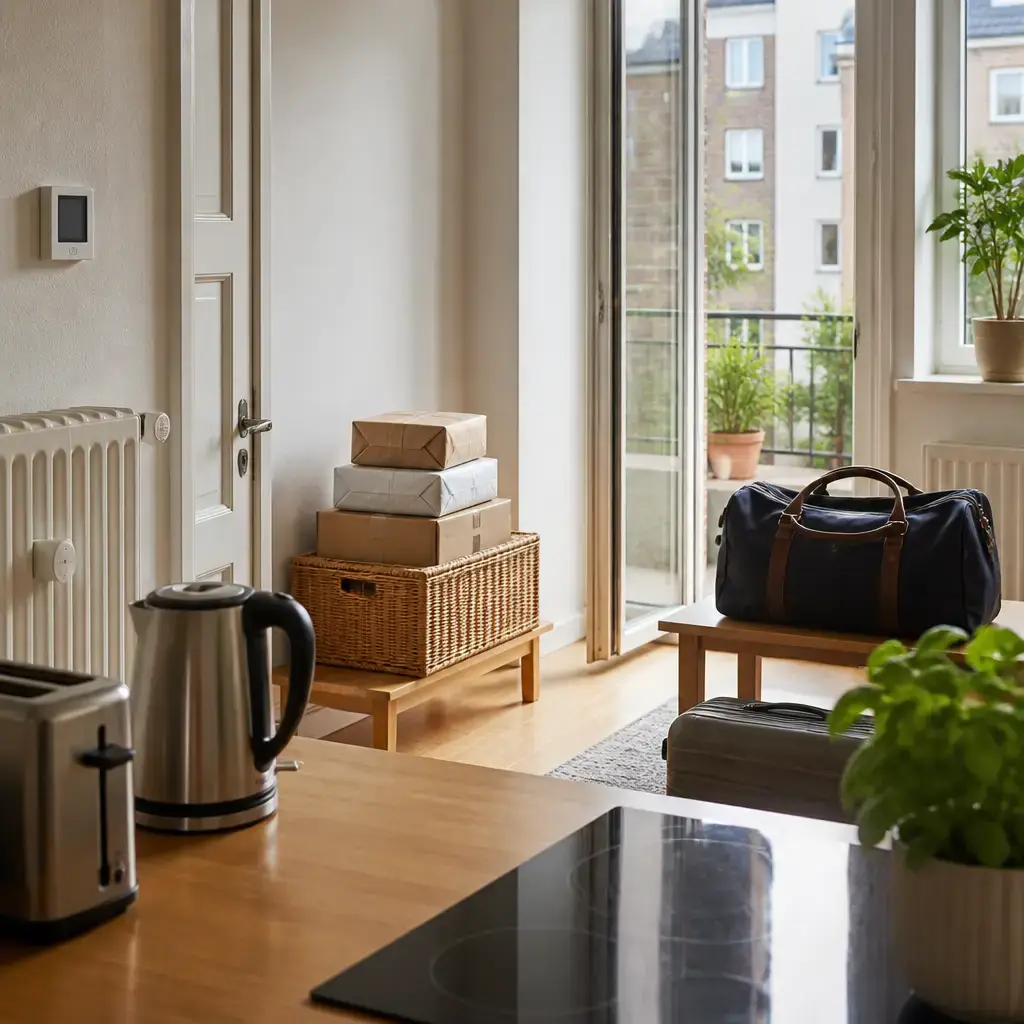
Wir sind mehrere Tage weg, also lass uns die Wohnung noch einmal überprüfen.
Veer zint MAY-rer-uh TAH-guh vek, AHL-zoh lahss oons dee VOH-noong nokh EYN-mahl UE-ber-PROO-fen. We'll be away for several days, so let's double-check the apartment.Ich habe die kleinen Geräte ausgesteckt und den Herd ausgeschaltet.
Ikh HAH-buh dee KLY-nen guh-RAY-tuh OWS-guh-SHTEKT oont dehn HAIRT OWS-guh-SHAHL-tet. I unplugged the small appliances and turned off the stove.Sind die Balkontür und die Schlafzimmerfenster gut gesichert?
Zint dee bal-KOHN-tewr oont dee SHLAHF-tsim-er-FEN-stair goot guh-ZIKH-ert? Are the balcony door and bedroom windows secure?Die Balkontür ist abgeschlossen, und ich überprüfe jetzt die Schlafzimmerfenster.
Dee bal-KOHN-tewr ist AP-guh-SHLOSS-en, oont ikh UE-ber-PROO-fuh yetst dee SHLAHF-tsim-er-FEN-stair. The balcony door is locked, and I will check the bedroom windows now.Sollen wir den Thermostat niedriger einstellen, während wir weg sind?
ZOL-en veer den tair-moh-STAHT NEE-dree-ger EYN-shtel-en, VAY-rent veer vek zint? Should we lower the thermostat while we are gone?Stell ihn niedriger ein, aber nicht so niedrig, dass die Wohnung zu kalt wird.
SHTEL een NEE-dree-ger EYN, AH-ber nikht zoh NEE-dreekh, dahss dee VOH-noong tsoo kahlt veert. Set it lower, but not so low that the apartment gets too cold.Ich habe auch unseren Nachbarn gebeten, Pakete anzunehmen.
Ikh HAH-buh OWKH OON-zuh-ren NAKH-barn guh-BAY-ten, pah-KAY-tuh an-TSOO-nay-men. I also asked our neighbor to collect any packages.Das lässt die Wohnung bewohnt aussehen, während wir weg sind.
Dahs lest dee VOH-noong beh-VOHNT OWS-zay-en, VAY-rent veer vek zint. That helps the place look occupied while we are away.Jetzt fühle ich mich wohler dabei, die Wohnung zu verlassen.
Yetst FUE-luh ikh mikh VOHL-er dah-BYE, dee VOH-noong tsoo fair-LASS-en. Now I feel more relaxed about leaving.Das Durchgehen dieser Checkliste hat etwas Zeit gekostet, aber es hat sich gelohnt.
Dahs DOORKH-gay-en DEE-zer CHEK-lis-tuh haht ET-vahs tsite guh-KOSS-tet, AH-ber es haht zikh guh-LOHNT. This checklist took a little time, but it was worth it.Sentence explanations
Wir sind mehrere Tage weg, also lass uns die Wohnung noch einmal überprüfen.
We'll be away for several days, so let's double-check the apartment.
- Wir sind
- we are
- mehrere
- several
- Tage
- days
- weg
- away
- also
- so
- lass uns
- let’s
- Wohnung
- apartment
- noch einmal
- again
- überprüfen
- check
More detail
Wir sind means “we are.” sind is the present-tense first-person plural form of sein (“to be”): ich bin, du bist, wir sind. Here, sein combines with weg to describe the group’s being away. In context, this present-tense form refers to a future period of absence, as in the fixed translation “We’ll be away.” mehrere means “several” and indicates an unspecified number greater than one. It modifies the plural noun Tage; compare ein Tag (“one day”) with mehrere Tage (“several days”). Tage is the plural of Tag (“day”). German commonly forms this plural with the ending -e: Tag → Tage. In this sentence, it occurs in the time expression mehrere Tage. weg means “away” here. With sein, the pattern weg sein means “to be away.” Example: Sie ist heute weg. — “She is away today.” also means “so” or “therefore” and links the situation to the proposed action that follows. It is not part of the meaning of weg. lass uns is the reusable German pattern for “let’s …”. lass is the informal singular imperative of lassen (“to let/allow”), and uns is the first-person plural object pronoun (“us”). Example: Lass uns anfangen. — “Let’s start.” Wohnung means “apartment” or “flat.” Its full noun phrase here is die Wohnung; die is the article form used with this feminine singular noun in the accusative. Because feminine singular die has the same form in the nominative and accusative, the article’s form alone does not distinguish those cases. The noun’s gender is a grammatical property of Wohnung, not a statement about the apartment itself. noch einmal means “once again” or, in this context, “again.” Together, these words form a common expression for repeating an action. Example: Bitte lies das noch einmal. — “Please read that again.” überprüfen means “to check” or “to verify.” It is an infinitive used after the lass uns construction: Lass uns die Wohnung überprüfen. — “Let’s check the apartment.” A present-tense form is ich überprüfe — “I check.” Together, Wir sind mehrere Tage weg says that the speakers will be away for several days. also introduces the consequence, and lass uns die Wohnung noch einmal überprüfen proposes checking the apartment again. The complete meaning is: “We’ll be away for several days, so let’s double-check the apartment.”
Ich habe die kleinen Geräte ausgesteckt und den Herd ausgeschaltet.
I unplugged the small appliances and turned off the stove.
- Ich habe
- I have
- kleinen
- small
- Geräte
- appliances
- ausgesteckt
- unplugged
- Herd
- stove
- ausgeschaltet
- turned off
More detail
Ich habe identifies the speaker as the subject and uses haben as a present-tense auxiliary: ich habe = “I have.” Here it does not express possession; together with a past participle, it forms the perfect tense. For example, Ich habe gearbeitet. means “I worked” or “I have worked.” kleinen means “small” here. Its base form is klein; the -en ending appears because the adjective describes plural Geräte after the definite article die in this accusative phrase. The ending belongs to the adjective, not to the noun. For comparison: klein = “small,” kleiner = “smaller,” am kleinsten = “smallest.” Geräte is the plural of Gerät, meaning “devices” or, in this household context, “appliances.” The form Geräte is plural; the sentence does not specify how many appliances there were. Example: Die Geräte sind neu. — “The devices are new.” ausgesteckt is the past participle of the separable verb ausstecken, “to unplug.” In the perfect tense, Ich habe die Geräte ausgesteckt means “I unplugged the appliances.” The prefix aus- is separated in some finite forms, for example Ich stecke das Gerät aus. — “I unplug the device.” Herd means “stove.” In this sentence it is the object of the second action; the definite masculine accusative form is den Herd. Example: Der Herd ist sauber. — “The stove is clean.” ausgeschaltet is the past participle of the separable verb ausschalten, “to switch off” or “to turn off.” Its perfect-tense use is parallel to ausgesteckt: Ich habe den Herd ausgeschaltet. — “I turned off the stove.” In a finite present-tense sentence, the prefix separates: Ich schalte den Herd aus. — “I turn off the stove.” The two actions are joined by und, which coordinates them. Both actions use haben plus a past participle in the perfect tense. Thus the complete utterance means: “I unplugged the small appliances and turned off the stove.”
Sind die Balkontür und die Schlafzimmerfenster gut gesichert?
Are the balcony door and bedroom windows secure?
- Sind
- are
- Balkontür
- balcony door
- und
- and
- Schlafzimmerfenster
- bedroom windows
- gut
- well
- gesichert
- secure
More detail
Sind is the present-tense form of sein (“to be”) for a plural subject. In a yes/no question, the finite verb comes first: Sind ...? means “Are ...?” The plural is appropriate because the subject coordinates two nouns with und. Compare Ist die Tür gesichert? (“Is the door secure?”) with Sind die Tür und die Fenster gesichert? (“Are the door and the windows secure?”). Balkontür is a compound noun meaning “balcony door”: Balkon + Tür. Its accompanying form die shows that this noun is feminine singular in this sentence. German compounds are written as one word, and the final element determines the compound's grammatical gender; Tür is feminine. The sentence asks about this door, without adding a separate number claim beyond the singular form of the noun. und joins the two noun phrases. Here it coordinates die Balkontür with die Schlafzimmerfenster, so Sind agrees with the combined plural subject rather than with only the first noun. Schlafzimmerfenster is a compound noun meaning “bedroom windows”: Schlafzimmer + Fenster. The form is plural here, as shown by the plural noun and its context-compatible translation “windows.” The article die can occur with both feminine singular and plural noun phrases, so the noun form supplies the relevant number distinction here. A useful singular/plural contrast is das Schlafzimmerfenster (“the bedroom window”) versus die Schlafzimmerfenster (“the bedroom windows”). gut means “well” in gut gesichert, strengthening the description of the security: the items are securely or properly secured. The same adjective can also describe a noun directly, as in eine gute Tür (“a good door”), but its role here is adverbial with the participial form gesichert. gesichert is the participle/adjectival form related to the verb sichern (“to secure”). With sein, it describes a resulting condition: the door and windows are secure or have been secured. The form does not itself specify whether a person secured them or exactly how; it states their condition. Compare Die Fenster sind gesichert. (“The windows are secure.”) with Ich sichere die Fenster. (“I secure the windows.”) Together, Sind + the coordinated subject die Balkontür und die Schlafzimmerfenster + gut gesichert forms a yes/no question: “Are the balcony door and bedroom windows secure?” The question treats the balcony door and the bedroom windows together and asks about their current secure condition.
Die Balkontür ist abgeschlossen, und ich überprüfe jetzt die Schlafzimmerfenster.
The balcony door is locked, and I will check the bedroom windows now.
- Balkontür
- balcony door
- abgeschlossen
- locked
- überprüfe
- check
- Schlafzimmerfenster
- bedroom window
More detail
Balkontür means “balcony door” here. It is a compound noun: Balkon + Tür; the final element determines the noun’s gender, so Tür makes die Balkontür feminine. In this sentence, die Balkontür is the singular subject. A useful plural is die Balkontüren (“the balcony doors”). abgeschlossen describes the door’s state as “locked.” It is the form of abschließen used here as a past participle/adjectival complement after ist (sein + participle/adjective). The sentence therefore states the present condition; it does not need to specify when the locking happened. überprüfe is the first-person singular present form of überprüfen, “to check” or “to inspect”: ich überprüfe = “I check.” With jetzt, German present tense can describe an action that is about to happen, matching “I will check … now” in the fixed translation. Example: Ich überprüfe die Liste. — “I am checking the list.” Schlafzimmerfenster means “bedroom window.” It is a compound of Schlafzimmer (“bedroom”) and Fenster (“window”). Because the final element Fenster is neuter, the singular is das Schlafzimmerfenster; its plural is also Schlafzimmerfenster. Here, die Schlafzimmerfenster is accusative plural, the object of überprüfe, so the fixed translation gives “the bedroom windows.” The sentence combines Die Balkontür ist abgeschlossen (“The balcony door is locked”) with und ich überprüfe jetzt die Schlafzimmerfenster (“and I will check the bedroom windows now”). The first clause has a singular subject and a state description. In the second, ich is the subject, überprüfe is present tense used for an immediate action, and die Schlafzimmerfenster is the plural object. Together, the utterance says that the balcony door is locked and that the speaker will check the bedroom windows now.
Sollen wir den Thermostat niedriger einstellen, während wir weg sind?
Should we lower the thermostat while we are gone?
- Sollen wir
- Should we
- Thermostat
- thermostat
- niedriger
- lower
- einstellen
- set; adjust
- während
- while
- weg sind
- are away
More detail
Sollen wir combines sollen (“to be supposed to / should”) with wir (“we”). In this question, sollen wir ...? makes a suggestion about a joint action: “Should we ...?” The modal verb is finite here, while the other verb stays in the infinitive and normally goes to the end of the main clause. Thermostat is the masculine noun der Thermostat, meaning “thermostat.” Here it is the direct object, so the masculine accusative form is den Thermostat. A useful plural is die Thermostate. niedriger is the comparative form of niedrig (“low”): niedrig → niedriger (“lower”) → am niedrigsten (“lowest”). It describes the intended lower setting; it is not the noun’s inflection. Example: Die Temperatur ist niedriger. — “The temperature is lower.” einstellen is a separable verb, ein|stellen, meaning “to set” or “to adjust” something. With a modal verb it remains an infinitive: Sollen wir den Thermostat niedriger einstellen? The prefix is not separated in this infinitive form. Example: Ich stelle die Heizung ein. — “I set the heating.” während introduces a time clause meaning “while.” In a clause introduced by während, the finite verb normally comes at the end. weg sind consists of weg (“away/gone”) and sind, the first-person plural present form of sein (“to be”). In während wir weg sind, wir is the subject and sind is final because this is a subordinate clause. The phrase therefore means “while we are away.” Together, den Thermostat niedriger einstellen means “set the thermostat lower,” and während wir weg sind specifies when: “while we are away.” The complete utterance is: “Should we lower the thermostat while we are gone?”
Stell ihn niedriger ein, aber nicht so niedrig, dass die Wohnung zu kalt wird.
Set it lower, but not so low that the apartment gets too cold.
- Stell … ein
- set
- ihn
- it
- niedriger
- lower
- aber
- but
- nicht so niedrig
- not so low
- die Wohnung
- the apartment
- kalt
- cold
- wird
- gets
More detail
Stell ... ein is the split form of einstellen in the informal singular imperative: “set/adjust.” German separable verbs place the prefix at the end in this command. The reusable pattern is Stell [object] [setting] ein. Example: Stell die Heizung höher ein. — “Set the heating higher.” ihn is the accusative masculine singular pronoun, “it” here referring to the thermostat identified in the preceding context. The form ihn is used when a masculine noun is the direct object; it is not the subject form er. niedriger means “lower.” It is the comparative form of the adjective niedrig (“low”) and describes the requested setting. The basic chain is niedrig — “low,” niedriger — “lower,” am niedrigsten — “lowest.” Here it is used adverbially with the setting action. aber connects the adjustment with a restriction: “but.” nicht so niedrig means “not so low.” Together with the following dass-clause, so ... dass ... expresses a degree and its consequence: “so ... that ...” The complete pattern here is nicht so [adjective], dass ... — “not so [adjective] that ...” die Wohnung means “the apartment.” Wohnung is a feminine noun, so its definite article is die in the nominative here because it is the subject of the subordinate clause. Example: Die Wohnung ist klein. — “The apartment is small.” kalt means “cold.” It describes the apartment’s resulting state; it is not the word being compared in niedriger. wird is the present-tense third-person singular form of werden. With an adjective such as kalt, kalt werden means “to become/get cold.” In the dass-clause, the finite verb comes at the end: dass die Wohnung zu kalt wird — “that the apartment gets too cold.” zu kalt means “too cold,” with zu marking an excessive degree. The first part, Stell ihn niedriger ein, commands the listener to set the thermostat to a lower level. aber nicht so niedrig, dass die Wohnung zu kalt wird limits that command: the new setting must not be low enough to make the apartment get too cold. The complete meaning is therefore: “Set it lower, but not so low that the apartment gets too cold.”
Ich habe auch unseren Nachbarn gebeten, Pakete anzunehmen.
I also asked our neighbor to collect any packages.
- Ich habe
- I have
- unseren
- our
- Nachbarn
- neighbor
- gebeten
- asked
- Pakete
- packages
- anzunehmen
- to accept
More detail
Ich habe: Ich is the first-person singular pronoun, “I.” habe is the first-person singular present form of haben, “to have.” Here it is the auxiliary for the perfect tense; the main verb appears later as gebeten. A reusable pattern is Ich habe ... gebeten — “I asked ...” (literally, “I have asked ...”). unseren: This is the possessive determiner meaning “our.” It has the masculine singular accusative form unseren, because it describes the direct object Nachbarn after bitten. The form changes with the noun’s grammatical gender, number, and case; for example, unser Paket is “our package,” while unsere Pakete is “our packages.” Nachbarn: Here this means “neighbor” and is the masculine singular accusative form of der Nachbar. This noun belongs to a group of masculine nouns that add -n or -en outside the nominative singular: der Nachbar, den Nachbarn. In the reusable pattern jemanden bitten, the person being asked is expressed as an accusative object: Ich bitte den Nachbarn — “I ask the neighbor.” gebeten: This is the past participle of bitten, “to ask” or “to request”: bitten – bat – hat gebeten. With the auxiliary haben, it forms the perfect tense: Ich habe gebeten — “I asked” or “I have asked.” German bitten commonly takes a person followed by an action: Ich habe sie gebeten zu warten — “I asked her to wait.” Pakete: This means “packages” and is the plural of the neuter noun das Paket. It is also accusative here, as the thing the neighbor is asked to accept; for this neuter plural form, nominative and accusative are identical. Ein Paket means “a package,” while mehrere Pakete means “several packages”; the fixed sentence itself only states that there are packages, not a specific number. anzunehmen: This is the infinitive of the separable verb annehmen, “to accept” or “to receive.” After bitten, an action requested from someone is expressed with zu plus the infinitive. Because annehmen is separable, zu is inserted between the prefix an- and the verb stem: anzunehmen, not zuannehmen. For example, Ich bitte ihn, den Brief anzunehmen means “I ask him to receive the letter.” Together, unseren Nachbarn gebeten identifies the person asked, and Pakete anzunehmen identifies the requested action: “to accept packages.” The full utterance is therefore “I also asked our neighbor to collect any packages.” Auch adds “also” to the whole report, while the perfect construction presents the asking as a completed past action.
Das lässt die Wohnung bewohnt aussehen, während wir weg sind.
That helps the place look occupied while we are away.
- Das
- that
- lässt
- helps / makes
- Wohnung
- apartment / home
- bewohnt
- occupied
- aussehen
- look / appear
- während
- while
- wir
- we
- weg sind
- are away
More detail
Das means “that” here and functions as the subject: it refers to the situation or measure described in the surrounding context, without identifying a separate noun in this sentence. German demonstrative pronouns such as das can point to a thing, situation, or previously mentioned content. lässt is the third-person singular present form of lassen. In this construction, lassen means “let” or “cause/make something appear a certain way,” rather than simply “leave.” The reusable pattern is etwas lässt jemanden/etwas ... aussehen (“something makes someone/something look ...”). The infinitive aussehen remains at the end of this verb group. Wohnung means “apartment” or “home” in this sentence. Its base form is the feminine noun die Wohnung; the form Wohnung here is singular and accusative after lässt, because it is the thing being made to look occupied. German articles and other modifiers show the noun’s case more clearly than the noun itself in many contexts. bewohnt means “occupied” or “lived in.” It is related to the verb bewohnen (“to inhabit”), but here it is used as an adjective describing the apparent state of the apartment. It does not mean that the apartment is actually occupied; it describes how it appears. aussehen means “to look” or “to appear.” Its base form is aussehen, a separable verb in ordinary finite use: Das sieht bewohnt aus means “That looks occupied.” After lässt, however, the infinitive stays together as aussehen: Das lässt die Wohnung bewohnt aussehen. während introduces a clause meaning “while.” It connects two events or states that occur during the same period. In a während subordinate clause, the finite verb normally goes to the end. wir means “we.” It is the first-person plural pronoun and is the subject of the clause introduced by während. weg sind means “are away.” sind is the first-person plural present form of sein, whose base form is sein; weg is the adjective/adverb meaning “away.” In this clause, weg is the state and sind is the finite verb placed at the end because of während. The pattern is während wir weg sind (“while we are away”). Together, Das lässt die Wohnung bewohnt aussehen says that “that” causes the apartment to appear occupied. während wir weg sind specifies the time: this appearance is maintained while the speakers are away. The complete meaning is: “That helps the place look occupied while we are away.” The construction is useful whenever an action or situation creates a particular appearance: Das lässt den Raum größer aussehen means “That makes the room look bigger.”
Jetzt fühle ich mich wohler dabei, die Wohnung zu verlassen.
Now I feel more relaxed about leaving.
- Jetzt
- now
- fühle ich mich
- I feel
- wohler
- more at ease
- dabei
- about it
- Wohnung
- apartment
- zu verlassen
- to leave
More detail
Jetzt means “now” and places the feeling in the present situation. It can also contrast with an earlier time: Jetzt bin ich bereit. — “Now I am ready.” fühle ich mich is the verb fühlen used reflexively: ich fühle mich means “I feel.” The pronoun mich refers to the speaker, and the verb form fühle is the first-person singular present form. Compare Ich fühle mich gut. — “I feel good.” Without the reflexive pronoun, Ich fühle etwas means “I feel something,” with a different structure. wohler is the comparative form of wohl here, meaning “more at ease” or “more comfortable.” The comparison is understood from the change in the speaker’s situation; it does not state who or what the speaker is being compared with. The useful chain is wohl — “at ease,” wohler — “more at ease,” am wohlsten — “most at ease.” dabei means “with that” or “in connection with doing that” in this sentence. Together with the following infinitive clause, dabei, ... zu verlassen identifies the activity connected with the feeling. It is not the meaning “there” in this use. A reusable pattern is sich wohler dabei fühlen, etwas zu tun — “to feel more at ease doing something.” Wohnung means “apartment” or “dwelling.” It is a feminine noun: die Wohnung; the form in the sentence is the plain noun form after die. Example: Die Wohnung ist leer. — “The apartment is empty.” zu verlassen is the infinitive of verlassen, “to leave.” The zu marks the infinitive clause, and verlassen is a separable-prefix-free verb whose form does not split in this construction. Here, the apartment is the thing being left: Ich plane, die Wohnung zu verlassen. — “I plan to leave the apartment.” This is distinct from weggehen, which more generally means “to go away” and does not itself specify leaving an object or place as its object. Putting the parts together, Jetzt sets the present time; fühle ich mich expresses the speaker’s own current feeling; wohler says that the speaker feels more at ease; and dabei, die Wohnung zu verlassen identifies leaving the apartment as the activity connected with that feeling. The complete meaning is: “Now I feel more at ease about leaving the apartment.”
Das Durchgehen dieser Checkliste hat etwas Zeit gekostet, aber es hat sich gelohnt.
This checklist took a little time, but it was worth it.
- Das Durchgehen
- going through; reviewing
- Checkliste
- checklist
- etwas
- some; a little
- Zeit
- time
- gekostet
- cost; took (time)
- hat sich gelohnt
- was worth it
More detail
Das Durchgehen is a noun made from the verb durchgehen, “to go through” or “to review.” The capital letter and the article Das show that the activity is being treated as a neuter noun. As a reusable pattern, das + an infinitive used as a noun can name an activity: Das Lesen hilft. — “Reading helps.” Checkliste means “checklist.” In dieser Checkliste, the form dieser marks the checklist as the thing being gone through; Checkliste is feminine singular, and this phrase has the genitive form used after the nominalized activity here. The observed combination means “of this checklist.” etwas means “some” or “a little” here. With a quantity such as Zeit, it gives an unspecified small amount, without stating an exact quantity. Example: Ich brauche etwas Zeit. — “I need a little time.” Zeit means “time.” It is commonly used as an uncountable noun for an amount or duration: Wir haben keine Zeit. — “We have no time.” gekostet is the past participle of kosten, “to cost.” In this sentence, Zeit kosten is the useful pattern “to take time,” rather than referring to a monetary price. The perfect construction uses hat plus gekostet; in English, this completed event is naturally translated as “took.” Example: Die Reparatur hat viel Zeit gekostet. — “The repair took a lot of time.” hat sich gelohnt is the perfect form of the reflexive verb sich lohnen, meaning “to be worth it.” The reflexive part belongs to the verb, and hat is the auxiliary. Here, es refers to the checklist-review effort identified in the fixed translation as “it,” not to a newly specified participant. Example: Die Arbeit hat sich gelohnt. — “The work was worth it.” Together, Das Durchgehen dieser Checkliste is the subject: “Going through this checklist.” It hat ... gekostet etwas Zeit: it took a little time. aber contrasts that cost with the result, es hat sich gelohnt: “but it was worth it.” The complete meaning is: “This checklist took a little time, but it was worth it.”
Grammar Points
während + Nebensatz: Das Verb steht am Ende.
Während die Nachbarn Pakete annehmen, sieht die Wohnung wohler aus.
VAY-rent dee NAKH-barn pah-KAY-tuh AN-nay-men, zeet dee VOH-noong VOHL-er OWS.While the neighbors accept packages, the apartment looks more comfortable.
Nach während steht ein Nebensatz; das konjugierte Verb steht am Ende. Im Hauptsatz steht das Verb an zweiter Stelle.
sich lohnen: sich hat gelohnt
Das Durchgehen der Checkliste hat sich gelohnt.
Dahs DOORKH-gay-en dair CHEK-lis-tuh haht zikh guh-LOHNT.Going through the checklist was worth it.
sich lohnen ist eine feste reflexive Wendung. Im Perfekt steht sie mit haben: hat sich gelohnt.
German Vocabulary
Wir sind mehrere Tage weg.
Quiz
Spelling
Tap the letters to spell the word.
to check; to inspect
Show Answer
überprüfenunplugged
Show Answer
ausgestecktseveral
Show Answer
mehrereappliances; devices