10 minutes free every day
Continue audio lessons in the app
Word explanations appear automatically in sync with the audio.
No login required · synced translations · playback with the screen locked
Choose your learning language and open this lesson in the app.

About This Lesson
Use Choosing the Best Place to Study to practice German conversation, pronunciation, vocabulary, grammar, and quizzes.
Dialogue
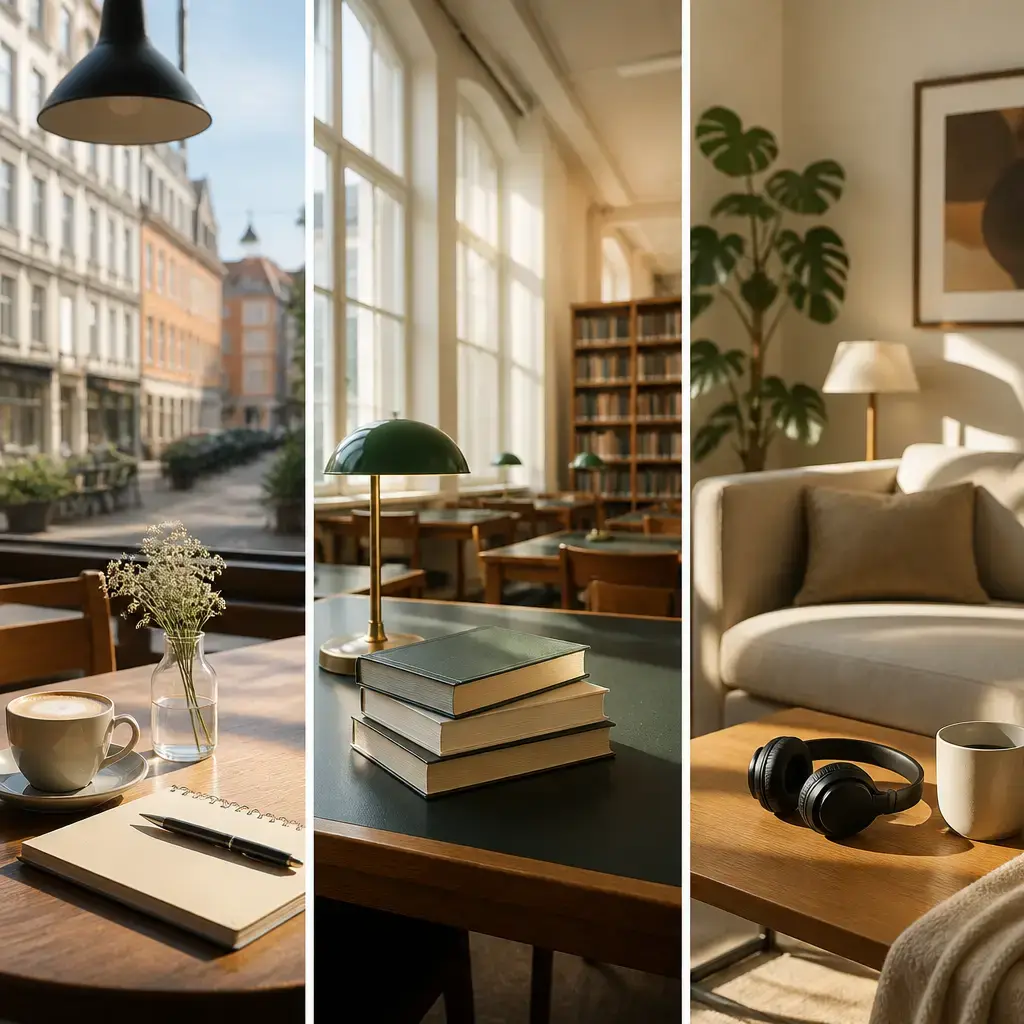
Ich muss den besten Ort zum Lernen auswählen.
ikh moos den BEST-en ort tsoom LAYR-nen OWS-vay-len. I need to choose the best place to study.Denk an Lärm, Licht, Komfort und Ablenkungen.
DENK an lairm, likht, kom-FORT oont AP-lenk-oong-en. Think about noise, light, comfort, and distractions.Das Café ist hell, aber die Leute laufen ständig an meinem Tisch vorbei.
das ka-FAY ist hell, AH-ber dee LOY-tuh LOW-fen SHTEN-dikh an MY-nem tish for-BYE. The cafe is bright, but people keep walking past my table.Diese Bewegung könnte es schwer machen, sich zu konzentrieren.
DEE-zuh beh-VAY-goong KURN-tuh ess shvair MAKH-en, zikh tsoo kon-tsen-TREE-ren. That movement could make it hard to focus.Die Bibliothek ist ruhiger, aber ich kann dort nicht das Sprechen üben.
dee bee-blee-oh-TAKE ist ROO-ih-ger, AH-ber ikh kan dort nikht das SHPREKH-en YOO-ben. The library is quieter, but I can't practice speaking there.Nutze die Bibliothek zum Lesen und übe danach zu Hause das Sprechen.
NUT-suh dee bee-blee-oh-TAKE tsoom LAY-zen oont YOO-buh da-NAKH tsoo HOW-zuh das SHPREKH-en. Use the library for reading, then practice speaking at home.So kann ich für jede Aufgabe einen passenden Ort auswählen.
zoh kan ikh fyoor YAY-duh OWF-gah-buh EYE-nen PAHS-en-den ort OWS-vay-len. That lets me choose a suitable place for each task.Eine klare Entscheidung sollte das Lernen weniger stressig machen.
EYE-nuh KLAH-ruh ent-SHY-doong SHOL-tuh das LAYR-nen VAY-nih-ger SHTRES-ikh MAKH-en. A clear choice should make studying feel less stressful.Sentence explanations
Ich muss den besten Ort zum Lernen auswählen.
I need to choose the best place to study.
- Ich muss
- I need to / I have to
- besten
- best
- Ort
- place
- zum Lernen
- for studying
- auswählen
- choose
More detail
Ich muss contains muss, the first-person singular present form of müssen (“to have to / to need to”). It expresses necessity here. In a main clause, the modal verb is conjugated in position 2 and the other verb goes to the end: Ich muss heute arbeiten. — “I have to work today.” besten is the attributive superlative form of gut (“good”): gut → besser (“better”) → am besten (“best,” used independently) or der beste (“the best,” before a noun). Here besten describes Ort. Its -en ending is required by the masculine accusative noun phrase den besten Ort; the ending belongs to the adjective, not to the noun. Ort means “place.” It is a masculine noun: der Ort in the basic form, den Ort in the accusative, and die Orte in the plural. In this sentence, den Ort is the object selected by the speaker. zum Lernen means “for studying.” zum is the contraction of zu dem. Lernen is the capitalized nominalized infinitive of lernen (“to study / learn”), and the dative form after zu marks the purpose. The same pattern appears in ein Raum zum Arbeiten — “a room for working.” auswählen means “to choose” or “to select.” It is a separable verb: in a finite main clause, aus moves to the end, as in Ich wähle einen Platz aus. — “I choose a spot.” In the infinitive after muss, it stays together as auswählen. Together, Ich muss den besten Ort zum Lernen auswählen. means “I need to choose the best place to study.” The structure is subject + modal verb + object + purpose phrase + infinitive: Ich muss [den besten Ort zum Lernen] [auswählen].】【。
Denk an Lärm, Licht, Komfort und Ablenkungen.
Think about noise, light, comfort, and distractions.
- Denk an
- think about
- Lärm
- noise
- Licht
- light
- Komfort
- comfort
- Ablenkungen
- distractions
More detail
Denk an is the informal singular imperative of denken (“to think”). With an, this verb means “to think about” or “to keep in mind,” and the thing thought about is expressed with the accusative: an etwas denken. Compare Denk an den Termin. — “Remember the appointment.” For formal singular or plural address, German uses Denken Sie an ...; for several people informally, Denkt an .... Lärm means unwanted or disturbing noise. It is a masculine noun and is normally used as an uncountable mass noun: Der Lärm ist laut. — “The noise is loud.” A particular individual sound can instead be expressed with Geräusch, depending on the intended meaning. Licht means light, as a substance or source of illumination. It is a neuter noun: Das Licht ist hell. — “The light is bright.” The related adjective hell describes something as bright or well lit; it is not the noun Licht itself. Komfort means comfort or convenience. It is a masculine noun and is commonly used for the pleasant ease provided by a place or arrangement: Der Komfort ist wichtig. — “Comfort is important.” Ablenkungen means distractions. The observed form is the plural of Ablenkung; the singular is eine Ablenkung (“a distraction”). For example, Wenige Ablenkungen helfen beim Lernen. — “Few distractions help with studying.” Together, Denk an introduces a list of things to consider: Lärm, Licht, Komfort und Ablenkungen. Thus the complete utterance means “Think about noise, light, comfort, and distractions.”
Das Café ist hell, aber die Leute laufen ständig an meinem Tisch vorbei.
The cafe is bright, but people keep walking past my table.
- Café
- café
- hell
- bright
- Leute
- people
- laufen
- walk
- ständig
- constantly
- Tisch
- table
- vorbei
- past; by
More detail
Café is a neuter noun: das Café; its plural is die Cafés. In this sentence it names the place being described. German nouns are capitalized. hell means that the café has a lot of light or is light in appearance. It is an adjective used after ist, so it describes the subject without an ending here. A useful contrast is dunkel (“dark”): Das Café ist dunkel. — “The café is dark.” Leute is a plural noun meaning “people.” The verb agrees with it in the plural: Die Leute laufen .... It is commonly used for people as a group; the singular is not formed by removing an ending. For one person, German commonly uses eine Person or ein Mensch, depending on the intended meaning. laufen is the present-tense plural form used with die Leute. In this context it means “walk” or “go on foot,” not necessarily “run.” Its infinitive is also laufen; a useful contrast is rennen (“run”/“sprint”), which emphasizes faster movement. Example: Die Leute laufen zum Bahnhof. — “The people walk to the station.” ständig is an adverb meaning “constantly” or “again and again.” It modifies the walking and conveys repeated or ongoing occurrence. It does not itself mark the verb’s tense: Die Leute laufen ständig vorbei. — “The people keep walking past.” Tisch is a masculine noun: der Tisch. In meinem Tisch, the possessive form is dative masculine/neuter, because the phrase an ... vorbei uses an with the dative in this fixed “past/by” construction. The possessive stem identifies the table as belonging or relating to the speaker: mein Tisch is the basic form, while meinem Tisch is the form required here. vorbei means “past” or “by” here. Together with movement and an, it forms the reusable pattern an + dative + vorbeilaufen: “walk past [someone/something].” Example: Sie läuft an der Schule vorbei. — “She walks past the school.” The separate parts an meinem Tisch and vorbei combine around the movement idea; vorbei alone does not specify what is being passed. The sentence begins with Das Café ist hell, “The café is bright.” aber introduces a contrast: despite that description, die Leute laufen ständig an meinem Tisch vorbei says that people repeatedly walk past the speaker’s table. The present tense presents this as an ongoing or recurring situation, and the complete meaning is: “The cafe is bright, but people keep walking past my table.”
Diese Bewegung könnte es schwer machen, sich zu konzentrieren.
That movement could make it hard to focus.
- Diese
- this; that
- Bewegung
- movement
- könnte
- could
- schwer
- difficult; hard
- machen
- make; do
- sich zu konzentrieren
- to concentrate; to focus
More detail
Diese means “this” here and is rendered as “that” in the fixed translation. It is the feminine singular nominative form of the demonstrative determiner, agreeing with Bewegung. The same form is also used with feminine singular accusative nouns and with plural nouns in some cases. For masculine singular nominative, the corresponding form is dieser; for neuter singular nominative, it is dieses. Bewegung means “movement.” Its plural is Bewegungen. Here it is the subject: the movement is presented as the possible cause of the difficulty. könnte is a Konjunktiv II form of können, used here to express possibility: “could.” können commonly means “can” or “be able to,” while könnte presents a possible result rather than a definite one. Example: Das könnte helfen. — “That could help.” schwer means “difficult” or “hard.” In es schwer machen, it describes the difficulty of the following activity, not a physical property of the movement. A useful opposite is leicht, “easy.” Example: Der Lärm macht das Lernen schwer. — “The noise makes studying difficult.” machen means “to make” in this construction. Its base form is machen; macht is a present-tense form, and gemacht is its past participle. The pattern etwas/es + adjective + machen expresses causing something to have the stated quality: Das macht es leicht. — “That makes it easy.” sich zu konzentrieren means “to concentrate” or “to focus.” The base verb is the reflexive sich konzentrieren, and zu marks the infinitive here. In this impersonal construction, sich belongs to the reflexive infinitive and does not identify a specific person in the source. When the understood subject is made explicit, the reflexive form agrees with that subject: Ich versuche, mich zu konzentrieren. — “I am trying to focus.” With du, it is dich: Du versuchst, dich zu konzentrieren. — “You are trying to focus.” Together, Diese Bewegung is the subject, and könnte ... machen says that it may have a particular effect. The construction es schwer machen, sich zu konzentrieren means “make it difficult to concentrate,” with the infinitive clause naming the activity affected. The complete meaning is: “That movement could make it hard to focus.”
Die Bibliothek ist ruhiger, aber ich kann dort nicht das Sprechen üben.
The library is quieter, but I can't practice speaking there.
- Die Bibliothek
- the library
- ist
- is
- ruhiger
- quieter
- aber
- but
- ich kann
- I can
- dort
- there
- nicht
- not
- das Sprechen
- speaking
- üben
- practice
More detail
Die Bibliothek means “the library” here. Bibliothek is a feminine noun, and die is the feminine singular nominative article in this sentence. German nouns are capitalized. Example: Die Bibliothek ist groß. — “The library is large.” ist is the present-tense third-person singular form of sein (“to be”): sein → ist. It agrees with the singular subject Die Bibliothek. Example: Der Raum ist ruhig. — “The room is quiet.” ruhiger means “quieter” here. It is the comparative of the adjective ruhig (“quiet”): ruhig → ruhiger → am ruhigsten (“quiet” → “quieter” → “the quietest”). The comparison is understood from context; the sentence says that the library is quieter, without stating the comparison target. Example: Dieses Zimmer ist ruhiger. — “This room is quieter.” aber connects two contrasting parts and means “but.” Example: Ich möchte kommen, aber ich habe keine Zeit. — “I would like to come, but I have no time.” ich kann combines the subject pronoun ich (“I”) with kann, the first-person singular present form of the modal verb können (“can; be able to”). With a modal verb, German normally places the other verb in the infinitive at the end of the clause. Example: Ich kann morgen kommen. — “I can come tomorrow.” dort is a location word meaning “there.” Its specific referent is not identified by the fixed sentence; its location meaning is understood from the context. Example: Wir lernen dort. — “We study there.” nicht negates the ability described by the surrounding clause: the speaker cannot practice speaking there. Its exact scope is understood together with kann ... üben, rather than as part of the meaning of dort alone. das Sprechen is the neuter nominalized infinitive of sprechen (“to speak”), meaning “speaking” as an activity. Nominalized infinitives are written with a capital letter and use the neuter article das. Example: Das Sprechen ist wichtig. — “Speaking is important.” üben means “to practice.” Here it is the infinitive governed by the modal kann; the combination das Sprechen üben means “practice speaking.” Example: Ich übe Deutsch. — “I practice German.” Together, Die Bibliothek ist ruhiger says “The library is quieter,” and aber introduces a contrast. The structure ich kann ... nicht ... üben expresses inability: ich kann dort nicht das Sprechen üben means “I can’t practice speaking there.” The complete utterance is therefore: “The library is quieter, but I can’t practice speaking there.”
Nutze die Bibliothek zum Lesen und übe danach zu Hause das Sprechen.
Use the library for reading, then practice speaking at home.
- Nutze
- use
- Bibliothek
- library
- zum Lesen
- for reading
- übe
- practice
- danach
- after that
- zu Hause
- at home
- das Sprechen
- speaking
More detail
Nutze is the imperative singular form of nutzen (“to use”), addressed to one person informally. The imperative has no written subject here: Nutze die Bibliothek means “Use the library.” Example: Nutze diese Gelegenheit. — “Use this opportunity.” Bibliothek is a feminine noun: die Bibliothek. In this sentence it appears as die Bibliothek because it is the accusative object of nutze; the feminine article has the same form in the nominative and accusative. Example: Ich besuche die Bibliothek. — “I visit the library.” zum Lesen means “for reading.” zum is the contraction of zu dem, and Lesen is the infinitive lesen used as a capitalized noun. This construction commonly expresses the purpose or activity associated with a place or object. Example: Ich gehe in die Bibliothek zum Lernen. — “I go to the library for studying.” übe is the informal singular imperative of üben (“to practise/practice”). It introduces the activity being practised, here das Sprechen. Example: Übe die Aussprache. — “Practise the pronunciation.” danach is an adverb meaning “after that” or “afterwards.” It links the second instruction to the activity just mentioned, without itself naming a new time span. Example: Lies den Text und sprich danach darüber. — “Read the text and then talk about it.” zu Hause is the fixed adverbial expression “at home.” It describes where the second practice activity takes place. Hause is conventionally capitalized in this expression. Example: Ich lerne zu Hause. — “I study at home.” das Sprechen means “speaking” here. Sprechen is the infinitive sprechen used as a neuter noun, with the article das; the whole noun phrase is the object of übe. This nominalized activity expression can be used for speaking as a skill or activity. Example: Das Sprechen fällt mir leichter. — “Speaking is easier for me.” Together, Nutze die Bibliothek zum Lesen gives the first instruction, “Use the library for reading.” und connects a second instruction, übe danach zu Hause das Sprechen: “then practise speaking at home.” The complete utterance is therefore: “Use the library for reading, then practice speaking at home.”
So kann ich für jede Aufgabe einen passenden Ort auswählen.
That lets me choose a suitable place for each task.
- So
- That way
- kann ich
- I can
- jede
- each/every
- Aufgabe
- task
- passenden
- suitable
- Ort
- place
- auswählen
- choose
More detail
So means “that way” here. It connects the situation or method to what the speaker can do; it is not the conjunction “so that” in this sentence. kann ich contains kann, the first-person singular present form of können (“to be able to; can”), and ich (“I”). With a following infinitive, können expresses ability or possibility. The pattern So kann ich + infinitive is reusable for “That way I can ...”. Because So is first, the finite verb comes before the subject: So kann ich .... jede means “each/every” here and modifies Aufgabe. The preposition für requires the accusative, so jede Aufgabe is feminine singular accusative. The form jede is also used for feminine singular nominative; the case is therefore not visible in this determiner alone. It does not assert a numeric count. Aufgabe means “task”. Its plural is Aufgaben. In für jede Aufgabe, it identifies each task as the unit for which a place is selected. passenden is the inflected form of the adjective passend, meaning “suitable” or “appropriate”. It describes Ort. In einen passenden Ort, the adjective has the accusative masculine singular ending -en, because Ort is masculine and the phrase is the object of für. Compare ein passender Ort (nominative) with einen passenden Ort (accusative). Ort means “place” or “location”. Its plural is Orte. Here it is masculine singular in the accusative phrase einen passenden Ort. auswählen means “to choose” or “to select”. It is a separable verb: without a modal, one can say Ich wähle einen Ort aus. With the modal kann, the infinitive stays together at the end: Ich kann einen Ort auswählen. Together, für jede Aufgabe means “for each task”, and einen passenden Ort means “a suitable place”. kann ich ... auswählen says that the speaker can select it, while So links that ability to the relevant method or arrangement. The whole utterance means: “That lets me choose a suitable place for each task.”
Eine klare Entscheidung sollte das Lernen weniger stressig machen.
A clear choice should make studying feel less stressful.
- klare
- clear
- Entscheidung
- choice; decision
- sollte
- should
- das Lernen
- studying; learning
- weniger stressig
- less stressful
- machen
- make
More detail
klare describes the decision as clear or definite. It is the adjective klar in a feminine singular nominative form, because it modifies Entscheidung in the subject phrase eine klare Entscheidung. The ending -e is part of the adjective’s agreement pattern after the indefinite article eine; it is not a form of the noun. Entscheidung means a choice or decision. Its base verb is entscheiden (“to decide”), while Entscheidung is the noun for the result or act of deciding. A useful related contrast is Auswahl (“selection”), which focuses more on the set of options or the act of selecting than on the decision itself. sollte expresses what should happen or what is expected to happen here. It is the form of sollen used with a third-person singular subject such as eine Entscheidung; in this sentence it gives a recommendation or expected effect rather than reporting a past obligation. Compare the reusable pattern Etwas sollte helfen — “Something should help.” das Lernen is the activity of studying or learning. Lernen is an infinitive used as a noun, so it is capitalized and takes the neuter article das. This nominalized form can name an activity: Das Lernen braucht Zeit. — “Learning takes time.” The article does not itself assert a numerical quantity; it identifies the activity as a noun phrase. weniger stressig means “less stressful.” weniger is the comparative form of wenig (“little; not much”) and reduces the degree of the adjective stressig (“stressful”). The phrase compares the resulting level of stress with a higher or previously understood level; it does not say that studying becomes completely stress-free. For example, Der neue Plan ist weniger stressig. — “The new plan is less stressful.” machen means “make” here in the sense of causing something to have a quality. Its base form is the infinitive machen, required at the end after the modal verb sollte. German commonly uses the pattern etwas + adjective + machen: Die Pause macht die Arbeit leichter. — “The break makes the work easier.” Together, eine klare Entscheidung is the subject: “a clear choice.” sollte places the statement in a should/expected-effect frame. The object is das Lernen, and weniger stressig machen says that the decision should cause studying to be less stressful. German places the infinitive machen at the end after sollte, producing the complete meaning: “A clear choice should make studying feel less stressful.”
Grammar Points
sich zu konzentrieren
Es ist schwer, sich zu konzentrieren.
ess ist shvair, zikh tsoo kon-tsen-TREE-ren.It is difficult to concentrate.
The reflexive pronoun sich accompanies the verb; zu comes before the infinitive.
ruhiger
Die Bibliothek ist ruhiger.
dee bee-blee-oh-TAKE ist ROO-ih-ger.The library is quieter.
The ending -er forms the comparative of an adjective: ruhig becomes ruhiger.
German Vocabulary
Quiz
Spelling
Tap the letters to spell the word.
to study; to learn
Show Answer
Lernendistraction
Show Answer
Ablenkungento choose; to select
Show Answer
auswählenlight