10 minutes free every day
Continue audio lessons in the app
Word explanations appear automatically in sync with the audio.
No login required · synced translations · playback with the screen locked
Choose your learning language and open this lesson in the app.

About This Lesson
Use Reporting a Kitchen Sink Leak to practice German conversation, pronunciation, vocabulary, grammar, and quizzes.
Dialogue
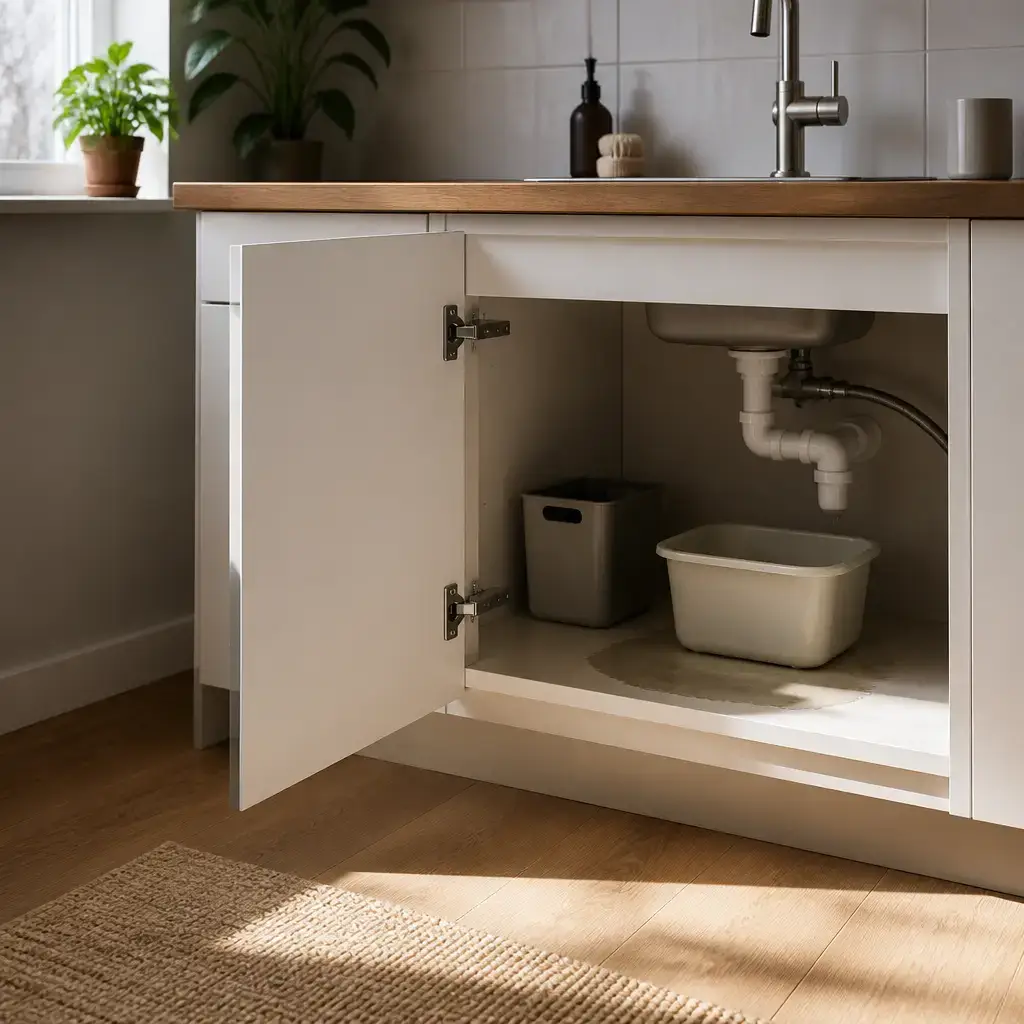
Ich habe bemerkt, dass sich unter der Küchenspüle ein feuchter Fleck bildet.
ikh HAH-buh buh-MEHRKT, dass zikh OON-ter dair KYOOKH-en-shpyoo-luh ayn FOYKHT-er FLEHK BIL-det. I noticed a damp patch forming under the kitchen sink.Das muss behoben werden, bevor der Schrank beschädigt wird.
dahs moos beh-HOH-ben VAIR-den, buh-FOHR dair SHRAHNGK beh-SHAY-dikht veert. That needs attention before it damages the cabinet.Ich habe dort einen Behälter aufgestellt, aber das Leck tropft weiterhin langsam.
ikh HAH-buh dort EYE-nen beh-HEL-ter OWF-guh-SHTELT, AH-ber dahs LEHK TROHPFT VY-ter-HIN LAHNG-zahm. I placed a container there, but the leak is still dripping slowly.Ist dort etwas gelagert, das den Zugang versperren könnte?
ist dort ET-vahs guh-LAH-gert, dahs dayn TSOO-gahng fehr-SHPER-en KURN-tuh? Is anything stored there that could block access?Ich habe den Bereich freigeräumt, damit der Techniker ihn problemlos untersuchen kann.
ikh HAH-buh dayn beh-RYKHE FRY-guh-ROYMT, dah-MIT dair TEKH-nee-ker een PROH-blaym-lohs oon-ter-ZOO-khen kahn. I cleared the area, so the technician can inspect it easily.Ich kann es als dringend kennzeichnen, auch wenn die Terminvergabe trotzdem etwas dauern kann.
ikh kahn ess ahls DRIHNG-ent KENT-tsykh-nen, owkh venn dee tair-MEEN-fehr-GAH-buh TROHTS-daym ET-vahs DOW-ern kahn. I can mark it as urgent, although scheduling may still take time.Bitte erwähnen Sie, dass der Boden sich zu verziehen beginnt.
BIT-tuh air-VAY-nen zee, dahs dair BOH-den zikh tsoo fehr-TSEE-en buh-GINT. Please mention that the floor is beginning to warp.Dieses Detail sollte in den Bericht aufgenommen werden.
DEE-zes day-TAIL ZHOHL-tuh in dayn beh-RIKHT OWF-guh-NOH-men VAIR-den. That detail should go in the report.Es wirkt sich auf die Sicherheit und den Reparaturplan aus.
ess veerkt zikh owf dee ZIKH-er-hyte oont dayn reh-pah-rah-TOOR-plahn ows. It affects safety and the repair plan.Sentence explanations
Ich habe bemerkt, dass sich unter der Küchenspüle ein feuchter Fleck bildet.
I noticed a damp patch forming under the kitchen sink.
- Ich habe
- I have…
- bemerkt
- noticed
- unter
- under
- Küchenspüle
- kitchen sink
- feuchter
- damp
- Fleck
- patch / spot
- bildet
- forms
More detail
Ich habe combines the subject Ich (“I”) with habe, the present-tense form of haben for the first-person singular. Together with the following participle bemerkt, it forms the German perfect tense: Ich habe bemerkt = “I noticed” or literally “I have noticed.” bemerkt is the past participle of bemerken, “to notice.” The pattern Ich habe + participle is reusable: Ich habe den Fehler bemerkt. — “I noticed the mistake.” unter means “under” here and introduces the location of the patch. With a stationary location, unter takes the dative: unter der Küchenspüle. With movement to a position under something, it can take the accusative instead: Ich stelle die Kiste unter den Tisch. — “I put the box under the table.” Küchenspüle is the feminine noun for “kitchen sink.” It is a compound noun referring to a sink in a kitchen. In this sentence, der Küchenspüle is dative singular after the location use of unter; the feminine dative form of the article is der. feuchter means “damp” in this noun phrase. It is the adjective feucht with the ending -er, agreeing with the masculine singular nominative noun phrase ein feuchter Fleck. The adjective describes the patch, not the sink. Compare ein feuchter Fleck — “a damp patch” — with eine feuchte Stelle — “a damp spot,” where the adjective ending changes because the noun phrase is feminine. Fleck is the masculine noun “patch” or “spot.” Here it refers to a damp area, not necessarily a separate object. Its plural is Flecken: Ich sehe zwei feuchte Flecken. — “I see two damp spots.” bildet is the third-person singular present form of bilden, “to form” or “to develop.” With the reflexive pronoun sich, sich bilden means “to form” or “to appear” on its own: Ein Fleck bildet sich. — “A spot is forming.” The present tense presents the formation as an ongoing process. In the dass clause, bildet comes at the end, as German subordinate-clause word order requires. The structure is Ich habe bemerkt, dass ...: “I noticed that ...”. Inside the dass clause, sich marks the reflexive construction sich bilden; unter der Küchenspüle gives the location; and ein feuchter Fleck is the forming subject. Together, the utterance means: “I noticed a damp patch forming under the kitchen sink.”
Das muss behoben werden, bevor der Schrank beschädigt wird.
That needs attention before it damages the cabinet.
- Das
- that; it
- muss
- must; has to
- behoben werden
- be fixed; be remedied
- bevor
- before
- der Schrank
- the cabinet
- beschädigt wird
- is damaged
More detail
Das means “that” or “it” here: a neutral singular pronoun referring to the matter that needs attention. Its exact referent is not grammatically identified by this sentence. In other contexts, das can also be the form of the demonstrative or article used with a neuter singular noun. muss is the present-tense form of müssen for ich, er, sie, and es, and also for the singular pronoun das: Das muss ... = “That has to ...”. It expresses necessity here, not merely a prediction. The infinitive müssen normally sends the other verb to the end of the clause in this structure. behoben werden is a passive construction: beheben means “remedy” or “fix,” and werden forms the passive. The meaning is that something needs to be fixed, without naming the person who will fix it. Compare the active pattern Jemand muss das beheben (“Someone has to fix that”) with the passive Das muss behoben werden (“That has to be fixed”). behoben is the past participle of beheben; it is not derived from heben in the sense “lift” for this construction. bevor introduces a time clause meaning “before.” It sets a condition that should be met earlier than the event in the following clause. In a bevor clause, the finite verb goes to the end: bevor der Schrank beschädigt wird. der Schrank means “the cabinet.” der marks this noun as masculine singular in the nominative form here. The noun itself is Schrank; its plural is Schränke, with the umlaut and plural ending. An example is Der Schrank ist alt. — “The cabinet is old.” beschädigt wird means “is damaged.” beschädigt is the past participle of beschädigen (“damage”), and wird is the present-tense form of werden used to form the passive with a singular subject. Thus der Schrank wird beschädigt presents the cabinet as the thing undergoing damage. The passive does not identify who or what causes the damage. Compare active Jemand beschädigt den Schrank (“Someone damages the cabinet”) with passive Der Schrank wird beschädigt (“The cabinet is damaged”). Together, Das muss behoben werden says that the matter must be fixed. bevor der Schrank beschädigt wird places that necessary repair before damage occurs to the cabinet. The whole utterance therefore means that the issue needs to be dealt with before the cabinet is damaged, matching the practical warning conveyed by the fixed translation.
Ich habe dort einen Behälter aufgestellt, aber das Leck tropft weiterhin langsam.
I placed a container there, but the leak is still dripping slowly.
- Ich habe
- I have
- dort
- there
- Behälter
- container
- aufgestellt
- placed
- aber
- but
- Leck
- leak
- tropft
- drips
- weiterhin
- still
- langsam
- slowly
More detail
Ich habe begins the German perfect tense here: the present-tense form habe of haben combines with the past participle aufgestellt, which appears later. This construction presents the placing as a completed action. Ich is the first-person singular subject, so habe is the appropriate form; with a plural subject, German uses haben, as in Wir haben gewartet (“We waited / have waited”). dort means “there” and points to a place already identifiable in the situation. It is a location adverb, so it does not change for number or gender. Behälter is the noun for a container or receptacle. The noun is masculine, conventionally shown as der Behälter; after einen, it is in the accusative form required for the directly affected object of aufstellen: einen Behälter. The article marks the noun phrase’s grammatical role and gender; it does not by itself assert a numerical count. aufgestellt is the past participle of the separable verb aufstellen, “to place or set up.” The verb is built from auf + stellen; in the perfect, the participle stays together while the auxiliary carries the tense: Ich habe den Behälter aufgestellt (“I placed the container”). Its base here is aufstellen, not the unrelated verb stehen. aber connects the completed placement with a contrasting situation: “but.” It does not itself indicate a new time or cause. Leck means “leak.” In this sentence, das Leck is the subject of the following verb; das is the definite article used with this neuter noun. The noun’s base form is Leck, and its plural is Lecks, usually with the plural article die: die Lecks. tropft is the third-person singular present form of tropfen, “to drip.” The subject is das Leck, so the singular form is used: Das Leck tropft (“The leak drips / is dripping”). The present tense can describe an ongoing process in German; it does not require a separate progressive verb form. weiterhin means “still” in the sense that the dripping continues. It modifies the situation rather than the noun: Das Leck tropft weiterhin says that the dripping has not stopped. langsam describes the manner of dripping: it happens slowly. The adjective is used here as an adverb, so it does not receive an ending. Compare ein langsamer Tropfen (“a slow drop”), where langsam modifies a noun and therefore has an adjective ending. Together, the first part states that the speaker placed a container at the relevant location. aber contrasts that completed action with the second part: the leak continues to drip slowly. The whole utterance therefore means: “I placed a container there, but the leak is still dripping slowly.”
Ist dort etwas gelagert, das den Zugang versperren könnte?
Is anything stored there that could block access?
- Ist dort
- is there
- etwas
- anything
- gelagert
- stored
- das
- that; which
- Zugang
- access
- versperren
- block
- könnte
- could
More detail
Ist dort forms a yes/no question: ist is the third-person singular present form of sein (“to be”), and dort means “there.” In a German main-clause question without a question word, the finite verb commonly comes first: Ist dort ...? = “Is there ...?” etwas is an indefinite pronoun meaning “anything” in this question. In a statement it can mean “something,” while the question context gives the natural English rendering “anything.” It does not itself state a particular numerical count. gelagert is the participle of lagern, “to store” or “to be stored.” Here it describes what is located there: etwas ist gelagert means “something is stored.” The participle can also appear in other constructions, such as Sie lagern Material (“They store material”). das is a relative pronoun referring back to the neuter singular etwas. Its gender and number come from that antecedent; its nominative form here reflects its role as the subject of the following relative clause. The relative clause adds a possible property of the stored thing. Zugang is a masculine noun meaning “access.” In den Zugang, the masculine singular accusative article den marks it as the object of versperren. A useful contrast is der Zugang in the nominative and den Zugang in the accusative. versperren is an infinitive meaning “to block” or “to obstruct,” especially a passage or access. Example: Der Schrank versperrt den Eingang. — “The cabinet blocks the entrance.” könnte is the third-person singular form of the subjunctive II of können (“can; be able to”). With an infinitive, ... versperren könnte expresses a possible result: “could block.” The infinitive versperren names the action, while könnte supplies the possibility; German places the infinitive before the finite modal form at the end of this subordinate clause. Together, Ist dort etwas gelagert asks whether anything is stored there. The relative clause das den Zugang versperren könnte identifies the relevant possibility: the stored thing could block access. The complete meaning is: “Is anything stored there that could block access?” This is a neutral way to ask about a possible obstruction without asserting that anything actually blocks access.
Ich habe den Bereich freigeräumt, damit der Techniker ihn problemlos untersuchen kann.
I cleared the area, so the technician can inspect it easily.
- Ich habe
- I have
- den Bereich
- the area
- freigeräumt
- cleared
- damit
- so that
- der Techniker
- the technician
- ihn
- it
- problemlos
- easily
- untersuchen
- inspect
- kann
- can
More detail
Ich habe introduces the speaker as the subject and uses haben as the auxiliary for the perfect tense. The perfect presents the clearing as completed: Ich habe ... freigeräumt = “I cleared / I have cleared ...”. den Bereich means “the area” here. Bereich is masculine, so the definite article is den in the accusative when the area is the object of freiräumen. The form der Bereich is the nominative form; den Bereich is the corresponding masculine accusative form. freigeräumt is the past participle of freiräumen, “to clear out” or “to make an area free.” The separable verb has the parts frei + räumen; its perfect participle is written as one word, freigeräumt. With haben, it forms the perfect: Ich habe den Bereich freigeräumt. — “I cleared the area.” damit introduces a subordinate clause expressing the intended result or purpose, “so that.” It connects the completed clearing with what the technician can then do. der Techniker is “the technician.” Techniker is masculine in this form, and der marks the nominative subject of the subordinate clause. In the fixed translation, this technician is the person who will inspect the area. ihn is an accusative masculine pronoun meaning “it” here. It refers to the cleared area, represented by masculine der Bereich; the form is accusative because the area is the object of untersuchen. Its basic nominative form is er, but the object form is ihn. problemlos means “without problems” or, naturally here, “easily.” It is an adverb modifying the inspection: the inspection can be carried out without difficulty. The related adjective is also problemlos, as in eine problemlose Untersuchung — “an uncomplicated inspection.” untersuchen means “to inspect” or “to examine.” Here it is an infinitive selected by the modal verb kann. A reusable pattern is jemanden/etwas untersuchen for inspecting or examining a person or thing: Der Techniker untersucht das Gerät. — “The technician examines the device.” kann is the third-person singular present form of können, “can” or “be able to.” Because its subject is der Techniker, the form is kann; the infinitive untersuchen remains at the end of the subordinate clause. In this sentence, kann expresses the technician’s ability or possibility to inspect the area, not a command. Together, Ich habe den Bereich freigeräumt says that the speaker completed clearing the area. damit der Techniker ihn problemlos untersuchen kann gives the purpose: the technician can inspect that area easily. The full utterance therefore means, “I cleared the area, so the technician can inspect it easily.”
Ich kann es als dringend kennzeichnen, auch wenn die Terminvergabe trotzdem etwas dauern kann.
I can mark it as urgent, although scheduling may still take time.
- Ich kann
- I can
- es
- it
- dringend
- urgent
- kennzeichnen
- mark; label
- auch wenn
- although; even if
- die Terminvergabe
- appointment scheduling
- trotzdem
- still; nevertheless
- etwas
- some time; a little while
- dauern
- take time; last
More detail
Ich kann expresses the speaker’s ability or possibility: “I can.” kann is the first-person singular present form of können, established here by Ich. With a modal verb in a main clause, the other verb remains in the infinitive and normally goes to the end: Ich kann das prüfen means “I can check that.” es is an unstressed accusative pronoun meaning “it” here. The fixed translation identifies the object only as “it”; it does not specify that object’s referent. dringend means “urgent” here. In etwas als dringend kennzeichnen, it is the description assigned to the object after als; it does not change form in this use. The reusable pattern etwas als wichtig kennzeichnen means “mark something as important.” kennzeichnen is the infinitive meaning “to mark” or “label.” Its base form is kennzeichnen, and here it follows the modal kann. The pattern etwas als + description kennzeichnen means to mark something as having that status. auch wenn introduces a subordinate clause with a concessive meaning, “although” here. It presents a circumstance that does not prevent the main statement from applying. In this clause, the finite verb is placed at the end. die Terminvergabe is a feminine singular noun phrase meaning “appointment scheduling.” The article die marks a definite noun phrase; its form also agrees with the noun’s feminine singular gender and number. The phrase is the subject of the subordinate clause because of its role in the clause, not because the article alone identifies that role. The compound contains Termin (“appointment”) and Vergabe (“allocation” or “assignment”); learn the complete noun as the useful unit here. trotzdem means “still” or “nevertheless.” It marks that the scheduling can continue to take time despite the concessive circumstance. etwas means “some time” or “a little while” in this use. With dauern, etwas dauern means “take some time,” without specifying how much. Example: Das kann etwas dauern. — “That may take some time.” dauern means “to take time” or “to last.” Here it is the infinitive in the subordinate clause. Because the clause also contains the modal kann, the two verb forms form a final verb group: dauern comes before the finite modal kann. The utterance combines Ich kann es als dringend kennzeichnen (“I can mark it as urgent”) with auch wenn die Terminvergabe trotzdem etwas dauern kann (“although scheduling may still take some time”). The first kann expresses ability; the final kann expresses possibility. Together: “I can mark it as urgent, although scheduling may still take time.”
Bitte erwähnen Sie, dass der Boden sich zu verziehen beginnt.
Please mention that the floor is beginning to warp.
- Bitte
- please
- erwähnen
- mention
- der Boden
- the floor
- sich zu verziehen
- to warp
- beginnt
- begins
More detail
Bitte makes the request polite. It commonly appears at the beginning of a request and means “please.” erwähnen is the infinitive meaning “to mention.” In this formal request, it follows the polite form Sie: Erwähnen Sie ... means “Mention ...” or “Please mention ...”. Sie is capitalized as the formal “you”; the verb form is also used with this formal subject. der Boden means “the floor” here. Boden is a masculine noun, so its nominative singular definite article is der. The article belongs to the noun; it does not by itself express a numerical count. sich zu verziehen is the infinitive construction “to warp.” The verb is sich verziehen, a reflexive verb in this meaning, and zu is placed before the infinitive form verziehen: sich zu verziehen. The reflexive element sich refers back to the thing that changes shape, here der Boden. beginnt is the present-tense third-person singular form of beginnen (“to begin”). With an infinitive construction, beginnen expresses the start of an action or process: beginnt, sich zu verziehen means “begins to warp.” The pattern beginnen, sich zu + infinitive is reusable for a process that is starting, for example: Das Holz beginnt, sich zu verziehen. — “The wood is beginning to warp.” This example introduces a new referent and illustrates the same pattern. The request Bitte erwähnen Sie is followed by a dass clause. In that clause, der Boden is the subject, sich zu verziehen names the process that is beginning, and beginnt appears at the end as the finite verb, as required in this subordinate-clause structure. Together, Bitte erwähnen Sie, dass der Boden sich zu verziehen beginnt. means “Please mention that the floor is beginning to warp.”
Dieses Detail sollte in den Bericht aufgenommen werden.
That detail should go in the report.
- Dieses
- this
- Detail
- detail
- sollte
- should
- Bericht
- report
- aufgenommen werden
- be included
More detail
Dieses is the demonstrative form meaning “this” here. It is neuter, singular, and nominative because it agrees with Detail, which is the subject. The form changes with grammatical gender, number, and case; for example, dieser Bericht means “this report,” while diese Information means “this information.” Detail is a neuter noun meaning “detail.” Its plural is Details. In this sentence it is the specific detail that is to be included, but the German noun itself does not identify what kind of detail it is. sollte is the third-person singular preterite form of the modal verb sollen. With a passive infinitive, it commonly expresses that something is supposed or expected to happen, corresponding here to “should.” The subject is Dieses Detail, so the singular form is used. Compare Das Detail sollte ... with Die Details sollten .... Bericht is a masculine noun meaning “report”; its plural is Berichte. In in den Bericht, in takes the accusative because the meaning is movement or placement into the report: “into the report.” This is different from in dem Bericht, which normally describes a location within the report and means “in the report.” aufgenommen werden forms the passive infinitive of aufnehmen, “to include” or “to record,” literally presenting the detail as the thing that is taken in. aufgenommen is the past participle, and werden supplies the passive construction. The active version would be Jemand sollte dieses Detail in den Bericht aufnehmen (“Someone should include this detail in the report”); the passive version leaves the responsible person unspecified and focuses on the detail. The parts combine as Dieses Detail (“this detail”) + sollte (“should”) + in den Bericht (“into the report”) + aufgenommen werden (“be included”). Thus the whole utterance means: “That detail should go in the report.” In this context, it presents inclusion in the report as the expected or appropriate action.
Es wirkt sich auf die Sicherheit und den Reparaturplan aus.
It affects safety and the repair plan.
- Es wirkt sich … aus
- it affects / has an effect
- Sicherheit
- safety
- Reparaturplan
- repair plan
More detail
Es wirkt sich ... aus is the separated form of sich auf etwas auswirken, meaning “to affect” or “to have an effect.” Here, Es is the subject translated as “it”; in the supplied context, it can refer to the previously mentioned detail. wirkt is the third-person singular present form of wirken, while sich is the reflexive pronoun. The prefix aus appears at the end because auswirken is separable in this construction. The reusable pattern is: Etwas wirkt sich auf etwas aus. — “Something affects something.” Sicherheit means “safety” here. It is a feminine noun: die Sicherheit. In this sentence, auf introduces the affected object and takes the accusative, giving auf die Sicherheit. Reparaturplan means “repair plan.” It is a compound noun formed from Reparatur (“repair”) and Plan (“plan”), and its grammatical gender is masculine: der Reparaturplan. After auf in this construction, it appears as accusative singular: den Reparaturplan. The article marks this case; it does not add a separate meaning of “repair.” Together, wirkt sich auf die Sicherheit und den Reparaturplan aus means “affects safety and the repair plan.” The coordinated objects are die Sicherheit and den Reparaturplan, and the complete utterance means: “It affects safety and the repair plan.”
Grammar Points
sich auf + Akkusativ auswirken
Das Leck wirkt sich auf die Sicherheit aus.
dahs LEHK veerkt zikh owf dee ZIKH-er-hyte ows.The leak affects safety.
The reflexive verb splits: sich comes before the object, while aus moves to the end.
German Vocabulary
Quiz
Spelling
Tap the letters to spell the word.
to damage
Show Answer
beschädigtto notice
Show Answer
bemerktto fix; to remedy
Show Answer
behobenkitchen sink