10 minutes free every day
Continue audio lessons in the app
Word explanations appear automatically in sync with the audio.
No login required · synced translations · playback with the screen locked
Choose your learning language and open this lesson in the app.

About This Lesson
Use Describing a Possible Heating Problem to practice German conversation, pronunciation, vocabulary, grammar, and quizzes.
Dialogue
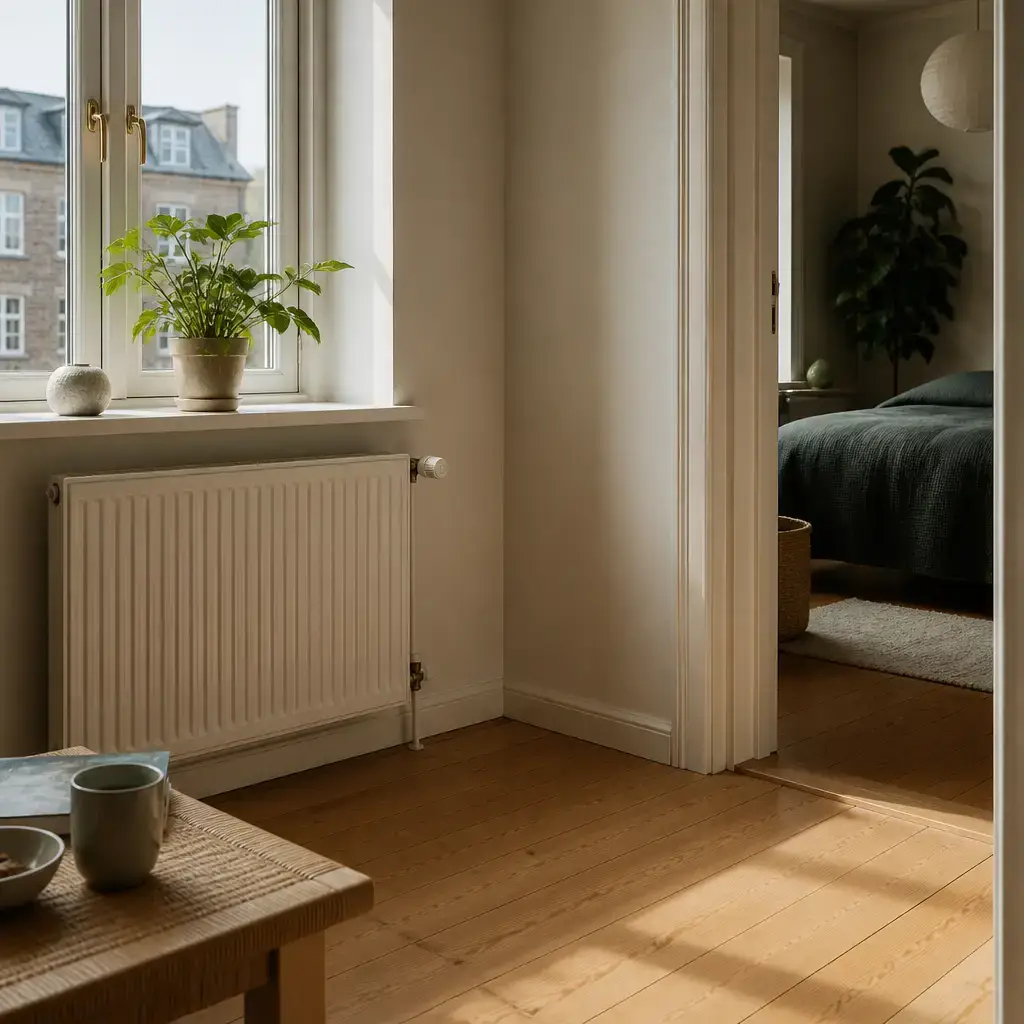
Die Heizung schaltet sich ein, aber der Raum wird nie wirklich angenehm.
dee HIGH-tsoong SHAL-tet zikh ayn, AH-ber dehr rowm virt nee VEERK-likh AHNG-uh-naym. The heating switches on, but the room never becomes comfortable.Das Thermostat funktioniert vielleicht, während das Heizkörperventil weiterhin klemmt.
dahs tehr-moh-STAHT foonk-tsee-oh-NEERT, VEH-rent dahs HIGHTZ-KUR-per-fen-TEEL VY-ter-heen klemt. The thermostat may be working, while the radiator valve remains stuck.Das habe ich mich gefragt, weil sich das Rohr in der Nähe der Wand warm anfühlt.
dahs HAH-buh ikh mikh guh-FRAHKT, vyle zikh dahs rohr in dehr NAY-uh dehr VANT varm AHN-fyoolt. I wondered about that, because the pipe feels warm near the wall.Dann liegt das Problem wahrscheinlich eher an der Zirkulation als an der Stromversorgung.
dahn leekt dahs proh-BLAYM vah-shyne-likh AY-er ahn dehr tser-koo-lah-TSEE-ohn ahls ahn dehr SHTROHM-fer-ZOR-goong. Then the problem is probably circulation rather than power.Könnte ein Techniker das überprüfen, ohne jeden Raum zu betreten?
KURN-tuh ayn TEKH-nee-ker dahs OO-ber-PROO-fen, OH-nuh YAY-den rowm tsoo buh-TRAY-ten? Could a technician check it without entering every room?Er braucht möglicherweise Zugang zu mehreren Räumen, um die Temperaturen in der ganzen Wohnung zu vergleichen.
air browkht MURK-lih-kher-VY-zuh TSOO-gahng tsoo MAYR-uh-ren ROY-men, oom dee tem-peh-rah-TOO-ren in dehr GAHN-tsen VOH-noong tsoo fer-GLY-khen. They may need access to compare temperatures across the apartment.Ich kann das organisieren, wenn er mir rechtzeitig Bescheid gibt.
ikh kahn dahs or-gah-nee-ZEER-en, ven air meer REKHt-tsyte-ikh buh-SHYTE geept. I can arrange that if they give reasonable notice.Wir sollten um ein konkretes Zeitfenster bitten, bevor wir bestätigen.
veer ZOL-ten oom ayn kon-KRAY-tes TSYTE-fen-ster BIT-ten, buh-FOHR veer buh-SHTAY-ti-gen. We should request a clear time window before we confirm.Sentence explanations
Die Heizung schaltet sich ein, aber der Raum wird nie wirklich angenehm.
The heating switches on, but the room never becomes comfortable.
- Die Heizung
- the heating
- schaltet sich ein
- switches on
- Raum
- room
- wird
- becomes
- nie
- never
- wirklich
- really
- angenehm
- comfortable
More detail
Die Heizung means “the heating” here. Heizung is a feminine noun: die Heizung; its plural is die Heizungen. The definite article die marks feminine singular in this noun phrase. The next-context sentence also uses heating-related vocabulary, but it does not change this noun’s meaning here. schaltet sich ein describes the heating switching on. The underlying verb is the separable verb einschalten (“switch on”); in a finite main clause, its parts can split: Die Heizung schaltet sich ein. — “The heating switches on.” With sich einschalten, the subject is the thing that comes on; the sentence does not name a separate person who switches it on. This construction does not by itself specify why or how the heating comes on. A reusable example is Das Licht schaltet sich ein. — “The light switches on.” Raum means “room” in the source. It is a masculine noun: der Raum; its plural is die Räume. In the sentence, the full noun phrase is der Raum, and the definite article der marks masculine singular nominative because the room is the subject of the following clause. wird is the third-person singular present form of werden. Here werden means “become” and introduces a change of state: Der Raum wird angenehm. — “The room becomes comfortable.” This differs from passive use of werden, where it helps form an event done to something. nie means “never.” Here it negates the room’s becoming comfortable across the relevant occasions or times; it does not mean that the heating never switches on. wirklich means “really” or “truly.” Here it strengthens angenehm: the room never becomes genuinely comfortable. A reusable example is Der Raum ist wirklich angenehm. — “The room is really comfortable.” angenehm means “comfortable” or “pleasant” here. It is a descriptive adjective used after wird, so it is predicative and has no adjective ending: Der Raum wird angenehm. Its comparative is angenehmer (“more comfortable/pleasant”), and its superlative is am angenehmsten (“most comfortable/pleasant”). Together, Die Heizung schaltet sich ein says that the heating switches on. aber contrasts that event with der Raum wird nie wirklich angenehm: despite the heating switching on, the room never becomes genuinely comfortable. The complete meaning is therefore: “The heating switches on, but the room never becomes comfortable.”
Das Thermostat funktioniert vielleicht, während das Heizkörperventil weiterhin klemmt.
The thermostat may be working, while the radiator valve remains stuck.
- Thermostat
- thermostat
- funktioniert
- works; is working
- vielleicht
- perhaps; maybe
- während
- while
- Heizkörperventil
- radiator valve
- weiterhin
- still; continues to
- klemmt
- is stuck
More detail
Thermostat is the noun for a thermostat. In the sentence it is the subject of funktioniert; the article Das shows the form used here for this noun. German compounds can combine nouns into one word: Heizkörperventil later means “radiator valve,” with Ventil as the final element. funktioniert comes from funktionieren and is the present-tense form for a singular third-person subject such as das Thermostat. Here the present describes the thermostat as working now or being in working order. Example: Die Heizung funktioniert. — “The heating works.” vielleicht means “perhaps” or “maybe.” It makes the statement uncertain: the speaker presents the thermostat’s working as a possibility, not as a definite fact. It does not itself mean that the thermostat is definitely working. während introduces the contrasting situation “while.” It is a subordinating conjunction, so the finite verb comes at the end of its clause. A reusable pattern is A ..., während B ...: Er liest, während sie kocht. — “He reads while she cooks.” Heizkörperventil is a compound noun meaning “radiator valve.” German nouns are capitalized, and the compound is written as one word. The article das before it belongs to the noun phrase in the source; the selected word itself is Heizkörperventil. weiterhin means “still” or “continuing.” It marks a situation that remains in force over time. Here it applies to the valve’s stuck condition, not to the thermostat’s possible functioning. Example: Das Fenster ist weiterhin offen. — “The window is still open.” klemmt comes from klemmen and is the present-tense form for a singular third-person subject, here das Heizkörperventil. In this context it means that the valve is stuck or jammed and does not move freely. Example: Die Tür klemmt. — “The door is stuck.” Together, Das Thermostat funktioniert vielleicht says that the thermostat may be working. während das Heizkörperventil weiterhin klemmt adds a simultaneous contrasting condition: the radiator valve remains stuck. The complete meaning is: “The thermostat may be working, while the radiator valve remains stuck.”
Das habe ich mich gefragt, weil sich das Rohr in der Nähe der Wand warm anfühlt.
I wondered about that, because the pipe feels warm near the wall.
- Das
- that
- habe ich mich gefragt
- I wondered
- weil
- because
- Rohr
- pipe
- in der Nähe
- near
- Wand
- wall
- warm
- warm
- sich … anfühlt
- feels
More detail
Das means “that” here. It is a demonstrative pronoun, and the fixed translation supports the meaning “that,” but it does not identify a more specific referent. As a pronoun, it is not functioning as the noun Rohr in this sentence. habe ich mich gefragt is the perfect-tense expression “I wondered.” The base verb is sich fragen (“to wonder”), with the reflexive pronoun mich matching the subject ich. habe is the first-person singular present form of haben, used as the perfect auxiliary; gefragt is the past participle of fragen. Because Das is placed first, the finite verb habe comes before the subject: Das habe ich mich gefragt. weil introduces a reason clause meaning “because.” In a standard German subordinate clause introduced by weil, the finite verb goes to the end. Here, the clause therefore ends with anfühlt, while the main clause comes before it. Rohr means “pipe.” Its full noun form is das Rohr; the article shows that it is neuter singular in this sentence. A useful plural is die Rohre (“pipes”). in der Nähe means “near” or “in the vicinity.” This is a reusable location pattern: in der Nähe von ... means “near ...” when followed by a noun phrase with von. In the supplied sentence, the following noun phrase is der Wand. Wand means “wall.” The full form here is der Wand: Wand is feminine, and der is its genitive singular article after the noun Nähe, giving in der Nähe der Wand (“near the wall”). warm means “warm.” It is a descriptive adjective used here after the verb, so it describes the perceived condition of the pipe rather than appearing before a noun. Its comparison forms are wärmer (“warmer”) and am wärmsten (“warmest”). Example: Das Wasser ist warm. — “The water is warm.” sich ... anfühlt is the separated form of the reflexive verb sich anfühlen, “to feel” or “to seem to feel” in a sensory description. The observed form anfühlt is third-person singular present: sich appears earlier in the clause and the separable prefix an is attached at the end. Example: Der Boden fühlt sich kalt an. — “The floor feels cold.” This is different from simply fühlen, which commonly means “to feel” something directly or “to sense” it. Together, Das habe ich mich gefragt means “I wondered about that.” The weil clause gives the reason: sich das Rohr ... warm anfühlt means that the pipe feels warm near the wall. The complete utterance is: “I wondered about that, because the pipe feels warm near the wall.”
Dann liegt das Problem wahrscheinlich eher an der Zirkulation als an der Stromversorgung.
Then the problem is probably circulation rather than power.
- Dann
- then
- liegt … an
- is due to
- Problem
- problem
- wahrscheinlich
- probably
- eher … als
- rather ... than
- Zirkulation
- circulation
- Stromversorgung
- power supply
More detail
Dann means “then” here and links this statement to the preceding reasoning. It can mark a result or conclusion, not only a point in time. liegt ... an is the construction an etwas liegen: a problem or situation is caused by something. liegt is the present-tense third-person singular form of liegen; in this construction it does not mean that the problem is physically lying somewhere. The preposition an takes the dative here, giving an der Zirkulation and an der Stromversorgung. Example: Der Fehler liegt an der Batterie. — “The fault is due to the battery.” Problem is the noun “problem.” Its plural is Probleme. wahrscheinlich means “probably” and expresses an assessment rather than certainty. It comes before the comparison in this sentence and qualifies the whole proposed explanation. eher ... als is a reusable comparison pattern meaning “rather ... than” or “more likely ... than.” Here it compares two possible causes: eher an der Zirkulation versus als an der Stromversorgung. The repeated an keeps the same cause construction with both alternatives. Example: Der Fehler liegt eher an der Pumpe als am Kabel. — “The fault is more likely due to the pump than to the cable.” am is the contracted form of an dem. Zirkulation is the feminine noun “circulation.” In this sentence it names the circulation as the more likely cause. After an, its article appears as dative feminine der: an der Zirkulation. Stromversorgung is the feminine compound noun “power supply.” It names the alternative cause in the comparison. The word combines Strom (“electricity/current”) with Versorgung (“supply/provision”), but the complete compound is the relevant unit here. Together, Dann liegt das Problem presents the problem as having a cause, wahrscheinlich marks that cause as probable, and eher an der Zirkulation als an der Stromversorgung selects circulation over the power supply as the more likely cause. The whole utterance means: “Then the problem is probably due to circulation rather than the power supply.”
Könnte ein Techniker das überprüfen, ohne jeden Raum zu betreten?
Could a technician check it without entering every room?
- Könnte
- could
- Techniker
- technician
- überprüfen
- check
- ohne
- without
- jeden
- every
- Raum
- room
- zu betreten
- to enter
More detail
Könnte is the form of können used here for a tentative or polite question about possibility: “Could ...?” The chain is können (can/be able to) → konnte (could/was able to, past indicative) → könnte (subjunctive II, often used for a tentative request or possibility). The form itself does not identify who the technician is; the subject is supplied by the following noun phrase. Techniker means “technician.” It is a masculine noun; its plural is also Techniker, so the ending does not change in the plural. Here it is the singular subject of the question. Example: Ein Techniker kommt morgen. — “A technician is coming tomorrow.” überprüfen means “to check” or “to inspect.” It is an infinitive, and its subject is understood to be the technician because it follows the modal verb könnte. With a modal verb, German uses the other verb in the infinitive: Der Techniker könnte das überprüfen. — “The technician could check it.” Überprüfen is written as one word; do not replace it with the related but different verb prüfen unless that wording is intended. ohne introduces what is absent or not done and takes the accusative when it introduces a noun phrase. In this sentence it begins the construction ohne ... zu + infinitive, meaning “without ...ing.” Example: Sie ging, ohne sich zu verabschieden. — “She left without saying goodbye.” jeden is the accusative masculine singular form of the determiner jeder (“every/each”). It agrees with the masculine noun Raum in the phrase jeden Raum. The form expresses a distributive meaning—each room considered individually—not a stated numerical count. Useful forms include jeder Raum (nominative masculine), jeden Raum (accusative masculine), and jede Tür (feminine nominative or accusative). Raum means “room” here. It is a masculine noun: der Raum in the singular and die Räume in the plural. Because betreten takes a direct object, the singular noun appears as accusative Raum, while the determiner shows the case: jeden Raum. Example: Sie betritt den Raum. — “She enters the room.” zu betreten means “to enter.” Betreten is the infinitive; its principal forms are betreten → betrat → hat betreten. In the ohne ... zu construction, zu comes directly before this infinitive: ohne jeden Raum zu betreten — “without entering every room.” The object jeden Raum comes between ohne and zu betreten because it belongs to betreten. Taken together, Könnte ein Techniker das überprüfen asks whether a technician might be able to check it, with das referring to the thing being checked in the fixed translation. ohne jeden Raum zu betreten adds the condition that this check would happen without entering each room. The complete meaning is: “Could a technician check it without entering every room?”
Er braucht möglicherweise Zugang zu mehreren Räumen, um die Temperaturen in der ganzen Wohnung zu vergleichen.
They may need access to compare temperatures across the apartment.
- Er
- they
- braucht
- needs
- möglicherweise
- possibly
- Zugang
- access
- mehreren
- several
- Räumen
- rooms
- um … zu
- in order to
- Temperaturen
- temperatures
- ganzen
- whole
- Wohnung
- apartment
- vergleichen
- compare
More detail
Er is the German masculine singular personal pronoun in the nominative, used here as the subject. In the supplied context it refers back to ein Techniker; the English translation uses singular “they” for that person. The form contrasts with sie for a feminine singular or plural referent and es for a neuter singular referent. braucht means “needs” here. It is the present-tense, third-person singular form of brauchen: ich brauche, er braucht. The present tense can describe a current or relevant need. möglicherweise is an adverb meaning “possibly” or “perhaps.” It makes the need uncertain: the sentence says that access may be needed, not that it is definitely needed. German adverbs such as this can be placed in the middle field of a statement, as here after the finite verb. Zugang is a masculine noun meaning “access.” Its useful pattern is Zugang zu + dative: Zugang zu etwas means “access to something.” The noun is written with a capital letter because German nouns are capitalized. mehreren means “several” here. It is the dative plural form of mehrere, required by zu in Zugang zu mehreren Räumen. It indicates more than one but does not state an exact number. Räumen means “rooms” in this sentence. Its base form is the masculine noun der Raum; the plural is die Räume, and the dative plural adds -n: den Räumen, mehreren Räumen. The umlaut and the ending both belong to the observed inflected form. um ... zu introduces a purpose: “in order to ...” or simply “to ...” in a purpose expression. German places the infinitive at the end of this construction. Pattern: um + ... + zu + infinitive, as in um Deutsch zu lernen — “in order to learn German.” Temperaturen is the plural of the feminine noun die Temperatur, meaning “temperatures.” Here it is the accusative object of vergleichen, and die is the definite plural article. The plural refers to the temperatures being compared, not to a stated number of temperature readings. ganzen means “whole” or “entire” here. It is the inflected form of ganz; in der ganzen Wohnung, it has a feminine singular dative ending because in expresses a location in this phrase. die ganze Wohnung is the nominative or accusative form, while in der ganzen Wohnung is dative. Wohnung is the feminine noun meaning “apartment” or “flat.” Its plural is Wohnungen. In in der ganzen Wohnung, in describes location and therefore takes the dative: der Wohnung. The phrase identifies the apartment as the area across which the temperatures are compared. vergleichen is the infinitive “to compare.” Its base form is vergleichen; the finite form for er is er vergleicht. In this sentence the infinitive follows zu because it belongs to the purpose construction um ... zu vergleichen. Putting the chunks together: Er braucht möglicherweise Zugang zu mehreren Räumen means “They may need access to several rooms.” The purpose clause um die Temperaturen in der ganzen Wohnung zu vergleichen says what that access is for: “in order to compare the temperatures throughout the apartment.” The complete meaning is therefore: “They may need access to several rooms in order to compare temperatures across the apartment.”
Ich kann das organisieren, wenn er mir rechtzeitig Bescheid gibt.
I can arrange that if they give reasonable notice.
- Ich kann
- I can
- das
- that
- organisieren
- arrange
- wenn
- if
- er
- he
- mir
- to me
- rechtzeitig
- in time
- Bescheid gibt
- gives notice
More detail
Ich kann means “I can.” kann is the first-person singular present form of können (“can, be able to”): ich kann, du kannst, er/sie kann. A modal verb is followed here by the infinitive organisieren, which appears at the end of the main clause. Example: Ich kann morgen kommen. — “I can come tomorrow.” das means “that” here. It is a demonstrative pronoun in the accusative neuter form, functioning as the object of organisieren. The fixed sentence does not identify exactly what das refers to; it supplies the intended meaning “that.” Example: Ich kann das machen. — “I can do that.” organisieren is the infinitive “to organize” or, in this context, “to arrange.” After kann, it names the action the speaker can carry out. Example: Wir organisieren den Termin. — “We are arranging the appointment.” wenn introduces a condition, usually translated here as “if.” In a clause introduced by wenn, the finite verb goes to the end. Example: Wenn er kommt, beginnen wir. — “If he comes, we begin.” er is the third-person singular masculine personal pronoun “he.” The fixed translation uses singular “they” for this person; that is a translation choice and does not change the German form. Example: Wenn er kommt, beginnen wir. — “If he comes, we begin.” mir means “to me.” It is the first-person singular dative form of ich: ich is the subject form, while mir marks a recipient or another dative role. In mir Bescheid geben, it marks the person who receives the notice. Example: Sie schreibt mir. — “She writes to me.” rechtzeitig means “in time.” Here it describes when the notice is given, conveying the required advance notice. Example: Bitte sag mir rechtzeitig Bescheid. — “Please let me know in time.” Bescheid gibt belongs to the reusable construction jemandem Bescheid geben, meaning “to let someone know” or “to give someone notice.” gibt is the third-person singular present form of geben (“to give”). Because this form is in the wenn clause, it stands at the end. The recipient is in the dative: mir Bescheid geben means “let me know.” Example: Er gibt uns morgen Bescheid. — “He will let us know tomorrow.” Together, Ich kann das organisieren means “I can arrange that.” The conditional clause wenn er mir rechtzeitig Bescheid gibt means “if they give reasonable notice,” with German masculine singular er rendered by singular “they” in the fixed translation. The complete utterance therefore means: “I can arrange that if they give reasonable notice.”
Wir sollten um ein konkretes Zeitfenster bitten, bevor wir bestätigen.
We should request a clear time window before we confirm.
- Wir sollten
- we should
- bitten
- request; ask
- konkretes
- specific; clear
- Zeitfenster
- time window
- bevor
- before
- bestätigen
- confirm
More detail
Wir sollten means “we should.” sollten is the first-person plural Konjunktiv II form of sollen, used here to express a recommendation. The reusable pattern Wir sollten + infinitive appears in Wir sollten warten. — “We should wait.” bitten means “to ask” or “to request.” A useful pattern is jemanden um etwas bitten, meaning “to ask someone for something.” Here, um ein konkretes Zeitfenster names what is requested. Example: Sie bittet um Hilfe. — “She asks for help.” bitten is the infinitive selected by sollten. konkretes means “specific” or “clear” here. Its base form is the adjective konkret. In ein konkretes Zeitfenster, the adjective has the ending -es because it agrees with the neuter singular noun phrase in the accusative: das Zeitfenster, ein konkretes Zeitfenster. The adjective, not the noun, carries this ending. Example: Wir brauchen konkrete Angaben. — “We need specific details.” Zeitfenster means “time window,” a period available or intended for something. It is a neuter noun: das Zeitfenster; its plural is also Zeitfenster. In this sentence, ein konkretes Zeitfenster is the thing being requested. Example: Wir brauchen ein Zeitfenster für das Gespräch. — “We need a time window for the conversation.” bevor means “before” and introduces a subordinate clause that places its event later than the event in the main clause. In a clause introduced by bevor, the finite verb normally stands at the end: Bevor wir starten, prüfen wir alles. — “Before we start, we check everything.” bestätigen means “to confirm.” Here it is the finite present-tense form for wir in the subordinate clause: wir bestätigen. It looks identical to the infinitive bestätigen; its position after wir and its role as the clause’s finite verb identify its function here. Example: Wir bestätigen den Termin morgen. — “We confirm the appointment tomorrow.” Together, Wir sollten ... bitten gives the recommendation “We should request ...”. ein konkretes Zeitfenster is the requested object. The subordinate clause bevor wir bestätigen says that the request should happen before we confirm. The whole utterance means: “We should request a clear time window before we confirm.”
Grammar Points
sich einschalten: schaltet sich ein
Die Heizung schaltet sich ein.
dee HIGH-tsoong SHAL-tet zikh ayn.The heating switches on.
Das reflexive Verb enthält sich; der abtrennbare Teil ein steht am Satzende.
Bescheid geben
Sie gibt rechtzeitig Bescheid.
zee geept REKHt-tsyte-ikh buh-SHYTE.She lets someone know in good time.
Bescheid geben ist eine feste Wendung; das Verb gibt steht konjugiert, Bescheid bleibt am Satzende.
German Vocabulary
Der Raum wird nie wirklich angenehm.
Das Heizkörperventil klemmt weiterhin.
Die Heizung schaltet sich ein.
In der Nähe der Wand.
Das Heizkörperventil weiterhin klemmt.
Das Rohr fühlt sich warm an.
Die Heizung schaltet sich ein.
Als an der Stromversorgung.
Das Thermostat funktioniert vielleicht.
Könnte ein Techniker das überprüfen?
In der Nähe der Wand.
Das Problem liegt wahrscheinlich eher an der Zirkulation.
Quiz
Spelling
Tap the letters to spell the word.
heating
Show Answer
Heizungthermostat
Show Answer
Thermostatcomfortable, pleasant
Show Answer
angenehmwall