10 minutes free every day
Continue audio lessons in the app
Word explanations appear automatically in sync with the audio.
No login required · synced translations · playback with the screen locked
Choose your learning language and open this lesson in the app.

About This Lesson
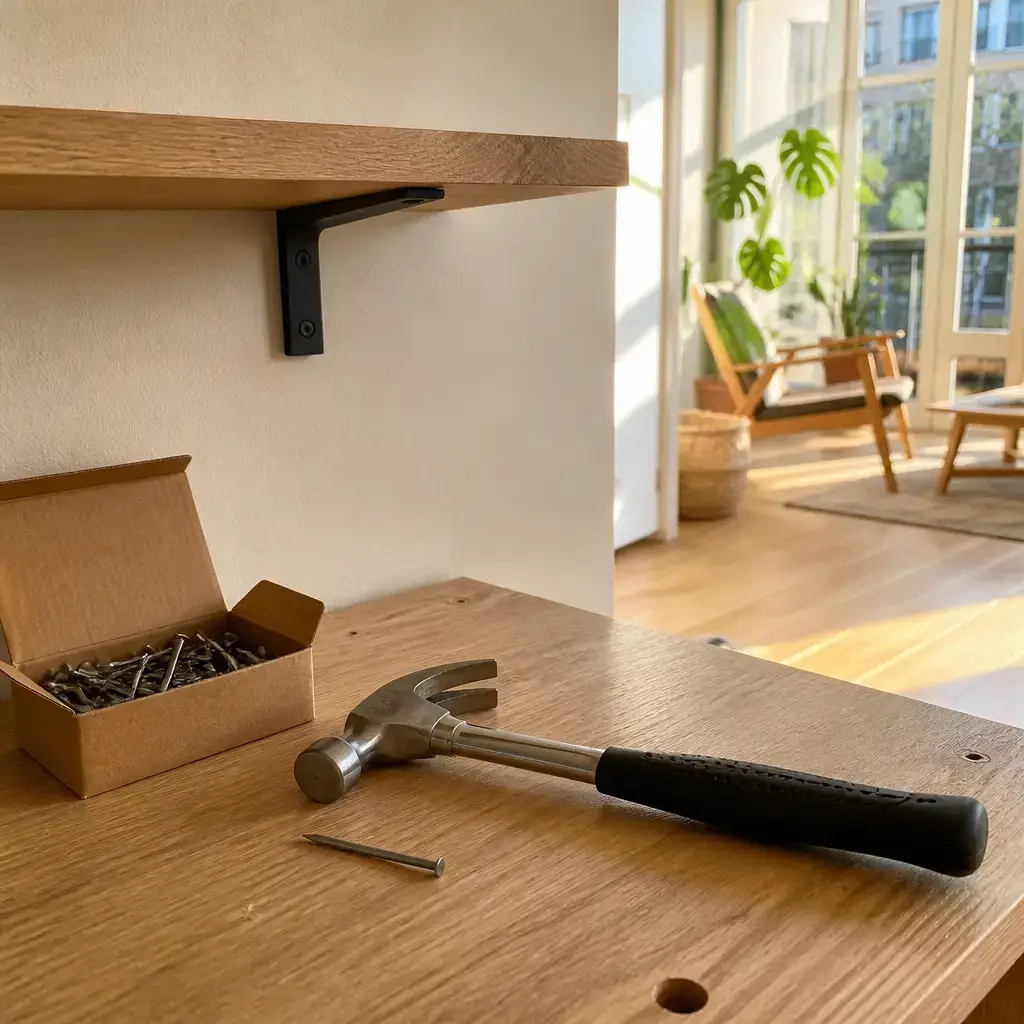
Use Borrowing a hammer and nails to practice Danish conversation, pronunciation, vocabulary, grammar, and quizzes.
Dialogue
Har du en hammer, jeg kan bruge?
hah doo en HAM-uh, yai kan BROO-uh? Do you have a hammer I can use?Brug denne, men hold godt fast om håndtaget.
broo DEN-uh, men hol goht fast ohm HAWN-tay-uh. Use this one, but grip the handle firmly.Jeg skal bruge den til at reparere denne hylde.
yai skal BROO-uh den teel uh ray-puh-RAIR-uh DEN-uh HYL-uh. I need it to fix this shelf.Har du også brug for søm?
hah doo OH-saw broo fohr suhm? Do you also need any nails?Et søm ville hjælpe.
et suhm vil YEL-puh. One nail would help.De ligger i kassen ved siden af dig.
dee LIG-uh ee KAS-en vay SEE-den ah dee. They are in the box beside you.Jeg lægger hammeren tilbage, når jeg er færdig.
yai LEG-uh HAM-uh-en beh-TAH-luh, nohr yai air FAIR-dee. I will return the hammer when I finish.Læg den her sammen med de andre værktøjer, når du er færdig.
lay den hair sah-MEN may dee AHN-druh VAIRK-toy-uh, nohr doo air FAIR-dee. Leave it here with the other tools when you are done.Sentence explanations
Har du en hammer, jeg kan bruge?
Do you have a hammer I can use?
- Har du
- do you have
- hammer
- hammer
- jeg
- I
- kan
- can
- bruge
- use
More detail
Har du is the Danish question pattern for “do you have”. har is the present-tense form of have, and du means “you”. In a yes/no question, the verb comes before the subject: Har du ...? Compare the statement Du har ... (“You have ...”). hammer means “hammer”. It is a noun; with the indefinite article en, the phrase en hammer means “a hammer”. Here, en introduces an unspecified hammer; it does not by itself state a numeric count. jeg means “I” and is the subject form used for the speaker. It is distinct from object forms such as mig (“me”): Jeg bruger hammeren means “I use the hammer,” while Han ser mig means “He sees me.” kan means “can” here, expressing ability or possibility. It is the present form of the modal verb kunne. Danish modal verbs are followed by an infinitive without at: jeg kan bruge means “I can use,” not a form with an added infinitive marker. bruge means “use”. This is the infinitive form after kan; the subject jeg supplies the understood actor. The present-tense form without a modal is bruger: Jeg bruger hammeren means “I use the hammer.” Together, Har du en hammer asks whether the addressee has an unspecified hammer. The clause jeg kan bruge identifies the requested hammer as one the speaker can use: literally, “Do you have a hammer that I can use?” The full utterance therefore means “Do you have a hammer I can use?”
Brug denne, men hold godt fast om håndtaget.
Use this one, but grip the handle firmly.
- Brug
- use
- denne
- this one
- hold godt fast
- grip firmly
- håndtaget
- the handle
More detail
Brug is the imperative of bruge (“to use”). It gives a direct instruction to one or more people; the form does not show the number of people addressed. Example: Brug denne. — “Use this one.” denne is a demonstrative meaning “this one” here. It is the common-gender singular form; Danish uses dette with singular neuter nouns and disse for plural nouns. In the supplied context, the item being selected is understood from the situation, while the word itself marks it as singular and near or contextually current. hold godt fast contains the imperative hold of holde (“to hold”) and the adverbial expression godt fast, which intensifies the grip: “firmly” or “tightly.” The pattern hold fast is reusable for maintaining a firm hold. Example: Hold fast i rækværket. — “Hold firmly onto the railing.” håndtaget means “the handle.” Its base noun is håndtag, a neuter noun: et håndtag (“a handle”), håndtaget (“the handle”). The ending -et marks singular definite form here. The phrase om håndtaget specifies what the firm grip is around: “around the handle.” Together, the imperative Brug denne selects the nearby/current item, and men introduces a contrasting instruction: hold godt fast om håndtaget. The complete meaning is: “Use this one, but grip the handle firmly.”
Jeg skal bruge den til at reparere denne hylde.
I need it to fix this shelf.
- Jeg skal
- I need to
- bruge
- use
- den
- it
- til at
- to
- reparere
- repair; fix
- denne
- this
- hylde
- shelf
More detail
Jeg skal combines jeg (“I”) with skal, the present form of skulle. Skal can express necessity, obligation, or a planned action. In this sentence, however, its meaning is completed by bruge: the combination skal bruge is used here for “need” or “require”, as confirmed by the fixed translation. bruge is the infinitive of bruge, whose ordinary meaning is “use”. In the combination skal bruge, the whole verb phrase means “need” or “require”: Jeg skal bruge en hammer means “I need a hammer.” Outside that combination, Jeg bruger en hammer means “I use a hammer.” den is a singular common-gender pronoun used here as the object of bruge, meaning “it”. The fixed translation identifies it as the item needed for the repair. The same form can also be used as a common-gender singular demonstrative or determiner. til at introduces the purpose of an action. The reusable pattern til at + infinitive commonly means “to …” or “for …ing”. Here it introduces the purpose for which the item is needed. reparere is the infinitive “to repair” or “to fix”. Danish uses the infinitive after til at; this form has no person ending. Example: Hun bruger lim til at reparere koppen. — “She uses glue to repair the cup.” denne is a singular common-gender demonstrative meaning “this”. In denne hylde, it agrees with the common-gender noun hylde; singularity alone does not determine this form. Other forms include dette with a neuter singular noun and disse with a plural noun. hylde is the noun “shelf”. Its plural is hylder: to hylder means “two shelves”. Here, denne hylde means “this shelf”. Together, Jeg skal bruge den means “I need it” in this context, til at reparere gives the purpose “to fix”, and denne hylde identifies what is to be fixed. The complete utterance therefore means: “I need it to fix this shelf.”
Har du også brug for søm?
Do you also need any nails?
- Har du
- do you have
- også
- also
- brug for
- need
- søm
- nails
More detail
Har du is the question opening formed with har (“have”) before the subject du (“you”). Danish commonly forms a yes/no question by placing the finite verb before the subject: Har du ...? means “Do you have ...?” or, with a following expression, “Do you ...?” også means “also/too” and adds the idea that this need is in addition to something else. Its position here is after du; in a new sentence, keep it near the part whose addition you want to emphasize. brug for is part of the reusable Danish expression have brug for (“need” or literally “have use for”). The phrase brug for should not be treated as an ordinary English-style verb meaning “need” by itself: the required pattern is have brug for + noun. Example: Jeg har brug for hjælp. — “I need help.” søm means “nail” here. The form can be singular or plural in Danish: et søm is “one/a nail,” while søm can also mean “nails” without an indefinite article. In this utterance, the fixed translation gives the plural reading “any nails”; the following context separately uses Et søm for “one nail.” Together, Har du ...? makes a yes/no question, også adds “also,” and brug for søm supplies what is needed. The whole utterance therefore means: “Do you also need any nails?”
Et søm ville hjælpe.
One nail would help.
- Et
- a/an
- søm
- nail
- ville
- would
- hjælpe
- help
More detail
Et is the indefinite article used here with a singular neuter noun. It means “a/an”; it does not by itself assert a numerical count beyond presenting the noun as one unspecified instance. Compare en with singular common-gender nouns and et with singular neuter nouns. søm means “nail” here. With et, the form is singular: “a nail.” Danish also uses søm as the plural of this noun, so the article is important for identifying the singular reading in this sentence. The noun’s form does not change between singular indefinite and plural; the surrounding words show which reading is intended. ville means “would” in this utterance. It is the past-tense form of vil, and it can express a hypothetical or conditional result when combined with an infinitive. A useful pattern is ville + infinitive: Det ville hjælpe means “That would help.” hjælpe means “help.” It is the infinitive form, used after the modal ville; Danish does not add at in this construction. The related present-tense form is hjælper, as in Det hjælper (“That helps”). Together, Et søm presents an unspecified singular nail as the thing under discussion, and ville hjælpe says that this nail would help. The complete meaning is “One nail would help.”
De ligger i kassen ved siden af dig.
They are in the box beside you.
- De
- they
- ligger
- are located
- kassen
- the box
- ved siden af
- beside
- dig
- you
More detail
De is the third-person plural subject pronoun, meaning “they” here. It does not identify the people or things further; the fixed translation supports only the plural “they.” Compare du (“you,” singular subject) with dig (“you,” singular object), used later in the sentence. ligger is the present-tense form of ligge, “to lie” or “to be situated.” Here it describes the location of the subject: “are located.” Danish uses ligge for something being situated, while lægge means “to lay” or “to put” something somewhere and normally takes an object. Example: Bogen ligger på bordet. — “The book is on the table.” kassen means “the box.” It is the definite singular form of kasse: en kasse means “a box,” while kassen means “the box.” The ending -en marks common-gender singular definiteness in this noun; it is not a separate word. ved siden af is a fixed prepositional construction meaning “beside” or “next to.” Its literal structure refers to being at the side of something, but it should be learned as the reusable pattern ved siden af + noun/pronoun. Example: Hun sidder ved siden af mig. — “She is sitting beside me.” dig is the object form of the singular second-person pronoun du, meaning “you.” After a preposition such as ved siden af, Danish uses the object form: ved siden af dig — “beside you.” Together, De ligger says “they are situated,” i kassen says “in the box,” and ved siden af dig adds the location “beside you.” The complete utterance therefore means: “They are in the box beside you.”
Jeg lægger hammeren tilbage, når jeg er færdig.
I will return the hammer when I finish.
- Jeg
- I
- lægger
- put/place
- hammeren
- the hammer
- tilbage
- back
- når
- when
- færdig
- finished/done
More detail
Jeg means “I” here: it is the first-person singular subject pronoun, used for the speaker. For comparison, du means “you” for one addressee, while jeg does not change for the speaker’s gender. lægger is the present form of lægge, “to put/place.” In this sentence, lægger ... tilbage means “put ... back,” so it is useful as a reusable placement pattern. The present form can also describe a planned future action when the time is clear from context; that is why the fixed translation uses “will return.” hammeren means “the hammer.” hammer is the base noun, and the ending -en marks definite singular for this noun: en hammer = “a hammer,” hammeren = “the hammer.” The definite form identifies the particular hammer intended here; the sentence does not state how many hammers there are overall. tilbage means “back” or “back to its previous place.” It completes the meaning of lægger in lægger ... tilbage: the object is placed back rather than merely placed somewhere. når means “when” and introduces the time clause that follows. A reusable pattern is når + clause, as in Jeg ringer, når jeg er klar. — “I’ll call when I’m ready.” færdig means “finished” or “done.” In jeg er færdig, the adjective is used with er (“am”) to describe the speaker’s state: “I am finished/done.” Its base form is færdig; it is not an inflected form of jeg or er. The first part, Jeg lægger hammeren tilbage, gives the action and its object: “I put/return the hammer.” The clause når jeg er færdig gives the time condition: “when I am finished.” Together, the utterance means “I will return the hammer when I finish,” with the Danish present form expressing the planned action in this context.
Læg den her sammen med de andre værktøjer, når du er færdig.
Leave it here with the other tools when you are done.
- Læg
- put / lay
- den
- it
- her
- here
- sammen med
- together with
- andre
- other
- værktøjer
- tools
- når
- when
- du
- you
- er
- are
- færdig
- done
More detail
Læg is the imperative of lægge, “to put/lay.” It gives a direct instruction to the person addressed; the imperative normally has no stated subject. Compare lægger, the present form: Jeg lægger hammeren tilbage. — “I put the hammer back.” den is a pronoun meaning “it” here. It is the common-gender singular form, and Danish uses it here as the object of Læg; Danish does not mark a separate object form for this pronoun. The fixed translation identifies its intended meaning as “it,” without identifying the object's specific noun. her is the adverb “here,” specifying the place of the instructed action. sammen med is a reusable construction meaning “together with” or “along with”: Læg bogen sammen med papirerne. — “Put the book together with the papers.” andre means “other” and is the plural form agreeing with værktøjer in de andre værktøjer. Its singular forms are anden with common-gender nouns and andet with neuter nouns. værktøjer means “tools”; its singular base form is værktøj, and værktøjer is the plural. Together, de andre værktøjer means “the other tools.” når introduces a time clause meaning “when.” It connects the instruction to the condition that follows: the putting should happen when the addressed person has finished. du is the second-person singular pronoun “you.” er is the present form of være, “to be.” færdig is an adjective meaning “done” or “finished.” Here it describes du, so du er færdig means “you are done.” færdig is the common-gender singular form; the neuter singular form is færdigt, and the plural form is færdige. The choice here is not based on singularity alone: du refers to one person, and Danish uses the common-gender form for this human-person construction regardless of whether that person is male or female. For a neuter singular subject, use færdigt, as in Det er færdigt. — “It is finished.” The whole utterance assembles as an imperative: Læg den her sammen med de andre værktøjer means “Put it here together with the other tools.” The time clause når du er færdig adds “when you are done,” giving the complete meaning: “Leave it here with the other tools when you are done.” This is a direct, ordinary instruction.
Grammar Points
skal + infinitiv
Jeg skal bruge hammeren.
yai skal BROO-uh HAM-uh-en.I need to use the hammer.
After skal, the next verb stays in the infinitive: skal bruge, not skal bruger.
have brug for + noun
Jeg har brug for søm.
yai har BROO fohr suhm.I need nails.
Danish expresses “need” with have brug for, literally “have need for,” followed by a noun.
Danish Vocabulary
Jeg kan bruge den.
Brug denne.
- Gender
- common
Jeg lægger hammeren tilbage.
Har du en hammer?
Har du også brug for søm?
Hold godt fast om håndtaget.
- Gender
- common
Denne hylde.
- Gender
- neuter
Om håndtaget.
Har du også brug for søm?
Til at reparere denne hylde.
Jeg skal bruge den.
- Gender
- neuter
Et søm; brug for søm.
Quiz
Word Order
Arrange the words in the correct order.
Do you also need any nails?
Show Answer
Har du også brug for søm?One nail would help.
Show Answer
Et søm ville hjælpe.Spelling
Tap the letters to spell the word.
hammer
Show Answer
hammerenrepair; fix
Show Answer
reparerethis
Show Answer
denneshelf