10 minutes free every day
Continue audio lessons in the app
Word explanations appear automatically in sync with the audio.
No login required · synced translations · playback with the screen locked
Choose your learning language and open this lesson in the app.

About This Lesson
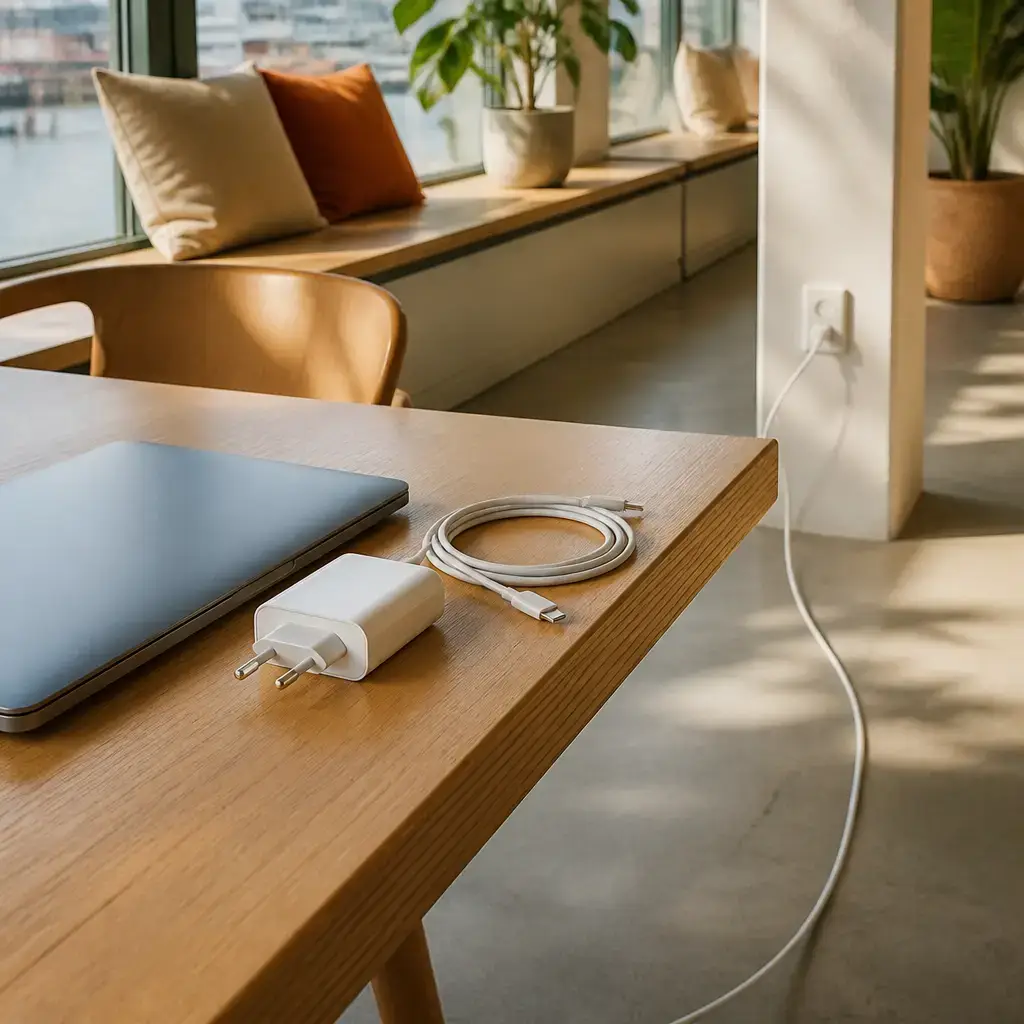
Use Borrowing a charger and adapter to practice Danish conversation, pronunciation, vocabulary, grammar, and quizzes.
Dialogue
Er der en oplader, jeg kan låne?
air dah en OH-plah-dah, yai kan LOH-nuh? Is there a charger I can borrow?Brug den ved siden af min bærbare computer.
BROO den veh SEE-thun ow meen BAIR-bah-reh kom-POO-tah. Use the one beside my laptop.Har jeg også brug for denne adapter?
har yai AW-soh broo for DEN-uh a-DAP-tah? Do I need this adapter too?Brug den, hvis dit stik ikke passer.
BROO den, ves deet steek EHK-uh PAS-uh. Use it if your plug does not fit.Kan kablet nå hen til bordet?
kan KAY-blut noh hen TEEL BOHR-thuh? Will the cable reach the table?Det kan nå, hvis du sidder tæt på væggen.
deh kan noh, ves doo SEE-thah teht poh VEH-gun. It reaches if you sit near the wall.Jeg lægger det hele tilbage, når jeg er færdig.
yai LEG-uh deh HEH-luh teh-BAIR, nawr yai air FAIR-dee. I will put everything back when I finish.Læg det på mit skrivebord, så jeg kan finde det.
lehg deh poh meet SKREE-vuh-bohrd, soh yai kan FEH-nuh deh. Leave it on my desk so I can find it.Sentence explanations
Er der en oplader, jeg kan låne?
Is there a charger I can borrow?
- Er der
- is there
- oplader
- charger
- jeg kan
- I can
- låne
- borrow
More detail
Er der is a reusable Danish way to ask whether something exists or is available: literally an existential “is there”. Here, der is an existential element, not a reference to a particular place. The verb er is the present form of være (“to be”). Example: Er der kaffe? — “Is there coffee?” oplader means “charger” here. Its base form is also oplader; Danish nouns do not change form for singular versus plural in every context, but the indefinite singular form here is marked by en: en oplader. The article marks an indefinite singular common-gender noun; it does not by itself emphasize a numerical count. Example: Jeg har en oplader. — “I have a charger.” jeg kan combines the first-person pronoun jeg (“I”) with kan, the present form of the modal verb kunne (“can; be able to”). kan is used with different subjects in the present rather than changing for person: jeg kan, du kan, hun kan. A modal is followed by an infinitive without at here. Example: Jeg kan hjælpe. — “I can help.” låne is the infinitive “borrow” in this sentence. With kan, it stays in the infinitive: jeg kan låne. Danish låne can have meanings related to borrowing or lending depending on the construction and context; the fixed translation establishes the borrowing meaning here. Example: Må jeg låne din bog? — “May I borrow your book?” Together, Er der asks whether something is available, en oplader identifies the sought item, and jeg kan låne expresses the possibility of borrowing it. The whole utterance therefore means: “Is there a charger I can borrow?”
Brug den ved siden af min bærbare computer.
Use the one beside my laptop.
- Brug
- use
- den
- the one
- ved siden af
- beside
- min
- my
- bærbare
- portable
- computer
- computer
More detail
Brug is the imperative of bruge, “to use.” It gives a direct instruction. Compare bruger (“use/uses” in a present-tense statement) and brugte (“used” in the past). Example: Brug denne. — “Use this one.” den means “the one” here: a singular common-gender form used without repeating the noun. In the supplied context, the preceding question makes a charger the supported referent. In other contexts, den can refer to another known common-gender singular item. Example: Jeg tager den. — “I’ll take that one.” ved siden af is the reusable prepositional expression “beside” or “next to.” It identifies the location of the item to use. Example: Tasken står ved siden af stolen. — “The bag is beside the chair.” min means “my” before a singular common-gender noun. Its form agrees with the possessed noun, not with the possessor. With a neuter noun, the corresponding form is mit; with plural nouns, it is mine. Example: min stol — “my chair,” but mit bord — “my table.” bærbare is the definite/possessive attributive form of the adjective bærbar, “portable.” In min bærbare computer, the possessive makes the noun phrase definite, so the adjective takes -e. The adjective describes computer; it is not the possessive form. Bærbar can also be used substantively in suitable contexts, as in den bærbare (“the laptop”), but that is a different use. computer means “computer.” The full noun phrase min bærbare computer means “my laptop,” literally “my portable computer.” Together, den identifies the already relevant item, and ved siden af min bærbare computer locates it. The complete utterance is therefore an imperative: “Use the one beside my laptop.”
Har jeg også brug for denne adapter?
Do I need this adapter too?
- Har jeg
- do I have
- også
- also; too
- brug for
- need
- denne
- this
- adapter
- adapter
More detail
Har jeg is the question order of the verb har (“have”) followed by the subject jeg (“I”). In a Danish yes/no question, the finite verb commonly comes before the subject: Har jeg ...? = “Do I ...?” Here, har is the present form of have. også means “also” or “too”. Its position after jeg adds the idea that this need is included along with some other need or item. Example: Har du også brug for den? — “Do you need it too?” brug for is part of the Danish expression have brug for (“need”). The word brug by itself can have other uses, but in this construction it combines with for to express needing something. The pattern is have brug for + noun/pronoun. denne means “this” and is the singular form used here before adapter. Danish also has dette with singular neuter nouns and disse for plural nouns; the choice is tied to the noun’s grammatical form, not simply to physical distance. adapter is “adapter”. It is a noun; the definite form is adapteren (“the adapter”). In this sentence, the indefinite-looking noun follows the demonstrative denne, which already identifies the item as “this adapter”. Together, Har jeg forms the yes/no question, også adds “too”, and brug for denne adapter expresses needing this adapter. The complete meaning is: “Do I need this adapter too?”
Brug den, hvis dit stik ikke passer.
Use it if your plug does not fit.
- Brug
- use
- den
- it
- hvis
- if
- dit
- your
- stik
- plug
- ikke
- not
- passer
- fit
More detail
Brug is the imperative of bruge, “to use.” The imperative gives a direct instruction and normally has the same form for the person being addressed. Example: Brug denne nøgle. — “Use this key.” den is a singular common-gender object pronoun, meaning “it” here. In the supplied context, it refers to the adapter mentioned in the question. Danish contrasts den with neuter singular det and plural dem; the choice depends on the referent’s grammatical gender and number, not on the pronoun’s position alone. hvis introduces a condition: “if.” A reusable pattern is hvis + clause, as in Ring, hvis du har tid. — “Call if you have time.” dit means “your” before a neuter singular noun. It agrees with stik, not with the possessor: dit stik is “your plug.” Before a common-gender singular noun, the corresponding form is din, and before a plural noun it is dine. The possessive expresses the relation to “you”; it does not by itself state how many plugs there are. stik is the noun “plug” in this sentence. It is a neuter noun, shown by the article et: et stik. Its plural is stik, so number is marked by context or another word rather than by a changed noun form here. In this utterance, the fixed translation supports the electrical meaning “plug.” ikke negates the clause that follows it here. Danish commonly places ikke after the finite verb in a simple main clause, but in this subordinate clause it follows the subject: dit stik ikke passer — “your plug does not fit.” passer is the present-tense form of passe, “to fit” here. The form is the same for different subjects in the present tense: jeg passer, du passer, and stikket passer. In other contexts, passe can have other meanings, such as “take care of,” but the plug context selects “fit.” Example: Skoen passer. — “The shoe fits.” Together, Brug den gives the instruction “Use it.” The conditional clause hvis dit stik ikke passer adds the condition “if your plug does not fit.” Thus the whole utterance means “Use it if your plug does not fit.”
Kan kablet nå hen til bordet?
Will the cable reach the table?
- Kan
- will
- kablet
- the cable
- nå
- reach
- hen til
- to; as far as
- bordet
- the table
More detail
Kan is the present-tense form of kunne, “can/be able to.” In this question, with the fixed translation, it asks prospectively whether the cable will be able to reach; Danish kan itself does not mark a separate future tense. It is followed by an infinitive: Kan du komme? means “Can you come?” kablet means “the cable” here. Its base form is kabel; the definite singular form is kablet. Danish forms definiteness on the noun, so et kabel is “a cable,” while kablet is “the cable.” nå is the infinitive “reach.” It is the form used after the modal kan: Kablet kan nå ... means “The cable can reach ...” In another common use, nå can mean “manage to get to” or “catch up with,” but the intended sense here is reaching a physical endpoint. hen til is a directional expression meaning “to” or “as far as,” emphasizing the endpoint reached. It can be reused with a destination: Gå hen til døren. — “Walk over to the door.” bordet means “the table.” Its base form is bord; bordet is the definite singular form. The indefinite form is et bord (“a table”), and the plural definite form is bordene (“the tables”). Together, Kan + kablet + nå asks whether “the cable” is able to reach hen til the endpoint bordet: “Will the cable reach the table?”
Det kan nå, hvis du sidder tæt på væggen.
It reaches if you sit near the wall.
- Det
- it
- kan
- can
- nå
- reach
- hvis
- if
- du
- you
- sidder
- sit
- tæt på
- close to
- væggen
- the wall
More detail
Det is the neuter singular form of the third-person pronoun meaning “it.” In the supplied context, it refers to the cable mentioned in the preceding question. Danish pronouns must match the grammatical properties of what they replace; det is used with a neuter singular referent. Example: Det virker. — “It works.” kan is the present form of kunne, “can” or “be able to.” It is followed by an infinitive, so kan nå means “can reach.” The modal kan does not change for the subject: jeg kan and du kan both mean “I can” and “you can.” Example: Kablet kan nå bordet. — “The cable can reach the table.” nå is the infinitive “reach” in this sentence. It can also mean “arrive” in other contexts, but here it describes sufficient physical length or range to reach something. After a modal such as kan, Danish uses the infinitive without an extra infinitive marker: kan nå. hvis introduces a condition and means “if.” It begins the conditional clause hvis du sidder tæt på væggen, which states the condition under which the main clause applies. Example: Det virker, hvis du trykker her. — “It works if you press here.” du is the second-person singular pronoun, “you.” It is the subject of the conditional clause. Danish uses du for one person in both informal and many ordinary direct-address situations; the verb form does not change to show that subject. sidder is the present form of sidde, “sit.” In this sentence, the present form describes the condition “if you are sitting” or “if you sit.” The form is used with du as well as other subjects: jeg sidder, du sidder, and de sidder. Example: Du sidder ved vinduet. — “You are sitting by the window.” tæt på is a fixed prepositional expression meaning “close to” or “near.” på connects the expression to the place or object that follows. Example: Stolen står tæt på døren. — “The chair is close to the door.” væggen means “the wall.” Its base form is væg, “wall,” and the ending -en marks the singular definite form: væg = “a wall” or “wall” in an indefinite noun phrase, while væggen = “the wall.” This ending belongs to the noun, not to tæt på. Example: Jeg maler væggen. — “I am painting the wall.” Together, Det kan nå means “It can reach,” and hvis du sidder tæt på væggen means “if you sit near the wall.” The whole utterance is therefore: “It reaches if you sit near the wall.” The modal construction kan + infinitive nå expresses the object’s ability or sufficient range, while the hvis clause gives the condition.
Jeg lægger det hele tilbage, når jeg er færdig.
I will put everything back when I finish.
- Jeg
- I
- lægger
- put; place
- det hele
- everything
- tilbage
- back
- når
- when
- jeg er færdig
- I am finished
More detail
Jeg means “I” and identifies the speaker as the subject. Danish uses jeg for the first-person singular subject; for example, Jeg kommer. means “I am coming.” lægger means “put” or “place” here. Its base form is lægge, and lægger is the present-tense form. Danish present tense can also describe a planned future action when the context makes that clear, as in this sentence’s “I will put.” Do not confuse it with ligger, “lies/is located”: lægger describes placing something, while ligger describes something already being located somewhere. Example: Jeg lægger bogen på bordet. — “I put the book on the table.” det hele means “everything” or “the whole lot” here. det is the neuter singular form of the demonstrative/personal form “it,” and hele is the adjective hel (“whole”) in its neuter form. Together, this expression refers to the complete set of relevant things, without stating a numerical count. Example: Jeg tager det hele med. — “I’m taking everything with me.” tilbage means “back,” indicating return to an earlier place or condition. With lægger, lægger ... tilbage means “put ... back.” Example: Hun lægger nøglen tilbage. — “She puts the key back.” når introduces a time clause meaning “when.” It connects an event with the time at which another event occurs. Example: Jeg ringer, når jeg kommer hjem. — “I’ll call when I get home.” jeg er færdig literally says “I am finished/done.” er is the present form of være (“be”), and færdig is an adjective meaning “finished” or “done.” In this sentence, the phrase identifies the point at which the speaker has finished the relevant task; it does not itself specify which task. Here færdig is the adjective’s common-gender form; it is not an inflection of jeg, and its form is not determined by the grammatical person of the subject. Example: Jeg er færdig med arbejdet. — “I am finished with the work.” Together, Jeg lægger det hele tilbage means “I put everything back,” with the Danish present tense understood as a future plan in the fixed translation. når jeg er færdig adds the time condition “when I finish.” The complete utterance therefore means “I will put everything back when I finish.”
Læg det på mit skrivebord, så jeg kan finde det.
Leave it on my desk so I can find it.
- Læg
- leave; put
- det
- it
- på
- on
- mit
- my
- skrivebord
- desk
- så
- so
- jeg kan
- I can
- finde
- find
- det
- it
More detail
Læg is the imperative of lægge, “to put/place.” The imperative is used for a direct instruction: Læg bogen her. means “Put the book here.” In this sentence, the intended instruction is “Leave/place it,” as reflected by the fixed translation. det is the third-person singular neuter object pronoun, “it.” Its specific referent is supplied by the surrounding situation, while its grammatical form is neuter singular. The same form appears again at the end and refers to the same intended item. på means “on” and introduces the surface or location where something is placed. mit means “my” and is the first-person singular possessive form used with a neuter singular noun. Danish possessives vary with the possessed noun: min is used with common-gender singular nouns, mit with neuter singular nouns, and mine with plural nouns. skrivebord means “desk.” Its base form is the neuter noun skrivebord; the corresponding definite singular form is skrivebordet, “the desk.” Because skrivebord is neuter singular, the phrase uses mit: mit skrivebord, “my desk.” så means “so” or “so that” here. It links the placing instruction to its purpose or intended result; it is not merely a time word in this use. jeg kan is the reusable pattern “I can.” jeg is the first-person singular subject pronoun, and kan is the present-tense form of kunne, “to be able to/can.” After this modal, Danish uses an infinitive without an extra infinitive marker: Jeg kan se det. means “I can see it.” finde is the infinitive of finde, “to find.” In kan finde, it follows the modal kan and expresses the action that the speaker will be able to perform. The final det is again “it,” functioning as the object of finde. Together, Læg det på mit skrivebord means “Leave/place it on my desk.” The comma introduces så jeg kan finde det, “so I can find it.” The complete utterance is therefore: “Leave it on my desk so I can find it.”
Grammar Points
have brug for + noun
Har du brug for en oplader?
har doo broo for en OH-plah-dah?Do you need a charger?
Danish expresses “need” with the fixed phrase have brug for, followed by the thing needed.
Når ..., så ...
Når du er færdig, så lægger du det hele tilbage.
nawr doo air FAIR-dee, soh LEG-uh doo deh HEH-luh teh-BAIR.When you are finished, you put everything back.
Når introduces a time clause. Så can introduce the result or next action in the main clause.
Danish Vocabulary
- Gender
- common
- Gender
- neuter
- Gender
- common
- Gender
- neuter
Quiz
Word Order
Arrange the words in the correct order.
Will the cable reach the table?
Show Answer
Kan kablet nå hen til bordet?Spelling
Tap the letters to spell the word.
plug
Show Answer
stikcharger
Show Answer
opladeruse
Show Answer
Brugadapter