10 minutes free every day
Continue audio lessons in the app
Word explanations appear automatically in sync with the audio.
No login required · synced translations · playback with the screen locked
Choose your learning language and open this lesson in the app.

About This Lesson
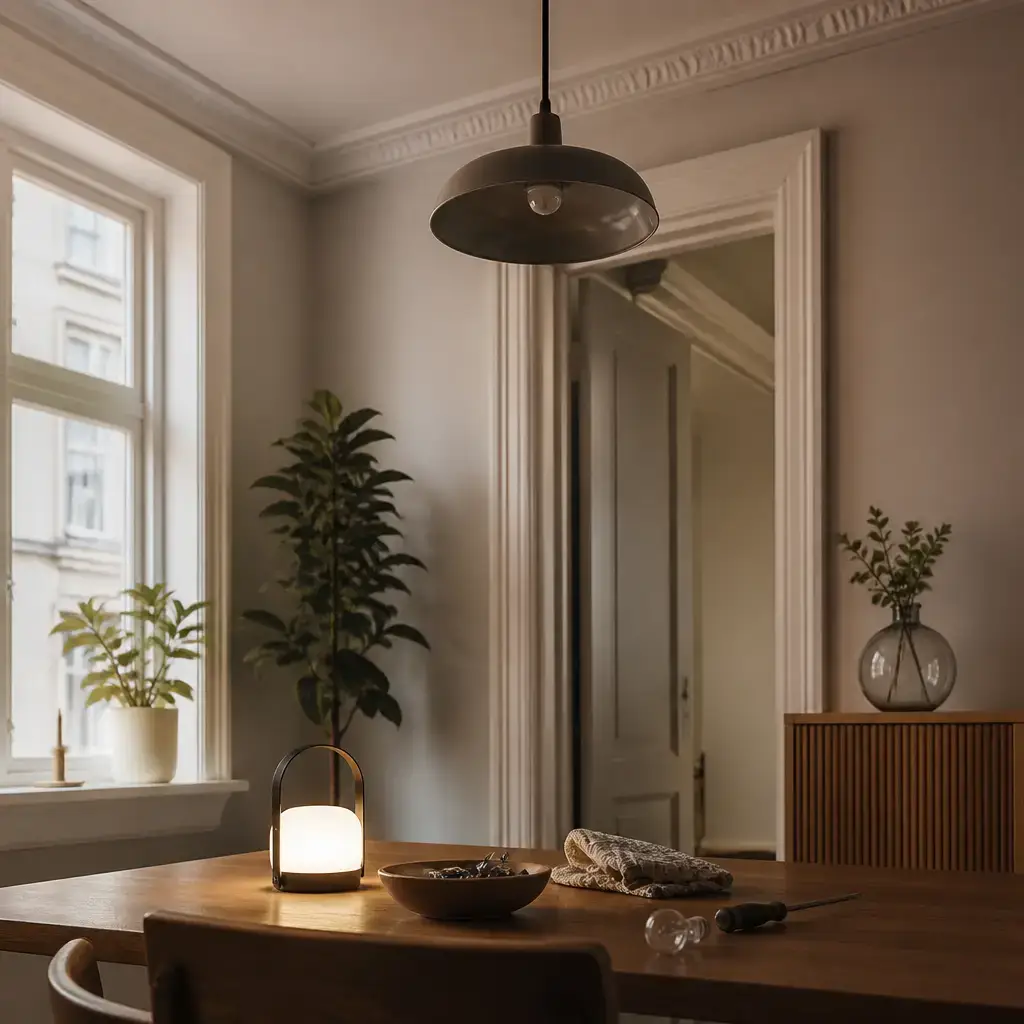
Use A Light Problem to practice Danish conversation, pronunciation, vocabulary, grammar, and quizzes.
Dialogue
Lyset virker ikke.
LOO-suh VAIR-guh EG-uh. The light does not work.Har du tjekket kontakten?
HAH doo CHEK-ud kon-TAHGD-den? Did you check the switch?Jeg tjekkede den, og den virker stadig ikke.
yai CHEK-uh-deh den, oh den VAIR-guh STEH-ee EG-uh. I checked it, and it still does not work.Måske er pæren gammel.
MOH-sguh air PAIR-n GAH-mul. Maybe the bulb is old.Rummet er for mørkt nu.
ROH-muth air fohr MURK(t) noo. The room is too dark now.Jeg kan hente en lille lampe.
yai kan HEN-uh un LEH-luh LEM-buh. I can bring a small lamp.Vi bør skifte pæren senere.
vee BUR SGIF-duh PAIR-n SAY-nuh-ruh. We should change the bulb later.Brug lampen, indtil vi skifter pæren.
broo LEM-bun un-TEEL vee SGIF-duh PAIR-n. Use the lamp until we replace it.Sentence explanations
Lyset virker ikke.
The light does not work.
- Lyset
- the light
- virker
- works
- ikke
- not
More detail
Lyset is the definite singular form of lys, “light.” The form lys is a neuter noun: et lys means “a light,” while lyset means “the light.” The definite ending -et marks the identified singular noun here. virker comes from virke, “to work” or “to function.” It is the present-tense form used with a singular subject as well as with plural subjects in Danish; the subject’s number is not shown by a different present-tense ending here. For example, Lampen virker. means “The lamp works.” ikke is the ordinary negation word “not.” In this main clause it follows the finite verb: Lyset virker ikke follows the reusable pattern “subject + present-tense verb + ikke.” Compare Lyset virker. — “The light works” — with Lyset virker ikke. — “The light does not work.” Together, Lyset identifies the light, virker says that it functions, and ikke reverses that statement. The whole utterance therefore means “The light does not work.”
Har du tjekket kontakten?
Did you check the switch?
- Har du
- have you
- tjekket
- checked
- kontakten
- the switch
More detail
Har du is the Danish question pattern for “have you …?” Here du is the subject “you,” and har is the present form of have. Danish commonly forms a question by placing the finite verb before the subject: Har du ...? Compare the reusable statement pattern Du har ... (“You have ...”). Example: Har du set filmen? — “Have you seen the film?” tjekket is the past participle of tjekke, “to check.” It combines with har to form the perfect: har tjekket, “have checked.” The participle does not change for the subject here, so the same form can occur with jeg har tjekket (“I have checked”) and du har tjekket (“you have checked”). Example: Jeg har tjekket døren. — “I have checked the door.” kontakten is the definite singular form of kontakt; the ending -en marks “the” with this noun. In this fixed sentence, the translation identifies kontakten as “the switch.” The indefinite form is en kontakt (“a switch”); the definite form is kontakten (“the switch”). Putting the parts together, Har du tjekket kontakten? asks whether the addressee has checked the switch. The verb-first order marks it as a yes/no question, and har plus the past participle tjekket presents the checking as a completed action relevant to the current situation.
Jeg tjekkede den, og den virker stadig ikke.
I checked it, and it still does not work.
- Jeg
- I
- tjekkede
- checked
- den
- it
- og
- and
- den
- it
- virker
- works
- stadig
- still
- ikke
- not
More detail
Jeg means “I” and is the first-person singular subject pronoun. It identifies the speaker as the person who performed the checking. A useful contrast is du (“you”), as in Har du tjekket ...? — “Have you checked ...?” tjekkede is the past-tense form of tjekke, “to check.” The ending -ede is used here for a completed past action: Jeg tjekkede ... means “I checked ...”. The context question uses tjekket, the past participle in Har du tjekket ...? (“Have you checked ...?”); this is a different form used with har. The first den is a common-gender singular object pronoun, translated here as “it.” It stands for the thing that was checked, but the fixed sentence does not uniquely name that thing. Danish den is also used for a common-gender singular noun in other roles; its grammatical form does not by itself identify the referent. og joins the two clauses and means “and.” It presents the checking and the following result as connected information. The second den is again a common-gender singular pronoun, translated here as “it.” In den virker, it functions as the subject of virker. The repeated form links the thing that was checked with the thing whose operation is being described, while the exact noun being referred to remains implicit. virker is the present-tense form of virke, “to work” or “to function.” In this sentence it describes the current state of the thing: den virker means “it works.” Danish present-tense forms commonly do not change for the subject’s person or number, so the same form can occur with jeg, du, or den; for example, Lampen virker. means “The lamp works.” stadig means “still.” It shows that the situation continues to hold at the relevant time. Here it modifies the negative statement, so stadig ikke virker means “still does not work,” not simply “works again.” ikke is the ordinary negation word “not.” With virker, it produces virker ikke, “does not work.” The combination stadig ikke places the continuing aspect and the negation together: the item remains nonfunctional. Together, Jeg tjekkede den means “I checked it.” og den virker stadig ikke means “and it still does not work.” The complete utterance therefore means “I checked it, and it still does not work.”
Måske er pæren gammel.
Maybe the bulb is old.
- Måske
- Maybe
- er
- is
- pæren
- the bulb
- gammel
- old
More detail
Måske means “maybe” and marks the statement as uncertain. It comes first here, so it applies to the whole proposition rather than to just one word. Example: Måske kommer hun. — “Maybe she is coming.” er is the present-tense form of at være, “to be.” In this sentence it links the subject to a description: X er Y = “X is Y.” The form er is used with different subjects in the present tense; Danish does not change it for singular versus plural. Example: Rummet er mørkt. — “The room is dark.” pæren means “the bulb” here. The ending -en marks the common-gender singular definite form: en pære = “a bulb,” pæren = “the bulb.” The fixed translation identifies the intended sense as a light bulb, rather than the other common meaning “pear.” gammel means “old.” It is the basic, non-comparative form of the adjective. After er, it describes the subject: Pæren er gammel. — “The bulb is old.” With a common-gender singular noun, the form is gammel; Danish also has gammelt with neuter singular nouns and gamle in definite or plural contexts, for example det gamle rum — “the old room.” Together, Måske + er + pæren + gammel gives “Maybe the bulb is old.” The structure is Måske er [subject] [description]: the speaker presents the bulb’s being old as a possibility, not as a certainty.
Rummet er for mørkt nu.
The room is too dark now.
- Rummet
- the room
- er
- is
- for
- too
- mørkt
- dark
- nu
- now
More detail
Rummet means “the room” here. The noun is rum (“room”), and rummet is its definite singular form: et rum → rummet. Danish uses the definite form when referring to a specific, identifiable room; the translation confirms that reading. er is the present-tense form of være (“to be”). It is used with all persons in the present: jeg er (“I am”), du er (“you are”), and rummet er (“the room is”). for means “too” in this position, before the adjective. It marks an excessive degree: the room is dark beyond what is suitable or wanted. This is different from meget (“very”), which expresses a high degree without necessarily implying that it is excessive. mørkt means “dark” here. Its base form is mørk. Danish adjectives agree with a singular neuter noun by taking -t; because rum is neuter (et rum), the form is mørkt. For comparison, mørkere means “darker” and mørkest means “darkest.” Example: Værelset er mørkt. — “The room is dark.” nu means “now” and places the situation at the present time. It modifies the whole statement rather than describing the room itself. Together, Rummet er for mørkt nu. follows the pattern definite noun + være + for + adjective + time word: “The room is too dark now.”
Jeg kan hente en lille lampe.
I can bring a small lamp.
- Jeg kan
- I can
- hente
- bring
- lille
- small
- lampe
- lamp
More detail
Jeg kan combines the first-person pronoun jeg (“I”) with kan, the present form of kunne (“can; be able to”). In this sentence, kan expresses ability or possibility. Danish modal verbs such as kan are followed by an infinitive without at: Jeg kan hente means “I can bring.” The form kan does not change for person or number. hente is the infinitive of hente. Here it means “bring,” in the sense of going to get something and bringing it to the relevant place or person; in other contexts it can mean “fetch” or “pick up.” After a modal such as kan, use the infinitive: Hun kan hente bogen. — “She can bring the book.” lille means “small” here. It is the singular form used before the common-gender noun lampe; Danish also uses lille before a singular neuter noun, while the plural form is små: en lille lampe (“a small lamp”), små lamper (“small lamps”). The adjective describes the lamp, not the ability to bring it. lampe means “lamp.” It is a common-gender noun, so the indefinite phrase is en lampe (“a lamp”); its definite singular form is lampen (“the lamp”), and its plural is lamper (“lamps”). The article en marks an indefinite singular noun phrase here; it does not by itself add a separate numerical emphasis. Together, Jeg kan + hente forms “I can bring,” and en lille lampe forms “a small lamp.” The complete utterance is therefore: “I can bring a small lamp.”
Vi bør skifte pæren senere.
We should change the bulb later.
- Vi bør
- we should
- skifte
- change; replace
- pæren
- the bulb
- senere
- later
More detail
Vi bør means “we should.” Vi is the first-person plural pronoun “we,” and bør is a modal verb expressing recommendation or obligation. It is used with an infinitive without at: Vi bør skifte = “We should change/replace.” The form bør does not show a separate person ending here. skifte is the infinitive “to change” or “to replace.” In this sentence, the object identifies what is being replaced: the bulb. With a different object, it can refer to changing something more generally, for example skifte tøj = “change clothes.” After bør, the infinitive appears directly, without at. pæren means “the bulb.” Its base form is pære (“bulb”); the ending -en marks singular definite form, “the bulb.” The following context confirms that this is the bulb associated with the lamp, but the form itself marks definiteness rather than indicating a particular type of bulb. senere means “later.” It is the time adverb used to place the changing after the current moment. It is related to sen (“late”): senere is the comparative form used adverbially for “later.” For example, Vi kommer senere means “We are coming later.” Together, Vi bør skifte pæren senere means “We should change the bulb later.” The modal bør gives the recommendation, skifte supplies the action, pæren identifies the object as the definite bulb, and senere places the action at a later time.
Brug lampen, indtil vi skifter pæren.
Use the lamp until we replace it.
- Brug
- use
- lampen
- the lamp
- indtil
- until
- skifter
- replace / change
- pæren
- the bulb
More detail
Brug is the imperative of bruge, “to use.” The imperative gives a direct instruction and normally has no stated subject: Brug lampen. means “Use the lamp.” Compare the present form bruger: Jeg bruger lampen. — “I use the lamp.” Lampen means “the lamp.” The noun is lampe, and -n marks the singular definite form: en lampe — “a lamp”; lampen — “the lamp.” The definite form identifies a particular lamp in the situation, without stating who owns it. Indtil means “until” and introduces the time limit for the instruction. It links the use of the lamp to the point when the following event happens. Skifter means “replace/change” here. Its base form is skifte; skifter is the present-tense form used with vi (“we”). Danish present-tense verbs do not change for the subject: jeg skifter, vi skifter — “I change,” “we change.” In this sentence, the intended object of the replacement is the bulb, as confirmed by the translation and the preceding context. Pæren means “the bulb.” The noun is pære, and -n marks its singular definite form: en pære — “a bulb”; pæren — “the bulb.” The reusable pattern is imperative + object, indtil + subject + present-tense verb + object: Brug lampen, indtil vi skifter pæren. The first clause gives the instruction to use the lamp. The indtil clause sets its endpoint: continue using it up to the time when we replace the bulb. Thus the whole utterance means “Use the lamp until we replace it,” where “it” refers to the bulb, not the lamp.
Grammar Points
ikke efter det bøjede verbum
Lyset virker ikke.
LOO-suh VAIR-guh EG-uh.The light doesn't work.
I dansk står ikke normalt efter det bøjede verbum i en hovedsætning.
Danish Vocabulary
Rummet er for mørkt nu.
Måske er pæren gammel.
Lyset virker ikke.
- Gender
- common
Har du tjekket kontakten?
- Gender
- neuter
Lyset virker ikke.
- Gender
- neuter
Rummet er for mørkt nu.
Måske er pæren gammel.
- Gender
- common
Måske er pæren gammel.
- Gender
- neuter
Rummet er for mørkt nu.
Den virker stadig ikke.
Har du tjekket kontakten?
Lyset virker ikke.
Quiz
Word Order
Arrange the words in the correct order.
The light does not work.
Show Answer
Lyset virker ikke.Did you check the switch?
Show Answer
Har du tjekket kontakten?Maybe the bulb is old.
Show Answer
Måske er pæren gammel.Spelling
Tap the letters to spell the word.
work
Show Answer
virkerswitch
Show Answer
kontaktencheck
Show Answer
tjekketnot