10 minutes free every day
Continue audio lessons in the app
Word explanations appear automatically in sync with the audio.
No login required · synced translations · playback with the screen locked
Choose your learning language and open this lesson in the app.

About This Lesson
Use Checking the room to practice Danish conversation, pronunciation, vocabulary, grammar, and quizzes.
Dialogue
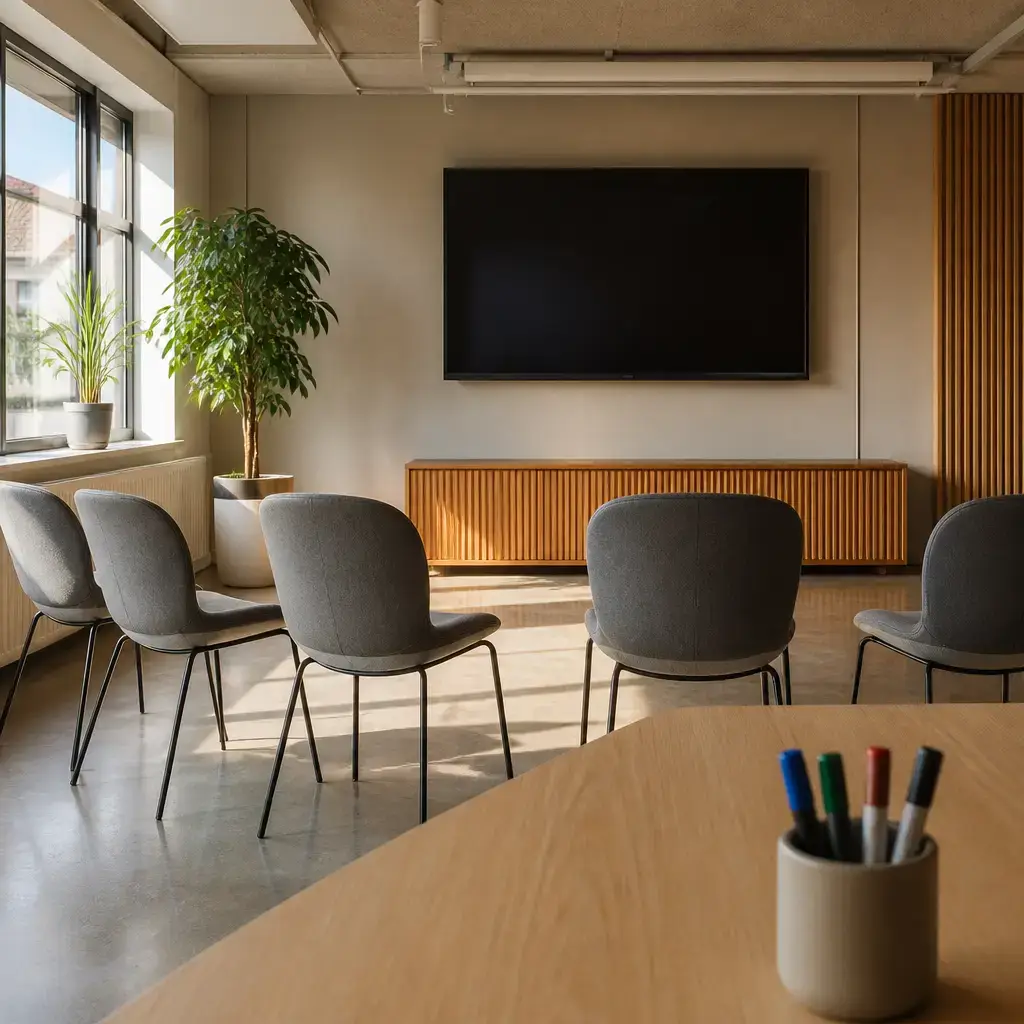
Er lokalet klart?
air loh-KAY-luhth KLAHD? Is the room ready?Stolene står på plads.
STOH-luh-nuh staw poh PLASS. The chairs are in place.Virker skærmen?
VAIR-guh SKAIR-mun? Is the screen working?Billedet ser tydeligt ud.
BEL-uh-thuh say TEW-thuh-lee oo. The picture looks clear.Har vi tuscher?
hah vee TOOS-guh? Do we have markers?De ligger på bordet.
dee LEH-guh poh BOHR-thuh. They're on the table.Er der plads til at gå rundt?
air dah PLASS till eh goh ROHN? Is there space to move around?Der er plads nok til at gå rundt.
dah air PLASS nawk till eh goh ROHN. There's enough room to walk around.Sentence explanations
Er lokalet klart?
Is the room ready?
- Er
- is
- lokalet
- the room
- klart
- ready
More detail
Er is the present-tense form of være (“to be”). In a yes/no question, Danish commonly places this finite verb before the subject: Er ...? means “Is ...?” or “Are ...?” depending on the subject. lokalet means “the room” or “the premises” here. It is the definite singular form of lokale (“room/premises”): et lokale = “a room,” lokalet = “the room.” The ending -et marks the definite form of this neuter noun; it does not itself mean a numerical quantity. klart means “ready” in this sentence. It is the neuter singular form of the adjective klar, agreeing with lokalet, which is a neuter noun. Compare en klar plan (“a clear/ready plan”) and et klart lokale (“a clear/ready room”). The adjective klar can also mean “clear,” so the surrounding noun and situation determine the intended sense. Together, Er + lokalet + klart forms a yes/no question: “Is the room ready?” The word order is the question pattern finite verb + subject + predicative adjective, while klart describes the state of lokalet.
Stolene står på plads.
The chairs are in place.
- Stolene
- the chairs
- står
- stand; are standing
- på plads
- in place
More detail
Stolene means “the chairs.” It is the definite plural form of stol (“chair”): en stol = “a chair,” stolen = “the chair,” and stolene = “the chairs.” The ending -ene marks both definiteness and plural in this form. står is the present-tense form of stå (“stand”). With objects such as chairs, stå can describe their position or state, not only the physical act of standing. Example: Bøgerne står på hylden. — “The books are on the shelf.” på plads is a reusable expression meaning “in place” or “properly positioned.” Here it describes the chairs’ location or arrangement. Example: Alt er på plads. — “Everything is in place.” Together, Stolene står på plads. means “The chairs are in place.” The definite plural subject Stolene identifies the chairs as a group, står presents their current position, and på plads specifies that they are where they should be.
Virker skærmen?
Is the screen working?
- Virker
- works; is working
- skærmen
- the screen
More detail
Virker is the present-tense form of virke, meaning “to work” or “to function.” Here it describes whether the screen is functioning. In a yes/no question, Danish commonly places the finite verb first: Virker ...? means “Does ... work?” or “Is ... working?” skærmen is the definite singular form of skærm, “screen.” The ending -en marks definite singular for this noun: en skærm = “a screen,” skærmen = “the screen.” The form names the thing whose functioning is being asked about. Together, the verb-first question pattern Virker + [subject]? asks whether the subject works. Thus Virker skærmen? means “Is the screen working?”
Billedet ser tydeligt ud.
The picture looks clear.
- Billedet
- the picture
- ser … ud
- looks
- tydeligt
- clear
More detail
Billedet means “the picture” here. It is the definite singular form of billede (“picture”): the ending -et marks a singular neuter noun in the definite form. Compare et billede (“a picture”) with billedet (“the picture”). ser ... ud is the Danish construction for “looks” or “appears” when describing how something seems. The observed verb ser is the present-tense form of se (“see”); together with ud, it forms the reusable pattern X ser Y ud (“X looks Y”). For example: Hun ser træt ud. — “She looks tired.” tydeligt means “clear” in this sentence. It is the neuter singular form of the adjective tydelig (“clear”), agreeing with the neuter noun billedet. The same adjective has tydelig with a common-gender singular noun and tydelige in the plural or definite forms, for example en tydelig besked (“a clear message”) and tydelige billeder (“clear pictures”). Together, Billedet identifies the subject, ser ... ud expresses how it appears, and tydeligt describes that appearance: “The picture looks clear.”
Har vi tuscher?
Do we have markers?
- Har
- have
- vi
- we
- tuscher
- markers
More detail
Har is the present-tense form of have. In a yes/no question, Danish commonly places the verb before the subject: Har vi ...? = “Do we have ...?” The same form also appears in statements, such as Vi har tuscher. (“We have markers.”) vi means “we”: the first-person plural subject pronoun. It refers to the speaker together with at least one other person; it does not identify exactly who those people are. tuscher means “markers” here. It is the plural form of tusch (“marker”). The plural form is appropriate because the question concerns markers in the plural; Danish nouns can have different plural forms, so this form should be learned with its singular counterpart: en tusch / tuscher. Together, Har vi tuscher? asks whether the relevant group has any markers. Its structure is the reusable yes/no question pattern verb + subject + noun: Har vi ...? (“Do we have ...?”).
De ligger på bordet.
They're on the table.
- De
- they
- ligger
- lie; are located
- på
- on
- bordet
- the table
More detail
De means “they” here. It is the third-person plural subject pronoun, so it refers to multiple items or people; the fixed translation identifies the meaning here as “they.” Danish also uses de as a formal singular “you” in some contexts, but that is not the reading in this sentence. ligger is the present-tense form of ligge, “to lie” or “to be located.” With objects, it commonly describes their position when they are lying on a surface: Bøgerne ligger på bordet. — “The books are on the table.” The form ligger is also used for a continuing location, not only for the physical act of lying down. på means “on” in this location pattern. It introduces the surface on which the items are located. For example, Nøglerne ligger på stolen. — “The keys are on the chair.” bordet means “the table.” The base noun is bord, “table,” and the ending -et marks the definite singular form: bord = “a table” or “table” in an indefinite reference, while bordet = “the table.” In Danish, definiteness is often expressed by a suffix attached to the noun rather than by a separate word. Together, De ligger says “they are lying/located,” and på bordet says “on the table.” The complete utterance is therefore “They’re on the table.”
Er der plads til at gå rundt?
Is there space to move around?
- Er der
- is there
- plads
- space; room
- til at
- to
- gå rundt
- move around; walk around
More detail
Er der is a common Danish way to ask whether something exists or is available: literally, it has the structure “is there …?” Er is the present-tense form of være (“to be”), and der is the existential word in this construction. The word order marks a question. For example: Er der kaffe? — “Is there coffee?” plads is a noun meaning “space” or “room.” In this sentence it refers to available physical room, not a particular place. A useful contrast is mere plads (“more space”) and nok plads (“enough space”). til at introduces an infinitive phrase describing what the space is sufficient or suitable for. Here it connects plads with the activity that can be done in that space. The infinitive marker at is followed by the infinitive gå. gå rundt means “walk around” or, in this context, “move around.” Gå is the infinitive of går and can have several context-dependent movement meanings, including “go” and “walk.” Rundt adds the idea of moving around within an area. Example: Vi kan gå rundt her. — “We can move around here.” Together, Er der plads til at gå rundt? asks whether there is enough available room for moving around: “Is there space to move around?”
Der er plads nok til at gå rundt.
There's enough room to walk around.
- Der er
- there is/are
- plads
- space; room
- nok
- enough
- til at
- to
- gå rundt
- walk around
More detail
Der er is the Danish existential construction meaning “there is” or “there are.” It presents something as existing or being available; the choice between “is” and “are” in English depends on the noun in the rest of the sentence. In the preceding question, Er der is the question form of the same construction: “Is there …?” plads is a noun meaning “space” or “room.” In this sentence it refers to available physical room, not a seat or a reserved place. A useful contrasting noun is tid, “time”: Der er tid means “There is time.” nok means “enough” and comes after the noun it limits here: plads nok, “enough room.” This is a quantity expression; it does not say how much room there is beyond being sufficient for the stated activity. For example, Der er nok tid means “There is enough time.” til at introduces an infinitive clause, here expressing what the available room is sufficient for: “to …” The pattern nok til at + verb is reusable for “enough … to …,” as in Det er varmt nok til at svømme, “It is warm enough to swim.” gå rundt means “walk around” in this utterance. gå is the verb “to go” or “to walk,” while rundt adds the idea of moving around rather than toward one specified destination. The infinitive form gå follows at; the form does not take a personal ending here. For example, Vi kan gå rundt means “We can walk around.” Together, Der er plads nok says that sufficient room is available, and til at gå rundt specifies the activity that there is sufficient room for. The complete meaning is: “There’s enough room to walk around.”
Grammar Points
klar → klart
Lokalet er klart.
loh-KAY-luhth air KLAHDThe room is ready.
Adjectives take -t after neuter nouns such as et lokale.
stol → stolene
Stolene står på plads.
STOH-luh-nuh staw poh PLASSThe chairs are in place.
Danish often marks definite plural nouns with the suffix -ene.
Danish Vocabulary
- Gender
- neuter
- Gender
- neuter
- Gender
- neuter
- Gender
- common
- Gender
- common
- Gender
- neuter
Quiz
Word Order
Arrange the words in the correct order.
Is the room ready?
Show Answer
Er lokalet klart?The chairs are in place.
Show Answer
Stolene står på plads.Is the screen working?
Show Answer
Virker skærmen?Spelling
Tap the letters to spell the word.
to work; to function
Show Answer
virkerpicture
Show Answer
billedetready
Show Answer
klartroom