10 minutes free every day
Continue audio lessons in the app
Word explanations appear automatically in sync with the audio.
No login required · synced translations · playback with the screen locked
Choose your learning language and open this lesson in the app.

About This Lesson
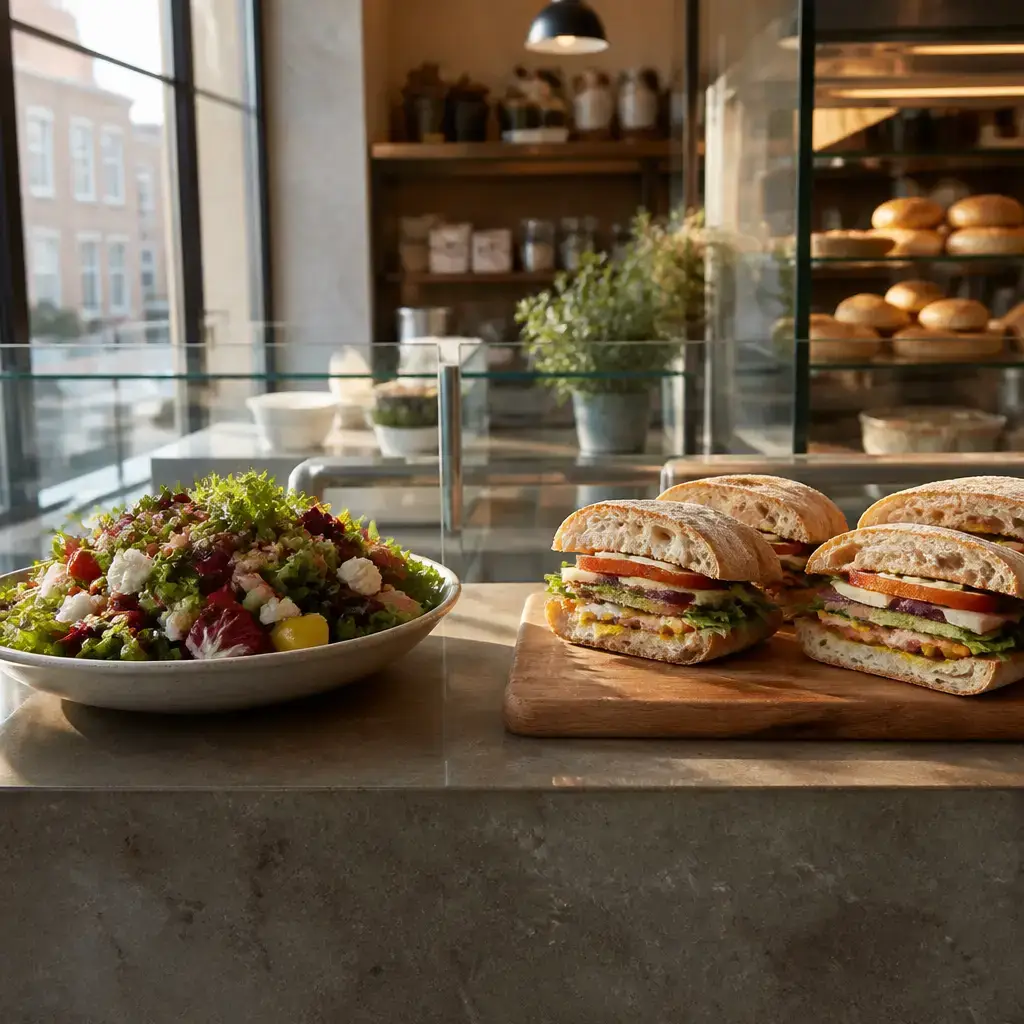
Use Choosing between a sandwich and a salad to practice Danish conversation, pronunciation, vocabulary, grammar, and quizzes.
Dialogue
Skal jeg vælge en sandwich eller en salat?
sgal yai VEL-uh uhn SAN-witsh EL-uh uhn sa-LAHD? Should I choose a sandwich or a salad?Salaten er en lettere mulighed.
sa-LAHD-en air uhn LEH-duh-ruh moo-lee-HAYTH. The salad is a lighter option.Jeg er ikke særlig sulten.
yai air IK-uh SAYR-lee SOOL-dn. I am not very hungry.Så passer den måske bedre til dig.
soh PAS-uh den MOH-sguh BEH-thruh teel dai. Then it may suit you better.Hvad skal du have?
VAHTH sgal doo HAY-vuh? What are you getting?Jeg vil have noget større.
yai vel HAY-vuh NOH-uth STUR-uh. I want something bigger.Jeg vælger sandwichen.
yai VEL-uh SAN-witsh-en. I will choose the sandwich.Salaten passer mig fint.
sa-LAHD-en PAS-uh mai FEHNT. The salad works for me.Lad os bestille, når medarbejderen kommer tilbage.
lath ohs beh-STEL-uh, nawr MEH-tha-bye-thuh-ren KOM-uh tuh-LAI. Let's order when the server comes back.Sentence explanations
Skal jeg vælge en sandwich eller en salat?
Should I choose a sandwich or a salad?
- Skal jeg
- Should I …?
- vælge
- choose
- en sandwich
- a sandwich
- eller
- or
- en salat
- a salad
More detail
Skal jeg is a useful Danish question pattern: skal is the present form of skulle, and with jeg it can ask what the speaker ought to do or should choose. In this sentence, the following verb makes the intended meaning “Should I …?” In a statement, the usual order is jeg skal ...; in this question, skal comes before jeg. vælge is the infinitive “to choose.” After skal, Danish uses the infinitive without an English-style “to”: Jeg skal vælge means “I should choose,” while Skal jeg vælge ...? asks whether that is what the speaker should do. The form vælge is the base form; it is not changed here for jeg. en sandwich means “a sandwich.” en is the indefinite article used with this noun. It introduces an unspecified item, but the article itself does not assert a particular numeric count beyond the singular form expressed by the noun phrase. Danish commonly uses en with common-gender nouns; the noun’s gender, rather than the speaker’s gender, determines the article. Example: Jeg spiser en sandwich. — “I am eating a sandwich.” eller connects alternatives and means “or.” It can join nouns, phrases, or complete clauses. Here it links the two possible things that the speaker might choose. en salat means “a salad.” As with en sandwich, en is the indefinite article for this common-gender noun, and salat is in its singular indefinite form. The next context sentence uses salaten, the definite form “the salad,” showing the related form with the definite ending -en; that is a different form from the indefinite en salat here. Together, Skal jeg + vælge forms the question “Should I choose …?” The alternatives are en sandwich and en salat, joined by eller, so the complete utterance means: “Should I choose a sandwich or a salad?”
Salaten er en lettere mulighed.
The salad is a lighter option.
- Salaten
- the salad
- lettere
- lighter
- mulighed
- option
More detail
Salaten means “the salad” here. It is the definite singular form of salat: en salat = “a salad”, salaten = “the salad”. The ending -en marks definiteness for this noun; it does not itself identify who is referring to the salad. lettere means “lighter” in this sentence. It is the comparative form of let, which can mean “light” and, in other contexts, “easy”. The comparison is attached to let itself: let → lettere → lettest (“light/easy” → “lighter/easier” → “lightest/easiest”). Here the intended comparison is about the salad being a lighter option, not an easier one. mulighed means “option” here. The indefinite article en before it shows that mulighed is a common-gender singular noun: en mulighed = “an option”. The article does not by itself assert a numerical count. The phrase en lettere mulighed means “a lighter option”. The sentence uses er (“is”) to connect the subject Salaten with the description en lettere mulighed. Together, Salaten er en lettere mulighed. means “The salad is a lighter option.”
Jeg er ikke særlig sulten.
I am not very hungry.
- Jeg er
- I am
- ikke
- not
- særlig
- very
- sulten
- hungry
More detail
Jeg er means “I am.” Jeg is the first-person singular pronoun “I,” and er is the present-tense form of være (“to be”) used with it. Example: Jeg er klar. — “I am ready.” ikke places negation on the following description: it makes the statement negative. Example: Jeg er ikke træt. — “I am not tired.” særlig means “very” in this use, as part of the degree expression ikke særlig (“not very”). Here it modifies the adjective sulten; it is not describing a special person or thing. Example: Hun er ikke særlig glad. — “She is not very happy.” sulten means “hungry.” It is an adjective whose base form is sulten; a useful contrast is mæt (“full,” “not hungry”). In this sentence, sulten is the singular common-form adjective after er. The form does not identify the speaker’s gender. Example: Vi er sultne. — “We are hungry.” Together, Jeg er + ikke + særlig sulten means “I am not very hungry.” The negation applies to the degree of hunger: the speaker says that their hunger is low, without claiming that they are completely full.
Så passer den måske bedre til dig.
Then it may suit you better.
- Så
- Then
- passer
- suits
- den
- it
- måske
- perhaps
- bedre
- better
- til dig
- for you
More detail
Så means “then” here and connects this sentence to what has just been said. It can have other uses in Danish, but its meaning here is fixed by the sentence. Example: Så går vi. — “Then we’ll go.” passer is the present-tense form of passe, “to suit” or “to fit.” Danish present-tense verbs generally do not change according to the subject’s person or number: jeg passer, du passer, and den passer all use passer. In passe ... til, the construction means that something suits or fits someone: Det passer til mig. — “It suits me.” den is a Danish third-person singular pronoun used here as the subject, meaning “it.” Its form marks the common-gender singular class, but the supplied sentence does not uniquely identify what “it” refers to. The pronoun is not itself a marker of the intended object’s identity. måske means “perhaps” or “maybe.” It presents the statement as possible rather than certain. In this sentence it occurs after the subject den and the verb passer. bedre is the comparative form of god (“good”): god → bedre → bedst (“best”). Here it compares the suitability expressed by passer with another relevant option or situation. Example: Denne passer bedre. — “This one fits better.” til dig uses the preposition til (“to”/“for”) followed by dig, the oblique form of the second-person singular pronoun. The subject form is du, but after a preposition Danish uses dig: Det passer til dig. — “It suits you.” Together, Så introduces a continuation or consequence, den is the subject, and passer ... til dig expresses suitability for the listener. måske softens the claim, while bedre makes it comparative. The whole utterance therefore means: “Then it may suit you better.”
Hvad skal du have?
What are you getting?
- Hvad
- what
- skal du
- are you going to / do you need to
- have
- have; get
More detail
Hvad means “what” and asks about the thing involved in the action. It is an interrogative pronoun. For a person, Danish uses hvem (“who”) instead. skal du combines skal with the subject du (“you”). Skal is the present-tense form of skulle; with an action verb, it can express what someone is going to do or is expected to do. Here it forms a question about what you are going to get. Danish questions commonly place the finite verb before the subject: Skal du ...? (“Are you going to ...?”). The form skal does not change for the person in this construction. have is the infinitive form of have (“to have”). In this utterance, with skal, it refers to getting or choosing something, rather than simply possessing it. The infinitive follows skal without an English-style “to.” Example: Jeg skal have kaffe. — “I’m going to get coffee.” Together, Hvad + skal du + have produces “What are you getting?” The question leaves the thing unspecified and asks you to identify it. In a slightly different context, the same Danish wording can also be understood as “What are you going to have?”
Jeg vil have noget større.
I want something bigger.
- vil have
- want
- noget
- something
- større
- bigger
More detail
vil have expresses wanting or wishing to have something in this sentence. vil is the present form of ville, and have is the infinitive. Together, the reusable pattern Jeg vil have ... means “I want ...”; vil can have other uses in Danish, but the fixed translation identifies the wanting meaning here. noget means “something.” It is an indefinite pronoun used when the thing is not specified. A related form, nogen, is used for an unspecified person, not for the thing meant here. større means “bigger” or “larger” here. It is the comparative form of stor (“big, large”); the basic comparison chain is stor → større → størst (“big” → “bigger” → “biggest”). The comparative form større does not itself identify what the comparison is with. Example: Jeg vil have en større kop. — “I want a bigger cup.” The parts combine as Jeg vil have (“I want”) + noget større (“something bigger”), giving “I want something bigger.”
Jeg vælger sandwichen.
I will choose the sandwich.
- Jeg
- I
- vælger
- choose / am choosing
- sandwichen
- the sandwich
More detail
Jeg is the first-person singular pronoun, “I.” It identifies the speaker as the subject. This form does not change according to the speaker’s gender. Example: Jeg læser. — “I am reading.” vælger comes from the verb vælge, “to choose.” It is the present-tense form. Danish present-tense verbs generally do not change according to the subject, so vælger is not specifically a special form used only with jeg. In this sentence, the present form is understood as a choice the speaker will make, matching the fixed translation. Example: Jeg vælger te. — “I will choose tea.” sandwichen means “the sandwich.” The noun is sandwich; the ending -en marks a singular definite noun in this form, corresponding to “the.” The indefinite form is en sandwich, while the definite form is sandwichen. Example: Jeg spiser sandwichen. — “I am eating the sandwich.” Together, Jeg vælger sandwichen. has the pattern “I choose/will choose the sandwich”: Jeg is the chooser, vælger expresses the choice, and sandwichen is the specific item chosen. In the fixed translation, the complete meaning is “I will choose the sandwich.”
Salaten passer mig fint.
The salad works for me.
- Salaten
- the salad
- passer
- works; suits
- mig
- me
- fint
- fine; well
More detail
Salaten is the definite singular form of salat (“salad”): salat means “a salad” in an indefinite noun phrase, while salaten refers to “the salad.” The ending -en marks the common-gender definite singular form here. passer comes from passe, “to suit” or “to work/be suitable.” It is the present-tense form; Danish verbs do not change for the subject’s person or number, so passer can be used with different subjects. In this sentence, it describes the salad as suitable for the speaker. Example: Det passer mig. — “That suits me.” mig is the object form of the first-person pronoun: jeg means “I” when it is the subject, while mig means “me” when it is the object or the person affected. The pattern passe nogen means “suit someone,” so mig identifies the person for whom the salad is suitable. fint adds the evaluation “fine” or “well” to the suitability. In passer mig fint, it means that the salad suits the speaker well. Here it is used adverbially; it is not the noun’s form or a verb ending. The related adjective is fin, “fine,” while fint is also its neuter form and is commonly used in this adverbial expression. Example: Det fungerer fint. — “It works well.” Together, Salaten passer mig fint means “The salad works for me” or, more literally, “The salad suits me fine.” The definite noun is the thing being evaluated, passer expresses suitability, mig marks the person it suits, and fint says that the fit is good.
Lad os bestille, når medarbejderen kommer tilbage.
Let's order when the server comes back.
- Lad os
- let's
- bestille
- order
- når
- when
- medarbejderen
- the server
- kommer tilbage
- comes back
More detail
Lad os is the Danish pattern for “let’s,” literally built from lad (“let”) and os (“us”). It introduces a suggestion that includes the speaker and at least one other person. A reusable pattern is Lad os + infinitive: Lad os spise. — “Let’s eat.” bestille means “to order” here, as in ordering food or something else. It is the infinitive form, used after Lad os. The present-tense form is bestiller: Jeg bestiller mad. — “I order food.” når means “when” and introduces the time clause that tells when the ordering will happen. Danish commonly uses når for a present or future event, including an expected one-time event: Vi går, når han kommer. — “We’ll leave when he comes.” Da is instead associated with a past time or event: Da han kom, gik vi. — “When he came, we left.” medarbejderen means “the employee” or “the staff member” from the noun medarbejder. The ending -en marks the singular definite form, “the employee.” In this setting, the fixed translation identifies that employee as the server. Danish definite forms are commonly formed by adding an ending to the noun rather than using a separate word equivalent to “the.” kommer tilbage means “comes back.” kommer is the present-tense form of komme, “come,” and tilbage means “back.” Together they describe returning to the relevant place. Han kommer tilbage. — “He comes back.” The sentence is assembled as Lad os bestille (“Let’s order”) followed by når medarbejderen kommer tilbage (“when the server comes back”). The whole utterance therefore means: “Let’s order when the server comes back.”
Grammar Points
sandwich → sandwichen
sandwichen
SAN-witsh-enthe sandwich
Danish often marks a definite noun by adding -en to the noun: sandwich becomes sandwichen.
let → lettere; stor → større
lettere
LEH-duh-ruhlighter
Comparative adjectives often use -ere: let becomes lettere. Some adjectives also change their vowel, as stor becomes større.
Danish Vocabulary
Så passer den måske bedre til dig.
Hvad skal du have?
Hvad skal du have?
Skal jeg vælge en sandwich eller en salat?
Salaten er en lettere mulighed.
- Gender
- common
Salaten er en lettere mulighed.
Så passer den måske bedre til dig.
Så passer den måske bedre til dig.
- Gender
- common
Skal jeg vælge en sandwich eller en salat?
- Gender
- common
Skal jeg vælge en sandwich eller en salat?
Jeg er ikke særlig sulten.
Skal jeg vælge en sandwich eller en salat?
Quiz
Word Order
Arrange the words in the correct order.
The salad is a lighter option.
Show Answer
Salaten er en lettere mulighed.I am not very hungry.
Show Answer
Jeg er ikke særlig sulten.What are you getting?
Show Answer
Hvad skal du have?Spelling
Tap the letters to spell the word.
light
Show Answer
lettereoption; possibility
Show Answer
mulighedhungry
Show Answer
sultensuit; fit