10 minutes free every day
Continue audio lessons in the app
Word explanations appear automatically in sync with the audio.
No login required · synced translations · playback with the screen locked
Choose your learning language and open this lesson in the app.

About This Lesson
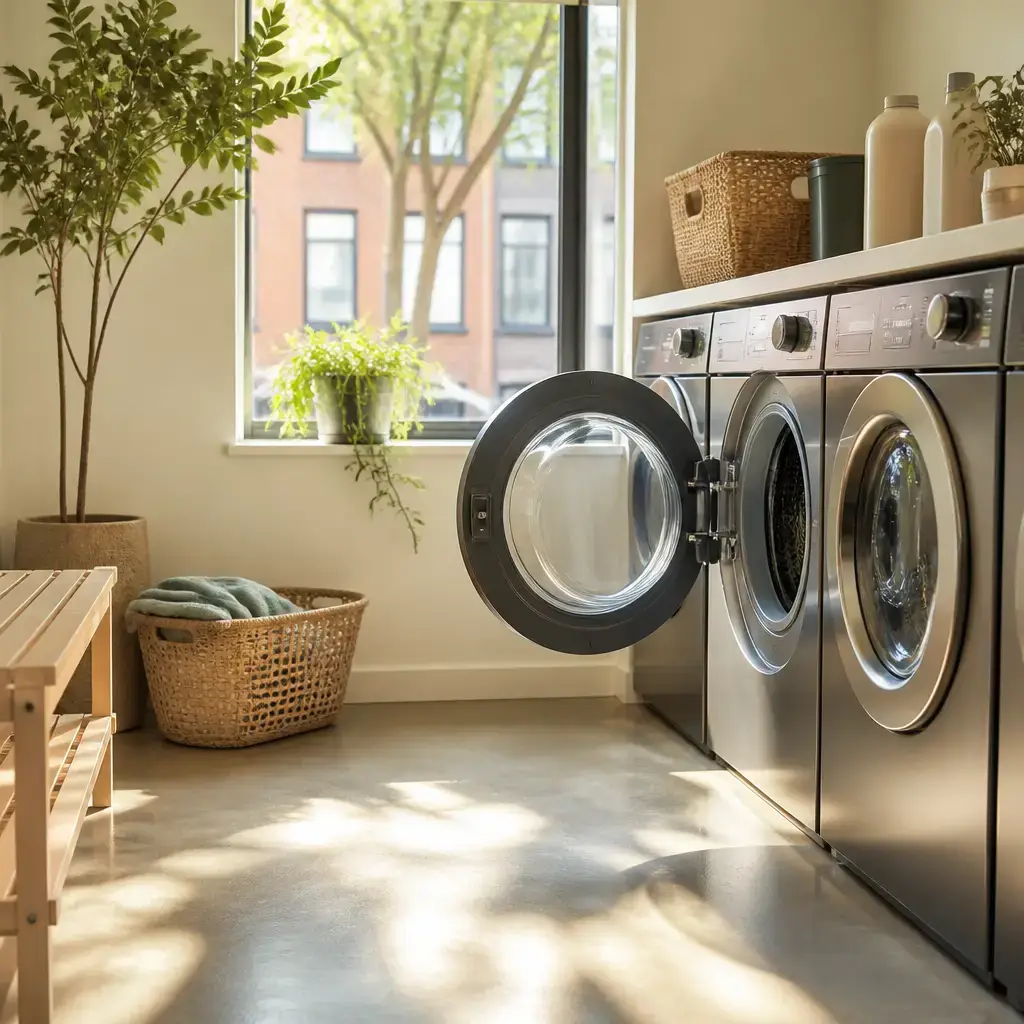
Use Using a shared laundry room to practice Danish conversation, pronunciation, vocabulary, grammar, and quizzes.
Dialogue
Må jeg bruge det fælles vaskerum?
moh yigh BROO-uh deh FEL-uhs VAS-guh-ROHM? Can I use the shared laundry room?Det er åbent nu.
deh air OH-bunt noo. It is open now.Er denne maskine ledig?
air DEN-uh muh-SHEE-nuh LEH-thee? Is this machine free?Denne er ledig.
DEN-uh air LEH-thee. This one is available.Hvor skal jeg stille min kurv?
voh skal yigh STEL-uh men koorv? Where should I put my basket?Stil den ved siden af væggen.
steel den veh SEE-thun eh VEG-un. Set it beside the wall.Jeg tager mit tøj ud, når vasken er færdig.
yigh TAIR mee toy ooth, nor VAS-gun air FAIR-dee. I will take my clothes out when the wash is done.Hent dem med det samme.
HEN dem meh deh SAM-uh. Please collect them right away.Sentence explanations
Må jeg bruge det fælles vaskerum?
Can I use the shared laundry room?
- Må jeg
- Can I …?
- bruge
- use
- det
- the
- fælles
- shared
- vaskerum
- laundry room
More detail
Må jeg is a reusable Danish question pattern meaning “May/Can I …?” Here må is the present form of måtte, used to ask for permission, and jeg means “I.” The following verb stays in the infinitive: Må jeg komme ind? means “May I come in?” bruge means “use.” It is the infinitive form, which follows the modal verb må; it does not take a separate infinitive marker in this construction. For example, Må jeg bruge din telefon? means “Can I use your phone?” det is the neuter singular determiner used with vaskerum, whose indefinite form is et vaskerum. In this sentence it corresponds naturally to “the” in the noun phrase det fælles vaskerum. It can also have a demonstrative sense, “that,” in other contexts, so its exact English rendering depends on the noun phrase and context. fælles means “shared” or “common.” This form is used with both singular and plural nouns and does not change for grammatical gender: et fælles rum means “a shared room,” while fælles rum can mean “shared rooms” when the noun is plural. vaskerum is a neuter noun meaning “laundry room.” Its indefinite form is et vaskerum; the definite form is vaskerummet. The compound refers to a room for doing laundry, not to the act of using it. Together, det fælles vaskerum means “the shared laundry room.” The modal question Må jeg bruge ...? asks whether the speaker has permission to use it, so the whole utterance means “Can I use the shared laundry room?”
Det er åbent nu.
It is open now.
- Det er
- it is
- åbent
- open
- nu
- now
More detail
Det er combines det, a Danish subject pronoun, with er, the present-tense form of være (“to be”). Here det is the subject of the statement; the fixed translation gives its meaning as “it,” but does not identify a more specific referent. Er is used for a present state, as in Det er klart. — “It is clear.” Åbent means “open” here. It is the neuter singular form of the adjective åben: åben with a common-gender singular noun, åbent with a neuter singular noun, and åbne with plural or definite forms. In this sentence, åbent agrees with the neuter subject det. The useful opposite is lukket, “closed”: Det er lukket. — “It is closed.” Nu is the adverb “now,” specifying when the state holds. It can also be used in Jeg kommer nu. — “I am coming now.” Together, Det er åbent nu. means “It is open now.” The pattern is Det er + adjective + nu, used to state the current condition of something without naming that thing in the sentence. In the supplied context, this can naturally function as an update about the place or facility being discussed.
Er denne maskine ledig?
Is this machine free?
- Er
- is
- denne
- this
- maskine
- machine
- ledig
- free; available
More detail
Er is the present-tense form of Danish være, “to be.” In a yes/no question, the verb comes before the subject: Er ...? means “Is ...?” The same form is used with different subjects in the present tense; the word order signals the question here. denne means “this” and is a singular demonstrative. It points to one nearby or contextually identified item. Danish also has denne with common-gender singular nouns and dette with neuter-gender singular nouns; the noun’s grammatical gender determines the choice. Here, denne agrees with maskine, which is a common-gender noun. maskine means “machine.” Its base form is singular indefinite: en maskine, “a machine.” The definite singular form is maskinen, “the machine.” Example: Jeg bruger en maskine. — “I use a machine.” ledig means “free” or “available” in this context: the machine is not currently occupied or in use. It is an adjective. With a common-gender singular noun it has the form ledig; with a neuter singular noun it is ledigt, and with plural or definite forms it is generally ledige. Example: Pladsen er ledig. — “The seat is available.” Together, Er denne maskine ledig? has the pattern Er + demonstrative + noun + adjective? The verb-first order makes it a yes/no question, and ledig describes the machine’s current availability. Thus the complete meaning is “Is this machine free?”
Denne er ledig.
This one is available.
- Denne
- this one
- er
- is
- ledig
- available
More detail
Denne means “this one” here. It is the standalone singular form used for a common-gender noun; the neuter counterpart is dette, and the plural form is disse. Because it stands alone, it refers to a nearby or otherwise understood item without repeating its noun. Example: Denne er ny. — “This one is new.” Er is the present-tense form of være, “to be.” It is used with all subjects in the present: jeg er, du er, and de er all use er. Example: Den er åben. — “It is open.” Ledig means “available” in this sentence. As a predicative adjective after er, it describes the item identified by Denne. The adjective has the neuter form ledigt and the plural form ledige: et ledigt sæde means “an available seat,” while ledige sæder means “available seats.” Together, Denne er ledig. says that the indicated singular item is available: “This one is available.”
Hvor skal jeg stille min kurv?
Where should I put my basket?
- Hvor
- where
- skal jeg
- should I
- stille
- put/place
- min
- my
- kurv
- basket
More detail
Hvor means “where” and asks about a location. It can introduce a question about the place associated with an action, as in Hvor bor du? (“Where do you live?”). skal jeg combines the modal verb skal with the pronoun jeg (“I”). In this question, skal expresses what the speaker should do, and the order skal jeg is question word order: the modal comes before the subject. Skal jeg vente? means “Should I wait?” stille is the infinitive of stille, meaning “to put” or “to place” here. After the modal skal, Danish uses the infinitive without at: skal ... stille. The verb stille can be used for placing something in a position; other placement verbs may be appropriate in different situations. min means “my” before a singular common-gender noun. Its form agrees with the possessed noun, not with the possessor: min kurv (“my basket”), while a neuter singular noun uses mit and a plural noun uses mine. kurv means “basket.” It is a common-gender noun: en kurv is “a basket,” and the definite form is kurven (“the basket”). Together, Hvor skal jeg stille min kurv? asks for the place where the speaker should put their basket: “Where should I put my basket?” The question uses Hvor for the location, skal jeg for the question about what the speaker should do, and stille as the infinitive required after skal.
Stil den ved siden af væggen.
Set it beside the wall.
- Stil
- set; put
- den
- it
- ved siden af
- beside; next to
- væggen
- the wall
More detail
Stil is the imperative of stille, “to put” or “to place.” It gives a direct instruction to one or more listeners; the subject is understood rather than stated. In the previous question, stille is the verb used for putting the basket somewhere. Example: Stil koppen på bordet. — “Put the cup on the table.” den means “it” here. It is the singular common-gender object pronoun, used for a definite common-gender noun when that noun is not repeated. The form contrasts with det, which is used for a neuter-gender noun or referent. Its specific referent is supplied by the intended context, while its grammatical role here is the object of Stil. ved siden af is a reusable prepositional phrase meaning “beside” or “next to.” ved means “by/at,” and siden af forms the spatial expression; learn the whole phrase rather than translating each part separately. Example: Tasken står ved siden af stolen. — “The bag is beside the chair.” væggen means “the wall.” Its base form is væg, “wall”; væggen is the singular definite form, corresponding to “the wall.” The ending -en marks definiteness for this noun. Example: Jeg maler væggen. — “I am painting the wall.” Together, Stil den gives the instruction “Set it,” and ved siden af væggen specifies the location: “beside the wall.” The complete utterance therefore means “Set it beside the wall.”
Jeg tager mit tøj ud, når vasken er færdig.
I will take my clothes out when the wash is done.
- Jeg
- I
- tager … ud
- take out
- mit
- my
- tøj
- clothes
- når
- when
- vasken
- the wash
- færdig
- done
More detail
Jeg means “I” here, the first-person singular subject. Danish uses the same form for the subject; the object form is mig, as in Hun ser mig (“She sees me”). tager is the present form of tage, “to take.” In this sentence, tager ... ud means “take ... out.” Danish present tense can describe a planned future action when the context makes the time clear; the fixed translation therefore uses “will take.” ud means “out” and completes the direction pattern tage noget ud (“take something out”). The two parts are separated here because mit tøj comes between them. Example: Jeg tager koppen ud. — “I take the cup out.” mit means “my” before the neuter singular noun tøj. Danish possessive forms include min with common-gender singular nouns, mit with neuter singular nouns, and mine with plural nouns. The form agrees with the possessed noun, not with the person who possesses it. tøj means “clothes” or “clothing.” It is a neuter noun and normally has the same form for this uncountable or collective meaning rather than a plural ending. Example: Mit tøj er vådt. — “My clothes are wet.” når introduces a time clause meaning “when.” It links the main action to the time at which the following condition holds. In the clause after når, the finite verb remains before the adjective: vasken er færdig. vasken means “the wash” here. It is the definite singular form of vask (“wash”); the ending -en marks a common-gender singular noun as definite. In this utterance, the fixed translation identifies it as the wash rather than leaving the intended meaning open to another sense of vask. færdig means “done” or “finished” here. It is the common-gender form of the adjective; it agrees with vasken, a common-gender noun. With a neuter noun, the form is færdigt, and with plural nouns it is færdige: Arbejdet er færdigt — “The work is finished.” Together, Jeg tager mit tøj ud means “I will take my clothes out,” and når vasken er færdig means “when the wash is done.” The complete utterance is therefore: “I will take my clothes out when the wash is done.”
Hent dem med det samme.
Please collect them right away.
- Hent
- collect
- dem
- them
- med det samme
- right away
More detail
Hent is the imperative of hente, meaning “to collect,” “to fetch,” or “to pick up” depending on the item and situation. The imperative addresses one or more people and uses the short form hent: Hent bogen! means “Fetch the book!” dem is the object form of the pronoun de. It refers to plural people or things when they are receiving the action. Compare subject de (“they”) with object dem (“them”): De henter dem. means “They collect them.” In the supplied context, dem is understood as the clothes mentioned previously. med det samme is a fixed adverbial expression meaning “right away” or “immediately.” It modifies the action rather than naming another participant. For example, Jeg kommer med det samme. means “I’m coming right away.” Together, the imperative Hent + the object dem + the time expression med det samme gives “Collect them right away.” The English “please” presents the request politely; there is no separate word for “please” in the Danish sentence.
Grammar Points
denne + noun
denne maskine
DEN-uh muh-SHEE-nuhthis machine
The demonstrative denne comes before a singular common-gender noun, such as maskine.
ved siden af + noun
min kurv ved siden af væggen
men koorv veh SEE-thun eh VEG-unmy basket beside the wall
Ved siden af is a fixed prepositional phrase meaning “beside” or “next to”; the noun follows it.
Danish Vocabulary
Må jeg bruge det fælles vaskerum?
Denne er ledig.
det fælles vaskerum
- Gender
- common
min kurv
Er denne maskine ledig?
- Gender
- common
Er denne maskine ledig?
- Gender
- common
min kurv
Det er åbent nu.
Hvor skal jeg stille min kurv?
- Gender
- neuter
det fælles vaskerum
ved siden af væggen
- Gender
- neuter
Det er åbent nu.
Quiz
Word Order
Arrange the words in the correct order.
Can I use the shared laundry room?
Show Answer
Må jeg bruge det fælles vaskerum?It is open now.
Show Answer
Det er åbent nu.Is this machine free?
Show Answer
Er denne maskine ledig?Spelling
Tap the letters to spell the word.
to put; to place
Show Answer
stilleopen
Show Answer
åbentshared; common
Show Answer
fællesthis one