10 minutes free every day
Continue audio lessons in the app
Word explanations appear automatically in sync with the audio.
No login required · synced translations · playback with the screen locked
Choose your learning language and open this lesson in the app.

About This Lesson
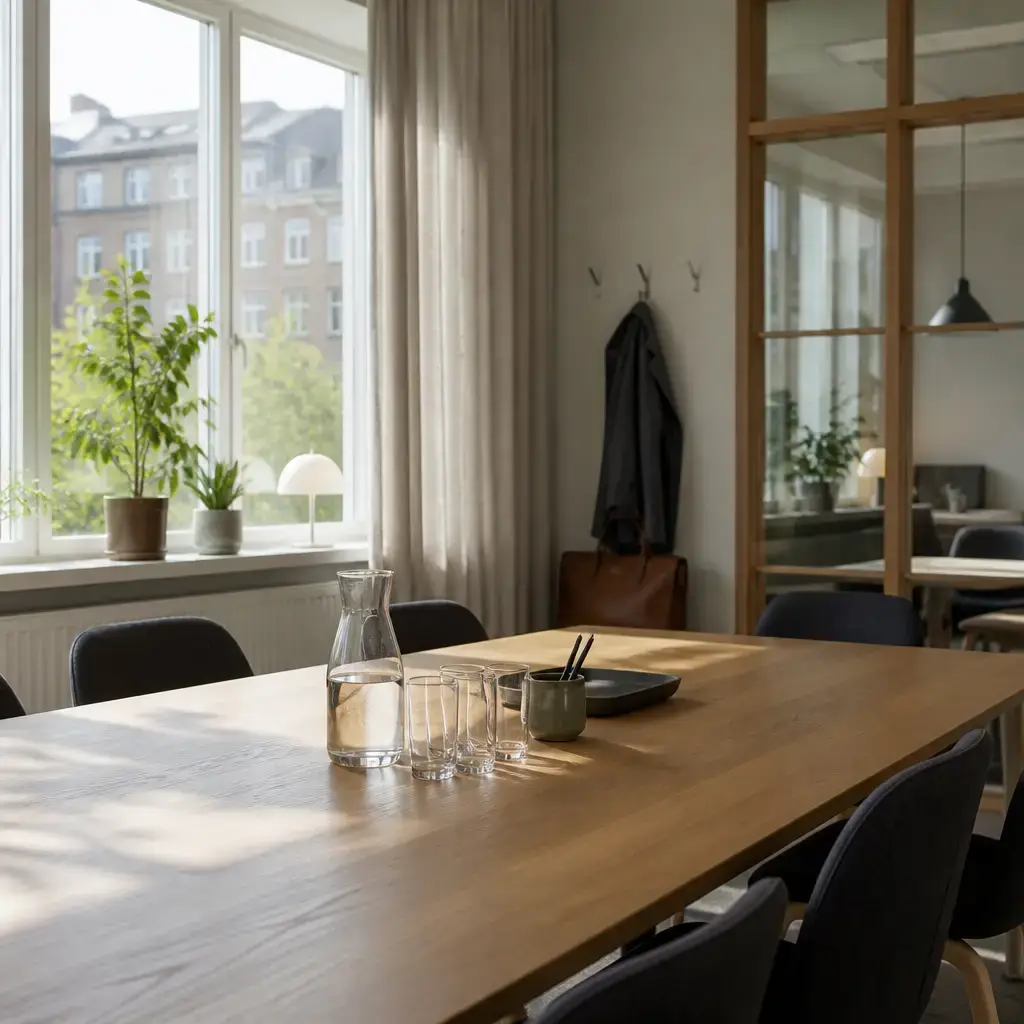
Use Using a shared meeting room to practice Danish conversation, pronunciation, vocabulary, grammar, and quizzes.
Dialogue
Kan vi bruge det fælles mødelokale?
kan vee BROO-uh deh FEH-less MUR-deh-loh-KAH-leh Can we use the shared meeting room?Det kan I, men hold det pænt for andre.
deh kan EE, men HOHL deh pent for AHN-druh You can, but keep it tidy for other people.Er dette bord ledigt?
air DEH-duh bohrd LEH-thee Is this table free?Det er ledigt nu.
deh air LEH-thee noo It is available now.Jeg lægger min taske ved væggen.
yai LEG-uh men TASK-uh veh VEH-gun I will put my bag by the wall.Hold venligst bordet frit.
HOHL VEN-list BOHR-duh FREED Please keep the table clear.Vi efterlader rummet rent, når vi er færdige.
vee EF-ter-LAY-uh ROOM-uh RENT, nohr vee air FAIR-thee-uh We will leave the room clean when we finish.Det hjælper den næste gruppe.
deh YEL-per den NEH-stuh GROH-buh That helps the next group.Sentence explanations
Kan vi bruge det fælles mødelokale?
Can we use the shared meeting room?
- Kan vi
- Can we
- bruge
- use
- det
- the
- fælles
- shared
- mødelokale
- meeting room
More detail
Kan vi combines kan, the present-tense form of kunne (“can/be able to”), with vi (“we”). In a question, this order places the verb before the subject: Kan vi ...? = “Can we ...?” Depending on context, kan can ask about ability or permission; here the fixed translation supports asking whether we may use the room. Example: Kan vi komme ind? — “Can we come in?” bruge means “use” here. It is the infinitive after the modal verb kan; Danish uses the infinitive without at after modal verbs. The reusable pattern is kan + infinitive, as in Vi kan vente. — “We can wait.” det is the definite article used with a singular neuter noun in this noun phrase. It is not the pronoun “it” here: together with the following noun, det ... mødelokale identifies a particular room. The choice of det is determined by the noun’s grammatical gender and definiteness, not by a numeric meaning. fælles means “shared” here. It is an adjective whose form is the same with common-gender and neuter singular nouns, and it also remains fælles in the plural. Example: et fælles projekt — “a shared project”; et fælles rum — “a shared room.” mødelokale means “meeting room.” It is a neuter compound noun: et mødelokale is the indefinite form, while mødelokalet is the definite singular form. In this sentence, definiteness is marked by det before the adjective and noun: det fælles mødelokale. Together, Kan vi bruge det fælles mødelokale? means “Can we use the shared meeting room?” The question asks whether the subject vi (“we”) may use the specific shared meeting room.】【。assistantசிய hag̃json?
Det kan I, men hold det pænt for andre.
You can, but keep it tidy for other people.
- Det kan I
- You can
- men
- but
- hold
- keep
- det
- it
- pænt
- tidy
- for andre
- for others
More detail
Det kan I is a compact Danish permission/ability pattern. kan is the present form of kunne (“can, be able to”), and the modal is followed by the subject I. Here I is the second-person plural pronoun, addressing more than one person; it is distinct from singular du. The object or activity understood with det is supplied by the context, while the fixed translation supports “You can.” Example: I kan bruge rummet. — “You can use the room.” In a main clause, the subject I follows the modal here; the lexical verb, such as bruge, comes later when it is stated. men connects two contrasting parts and means “but.” hold is the imperative of holde (“keep, hold”). The imperative gives a direct instruction, with the subject normally understood as “you.” Example: Hold døren åben. — “Keep the door open.” det is a neuter singular pronoun used here as the object of hold, meaning “it.” Its specific referent is the thing being discussed; the supplied wording does not require naming that thing. The same form can also have other grammatical roles in Danish, so its object role here comes from its position after the imperative. pænt is the neuter singular form of the adjective pæn (“neat, nice”). It describes the state in which det should be kept. The forms are pæn with a common-gender singular noun, pænt with a neuter singular noun, and pæne in the plural and definite forms. Example: Hold værelset pænt. — “Keep the room tidy.” for andre adds the people considered in the instruction: for means “for,” and andre means “others” or “other people.” Andre is a plural form referring to people here; it is not the adjective pæn and does not describe the thing being kept tidy. Together, Det kan I, men hold det pænt for andre. means “You can, but keep it tidy for other people.” The first part grants permission or ability, men introduces the contrasting instruction, and hold det pænt for andre says to maintain the thing in a neat condition out of consideration for others.
Er dette bord ledigt?
Is this table free?
- Er dette
- Is this …?
- bord
- table
- ledigt
- free; available
More detail
Er dette forms a yes/no question: er is the present-tense form of være (“to be”), and dette means “this” in the neuter singular form. Danish commonly places the verb before the subject or demonstrative in a yes/no question. Compare the statement Dette er ... (“This is ...”) with the question Er dette ...? (“Is this ...?”). bord means “table”. Its indefinite form is et bord; the article et shows that this noun belongs to the neuter grammatical gender. For example, et bord means “a table”, while bordet means “the table”. ledigt means “free” or “available” here. Its base form is the adjective ledig; ledigt is the neuter singular form, matching the neuter noun bord in this sentence. The same adjective can describe availability in another context: Rummet er ledigt. — “The room is available.” Together, Er dette bord ledigt? asks whether this table is free or available. The question has the pattern Er dette [noun] [adjective]?, literally “Is this [noun] [adjective]?”
Det er ledigt nu.
It is available now.
- Det er
- It is
- ledigt
- available; free
- nu
- now
More detail
Det er means “it is” here. Det is a third-person singular pronoun; in the supplied exchange, it refers back to the table asked about in the preceding sentence. Er is the present-tense form of være (“to be”). A reusable pattern is Det er + description. Example: Det er klart. — “It is clear.” ledigt describes the table as available or free in this context. Its base form is ledig; ledigt is the neuter singular form, agreeing with the neuter noun bord (“table”). With a common-gender singular noun, the adjective is ledig; with a plural noun, it is ledige. Example: Bordet er ledigt. — “The table is free.” nu means “now” and places the situation at the present time. Example: Jeg kommer nu. — “I am coming now.” Together, Det er + ledigt says that the table is available, and nu specifies that this is true at the present moment: “It is available now.”
Jeg lægger min taske ved væggen.
I will put my bag by the wall.
- Jeg
- I
- lægger
- put / place
- min
- my
- taske
- bag
- ved
- by / beside
- væggen
- the wall
More detail
Jeg means “I” and is the subject: the person who places the bag. Danish subject pronouns include jeg “I”, du “you” (singular), and vi “we”. Example: Jeg læser. — “I read.” lægger is the present-tense form of lægge, “to put” or “to place”. It describes placing something, rather than simply having it in a position. Danish present tense can also refer to a planned or imminent future action; here the fixed translation therefore uses “will put”. Example: Hun lægger bogen på bordet. — “She puts the book on the table.” min means “my” here. It is the possessive form used with a singular common-gender noun such as taske; with a singular neuter noun, the form is mit, and with plural nouns it is mine. Example: mit hus — “my house”; mine bøger — “my books”. taske means “bag”. The form is indefinite singular here: en taske, “a bag”. Its definite singular form is tasken, “the bag”. Example: Jeg har en taske. — “I have a bag.” ved means “by” or “beside” when it expresses location. It introduces the place where something is put or located. Example: Bilen står ved huset. — “The car is by the house.” væggen means “the wall”. It is the definite singular form of væg, “wall”: en væg → væggen. The definite form identifies a particular wall in the situation, without the word itself specifying which wall. Example: Billedet hænger på væggen. — “The picture hangs on the wall.” Together, Jeg lægger gives “I put / I will put”, min taske gives “my bag”, and ved væggen gives “by the wall”. The complete utterance means: “I will put my bag by the wall.”
Hold venligst bordet frit.
Please keep the table clear.
- Hold
- keep
- venligst
- please
- bordet
- the table
- frit
- clear
More detail
Hold is the imperative of holde, meaning “keep” here. The imperative gives a direct instruction; holde can also mean “hold” in a physical sense, but the fixed sentence uses the sense “keep something in a condition.” Example: Hold døren åben. — “Keep the door open.” venligst is a polite word meaning “please.” It softens a request or instruction and does not itself express an object or an action. bordet means “the table.” It is the definite singular form of bord (“table”): et bord — “a table,” bordet — “the table.” The ending -et marks this noun as definite singular in this form. frit means “clear” here, in the sense of having nothing obstructing or occupying the table. It is the neuter singular form of fri (“free/clear”), agreeing with the neuter noun bordet. Compare et frit bord — “a clear table” and frie borde — “clear tables.” The form frit is an adjective form, not a form of bord. Together, Hold + bordet + frit forms the instruction “keep the table clear,” while venligst adds “please.” The complete utterance therefore means: “Please keep the table clear.”
Vi efterlader rummet rent, når vi er færdige.
We will leave the room clean when we finish.
- Vi
- we
- efterlader
- leave behind
- rummet
- the room
- rent
- clean
- når
- when
- vi er færdige
- we are finished
More detail
Vi means “we”: the speaker is included together with at least one other person. It is the subject form of the first-person plural pronoun. For comparison, jeg means “I” and refers to the speaker alone. efterlader is the present-tense form of efterlade, “to leave behind.” In this sentence, the present form describes the planned or expected leaving; Danish does not need a separate future ending here. The verb can be reused with an object: Vi efterlader nøglen her. — “We leave the key here.” rummet means “the room.” It is the definite singular form of rum: et rum means “a room,” while rummet means “the room.” The ending -et marks this noun’s definite form; it is not a separate word. rent means “clean” here. It is the neuter singular form of the adjective ren, agreeing with rummet, whose indefinite form is et rum. Compare ren with a common-gender singular noun and rene with plural or definite noun phrases in relevant uses. In the pattern efterlade + object + adjective, the adjective describes the condition in which the object is left: De efterlader huset tomt. — “They leave the house empty.” når introduces a time clause meaning “when.” It connects the main action with the time at which another event or state applies. It is different from hvis, which means “if” and expresses a condition rather than simply a time. vi er færdige means “we are finished.” er is the present form of være, “to be.” færdige is the plural form of færdig, agreeing with vi; it is not an inflection of er. The same adjective is singular in Jeg er færdig — “I am finished.” Together, Vi efterlader rummet rent says that we leave the room in a clean condition. når vi er færdige specifies that this happens when we have finished. The complete meaning is: “We will leave the room clean when we finish.”
Det hjælper den næste gruppe.
That helps the next group.
- Det
- That
- hjælper
- helps
- den
- the
- næste
- next
- gruppe
- group
More detail
Det is a neuter singular demonstrative pronoun. Here it means “that” and refers to something already understood from the context; the supplied translation confirms this intended reading without identifying a more specific noun. As a demonstrative pronoun, it can stand by itself: Det hjælper. — “That helps.” Do not confuse this use with det as a dummy subject in expressions such as Det regner (“It is raining”). hjælper comes from the verb hjælpe, “to help”. The ending -r marks the present tense in this form; Danish present-tense verbs generally do not change for person or number, so jeg hjælper, du hjælper, and de hjælper all use hjælper. Example: Hun hjælper gruppen. — “She helps the group.” den is the definite common-gender singular determiner, corresponding here to “the”. It accompanies the following noun phrase rather than asserting a numeric count. In den næste gruppe, it helps form a definite phrase with the adjective before the noun. Compare en gruppe (“a group”) with den næste gruppe (“the next group”). næste means “next”. It identifies the group by its position in an understood sequence, rather than describing its size or quality. In den næste gruppe, the adjective comes before the noun. Example: Vi møder den næste gruppe. — “We meet the next group.” gruppe is the noun “group”. Its indefinite singular form is gruppe; after the determiner in den næste gruppe, it remains in this form inside the definite noun phrase. The standalone definite form is gruppen, as in Gruppen hjælper. — “The group helps.” Together, Det is the subject, hjælper expresses present help, and den næste gruppe is the definite object: “the next group”. The complete utterance therefore means “That helps the next group.”
Grammar Points
ved + bestemt substantiv
ved væggen
veh VEH-gunby the wall
Efter ved står her det bestemte substantiv væggen: ved væggen betyder “by the wall”.
fælles + substantiv
fælles mødelokale
FEH-less MUR-deh-loh-KAH-lehshared meeting room
Adjektivet fælles står foran substantivet og har samme form i ental og flertal.
Danish Vocabulary
for andre
- Gender
- neuter
dette bord
Kan vi bruge det fælles mødelokale?
det fælles mødelokale
Hold det pænt for andre.
- Gender
- neuter
Er dette bord ledigt?
Jeg lægger min taske ved væggen.
- Gender
- neuter
det fælles mødelokale
Det er ledigt nu.
- Gender
- neuter
Hold det pænt for andre.
- Gender
- common
min taske
ved væggen
Quiz
Word Order
Arrange the words in the correct order.
Can we use the shared meeting room?
Show Answer
Kan vi bruge det fælles mødelokale?Is this table free?
Show Answer
Er dette bord ledigt?It is available now.
Show Answer
Det er ledigt nu.Spelling
Tap the letters to spell the word.
other people; others
Show Answer
andrekeep; hold
Show Answer
holdtable
Show Answer
bordshared; common