10 minutes free every day
Continue audio lessons in the app
Word explanations appear automatically in sync with the audio.
No login required · synced translations · playback with the screen locked
Choose your learning language and open this lesson in the app.

About This Lesson
Use Describing a Lost Bag to practice Danish conversation, pronunciation, vocabulary, grammar, and quizzes.
Dialogue
Jeg leder efter min taske på hittegodskontoret.
yigh LEH-uh EF-tuh meen TAS-kuh poh HEH-tuh-gots-kohn-TOH-uh. I'm looking for my bag at lost property.Kan du beskrive den for mig?
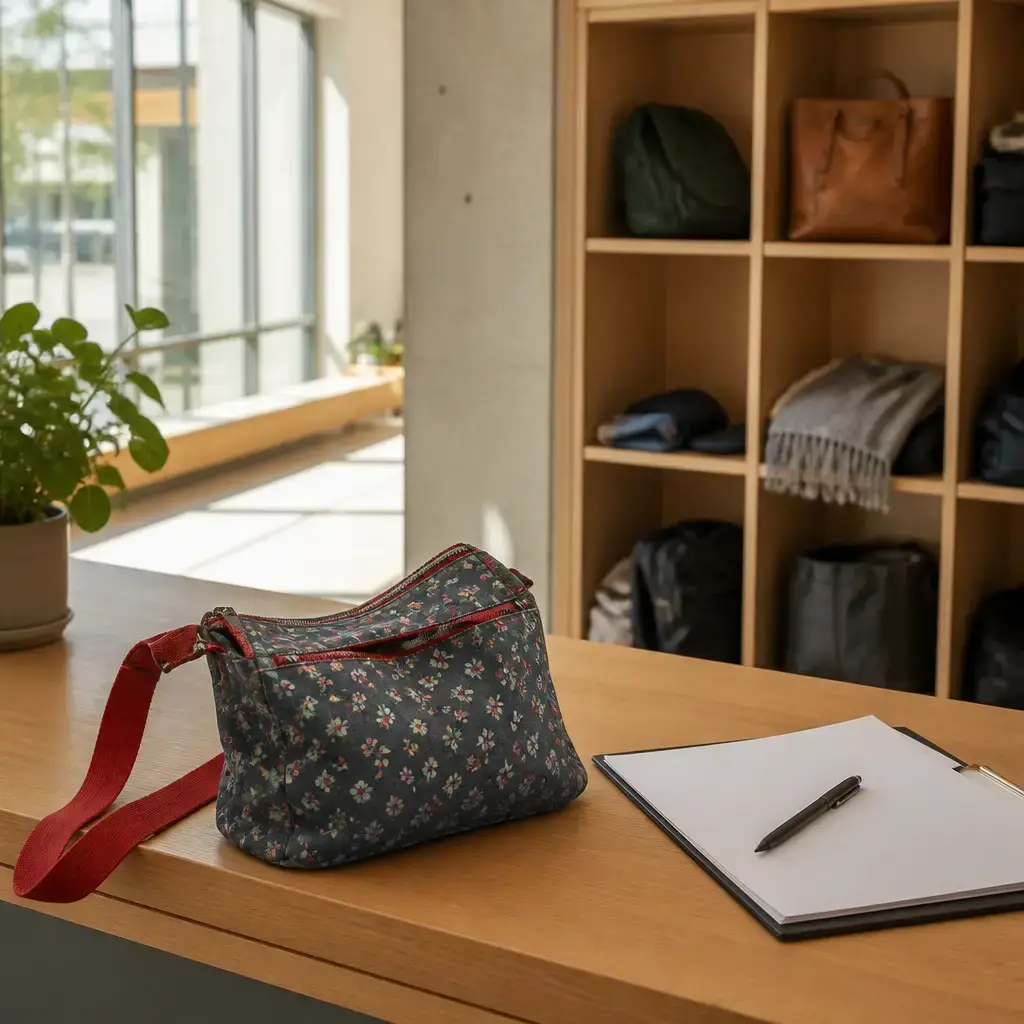
kan doo beh-SKREE-vuh den foh my? Can you describe it for me?Den har en rød rem og en ødelagt lynlås.
den hah en RERD rem oh en UR-uh-lahgt LEUN-lohs. It has a red strap and a broken zipper.Er der et mønster på forsiden?
air dair et MURN-stuh poh FOH-uh-seen? Is there any pattern on the front?Der er et lille blomstermønster.
dair air et LIL-uh BLOM-stuh-MURN-stuh. There's a small flower pattern.Den kan være din.
den kan VAIR deen. This might be yours.Det er helt sikkert min taske.
deh air helt SEH-guhd meen TAS-kuh. That's definitely my bag.Skriv venligst under på denne formular, før du tager den.
SKREEV VEN-ligst OON-uh poh DEN-uh for-moo-LAIR, FEUR doo TAY-uh den. Please sign this form before you take it.Sentence explanations
Jeg leder efter min taske på hittegodskontoret.
I'm looking for my bag at lost property.
- Jeg
- I
- leder efter
- look for
- min
- my
- taske
- bag
- på
- at
- hittegodskontoret
- lost-property office
More detail
Jeg means “I” here: the speaker is the person carrying out the search. It is the first-person singular subject pronoun. In a reusable sentence, keep jeg as the subject when you mean “I”; for example, Jeg venter. means “I am waiting.” leder efter expresses “look for” or “search for.” The verb is leder, the present-tense form of lede (“to lead” or, in this construction, “to search”), and efter is part of the fixed verb construction lede efter. The construction is used for actively trying to find something: Jeg leder efter mine nøgler. means “I’m looking for my keys.” Do not treat efter here as an independent English-style “after”; together with lede, it gives the search meaning. min means “my” before the singular common-gender noun taske. The possessive form agrees with the possessed noun: min taske (“my bag”), mit hus (“my house”), and mine tasker (“my bags”). The choice is therefore determined by the noun’s grammatical gender and number, not by the possessor. taske means “bag.” It is a singular common-gender noun; its indefinite form is en taske, and its definite form is tasken (“the bag”). In this sentence, min already identifies the bag as belonging to the speaker, so the noun remains in its basic, indefinite-looking form rather than taking the definite ending. på means “at” in this location expression. It introduces the place where the search is taking place: på kontoret means “at the office.” Its exact English equivalent can vary with the location, but here the fixed translation supports “at.” hittegodskontoret means “the lost-property office.” It is a compound built from hittegods (“lost property”) and kontor (“office”), with the definite form of the compound: hittegodskontor becomes hittegodskontoret. The ending -et marks the definite singular form of the neuter noun kontor; it is not a separate word meaning “the.” Together, Jeg leder efter min taske means “I’m looking for my bag,” and på hittegodskontoret adds the location “at the lost-property office.” The complete utterance therefore means: “I’m looking for my bag at the lost-property office.”
Kan du beskrive den for mig?
Can you describe it for me?
- Kan du
- Can you
- beskrive
- describe
- den
- it
- for mig
- for me
More detail
Kan du is a reusable Danish question pattern meaning “Can you …?” kan is the present-tense form of kunne (“can, be able to”) and is used with du, the second-person singular pronoun “you.” In a question, the modal verb comes before the subject: Kan du ...? After kan, the following verb stays in the infinitive. beskrive means “describe.” It is the infinitive form, so it follows the modal kan without an infinitive marker. For example: Kan du beskrive bilen? — “Can you describe the car?” den is a singular common-gender pronoun meaning “it” here. In the supplied context, it refers to the bag, and the translation confirms that intended reading. Danish den is also used as a determiner before a common-gender singular noun, but in this sentence it stands alone as the object of beskrive. for mig means “for me.” mig is the object form corresponding to jeg (“I”). The pattern for + person can show who benefits from an action: Hun gør det for mig. — “She does it for me.” Together, Kan du beskrive den for mig? asks whether the listener is able to describe the bag for the speaker: “Can you describe it for me?”
Den har en rød rem og en ødelagt lynlås.
It has a red strap and a broken zipper.
- Den
- it
- har
- has
- rød
- red
- rem
- strap
- ødelagt
- broken
- lynlås
- zipper
More detail
Den means “it” here and refers to the item being described. Danish uses den for a singular common-gender referent; the corresponding form for a singular neuter-gender referent is det. The pronoun itself does not identify the item's exact type beyond this grammatical distinction. har is the present-tense form of have, “to have.” It is used with all persons in the present: jeg har (“I have”), du har (“you have”), and den har (“it has”). rød means “red” here. It is the common-gender singular form used with en rem. The related forms are rødt with a singular neuter noun and røde in plural or definite uses. Example: et rødt mærke means “a red mark.” rem means “strap.” It is a common-gender noun: en rem means “a strap,” while remmen means “the strap” and remme means “straps.” In this sentence, the repeated indefinite article en introduces a strap without specifying a numerical count as a separate claim. ødelagt means “broken” here. It comes from ødelægge, “to damage or destroy,” and describes the condition of the zipper. In en ødelagt lynlås, this form is used with a singular common-gender noun; with a plural or definite noun, the adjective commonly appears as ødelagte. Example: en ødelagt stol means “a broken chair.” lynlås means “zipper.” It is a common-gender noun: en lynlås means “a zipper,” lynlåsen means “the zipper,” and lynlåse means “zippers.” The sentence begins with Den har, “It has.” The first noun phrase is en rød rem, “a red strap”: the article en introduces the noun, and rød describes it. og connects this phrase to the second noun phrase, en ødelagt lynlås, “a broken zipper.” Together, the utterance means: “It has a red strap and a broken zipper.”
Er der et mønster på forsiden?
Is there any pattern on the front?
- Er der
- is there
- mønster
- pattern
- forsiden
- the front
More detail
Er der is the Danish existential question pattern “is there …?” Here er is the present form of være (“to be”), while der is an existential placeholder, not a reference to a particular place. The reusable pattern is Er der + noun? For example: Er der kaffe? — “Is there coffee?” mønster means “pattern” here. Its indefinite singular form is et mønster; the noun is neuter, so it takes et rather than en. Et presents the pattern as an indefinite item; it does not by itself assert a numerical count of one. Useful forms include et mønster (an indefinite singular pattern), mønstret (the pattern), and mønstre (patterns). forsiden means “the front” or “the front side” here. It is the definite singular form of en forside (“a front side”): the ending -en marks definiteness. The preposition på before it gives the location meaning “on the front.” Together, på forsiden means “on the front,” and Er der et mønster på forsiden? asks whether a pattern exists in that location. The whole utterance therefore means “Is there any pattern on the front?”
Der er et lille blomstermønster.
There's a small flower pattern.
- Der er
- there is / there’s
- lille
- small
- blomstermønster
- flower pattern
More detail
Der er is the Danish existential pattern for saying that something exists or is present: “there is/there are.” er is the present form of være (“to be”), while der functions here as an introductory, non-referential “there”; it is not the thing being located. For example: Der er en bog. — “There is a book.” lille means “small” here. It is the singular form of lille; the plural form is små, as in små blomster — “small flowers.” In this sentence, lille describes the singular compound noun blomstermønster. blomstermønster is a compound noun meaning “flower pattern.” Its parts are blomst (“flower”) and mønster (“pattern”), but the compound is one noun in Danish. The final part is the grammatical head: mønster is neuter, which is why the indefinite article is et rather than en in et blomstermønster. The article marks indefiniteness here, not a specific numeric count. Together, Der er + et lille blomstermønster produces: “There’s a small flower pattern.” The pattern can be reused with another noun, for example Der er et stort vindue. — “There is a large window.”
Den kan være din.
This might be yours.
- Den
- this
- kan være
- might be
- din
- yours
More detail
Den means “this” here and functions as a singular demonstrative pronoun. In Danish, den is used with a common-gender singular referent; det is used with a neuter-gender singular referent, and de is plural. The form identifies the grammatical type of the referent, but the supplied sentence does not uniquely identify what “this” refers to. kan være combines kan, the present form of kunne, with the infinitive være (“be”). kan can express ability or possibility; here it expresses possibility, so the combination means “might be.” After a modal such as kan, the following verb normally appears in the infinitive: kan være = “can/might be.” din means “yours” here. It is an independent possessive form, and its common-gender singular form is din; related forms include dit for a neuter-gender singular possessed noun and dine for plural possessed nouns. The possessive identifies the owner as “you,” while the sentence leaves the possessed item understood. Together, Den + kan være + din gives “This might be yours.” The demonstrative points to a singular common-gender item, kan være presents being yours as a possibility, and din expresses possession without repeating the item.
Det er helt sikkert min taske.
That's definitely my bag.
- Det er
- that is
- helt sikkert
- definitely
- min
- my
- taske
- bag
More detail
Det er is a Danish identification pattern meaning “it is,” “that is,” or, in a suitable context, “this is.” Here it corresponds to “That’s.” In this pattern, det introduces or points to what is being identified; it should not be treated as a form that agrees with the following noun. Er is the present-tense form of være (“to be”): jeg er = “I am,” du er = “you are,” and det er = “it/that is.” Helt sikkert strengthens the statement to “definitely” or “certainly.” Sikkert is the adverbial form related to sikker (“sure” or “certain”), while helt means “completely” or “entirely.” Together they form a common adverbial expression: Det er helt sikkert. = “That is definitely so.” Min means “my” before a singular common-gender noun. Danish possessive forms agree with the possessed noun: min with a common-gender singular noun, mit with a neuter singular noun, and mine with plural nouns. The possessive form marks the relation to the speaker; it does not by itself state how many owners there are. Taske means “bag.” Its indefinite form is en taske (“a bag”), and its definite form is tasken (“the bag”). Because taske is a common-gender singular noun, the matching possessive form is min: min taske = “my bag.” Putting the parts together, Det er identifies something, helt sikkert expresses strong certainty, and min taske identifies the item and its relation to the speaker. The whole utterance therefore means “That’s definitely my bag.”
Skriv venligst under på denne formular, før du tager den.
Please sign this form before you take it.
- Skriv … under
- sign
- venligst
- please
- denne
- this
- formular
- form
- før
- before
- tager
- take
- den
- it
More detail
Skriv ... under is the Danish expression for “sign.” Skriv is the imperative of skrive (“to write”), but together with under it means to sign. The imperative gives a direct instruction to the person addressed; the subject “you” is understood rather than stated. A useful pattern is skriv under på + document: “sign + document.” Venligst means “please” and makes the instruction more polite. It does not change the action or its time. Denne means “this” and is the singular demonstrative used here with formular. It points to a specific nearby or contextually identified item. Danish demonstratives must fit the noun’s grammatical gender and number; denne is used with singular common-gender nouns, while dette is used with singular neuter nouns and disse with plural nouns. Formular means “form.” It is a common-gender noun: en formular, “a form.” In denne formular, the demonstrative and noun together mean “this form.” Før means “before” and introduces the event that must happen later in the stated order. The pattern før + subject + verb is reusable: før du går means “before you leave.” Tager is the present-tense form of tage, “to take.” Danish present tense is used here for the action in the subordinate clause; du tager means “you take.” The form tager is also used with other singular or plural subjects in the present, so the subject du is identified by the pronoun rather than by a special verb ending. Den means “it” here and functions as the object of tager. It is a singular common-gender pronoun, matching the intended referent formular; the fixed translation confirms that “it” refers to the form. Danish uses den for a common-gender singular referent and det for a neuter singular referent. Together, Skriv venligst under på denne formular means “Please sign this form.” The clause før du tager den adds “before you take it”: first the addressee should sign the form, and afterward the addressee takes it. The complete utterance is therefore: “Please sign this form before you take it.”
Grammar Points
din/min + substantiv
Er det din taske?
air deh deen TAS-kuh?Is it your bag?
Danish possessives such as din and min come before the noun and agree with its gender; taske is common gender.
Imperativ + partikel
Skriv under, venligst.
SKREEV OON-uh, VEN-ligst.Please sign.
The imperative uses the verb form skriv, while under is a fixed particle in the expression skriv under.
Danish Vocabulary
Quiz
Word Order
Arrange the words in the correct order.
Can you describe it for me?
Show Answer
Kan du beskrive den for mig?Is there any pattern on the front?
Show Answer
Er der et mønster på forsiden?There's a small flower pattern.
Show Answer
Der er et lille blomstermønster.Spelling
Tap the letters to spell the word.
bag
Show Answer
taskebroken
Show Answer
ødelagtdescribe
Show Answer
beskrivezipper