10 minutes free every day
Continue audio lessons in the app
Word explanations appear automatically in sync with the audio.
No login required · synced translations · playback with the screen locked
Choose your learning language and open this lesson in the app.

About This Lesson
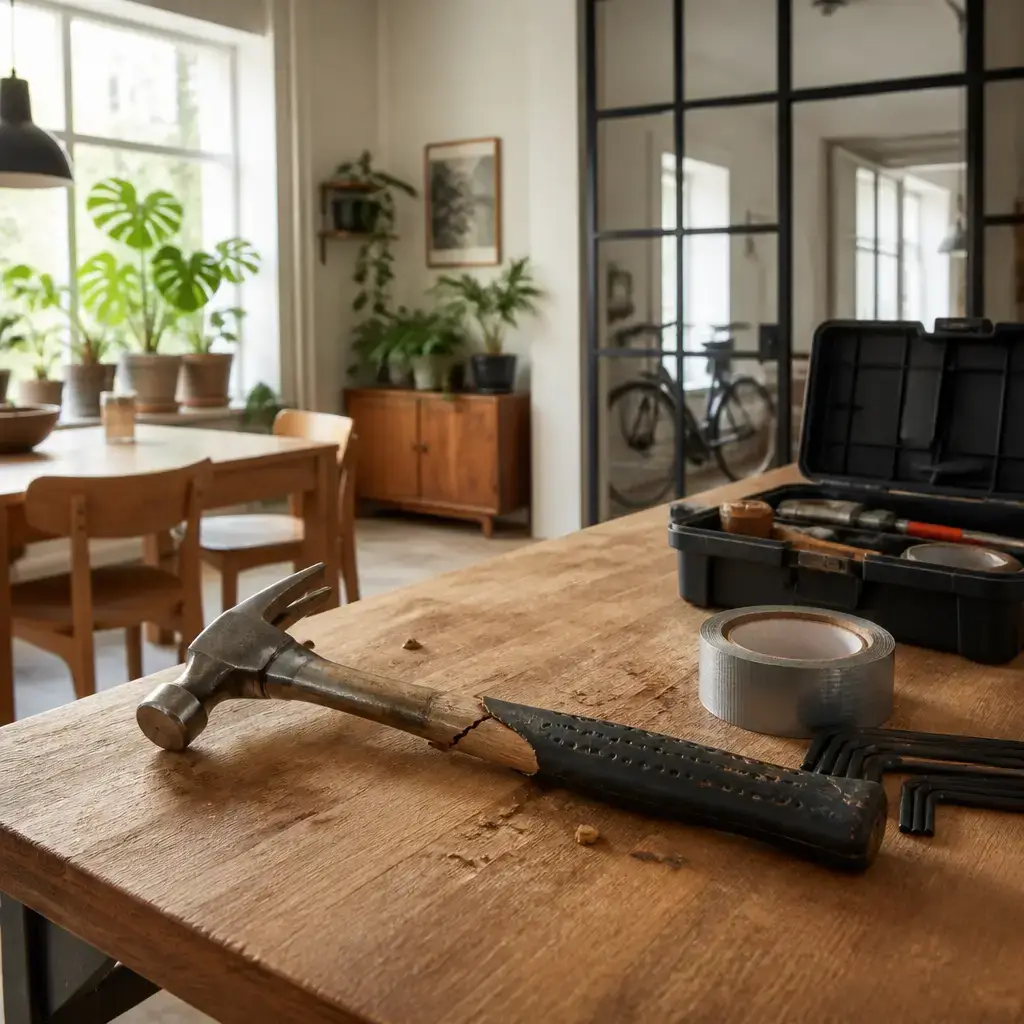
Use Apologizing for a damaged borrowed tool to practice Danish conversation, pronunciation, vocabulary, grammar, and quizzes.
Dialogue
Jeg er nødt til at undskylde for det, der skete med det værktøj, jeg lånte.
yai air NURT təl oon-SGIL-luh for day, dair SGAY-duh maydh day VAIRK-toy, yai LOHN-duh. I need to apologize for what happened to the tool I borrowed.Hvad skete der med det?
vath SGAY-duh dair maydh day? What happened to it?Håndtaget revnede, mens jeg brugte det.
HON-tay-th, RAU-NAY-thuh, mens yai BROO-duh day. The handle cracked while I was using it.Lad mig se, hvor stor skaden er.
LAD my SAY, vohr STOHR SGAY-thn air. Let me see how bad the damage is.Jeg kan erstatte det eller hjælpe med at reparere det.
yai kan air-SBAD-uh day EL-uh YEL-buh maydh uh ray-pa-RAY day. I can replace it or help repair it.Vi bør undersøge, om en reparation holder.
vee bur oon-SUR-uh, om en ray-pa-RAY-shon HOL-duh. We should check whether a repair will hold.Jeg er ked af, at jeg har givet dig ekstra arbejde.
yai air KAYDH af, ad yai har GEE-vuth dai EK-struh AR-bai-duh. I am sorry for causing extra work.Sig det til mig med det samme næste gang.
SAY day təl my maydh day SAM-uh NESS-duh GONG. Tell me right away next time.Vi kan få styr på det.
vee kan foh STYUR poh day. We can sort it out.Sentence explanations
Jeg er nødt til at undskylde for det, der skete med det værktøj, jeg lånte.
I need to apologize for what happened to the tool I borrowed.
- Jeg er nødt til
- I need to
- undskylde
- apologize
- for det, der skete
- for what happened
- med
- with
- værktøj
- tool
- lånte
- borrowed
More detail
Jeg er nødt til expresses that the speaker needs to or is obliged to do something. The reusable pattern is jeg er nødt til at + infinitive: Jeg er nødt til at vente. — “I need to wait.” er is the present form of være, while Jeg is the first-person subject. undskylde means “to apologize.” It is an infinitive after at in the pattern above. Example: Jeg vil undskylde. — “I want to apologize.” for det, der skete means “for what happened.” In this utterance, det refers to the event being apologized for. skete is the past form of ske, “to happen,” and der introduces the relative clause in its subject role. The pattern det, der ... can mean “what ...”: Jeg husker det, der skete. — “I remember what happened.” med means “with” here and connects the event with the thing affected or involved. Its translation varies by context, so the surrounding words determine the appropriate English rendering. værktøj means “tool.” It is a neuter noun: the indefinite article is et, as in et værktøj — “a tool.” In the fixed noun phrase det værktøj, the preceding det is part of the noun phrase and agrees with a neuter noun; the fixed translation renders the phrase as “the tool.” This is not the same form as the definite suffix in værktøjet. lånte means “borrowed” here. It is the past form of låne, “to borrow.” Danish past forms such as lånte do not change for the subject’s person or number: jeg lånte — “I borrowed,” and vi lånte — “we borrowed.” The relative clause jeg lånte identifies the tool as the one the speaker borrowed. Together, Jeg er nødt til at undskylde says “I need to apologize.” for det, der skete specifies what the apology concerns, and med det værktøj, jeg lånte identifies the involved tool. The complete meaning is: “I need to apologize for what happened to the tool I borrowed.”
Hvad skete der med det?
What happened to it?
- Hvad
- what
- skete
- happened
- med
- to; with
- det
- it
More detail
Hvad means “what” here and asks for the event or situation being identified. It is the interrogative form used when the unknown information is a thing, event, or fact. Example: Hvad så du? — “What did you see?” skete is the past-tense form of ske, “to happen” or “to occur.” The present form is sker; skete places the event in the past. Example: Hvad skete der i går? — “What happened yesterday?” med normally means “with,” but after ske the reusable pattern ske med + something means “happen to + something.” It introduces the thing affected by or involved in the event. Example: Hvad skete der med bilen? — “What happened to the car?” det is a neuter singular pronoun meaning “it” here. Its specific referent is the thing being discussed; in the supplied surrounding context, that thing is the borrowed tool. Danish also uses den for common-gender singular reference, but the correct pronoun depends on the grammatical gender of the noun, not simply on whether there is one object. The full question follows the pattern Hvad skete der med det? Here der is part of the Danish construction used with ske; it does not mean the English location word “there” in this question. The parts combine as “what happened to it?” The past form skete asks about an event that has already occurred, med det identifies the affected thing, and the question word Hvad asks what that event was. In the surrounding context, the question concerns what happened to the tool.
Håndtaget revnede, mens jeg brugte det.
The handle cracked while I was using it.
- Håndtaget
- the handle
- revnede
- cracked
- mens
- while
- jeg
- I
- brugte
- used
- det
- it
More detail
Håndtaget means “the handle” here. It is the definite singular form of håndtag (“handle”): et håndtag is “a handle,” while håndtaget is “the handle.” The ending -et marks definiteness and also reflects this noun’s neuter gender; it is not a general ending for every Danish noun. revnede means “cracked” in this sentence. It is the past-tense form of revne (“to crack” or “split”). The form describes the handle’s change of state: the handle developed a crack. Example: Glasset revnede. — “The glass cracked.” mens introduces an activity that was in progress at the time of another event. It commonly corresponds to “while.” In the pattern mens + subject + verb, the clause after mens gives the ongoing background activity. jeg is the first-person singular subject pronoun, “I.” In Danish, the corresponding object form is mig, not jeg: Jeg så ham. — “I saw him”; Han så mig. — “He saw me.” Here jeg is the subject of the clause introduced by mens. brugte is the past-tense form of bruge (“to use”). Here it means “was using” because it appears in the ongoing activity clause after mens; Danish does not need a separate progressive verb form for this meaning. Example: Jeg brugte kniven. — “I used the knife.” det means “it” here and refers to the handle identified by Håndtaget. It is the neuter singular object form, matching the grammatical gender of håndtag. Danish pronouns distinguish forms such as den and det according to grammatical gender, not according to whether the referent is physically male or female. Together, Håndtaget revnede says “The handle cracked.” The construction mens jeg brugte det adds the simultaneous activity: “while I was using it.” Thus the complete utterance is: “The handle cracked while I was using it.”
Lad mig se, hvor stor skaden er.
Let me see how bad the damage is.
- Lad mig
- let me
- se
- see
- hvor stor
- how big; how severe
- skaden
- the damage
- er
- is
More detail
Lad mig is the reusable Danish pattern “let me …”. Lad is the imperative of lade (“to let/allow”), and mig is the object form of “I/me”. It is followed by an infinitive: Lad mig komme. — “Let me come.” se means “see” here and is the infinitive after Lad mig. The pattern Lad mig + infinitive is used to propose doing something oneself: Lad mig hjælpe. — “Let me help.” hvor stor means “how severe” in this sentence. Stor is the adjective “big”; with hvor, it forms a degree expression meaning “how big” or, with an event or problem, “how severe”. Its basic comparison chain is stor (“big”), større (“bigger”), størst (“biggest”). Here, stor describes the extent of the damage, not physical size. skaden means “the damage”. It is the definite singular form of skade (“damage”): en skade — “an injury/damage”, skaden — “the injury/damage”. The definite form identifies the damage being discussed; the fixed translation gives its intended meaning here. er means “is”. It is the present-tense form of være (“to be”). In hvor stor skaden er, the finite verb comes after the subject skaden, as is normal in this subordinate clause. Compare the direct question Hvor stor er skaden? — “How severe is the damage?” Together, Lad mig se means “Let me see”, and hvor stor skaden er is the embedded clause “how severe the damage is”. The complete utterance is therefore: “Let me see how bad the damage is.”
Jeg kan erstatte det eller hjælpe med at reparere det.
I can replace it or help repair it.
- Jeg kan
- I can
- erstatte
- replace
- det
- it
- hjælpe
- help
- reparere
- repair
More detail
Jeg kan means “I can.” Jeg is the first-person singular pronoun “I”. kan is the present-tense form of kunne (“can, be able to”). With this modal verb, Danish normally places the following verb in the infinitive without at: Jeg kan erstatte ... = “I can replace ...”. erstatte means “replace” and is an infinitive. It can be reused after modal verbs: Hun kan erstatte delen. — “She can replace the part.” det means “it” here and is an object pronoun. Its neuter singular form is det; the fixed sentence does not identify the exact thing it refers to. Danish also uses den for a common-gender singular referent, so the choice between det and den depends on the grammatical gender of the referent, not simply on whether there is one object. hjælpe means “help”. It is another infinitive coordinated with erstatte: kan erstatte ... eller hjælpe ... — “can replace ... or help ...”. The conjunction eller presents two alternatives. reparere means “repair”. In hjælpe med at reparere, the pattern hjælpe med at is followed by an infinitive: “help with repairing”. Unlike the infinitive after kan, this infinitive is introduced by at: Jeg hjælper med at reparere cyklen. — “I help repair the bicycle.” Together, Jeg kan erstatte det eller hjælpe med at reparere det says that the speaker is able either to replace the object or to help repair it. The two occurrences of det are the same intended object in this utterance, as reflected by “it” in both places. The sentence is a neutral, reusable way to offer two possible actions.
Vi bør undersøge, om en reparation holder.
We should check whether a repair will hold.
- Vi bør
- we should
- undersøge
- check
- om
- whether
- reparation
- repair
- holder
- holds
More detail
Vi bør means “we should.” vi is the first-person plural pronoun, “we,” and bør is the modal verb corresponding to burde; in this sentence it expresses a recommendation or something considered advisable. After a modal such as bør, the following verb is in the infinitive: Vi bør undersøge (“We should check”). undersøge is the infinitive meaning “to check” or “to examine.” Its infinitive form is used after bør. Example: Vi bør undersøge sagen. — “We should examine the matter.” om introduces an indirect yes/no question and is translated here as “whether.” The reusable pattern is undersøge, om ... — “check whether ...”. It is different from a direct question such as Holder den? (“Will it hold?”), because the question is embedded after undersøge. reparation is a noun meaning “repair.” The form en reparation is an indefinite singular noun phrase: en marks one unspecified member of the noun’s common-gender class, but the phrase does not by itself assert a numerical count in the intended English translation. The plural is reparationer (“repairs”). holder is the present-tense form of holde, “to hold.” Here holde refers to lasting or remaining sound under use, so holder means “holds” in the embedded question. Danish commonly uses the present tense for a future situation when the future meaning is clear from context; therefore om en reparation holder is naturally translated “whether a repair will hold.” The form holder agrees with neither a separate adjective nor the noun by gender or number; it is the verb’s present form. Together, Vi bør undersøge, om en reparation holder. means “We should check whether a repair will hold.” The structure is we should + check + whether + a repair + holds: the group introduced by om states what should be checked.
Jeg er ked af, at jeg har givet dig ekstra arbejde.
I am sorry for causing extra work.
- Jeg
- I
- er ked af
- am sorry
- jeg har
- I have
- givet
- given
- dig
- you
- ekstra
- extra
- arbejde
- work
More detail
Jeg means “I” here and is the subject of both the main clause and the subordinate clause later in the sentence. Danish subject pronouns include jeg “I,” du “you” as subject, and han/hun “he/she”; the form is selected by the subject’s role, not by the noun arbejde. er ked af is the fixed expression “am sorry” or “regret.” Its central verb is er, the present form of være “be”; ked af is not a literal English-style description of physical sadness in this sentence, but part of the expression være ked af. The expression can be followed by at plus a clause: Jeg er ked af, at ... — “I am sorry that ...”. jeg har begins the subordinate clause and means “I have.” har is the present form of have and functions here as an auxiliary. With a past participle, the pattern har + past participle forms a perfect construction, connecting an earlier event with the current situation. For example, Jeg har læst bogen. means “I have read the book.” givet is the past participle of give “give.” In har givet, it is the form required after the auxiliary har; the combination literally presents an earlier giving as relevant now. Here the intended result is that the speaker has caused the other person extra work. The observed form is givet, not the infinitive give. dig is the object form of du “you.” It marks the person affected by the giving or causing. Compare subject Du hjælper mig — “You help me” — with object Jeg hjælper dig — “I help you.” The fixed translation identifies this person as the recipient of the extra work. ekstra means “extra” or “additional.” It is a descriptive modifier of arbejde here. Danish ekstra commonly stays in this form rather than taking the ordinary adjective agreement forms seen with many other adjectives; do not treat it as a form of arbejde. arbejde means “work.” In this sentence it is used without an article to refer to work as an amount or activity, not to assert a particular count of work items. As a noun, it can also refer to a job or employment in other contexts, but the fixed translation supports the “work” meaning here. The comma introduces the at-clause: at jeg har givet dig ekstra arbejde means “that I have given you extra work.” The whole pattern is Jeg er ked af, at ... + a clause, so the sentence assembles as “I am sorry that I have given you extra work.” In natural English, the same meaning is “I am sorry for causing extra work.”
Sig det til mig med det samme næste gang.
Tell me right away next time.
- Sig
- tell
- det
- it
- til mig
- to me
- med det samme
- right away
- næste gang
- next time
More detail
Sig is the imperative of sige (“to say; to tell”). The useful form chain is sige (infinitive), siger (present), sagde (past), and sig (imperative). In this sentence, sig gives a direct instruction: “tell” or “say.” Example: Sig sandheden. — “Tell the truth.” det is a pronoun functioning as the object of sig. Here it has the intended meaning “it,” while the supplied sentence does not identify what “it” refers to. The form det is the neuter singular form; Danish also uses den for common-gender singular reference. Example: Jeg ved det. — “I know it.” til mig expresses the recipient: til means “to,” and mig is the first-person singular object form of jeg (“I”). Thus jeg is used for the subject, while mig is used after a preposition or as an object. Example: Hun skriver til mig. — “She writes to me.” med det samme is a reusable expression meaning “right away” or “immediately.” Its meaning here is as a unit, so it specifies that the telling should happen without delay. Example: Kom med det samme. — “Come right away.” næste gang means “next time” or “the next occasion.” næste means “next/following,” and gang is the noun meaning “time” in the sense of an occasion here. The phrase normally refers to a future occasion without needing an article: Jeg gør det næste gang. — “I’ll do it next time.” Together, Sig det til mig means “Tell it to me,” naturally “Tell me.” med det samme adds the timing “right away,” and næste gang sets the occasion as “next time.” The complete utterance is therefore the instruction: “Tell me right away next time.”
Vi kan få styr på det.
We can sort it out.
- Vi kan
- we can
- få styr på
- sort out; get under control
- det
- it
More detail
Vi kan means “we can.” vi is the first-person plural pronoun, used for a group including the speaker. kan is the present-tense form of kunne, “can/be able to.” Danish modal verbs such as kan are followed by an infinitive without an English-style “to”: Vi kan få = “we can get/manage to get.” få styr på is a reusable Danish expression meaning to get control of, organize, understand, or otherwise deal with something successfully. In this sentence, the natural meaning is “sort out.” The expression is built with få (“get”), styr (“control/order”), and på (“on”), but its combined meaning is more idiomatic than a word-for-word translation. After a modal, få remains in the infinitive. Example: Vi skal få styr på problemet. — “We need to sort out the problem.” det means “it” here. It is the Danish neuter singular pronoun, used for a matter already identifiable from the situation or conversation; the sentence does not specify exactly what that matter is. Danish also uses den for singular common-gender referents, while det is the form used for a neuter referent or an unspecified matter expressed with this pronoun. Example: Jeg kan ordne det. — “I can sort it out.” Together, Vi kan + få styr på + det gives “We can sort it out.” The modal presents this as something the speaker and others are able to do, and få styr på det identifies the action as successfully dealing with the matter.
Grammar Points
være nødt til at + infinitiv
Jeg er nødt til at undersøge skaden.
yai air NURT təl uh oon-SUR-uh SGAY-thn.I need to examine the damage.
Use være nødt til at + infinitive to express necessity or obligation.
om + sætning
Undersøg, om reparationen holder.
oon-SUR, om ray-pa-RAY-shon-en HOL-duh.Check whether the repair will last.
Use om to introduce an indirect yes/no question, meaning “whether” or “if”.
Danish Vocabulary
jeg brugte det
- Gender
- neuter
Håndtaget revnede.
Lad mig se.
det værktøj, jeg lånte
mens jeg brugte det
Håndtaget revnede.
- Gender
- common
hvor stor skaden er
Hvad skete der med det?
hvor stor skaden er
Jeg er nødt til at undskylde.
Jeg er nødt til at undskylde.
- Gender
- neuter
det værktøj, jeg lånte
Quiz
Word Order
Arrange the words in the correct order.
What happened to it?
Show Answer
Hvad skete der med det?The handle cracked while I was using it.
Show Answer
Håndtaget revnede, mens jeg brugte det.We can sort it out.
Show Answer
Vi kan få styr på det.Spelling
Tap the letters to spell the word.
handle
Show Answer
Håndtagetapologize
Show Answer
undskyldewhile
Show Answer
menshappen