10 minutes free every day
Continue audio lessons in the app
Word explanations appear automatically in sync with the audio.
No login required · synced translations · playback with the screen locked
Choose your learning language and open this lesson in the app.

About This Lesson
Use Phone battery problem to practice Danish conversation, pronunciation, vocabulary, grammar, and quizzes.
Dialogue
Min telefons batteri er næsten dødt.
men teh-leh-FOHNS beh-teh-REE air NEH-sten DURT. My phone battery is almost dead.Har du en oplader eller en powerbank med dig?
hah doo en oh-PLAH-der EH-ler en POW-er-benk meh DYE? Do you have a charger or power bank with you?Jeg lod begge dele blive hjemme.
yai lohd BEH-geh DEH-leh BLEE-veh YEM-meh. I left both at home.Jeg skal ringe, det haster.
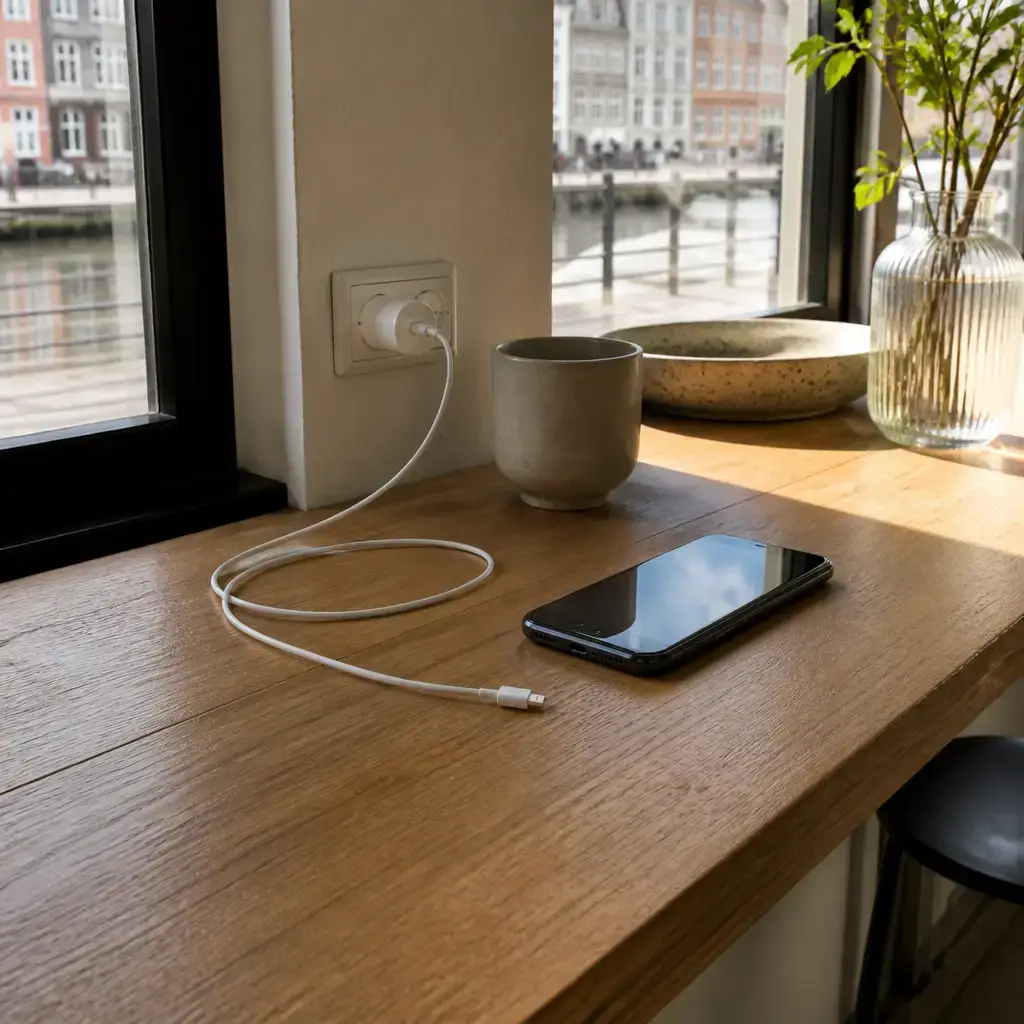
yai skel RENG-eh, deh HES-der. I need to make an urgent call.Der er en stikkontakt ved siden af vinduet.
dair air en STEG-kon-takt veh SEE-den af VEE-noo-eth. There is an outlet beside the window.Må jeg bruge dit kabel i et par minutter?
moh yai BROO-eh dit KAY-bel ee ed par mee-NOO-der? Could I use your cable for a few minutes?Du kan bruge det længe nok til at ringe.
doo kan BROO-eh deh LENG-eh nok tel eh RENG-eh. You can use it long enough to make the call.Jeg giver dig det tilbage, så snart min telefon tænder.
yai GHEE-ver dye deh beh-TAH-leh, soh SNART men teh-leh-FOHNS TEN-der. I will return it as soon as my phone turns on.Lad den være tilsluttet, indtil du har nok strøm på batteriet.
lad den VAIR-eh til-SLOO-ded, EN-del doo hah nok strohm poh beh-teh-REE-et. Keep it plugged in until you have enough battery.Sentence explanations
Min telefons batteri er næsten dødt.
My phone battery is almost dead.
- Min
- my
- telefons
- phone’s
- batteri
- battery
- er
- is
- næsten
- almost
- dødt
- dead
More detail
Min means “my” and is the possessive form used with an en-word noun in the singular. With an et-word noun, Danish uses mit, and with plural nouns, mine: min telefon, mit batteri, mine telefoner. The possessive agrees with the possessed noun, not with the possessor. telefons means “phone’s.” The final -s marks possession in Danish: telefon means “phone,” while telefons batteri means “the phone’s battery.” This form is not a plural; the possessed noun is batteri. batteri means “battery.” It is an et-word noun: et batteri. That noun type explains the form mit batteri in the alternative possessive pattern, although the sentence uses min with telefon instead. er is the present-tense form of være, “to be.” Danish uses er with all persons in the present: jeg er (“I am”), du er (“you are”), and de er (“they are”). Here it links the battery to its condition. næsten means “almost” or “nearly.” It reduces the force of the following description: the battery is not described as completely dead, but as very close to that state. For example, Det er næsten færdigt means “It is almost finished.” dødt means “dead” here, describing the battery’s condition. Its base form is død (“dead”); dødt is the singular neuter form used with et-word batteri. Compare en død telefon (“a dead phone”) with et dødt batteri (“a dead battery”). Together, Min telefons batteri means “my phone’s battery,” er means “is,” and næsten dødt means “almost dead.” The complete utterance is therefore “My phone battery is almost dead,” with the possessive structure literally corresponding to “the battery of my phone.”
Har du en oplader eller en powerbank med dig?
Do you have a charger or power bank with you?
- Har du
- do you have
- oplader
- charger
- powerbank
- power bank
- med dig
- with you
More detail
Har du is the Danish question pattern for “do you have …?” The verb har is the present-tense form of have (at have), and du means “you” as the subject. Danish commonly forms a yes/no question by placing the finite verb before the subject: Har du ...? Compare the statement Du har ... (“You have ...”) with the question Har du ...?. oplader means “charger” here. Its base form is oplader; the singular indefinite form uses the common-gender article en: en oplader. Useful forms are opladeren (“the charger”) and opladere (“chargers”). eller connects alternatives and means “or”. The question therefore presents two possible items rather than asking about both together. powerbank is a borrowed noun meaning “power bank”. In this sentence it is the singular indefinite item after en: en powerbank. The two noun phrases en oplader and en powerbank are parallel alternatives. med dig means “with you”. med is the preposition “with”, and dig is the object form used for “you” after a preposition; the corresponding subject form is du. In this utterance, med dig adds the idea of having the item on or available with the person now, rather than merely owning one. For example: Har du din nøgle med dig? — “Do you have your key with you?” Taken together, Har du + en oplader eller en powerbank + med dig? asks whether the listener currently has either a charger or a power bank with them: “Do you have a charger or power bank with you?”
Jeg lod begge dele blive hjemme.
I left both at home.
- Jeg
- I
- lod
- left
- begge dele
- both
- blive
- stay
- hjemme
- at home
More detail
Jeg means “I” here and is the first-person singular subject pronoun. It does not change for grammatical gender. Compare jeg with du (“you”) when the subject changes. lod is the past-tense form of lade. In this sentence, lade means “leave” in the construction lade noget blive ...: the speaker left something in a place. The present–past pair is lader–lod; the past form is irregular. Example: Hun lod tasken blive i bilen. — “She left the bag in the car.” begge dele means “both things” or “both of them.” begge means “both” for two items, while dele is the plural of del (“part” or “thing” in this use). Together they refer to the two items mentioned in the preceding question, without repeating their nouns. Example: Jeg tager begge dele. — “I’ll take both.” blive is the infinitive of blive, meaning “stay” here. After lod, it expresses that the items remained in the specified place: lade noget blive = “leave something behind / leave something in place.” Blive can have other meanings in Danish, including “become,” but hjemme gives the “stay/remain” meaning here. hjemme means “at home” and is an adverb describing location. Danish contrasts hjemme (“at home,” a location) with hjem (“home” as a destination), as in Jeg går hjem. — “I’m going home.” The pattern Jeg lod [noget] blive hjemme combines the subject Jeg, past lod, the object begge dele, the infinitive blive, and the location hjemme. The complete meaning is “I left both at home.”
Jeg skal ringe, det haster.
I need to make an urgent call.
- Jeg skal
- I need to
- ringe
- call; make a call
- det haster
- it is urgent
More detail
Jeg skal means “I need to” here. Jeg is the first-person singular pronoun “I”, and skal is the present form of skulle. In this sentence, skal expresses necessity; in other contexts it can also express a plan or expectation. The pattern jeg skal + infinitive is reusable: Jeg skal spise. — “I need to / am going to eat,” with the exact force supplied by context. ringe means “to call” or “to make a call.” It is the infinitive after the modal verb skal; the modal carries the present-tense form, while ringe remains in the infinitive. at ringe is the form used when the infinitive is introduced by at, as in Jeg prøver at ringe. — “I am trying to call.” det haster is a fixed expression meaning “it is urgent” or “there is a need to act quickly.” haster is the present form of haste, “to be urgent / to hurry.” Here det functions as the grammatical subject of the expression; the sentence does not identify a separate concrete thing that det refers to. The expression is about urgency rather than describing a person’s speed. Together, Jeg skal ringe gives “I need to make a call,” and det haster adds that the call is urgent. The comma joins these two clauses, producing the complete meaning: “I need to make an urgent call.”
Der er en stikkontakt ved siden af vinduet.
There is an outlet beside the window.
- Der er
- there is/are
- stikkontakt
- outlet
- ved siden af
- beside; next to
- vinduet
- the window
More detail
Der er is the Danish existential construction used to say that something exists or is located somewhere: “there is” or “there are.” The following noun determines whether the English meaning is singular or plural; der itself does not identify a physical place. stikkontakt means “outlet” or “electrical socket.” It is a common-gender noun: en stikkontakt is “an outlet,” while stikkontakten is “the outlet.” In this sentence, the indefinite form stikkontakt follows en in the existential pattern. Example: Der er en lampe her. — “There is a lamp here.” ved siden af is a fixed prepositional expression meaning “beside” or “next to.” It introduces the reference point for the location. Example: Bogen ligger ved siden af computeren. — “The book is next to the computer.” vinduet means “the window.” Its base noun is vindue; the ending -t marks the definite singular form for this neuter noun: et vindue — “a window,” vinduet — “the window.” The definite form is appropriate because the translation identifies a specific window as the reference point. Together, Der er en stikkontakt ved siden af vinduet. says that an outlet is located beside the window: “There is an outlet beside the window.”
Må jeg bruge dit kabel i et par minutter?
Could I use your cable for a few minutes?
- Må jeg
- Could I
- bruge
- use
- dit
- your
- kabel
- cable
- et par minutter
- a few minutes
More detail
Må jeg combines the modal verb må with the subject pronoun jeg. Here it asks for permission: “Could/May I …?” The modal is followed by the infinitive without at. For example, Må jeg komme ind? means “May I come in?” bruge means “use” here. It is the infinitive form; after må, Danish uses this form directly: Må jeg bruge ...? (“May I use ...?”). The same verb can be used for objects and resources, as in Jeg bruger telefonen (“I use the phone”). dit means “your” and agrees with the noun it modifies, not with the possessor. It is the form used with a singular neuter noun, such as et kabel; compare din with a singular common-gender noun and dine with a plural noun. In this sentence, it marks possession by the person addressed. kabel means “cable.” Its indefinite singular form is et kabel, and its plural is kabler. The noun is therefore a neuter noun, which explains the form dit in dit kabel. et par minutter means “a few minutes” in this sentence. minutter is the plural of minut, and et par is a compact quantity expression meaning “a couple of” or, in contexts like this, “a few.” It does not mean that a precise number is being asserted here. For example, Vent et par minutter. means “Wait a few minutes.” Together, Må jeg bruge dit kabel asks permission to use the other person’s cable, and i et par minutter limits the intended duration to a few minutes. The complete utterance is therefore: “Could I use your cable for a few minutes?” This is a polite, ordinary way to make a request.
Du kan bruge det længe nok til at ringe.
You can use it long enough to make the call.
- Du kan
- you can
- bruge
- use
- det
- it
- længe nok
- long enough
- til at
- in order to
- ringe
- call
More detail
Du kan is a reusable way to say “you can” or “you are able to.” kan is the present form of kunne; it is followed by an infinitive: Du kan bruge = “You can use.” The modal does not take an infinitive marker before bruge. bruge means “use.” Its base form is also bruge, and after a modal such as kan, Danish uses this infinitive form. Example: Jeg kan bruge telefonen. — “I can use the phone.” det is a neuter singular pronoun meaning “it” here. Its exact referent is supported by the context as the item being used, but the pronoun itself expresses the grammatical class and role rather than naming the item. Danish contrasts det with den in contexts where the noun has common gender. længe nok means “long enough.” længe expresses duration, and nok placed after it means that the duration is sufficient for the purpose. Example: Bliv her længe nok. — “Stay here long enough.” til at introduces a purpose or result that is connected to an infinitive: længe nok til at ... means “long enough to ...”. It is a useful pattern for saying that one amount or duration is sufficient for an action. ringe means “call” in this sentence. It is the infinitive after til at; the form does not change for the person doing the action. Example: Jeg har tid til at ringe. — “I have time to call.” Together, Du kan bruge det says “You can use it.” Adding længe nok til at ringe specifies that the permitted or possible duration is sufficient for making the call. The complete meaning is: “You can use it long enough to make the call.”
Jeg giver dig det tilbage, så snart min telefon tænder.
I will return it as soon as my phone turns on.
- Jeg
- I
- giver
- give
- dig
- you
- det
- it
- tilbage
- back
- så snart
- as soon as
- min
- my
- telefon
- phone
- tænder
- turns on
More detail
Jeg means “I” here and is the subject—the person performing the giving. Danish uses jeg for the first-person singular subject; the corresponding object form is mig. Example: Jeg ser dig. means “I see you.” giver is the present-tense form of give, “to give.” In Danish, the present tense can describe a future action when the time or condition makes the future meaning clear, as it does here. Example: Jeg giver dig bogen i morgen. means “I will give you the book tomorrow.” dig means “you” as an object. It is the object form of the singular pronoun whose subject form is du: Du ser mig means “You see me,” while Jeg ser dig means “I see you.” det means “it” here. This is the neuter singular form used for the thing being returned; its specific identity is supplied by the context, not by the pronoun alone. Example: Jeg har det. means “I have it.” tilbage means “back.” With a verb of giving, give ... tilbage is the reusable pattern for returning something: Jeg giver bogen tilbage means “I return the book.” Together, giver ... det tilbage means “return it,” literally giving it back. The separated object and adverb are both part of the same reusable meaning. så snart is the conjunction “as soon as.” It introduces the time condition for the main action. Example: Jeg ringer, så snart jeg kommer hjem. means “I will call as soon as I get home.” min means “my” before a singular common-gender noun. The noun telefon is common gender, so min is the appropriate singular form; before a singular neuter noun, Danish uses mit, and before a plural noun, mine. Example: min bog means “my book,” while mit hus means “my house.” telefon means “phone.” It is a common-gender noun in Danish: en telefon, with the definite form telefonen. Example: Min telefon er ny. means “My phone is new.” tænder is the present-tense form of tænde, “to turn on” or “to light,” and here it means “turns on.” Its subject is min telefon, so the phone is the thing that turns on. Example: Lyset tænder. means “The light turns on.” The complete structure is Jeg giver dig det tilbage (“I will return it to you”) followed by så snart min telefon tænder (“as soon as my phone turns on”). In context, the present forms giver and tænder produce a future-oriented meaning: the return will happen once the phone turns on. Thus the whole utterance means, “I will return it as soon as my phone turns on.”
Lad den være tilsluttet, indtil du har nok strøm på batteriet.
Keep it plugged in until you have enough battery.
- Lad
- keep; let
- den
- it
- være tilsluttet
- be plugged in
- indtil
- until
- du har
- you have
- nok
- enough
- strøm
- power; charge
- batteriet
- the battery
More detail
Lad is the imperative of lade. In this sentence, lade means “let” or “keep” and introduces a state that should continue: Lad + object + infinitive. Example: Lad døren stå åben. — “Leave the door open.” den is a singular common-gender object pronoun meaning “it” here. Its specific referent is not named in this sentence; the translation establishes the intended English reading “it.” Danish also uses det for a singular neuter referent, so the pronoun’s form is chosen by the grammatical gender of what it refers to, not by English “it” alone. være is the infinitive of at være, “to be.” After the imperative construction Lad den ..., it describes the state that den is to remain in. tilsluttet means “connected” or “plugged in” here. Together, være tilsluttet describes being connected to a power source. The fixed form tilsluttet is a participial/adjectival form; it does not itself show the person of the subject. indtil introduces the endpoint of the duration: “until.” It is followed here by the clause du har nok strøm på batteriet. Example: Vent, indtil jeg kommer. — “Wait until I come.” du har means “you have.” har is the present-tense form of at have, “to have,” and it is used with du as well as with several other subjects; Danish present-tense verbs generally do not change for person. The clause says that you have a sufficient amount of something, not that you possess a separate object called “enough.” nok means “enough” or “sufficient.” Before a noun, it marks a sufficient amount: nok tid — “enough time.” strøm means “power” or, in this context, electrical charge/energy. It is a mass noun here, so the sentence refers to a sufficient amount of charge rather than to separate countable units. strøm can also mean electricity in other contexts. batteriet means “the battery.” It is the definite singular form of batteri: et batteri — “a battery,” batteriet — “the battery.” The phrase strøm på batteriet is understood here as charge available in the battery; på is not separately listed in the supplied phrase entries, but it links the charge to the battery. The sentence builds as Lad den være tilsluttet (“Keep it plugged in”) + indtil (“until”) + du har nok strøm på batteriet (“you have enough charge in the battery”). As a whole: “Keep it plugged in until you have enough battery,” with “enough battery” naturally understood as enough charge in the battery.
Grammar Points
næsten + adjektiv
næsten dødt
NEH-sten DURTalmost dead
næsten is an adverb modifying the adjective dødt; dødt takes the neuter form.
give tilbage: giver dig det tilbage
giver dig det tilbage
GHEE-ver dye deh beh-TAH-lehgive it back to you
The indirect-object pronoun dig comes before the object det, while tilbage stays after it.
Danish Vocabulary
Quiz
Word Order
Arrange the words in the correct order.
My phone battery is almost dead.
Show Answer
Min telefons batteri er næsten dødt.I left both at home.
Show Answer
Jeg lod begge dele blive hjemme.I need to make an urgent call.
Show Answer
Jeg skal ringe, det haster.Spelling
Tap the letters to spell the word.
phone
Show Answer
telefonsbattery
Show Answer
batterialmost
Show Answer
næstendead