10 minutes free every day
Continue audio lessons in the app
Word explanations appear automatically in sync with the audio.
No login required · synced translations · playback with the screen locked
Choose your learning language and open this lesson in the app.

About This Lesson
Use Rules for a shared kitchen to practice Danish conversation, pronunciation, vocabulary, grammar, and quizzes.
Dialogue
Jeg er ny i det fælles køkken. Hvad skal jeg vide?
yai air NÜ ee deh FEH-ləs KURR-ən. va skel yai VEE-uh? I'm new to this shared kitchen. What should I know?Hold køkkenbordene fri, og ryd op lige efter madlavningen.
hol KURR-ən-bor-deh-neh FREE, oh RÜD OP LEE-uh EF-tər MAD-lahv-ning-en. Keep the counters clear and clean up right after cooking.Hvor skal jeg stille en pande, når jeg har vasket den?
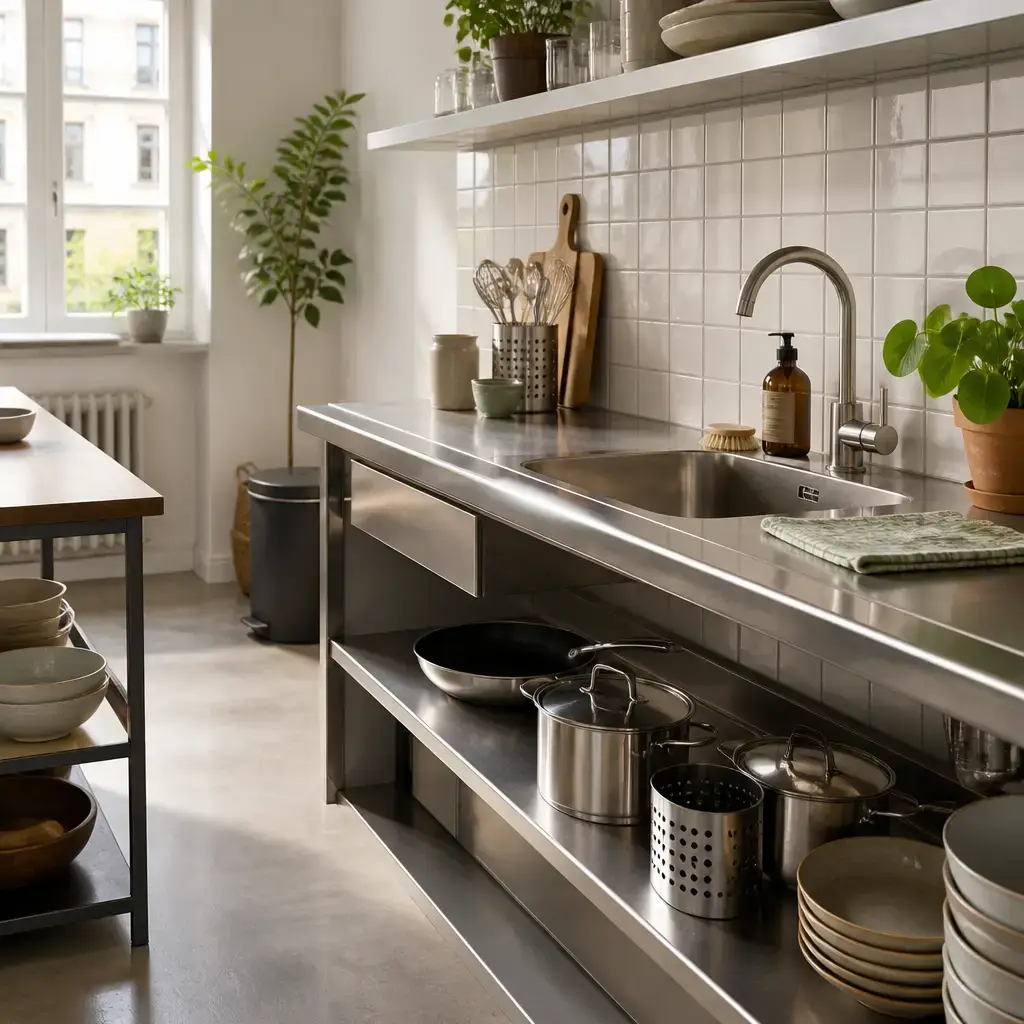
vor skel yai STEL-uh en PAN-uh, nor yai har VAS-kəth den? Where should I put a pan after I wash it?Brug den nederste hylde ved siden af vasken, når panden er tør.
broo den NEE-uh-steh HÜL-uh vay SEE-uh af VESG-en, nor PAN-uh air TUR. Use the lower shelf beside the sink, after the pan is dry.Skal jeg tørre køkkenbordet af, før jeg går?
skel yai TUR-uh KURR-ən-bor-deh af, fur yai gohr? Should I wipe the counter before I go?Tør det af, og sæt alt det, du har brugt, på plads.
TUR det af, oh SET alt det, doo har BROOGD, poh PLASS. Wipe it down and put away anything you used.Er der andet, jeg skal tjekke?
air dair AN-uh, yai skel CHEK-uh? Anything else I should check?Efterlad køkkenet klar til den næste person.
EF-tər-LAH-dah KURR-ən-ət KLAR til den NESS-teh peh-SOHN. Leave the space ready for the next person.Sentence explanations
Jeg er ny i det fælles køkken. Hvad skal jeg vide?
I'm new to this shared kitchen. What should I know?
- Jeg er
- I am
- ny
- new
- fælles
- shared; common
- køkken
- kitchen
- Hvad
- what
- skal
- should; must
- vide
- know
More detail
Jeg er is the first-person singular “I am” construction. Jeg means “I,” and er is the present-tense form of være (“to be”); er is also used with other present-tense subjects, so it does not change to mark the person here. Danish commonly uses være plus an adjective to describe a state or situation. ny means “new” here and describes the speaker. The adjective is in its common-gender singular form: ny; with a neuter singular noun, the corresponding form is nyt, and with plural or definite noun phrases it is often nye. This form therefore fits the singular personal subject in this sentence. fælles means “shared” here. It is a useful adjective for something used by more than one person or group. Unlike many Danish adjectives, fælles keeps this form across common-gender and neuter singular and plural uses, for example et fælles køkken (“a shared kitchen”) and fælles køkkener (“shared kitchens”). køkken means “kitchen.” It is a neuter noun: et køkken is “a kitchen,” and køkkenet is “the kitchen.” Its plural is køkkener, with the definite plural køkkenerne (“the kitchens”). Hvad is the question word “what.” It asks about a thing, information, or a matter; hvem is the usual question word for a person. In this question, hvad asks for the information the speaker ought to know. skal is the present form of skulle, a modal verb. It can express obligation or expectation, and in this question the fixed translation supports the advice-like meaning “should.” The reusable pattern is skal + an infinitive: Du skal vente means “You must/should wait.” In Hvad skal jeg vide?, the modal comes before the subject because the question word is placed first. vide is the infinitive of vide, meaning “to know” information or a fact. Danish distinguishes this from kende, which is used for being acquainted with a person, place, or thing. For example, Jeg ved det means “I know it,” while Jeg kender byen means “I know/am familiar with the city.” After the modal skal, vide appears as an infinitive without at. In i det fælles køkken, i means “in” or “at,” and det fælles køkken identifies the particular shared kitchen. Det is the neuter singular form used before an adjective and noun in this definite noun phrase; it agrees with neuter køkken. The fixed translation renders the phrase as “this shared kitchen.” Thus Jeg er ny i det fælles køkken assembles as “I am new to/in this shared kitchen.” The second sentence uses the pattern Hvad skal jeg + infinitive?: “What should I know?” Together, the utterance says that the speaker is new to the shared kitchen and asks for relevant information or rules.
Hold køkkenbordene fri, og ryd op lige efter madlavningen.
Keep the counters clear and clean up right after cooking.
- Hold … fri
- keep ... clear
- køkkenbordene
- the kitchen counters
- ryd op
- clean up
- lige efter
- right after
- madlavningen
- the cooking
More detail
Hold ... fri is a reusable Danish command meaning “keep ... clear.” Hold is the imperative of holde (“to keep” or “to hold”). The imperative addresses the listener directly; the subject is normally understood rather than stated. Here, fri describes the required state: clear or free of items. For example: Hold døren fri. — “Keep the door clear.” køkkenbordene means “the kitchen counters.” It is the definite plural form of køkkenbord (“kitchen counter”): køkkenbord → køkkenborde (plural) → køkkenbordene (definite plural). The ending -ene marks definite plural here. The noun is the thing that should remain clear; fri agrees with its meaning and describes its state. ryd op means “clean up” or “tidy up.” Ryd is the imperative of rydde (“to clear” or “tidy”), and op is a particle that forms the reusable expression rydde op. The particle is part of the construction’s meaning, so the expression is not just the ordinary verb rydde in isolation. Example: Ryd op efter mødet. — “Clean up after the meeting.” lige efter means “right after.” Efter introduces what follows in time, while lige makes the timing immediate: not simply after, but directly afterward. Example: Ring lige efter arbejdet. — “Call right after work.” madlavningen means “the cooking” in this sentence. It is the definite form of madlavning (“cooking” or “food preparation”): madlavning → madlavningen. The definite form presents the cooking activity as the relevant activity in the situation, rather than expressing a numeric count. Together, the first command is Hold køkkenbordene fri: “Keep the kitchen counters clear.” The second is ryd op lige efter madlavningen: “clean up right after cooking.” The comma and og (“and”) join these two commands, giving the complete instruction: “Keep the counters clear and clean up right after cooking.”
Hvor skal jeg stille en pande, når jeg har vasket den?
Where should I put a pan after I wash it?
- Hvor
- where
- skal jeg
- should I
- stille
- put; place
- pande
- pan
- når
- when
- har vasket
- have washed
- den
- it
More detail
Hvor asks for a place: “where?” It is used to ask about location or destination. Example: Hvor bor du? — “Where do you live?” skal jeg combines skal with the subject pronoun jeg. Here skal expresses what the speaker ought to do or is expected to do, so the combination means “should I?” Jeg is the first-person singular pronoun “I.” With another subject, the pronoun changes, for example skal du ...? — “should you ...?” stille is the infinitive meaning “put” or “place” in this sentence. After the modal skal, Danish uses the infinitive: skal jeg stille ...? The choice of stille presents placing the object somewhere; it is not the same as the verb stå, “stand/be standing.” en pande means “a pan.” Pande is a common-gender noun, shown here with the indefinite article en; the article introduces an unspecified pan, not an explicit numerical count. Its definite form is panden, “the pan,” as in Panden er tør — “The pan is dry.” når introduces a time clause meaning “when.” It links an action to the time at which another situation is true. Example: Jeg rydder op, når jeg er færdig. — “I clean up when I am finished.” har vasket is the perfect form of vaske, “wash”: har + the past participle vasket. With jeg, har is the auxiliary form used here; vasket is the form carrying the washing action. The perfect presents the washing as completed or relevant by the time in the når clause. Example: Jeg har vasket koppen. — “I have washed the cup.” den is a third-person singular common-gender object pronoun meaning “it” here. The fixed translation identifies its referent as the pan, so the clause means “when I have washed it.” Danish pronoun form is determined by the noun’s grammatical gender and number: a common-gender singular noun can be referred to with den, while a neuter singular noun uses det. Together, Hvor skal jeg stille en pande asks where the speaker should place a pan. The clause når jeg har vasket den specifies the time: when the speaker has finished washing the pan. The complete utterance therefore means “Where should I put a pan after I wash it?” This is a reusable question pattern: Hvor skal jeg stille ... når jeg har ...? — “Where should I put ... when I have ...?”
Brug den nederste hylde ved siden af vasken, når panden er tør.
Use the lower shelf beside the sink, after the pan is dry.
- Brug
- use
- nederste
- lower
- hylde
- shelf
- ved siden af
- beside
- vasken
- the sink
- når
- when
- panden
- the pan
- tør
- dry
More detail
Brug is the imperative of bruge, “to use.” The imperative gives a direct instruction and normally has no written subject. Compare the present form bruger: Du bruger hylden means “You use the shelf,” while Brug hylden! means “Use the shelf!” nederste means “lower” here as part of the fixed description of the shelf’s position. It is the definite attributive superlative form related to nederst (“lowest/at the bottom”): den nederste hylde = “the lower/lowest shelf.” The form agrees with the definite noun phrase in this construction; it is not an inflection of hylde. hylde means “shelf.” In Danish, its definite singular form is hylden, as in den nederste hylde (“the lower shelf”). Example: Bogen ligger på hylden. — “The book is on the shelf.” ved siden af is a reusable prepositional construction meaning “beside” or “next to.” It introduces the location used to identify the shelf: hylden ved siden af vasken = “the shelf beside the sink.” vasken means “the sink.” It is the definite singular form of vask; the ending -en marks the common-gender definite singular form here. Example: Koppen står ved siden af vasken. — “The cup is beside the sink.” når means “when” and introduces the time condition for the instruction. It connects the main instruction with a clause describing when to use the shelf. In this sentence, it refers to the pan being dry, not to a separate future event. panden means “the pan.” It is the definite singular form of pande. The definite form identifies the pan intended in this instruction, while en pande would be an indefinite singular “a pan.” Example: Panden er varm. — “The pan is hot.” tør means “dry” here. It is the common-gender singular form of the adjective tør; the form changes to tørt with a neuter singular noun and tørre in plural or definite attributive uses. In panden er tør, it is a predicative adjective after er and describes the pan’s state. Together, Brug den nederste hylde gives the instruction “Use the lower shelf.” ved siden af vasken specifies which shelf: it is beside the sink. The subordinate clause når panden er tør adds the timing condition “when the pan is dry.” The complete utterance therefore means: “Use the lower shelf beside the sink, after the pan is dry.”
Skal jeg tørre køkkenbordet af, før jeg går?
Should I wipe the counter before I go?
- Skal jeg
- should I
- tørre … af
- wipe down
- køkkenbordet
- the kitchen counter
- før
- before
- går
- go
More detail
Skal jeg means “should I” here. skal is the present form of skulle, used with an infinitive to ask about what the speaker ought to do or is expected to do: Skal jeg vente? = “Should I wait?” The pronoun jeg means “I” and identifies the speaker as the person who would perform the action. tørre ... af is a separable verb construction meaning “wipe down.” The lexical verb is tørre; af is the particle that completes this meaning. In the infinitive after skal, the verb remains tørre, while the particle appears separately after its object: Jeg skal tørre bordet af = “I should wipe the table down.” This is different from using tørre alone, which can mean “dry” or “wipe” depending on context. køkkenbordet means “the kitchen counter.” It is the definite singular form of køkkenbord (“kitchen counter”): et køkkenbord = “a kitchen counter,” køkkenbordet = “the kitchen counter.” The definite ending is attached to the noun rather than expressed by a separate word here. før introduces a time relation meaning “before.” It can introduce a clause with its own subject and verb: før jeg går = “before I go.” går is the present form of gå, meaning “go” here. With jeg, Danish uses jeg går; the form is not marked with a separate person ending in this phrase. For example, Jeg går nu means “I am going now” or “I go now,” depending on the situation. Together, Skal jeg tørre køkkenbordet af asks whether the speaker should wipe down the kitchen counter, and før jeg går specifies that this should happen before the speaker leaves or goes. The complete meaning is: “Should I wipe the counter before I go?”
Tør det af, og sæt alt det, du har brugt, på plads.
Wipe it down and put away anything you used.
- Tør … det … af
- wipe it down
- sæt
- put
- alt det
- everything / all that
- brugt
- used
- på plads
- away; in its place
More detail
Tør ... af is an imperative construction from tørre af, “wipe down.” Tør is the imperative form of tørre; the object det means “it” here, while af is the particle that completes this separable verb. The wording matches the earlier question about wiping the counter, but det itself is a neuter singular pronoun and does not independently name the object. Sæt is the imperative of sætte, “put/place.” Its useful form chain is sætte (base) – sætter (present) – satte (past) – sat (past participle). The imperative tells the addressee to carry out the action; it does not state who will do it by an explicit subject. alt det means “everything” or, more literally, “all that.” Alt is the neuter singular form used with det; this expression refers collectively to the things covered by the following relative clause. It is not a numeric count. du har brugt means “you used.” Du is the second-person singular subject, har is the present form of the auxiliary have, and brugt is the past participle of bruge, “use.” The auxiliary plus participle forms the perfect construction har brugt, linking the earlier use of the items to the present instruction. For example, Jeg har brugt koppen means “I have used the cup.” på plads is a fixed placement expression meaning “in its place” or, in this instruction, “away.” It describes the result expected after putting the items somewhere appropriate. For example, Sæt bogen på plads means “Put the book back in its place.” Together, Tør det af gives the first imperative: wipe it down. The coordinated og means “and,” introducing the second imperative, sæt. alt det, du har brugt identifies what should be put away: everything the addressee has used. på plads specifies the result or destination. The complete meaning is therefore: “Wipe it down and put away anything you used.”
Er der andet, jeg skal tjekke?
Anything else I should check?
- Er der
- is there
- andet
- anything else
- jeg skal
- I should
- tjekke
- check
More detail
Er der is the Danish existential question pattern meaning “is there/are there?” Literally, it asks whether something exists or is present. The verb er is the present form of være (“to be”), and der is the existential element in this pattern. Danish places the verb before the subject-like element in this question pattern. andet means “anything else” here. It is the neuter singular form of anden (“other/another”); in this fixed expression, it refers generally to an additional thing or task, without identifying a particular item. Compare en anden (“another [common-gender noun]”) and et andet (“another/other [neuter noun]”). The form andet can also occur before an understood neuter noun, as in et andet spørgsmål (“another question”), but here it stands on its own. jeg skal combines jeg (“I”) with skal, the present form of the modal verb skulle. In this sentence, skal expresses the task the speaker is expected or supposed to do, matching “should.” Modal verbs such as skal are followed by an infinitive without at: jeg skal tjekke = “I should check.” The subject jeg is explicitly “I”; skal does not change to mark gender. tjekke is the infinitive “to check.” It follows the modal skal, so it stays in the infinitive rather than taking a present-tense ending. For example, Jeg skal tjekke døren. means “I should check the door.” Together, Er der andet asks whether there is anything additional, and jeg skal tjekke specifies that the speaker is asking about something they should check. The complete utterance therefore means “Anything else I should check?” In the surrounding task-oriented context, it is a concise question about whether another checking task remains.
Efterlad køkkenet klar til den næste person.
Leave the space ready for the next person.
- Efterlad
- leave
- køkkenet
- the kitchen
- klar
- ready
- næste
- next
- person
- person
More detail
Efterlad is the imperative of efterlade, meaning “leave” or “leave behind.” It gives a direct instruction, with “you” understood as the subject. Compare at efterlade “to leave” with efterlad “leave!” køkkenet means “the kitchen.” The noun is et køkken “a kitchen”; its definite singular form adds -et: køkken → køkkenet. Here it is the thing being left in a particular condition. klar means “ready” or “prepared.” It describes the condition in which the kitchen is to be left. In standard Danish, køkken is a neuter noun, so an adjective agreeing with it as a predicative complement would normally be klart; the supplied target text contains klar, which is preserved here rather than silently changed. For comparison, en stol er klar means “a chair is ready,” while et bord er klart means “a table is ready.” næste means “next,” as in the item or person that follows. It is used here in den næste person, “the next person.” In modern Danish, næste is learned as this adjective rather than as a regular comparative form of nær; it keeps this form before singular common-gender and neuter nouns as well as before plural nouns: den næste, det næste, de næste. person means “person.” Its plural is personer, and its definite singular is personen, “the person.” In den næste person, person names the individual’s category, while den næste specifies that this is the following person. Together, Efterlad køkkenet klar til den næste person is an instruction to leave the kitchen ready for the next person. til connects the prepared state with that person, for whom the kitchen is intended.
Grammar Points
Imperativ: verbets stamme
Ryd op, og tør det af.
RÜD OP, oh TUR det AF.Clean up and wipe it down.
I dansk dannes bydeformen ofte uden pronomen ved at bruge verbets stamme: ryd, tør, brug, hold.
Bestemt form: navneord med endelse
Tjek vasken og køkkenbordene.
CHEK VESG-en oh KURR-ən-bor-deh-neh.Check the sink and the kitchen counters.
Den bestemte form sættes ofte på slutningen af navneordet: vask → vasken, køkkenbord → køkkenbordene.
Danish Vocabulary
Hold køkkenbordene fri
det fælles køkken
Hold køkkenbordene fri
- Gender
- neuter
det fælles køkken
- Gender
- common
Hold køkkenbordene fri
- Gender
- common
lige efter madlavningen
Jeg er ny i det fælles køkken.
- Gender
- common
en pande
ryd op lige efter madlavningen
Hvor skal jeg stille en pande?
når jeg har vasket den
Hvad skal jeg vide?
Quiz
Word Order
Arrange the words in the correct order.
Anything else I should check?
Show Answer
Er der andet, jeg skal tjekke?Spelling
Tap the letters to spell the word.
kitchen
Show Answer
køkkencooking
Show Answer
madlavningenshared
Show Answer
fællesknow