10 minutes free every day
Continue audio lessons in the app
Word explanations appear automatically in sync with the audio.
No login required · synced translations · playback with the screen locked
Choose your learning language and open this lesson in the app.

About This Lesson
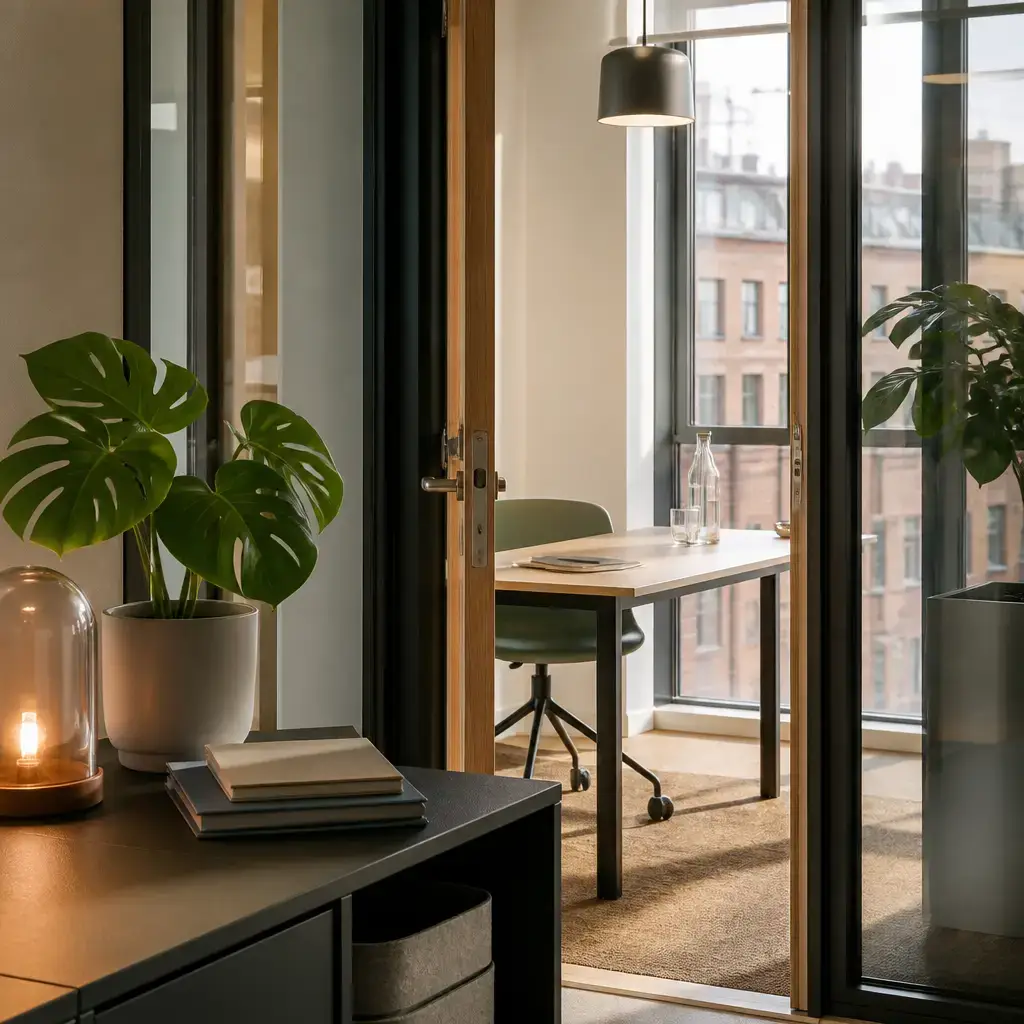
Use Booking and tidying a shared office room to practice Danish conversation, pronunciation, vocabulary, grammar, and quizzes.
Dialogue
Jeg har brug for et stille rum til et opkald.
yai hah BROO foh eh STIL-uh room teel eh OHB-kahl I need a quiet room for a call.Tjek den fælles kontorkalender først.
chek dehn FEHL-uhs kon-TOHR-kah-LEN-der ferst Check the shared office calendar first.Det lille rum ser ledigt ud i eftermiddag.
deh LIL-uh room sair LAY-dee ooth ee EF-tuh-meh-DAI The small room looks available this afternoon.Føj bookingen til kalenderen, før du bruger rummet.
foy BOO-king-en teel kah-LEN-uh-ren fer doo BROO-er ROOM-uhd Add the booking to the calendar before you use it.Skal jeg gøre noget efter opkaldet?
skal yai GER-uh NOH-uhd EF-ter OHB-kahl-uhd Should I do anything after the call?Ryd skrivebordet, og tag dine ting med dig.
rood SKREE-vuh-bohr-uhd, oh tak DEE-nuh teng meh dai Clear the desk and take your things with you.Jeg efterlader det ryddeligt, før jeg går.
yai EF-ter-LAY-der deh ROO-duh-lee, fer yai gohr I'll leave it tidy before I go.Det hjælper den næste person med at komme godt i gang.
deh YEL-buh dehn NEHS-tuh pair-SOHN meh at KOH-muh goht ee GAHNG That helps the next person get started smoothly.Sentence explanations
Jeg har brug for et stille rum til et opkald.
I need a quiet room for a call.
- har brug for
- need
- stille
- quiet
- rum
- room
- opkald
- call
More detail
har brug for expresses “need” in Danish. It is a fixed construction: have brug for + noun means to need something. In this sentence, har is the present-tense form of have; Jeg har brug for ... means “I need ...”. Example: Vi har brug for hjælp. — “We need help.” stille means “quiet” here and describes the room. It is an adjective placed before the noun. With the neuter indefinite noun phrase et rum, the adjective is stille; it has no separate neuter ending in this phrase. Example: et stille sted — “a quiet place.” rum means “room” or “space.” Its indefinite singular form is et rum, while the definite form is rummet — “the room.” The article et marks this noun as neuter gender; here it introduces a room without asserting a numerical count. opkald means “call,” specifically a call as an event. et opkald is its indefinite singular form, and opkaldet means “the call.” The phrase til et opkald means “for a call”: til links the room to its intended purpose, and et opkald names that purpose. Together, Jeg har brug for (“I need”) + et stille rum (“a quiet room”) + til et opkald (“for a call”) gives: “I need a quiet room for a call.”
Tjek den fælles kontorkalender først.
Check the shared office calendar first.
- Tjek
- check
- den
- the
- fælles
- shared
- kontorkalender
- office calendar
- først
- first
More detail
Tjek is the imperative of tjekke, meaning “check.” The imperative is used for a direct instruction and normally has the same form for one or several people: Tjek kalenderen. — “Check the calendar.” den is the definite article/pronoun used here with a common-gender singular noun. It marks kontorkalender as “the office calendar,” not as an indefinite or unspecified calendar. Danish definite marking can also appear as a suffix, as in kalenderen — “the calendar”; the choice depends on the noun phrase’s structure. fælles means “shared” here. This adjective has the same form with singular and plural nouns and does not change for common versus neuter gender: et fælles rum — “a shared room”; fælles kalendere — “shared calendars.” kontorkalender is a compound noun meaning “office calendar”: kontor means “office” and kalender means “calendar.” Danish commonly forms compounds by joining nouns into one written word. The compound is a common-gender noun, as shown by den in this sentence; its indefinite form is en kontorkalender. først means “first” and places the checking before other actions in the relevant sequence. It is also used in short instructions such as Læs først. — “Read first.” Together, Tjek gives the instruction, den fælles kontorkalender identifies the shared office calendar to be checked, and først specifies that this should happen first. The complete meaning is: “Check the shared office calendar first.”
Det lille rum ser ledigt ud i eftermiddag.
The small room looks available this afternoon.
- Det
- the
- lille
- small
- rum
- room
- ser … ud
- looks; seems
- ledigt
- available
- i eftermiddag
- this afternoon
More detail
Det is the definite article used with a singular neuter noun. Here it marks rum as a specific room; it does not itself state a numerical quantity. With an adjective before the noun, Danish uses this article pattern: det + adjective + noun. lille means “small” here. It is the adjective’s singular form; Danish uses små for plural forms, as in små rum (“small rooms”). In det lille rum, the adjective occurs in the definite noun phrase and agrees with the singular noun phrase. rum means “room.” Its indefinite singular form is rum, while the definite form is rummet: et rum (“a room”) → rummet (“the room”). In this sentence, definiteness is expressed by det before the adjective, so the noun remains rum rather than taking the ending in rummet. ser ... ud is a reusable Danish construction meaning “looks” or “seems” when describing appearance or an apparent state. ser is the present form of se (“to see”); ud completes the appearance construction here. Example: Det ser godt ud. — “It looks good.” ledigt means “available” here. The adjective’s base form is ledig; ledigt is its singular neuter form, agreeing with the neuter noun phrase det lille rum. The common-gender singular form is ledig, and a plural or definite form is ledige: en ledig stol (“an available chair”), ledige rum (“available rooms”). i eftermiddag is the time expression “this afternoon.” In this use, i introduces a time period, and the expression does not add an article before eftermiddag. Together, det lille rum means “the small room,” ser ... ud presents an apparent state, ledigt supplies that state as “available,” and i eftermiddag specifies the time. The complete meaning is: “The small room looks available this afternoon.”
Føj bookingen til kalenderen, før du bruger rummet.
Add the booking to the calendar before you use it.
- Føj
- add
- bookingen
- the booking
- kalenderen
- the calendar
- før
- before
- bruger
- use
- rummet
- the room
More detail
Føj is the imperative of føje, “to add.” It directly addresses the listener and gives a request or instruction. A reusable pattern is Føj X til Y (“Add X to Y”); til marks the destination or thing receiving the addition. bookingen means “the booking” here. The ending -en marks the definite singular form of booking: en booking is “a booking,” while bookingen is “the booking.” The indefinite article en identifies the noun as common gender, but it does not itself mean “one” in this sentence. kalenderen means “the calendar.” It is the definite singular form of kalender: en kalender → kalenderen. In bookingen til kalenderen, the booking is the item being added and the calendar is the destination. før means “before” and introduces a time clause. Here it connects the instruction with the action that must not yet have happened: før ... = “before ...”. bruger means “use” in this sentence. It is the present-tense form of bruge; the same form is used with several present-tense subjects, including du: du bruger = “you use.” The verb can also mean “spend” in other contexts, so the object and situation establish the meaning here. rummet means “the room.” It is the definite singular form of neuter et rum: et rum → rummet. The definite form identifies a particular room; in the supplied translation, this is rendered as “it,” referring to the room. Together, Føj bookingen til kalenderen forms the instruction “Add the booking to the calendar.” før du bruger rummet adds the time condition “before you use the room.” The complete utterance is therefore: “Add the booking to the calendar before you use it.”
Skal jeg gøre noget efter opkaldet?
Should I do anything after the call?
- Skal jeg
- should I
- gøre
- do
- noget
- anything
- efter
- after
- opkaldet
- the call
More detail
Skal jeg means “should I” here. skal is the present form of skulle, used here as a modal for asking what the speaker ought to do. In a direct yes/no question, the modal comes before the subject: Skal jeg ...? (“Should I ...?”). The subject jeg means “I” and does not change in this pattern. gøre means “do” here. It is the infinitive of gøre, used after the modal skal: skal + infinitive. The infinitive remains gøre rather than taking a personal ending. noget means “anything” in this question. The same form can mean “something” in an affirmative statement, so the surrounding question determines the intended English equivalent. Example: Jeg gør noget. — “I am doing something.” efter means “after” and introduces the time reference that follows it. It can be used before a noun phrase to place an action later than that event. opkaldet means “the call” here. opkald is a neuter noun meaning “call”; its indefinite form is used with et, as in et opkald. The ending -et marks the definite singular form: opkald → opkaldet. The ending belongs to the noun, not to efter. Together, Skal jeg gøre noget asks whether the speaker ought to take any action, and efter opkaldet places that possible action after the call. The whole utterance therefore means: “Should I do anything after the call?”
Ryd skrivebordet, og tag dine ting med dig.
Clear the desk and take your things with you.
- Ryd
- clear
- skrivebordet
- the desk
- tag
- take
- dine
- your
- ting
- things
- med dig
- with you
More detail
Ryd is the imperative of rydde, “to clear/tidy.” The imperative gives a direct instruction and does not show the subject explicitly; here the understood addressee is “you.” The form rydde is also useful in forms such as rydder (“clears/is clearing”) and ryddede (“cleared,” in the past). skrivebordet means “the desk.” It is the definite singular form of skrivebord (“desk”): et skrivebord is “a desk,” while skrivebordet is “the desk.” The ending -et marks this noun’s definite singular form. In this sentence, it is the thing being cleared. tag is the imperative of tage, “to take.” Its present-tense form is tager; the imperative has the shorter form tag. Danish commonly uses tage with a destination, object, or accompanying phrase: Tag bogen med means “Take the book along.” dine means “your” before a plural noun. Danish possessives distinguish the possessed noun’s form: din is used with a common-gender singular noun, dit with a neuter singular noun, and dine with a plural noun. Here dine agrees with ting, not with the person who possesses them. ting means “things” here. It is the plural of ting, which can mean “a thing” in the singular as well; the form is unchanged, so number is understood from the surrounding grammar. For example, en ting means “a thing,” while to ting means “two things.” med dig means “with you.” dig is the object form of the second-person pronoun whose subject form is du; after a preposition such as med (“with”), dig is used. The phrase tells the addressee to take the things along with them, rather than merely moving them somewhere else. The sentence has two coordinated imperatives: Ryd skrivebordet (“Clear the desk”) and tag dine ting med dig (“take your things with you”). The comma and og join the two instructions. Together, they give the addressee both actions: clear the desk and take their things along.
Jeg efterlader det ryddeligt, før jeg går.
I'll leave it tidy before I go.
- Jeg
- I
- efterlader
- leave behind
- det
- it
- ryddeligt
- tidy
- før
- before
- går
- go
More detail
Jeg means “I” here and is the subject of both actions. Danish personal pronouns include jeg “I” and du “you”; jeg does not change for grammatical gender. efterlader means “leave behind” in this sentence. Its base form is efterlade, and efterlader is the present-tense form. Danish present-tense verbs do not change for person, so the same form can be used with jeg, du, or another subject. The object being left is supplied by det. det means “it” here and is the object of efterlader. It is the Danish third-person singular neuter pronoun. Its grammatical class is distinct from the referent: the fixed translation identifies the referent only as “it,” without specifying what it is. ryddeligt means “tidy” here. It is the neuter singular form of the adjective ryddelig, agreeing with the neuter singular det. The adjective describes the state in which the object is left: efterlade noget ryddeligt = “leave something tidy.” For comparison, ryddelig means “tidy,” while mere ryddelig is the comparative “tidier/more tidy”; the exact adjective form in a larger phrase still follows Danish agreement patterns where applicable. før introduces the time clause “before …”. A useful pattern is før + a clause: før jeg går = “before I go.” går means “go” here. Its base form is gå, and går is the present-tense form. The subject jeg is stated inside the subordinate clause, so the clause has the pattern før jeg går. As with efterlader, the present-tense verb form does not change for person. Together, Jeg efterlader det ryddeligt says “I’ll leave it tidy,” with ryddeligt describing the resulting state of det. før jeg går adds the time relation “before I go.” The complete utterance therefore means “I’ll leave it tidy before I go.”
Det hjælper den næste person med at komme godt i gang.
That helps the next person get started smoothly.
- Det
- That
- hjælper
- helps
- næste
- next
- person
- person
- komme godt i gang
- get started smoothly
More detail
Det is a neuter singular pronoun meaning “that” here. In this context it points back to the situation or action just mentioned—leaving things tidy—not to a newly named person. Danish det can refer back to an action or whole situation. hjælper is the present form of hjælpe, “to help.” Danish verbs do not change form for different subjects in the present tense: jeg hjælper, du hjælper, and den hjælper all use hjælper. næste means “next.” It is a descriptive word placed before the noun: den næste person means “the next person.” Its form does not change here for the singular noun’s gender. Compare første (“first”) for a different position in a sequence. person means “person.” It is a common-gender noun in Danish, which is why the phrase uses the common-gender definite article den: den næste person. The noun is singular and definite here, identifying the person who comes next in the relevant sequence. komme godt i gang is a useful Danish construction meaning “get started smoothly” or “get off to a good start.” In hjælper ... med at komme, komme is the infinitive after med at. The expression komme i gang means “get started”; godt is an adverb modifying how the starting goes. For example: Hun kommer godt i gang. — “She gets off to a good start.” The pattern hjælpe [someone] med at [infinitive] means “help [someone] to [do something].” Here, Det hjælper den næste person gives “That helps the next person,” and med at komme godt i gang specifies what the help enables them to do. Together, the utterance means: “That helps the next person get started smoothly.”
Grammar Points
Imperativ: verbets stamme uden -e
Tjek først kontorkalenderen.
CHEK ferst kon-TOHR-kah-LEN-uh-renCheck the office calendar first.
I dansk dannes imperativ ofte ved at fjerne -e fra verbet: tjekke → Tjek.
Bestemt form: navneord + -en eller -et
Ryd skrivebordet.
rood SKREE-vuh-bohr-uhdClear the desk.
Den bestemte form sættes ofte som endelse på navneordet: skrivebord → skrivebordet.
Danish Vocabulary
- Gender
- common
i eftermiddag
den fælles kontorkalender
Tjek den fælles kontorkalender først
Jeg har brug for et stille rum
- Gender
- common
den fælles kontorkalender
ser ledigt ud
Det lille rum
- Gender
- neuter
efter opkaldet
- Gender
- neuter
et stille rum
rummet ser ledigt ud
et stille rum
Tjek den fælles kontorkalender
Quiz
Word Order
Arrange the words in the correct order.
Check the shared office calendar first.
Show Answer
Tjek den fælles kontorkalender først.Should I do anything after the call?
Show Answer
Skal jeg gøre noget efter opkaldet?Spelling
Tap the letters to spell the word.
call
Show Answer
opkaldetshared
Show Answer
fællesfirst
Show Answer
førstquiet