10 minutes free every day
Continue audio lessons in the app
Word explanations appear automatically in sync with the audio.
No login required · synced translations · playback with the screen locked
Choose your learning language and open this lesson in the app.

About This Lesson
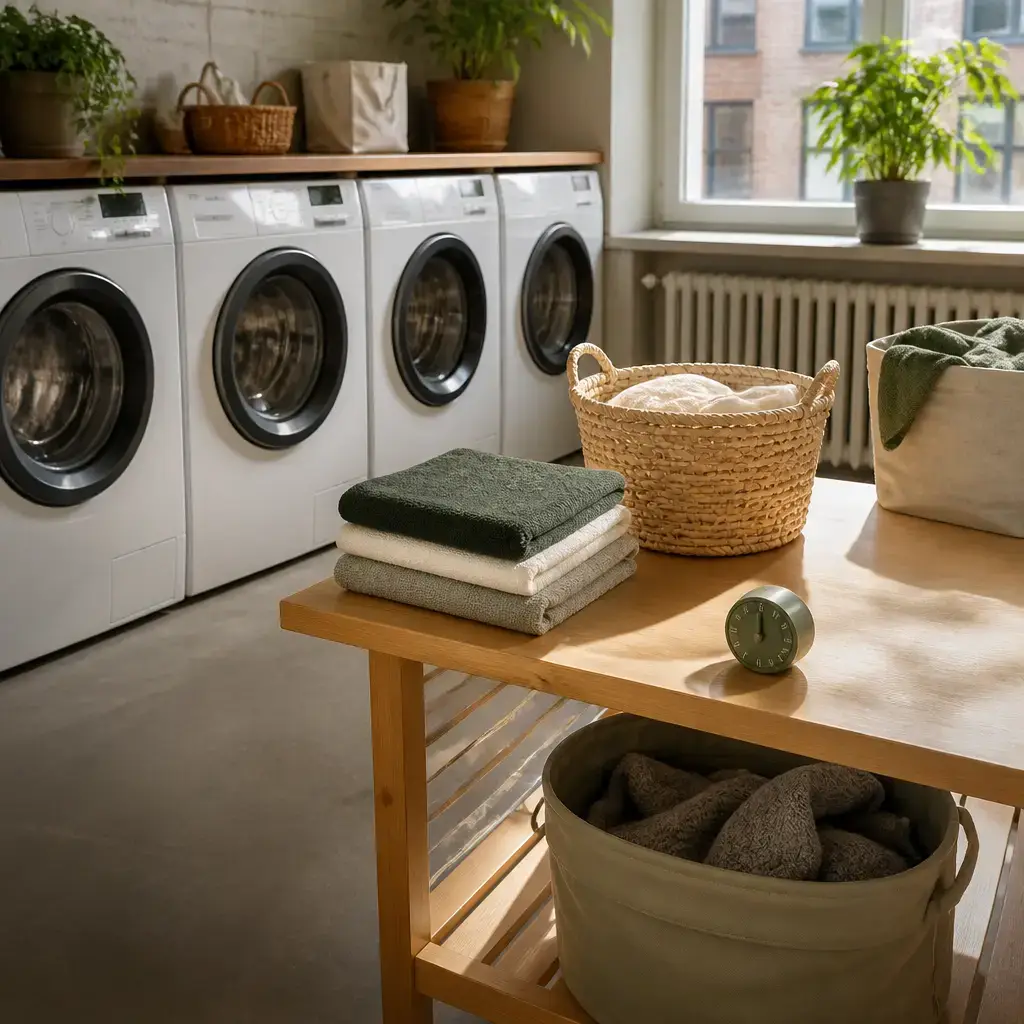
Use Using the laundry schedule and a timer to practice Danish conversation, pronunciation, vocabulary, grammar, and quizzes.
Dialogue
Der er travlt i det fælles vaskerum i dag.
deh air TRAHVLT ee deh FEL-uhs VAS-kuh-room ee DAY The shared laundry room is busy today.Skriv dit navn på planen, før du starter en vask.
SGREEV deet NOWN poh PLEN-un, FUR doo STAR-duh en VAHSG Put your name on the schedule before starting a load.Der er en ledig vaskemaskine senere i eftermiddag.
deh air en LAY-thee VAHS-kuh-mahs-GEE-nuh SAY-nuh-ruh ee EF-tuh-meh-DAW There's a washer open later this afternoon.Sæt en timer.
SEHD en TEE-muh Set a timer.Så den næste person ikke skal vente.
SOH den NEST-uh peh-SOHN IK-uh skal VEN-duh So the next person is not stuck waiting.Skal jeg flytte mit tøj, så snart vasken er færdig?
SKEL yigh FLUH-duh meet TOY, soh SNART VAHS-kuhn air FAIR-thee Should I move my clothes as soon as the cycle ends?Ja, gør det; vådt tøj, der bliver liggende i maskinen, får alle til at vente.
YAH, GUR-uh deh; VAWT TOY, deh BLEE-vuh LEG-uh-nuh ee MAHS-GEE-nun, FAWR AL-uh tehl uh VEN-duh Please do; wet clothes left in a machine hold everyone up.Jeg tager min kurv med ned, før vasken er færdig.
yigh TAY-uh min KURV meh NAYTH, FUR VAHS-kuhn air FAIR-thee I'll bring my basket down before it finishes.Det burde få det hele til at fungere godt.
deh BOO-uh faw deh HAY-luh tehl uh FAWNG-GAIR-uh GOHT That should keep things running smoothly.Sentence explanations
Der er travlt i det fælles vaskerum i dag.
The shared laundry room is busy today.
- Der er
- there is / there are
- travlt
- busy
- i
- in
- det
- the
- fælles
- shared
- vaskerum
- laundry room
- i dag
- today
More detail
Der er is a common Danish pattern corresponding to “there is/are.” In this sentence, however, it is part of the impersonal expression Der er travlt, meaning “it is busy” or “there is a lot of activity”; it does not introduce a following noun phrase as the thing that exists. Example: Der er kaffe i køkkenet. means “There is coffee in the kitchen.” travlt means “busy” here and describes the level of activity. It is the neuter form of the adjective travl: travl is used with a common-gender singular noun, travlt with a neuter singular noun and in this impersonal expression, and travle in plural or definite adjective forms. Here, travlt does not describe a separately stated noun. The first i means “in” and introduces the place where the activity is occurring. Danish i can also introduce time expressions, as in i dag. det is the definite article “the” used with a neuter singular noun. vaskerum is neuter: et vaskerum means “a laundry room,” while det vaskerum means “the laundry room.” The form det marks definiteness and neuter agreement; it does not itself state a numeric count. fælles means “shared” or “common” and describes vaskerum. Example: et fælles køkken means “a shared kitchen.” vaskerum means “laundry room.” It is a compound noun, and its indefinite form is et vaskerum; its definite form is vaskerummet, “the laundry room.” i dag is the time expression “today,” placing the situation on the current day. In this expression, i is temporal rather than locative. Together, i det fælles vaskerum means “in the shared laundry room,” and i dag adds “today.” The utterance follows the reusable pattern Der er travlt i [place] i dag: “It is busy in [place] today.” Thus Der er travlt i det fælles vaskerum i dag. means “The shared laundry room is busy today.”
Skriv dit navn på planen, før du starter en vask.
Put your name on the schedule before starting a load.
- Skriv
- write; put in writing
- dit
- your
- navn
- name
- planen
- the schedule
- før
- before
- starter
- start
- vask
- load of laundry
More detail
Skriv is the imperative of skrive, “to write.” The imperative gives a direct instruction and normally has no expressed subject. Present: jeg skriver = “I write,” while skriv! = “write!” Example: Skriv dit navn her. — “Write your name here.” dit means “your” here and agrees with the thing possessed, not with the person who possesses it. It is the form used with a singular neuter noun such as navn (et navn). Compare din with a singular common-gender noun: din adresse — “your address.” navn means “name.” Its base form is navn; the indefinite singular is et navn, and the definite singular is navnet — “the name.” Example: Mit navn står her. — “My name is written here.” planen means “the schedule” in this sentence. It is the definite singular form of plan: en plan — “a plan/schedule,” planen — “the plan/schedule.” In på planen, på means “on,” so the phrase places the name on the schedule. Example: Navnet står på planen. — “The name is on the schedule.” før introduces the time relation “before.” The following clause, du starter en vask, states the action that must happen later: the writing is to be done before starting the wash. Example: Læs beskeden, før du går. — “Read the message before you leave.” starter is the present-tense form of starte, “to start.” The subject here is du, “you”: du starter = “you start.” The same form can also occur with other singular or plural subjects in present tense, such as jeg starter and de starter. Example: Hun starter maskinen. — “She starts the machine.” vask means “a wash” or “a load of laundry” here. Its base form is vask; with the indefinite article, en vask means “a wash/load.” In this sentence, starter en vask means “start a wash” rather than simply “start” in general. Example: Jeg hænger tøjet op efter en vask. — “I hang the clothes up after a wash.” Together, Skriv dit navn på planen means “Put your name on the schedule.” The comma and før then add the time clause du starter en vask, “you start a wash/load,” producing the complete meaning: “Put your name on the schedule before starting a load.”
Der er en ledig vaskemaskine senere i eftermiddag.
There's a washer open later this afternoon.
- Der er
- there is
- ledig
- available
- vaskemaskine
- washing machine; washer
- senere
- later
- i eftermiddag
- this afternoon
More detail
Der er is the Danish existential pattern “there is/are.” In this sentence, der is a placeholder used to introduce something that exists or is available, while er is the present form of være (“to be”). The pattern is reusable with both singular and plural nouns: Der er en bog means “There is a book,” and Der er to bøger means “There are two books.” ledig means “available” here: the washing machine is not occupied, so it can be used. It is an adjective. With the common-gender singular noun en vaskemaskine, the form is ledig; with a neuter singular noun it is ledigt, and with plural or definite forms it is ledige. For example, Maskinen er ledig means “The machine is available.” vaskemaskine means “washing machine” or “washer.” It is a compound noun: vaske relates to washing and maskine means “machine,” but the whole compound is the normal word for the appliance. Its grammatical gender is common gender, shown by the article en: en vaskemaskine. A useful related form is the definite singular vaskemaskinen, “the washing machine.” senere means “later.” It is the comparative form associated with sen (“late”) and is commonly used for a later time: Jeg kommer senere means “I’ll come later.” In this sentence it places the availability at a time after the current or previously understood time. i eftermiddag means “this afternoon.” The preposition i is followed by eftermiddag, “afternoon.” In this time expression, i eftermiddag refers to the afternoon of the relevant day, whereas senere i eftermiddag means “later this afternoon.” Together, Der er en ledig vaskemaskine says that an available washing machine exists, and senere i eftermiddag specifies when it will be available. The complete utterance means: “There’s a washer available later this afternoon.”
Sæt en timer.
Set a timer.
- Sæt
- set
- timer
- timer
More detail
Sæt is the imperative of sætte, meaning “set” here. The imperative gives a direct instruction and normally has no stated subject: Sæt timeren. means “Set the timer.” The same verb can also mean “put” in a suitable context, but the object here selects the timer-setting meaning. timer means “timer.” In en timer, it is a singular indefinite noun with the common-gender article en; the noun’s indefinite singular form is timer, while the definite singular form is timeren. The form timer can also occur as a plural form in other contexts, so the article helps identify the form here. En is the indefinite article, not by itself a separate claim about a numerical count. Together, Sæt en timer. means “Set a timer.” It is a short imperative: sæt + an indefinite object, en timer. In this context, the instruction fits setting a timer so that the next person will not have to wait.
Så den næste person ikke skal vente.
So the next person is not stuck waiting.
- Så
- so
- næste
- next
- person
- person
- skal
- is to / should
- ikke
- not
- vente
- wait
More detail
Så introduces the intended result or purpose here: “so that.” In this sentence it links the action in the preceding context to the desired outcome for the next person. næste means “next” in the sequence. The form is the same in den næste person; Danish uses næste in both singular and plural, including definite phrases. For example, den næste bus means “the next bus.” person means “person.” It is a common-gender noun: en person is “a person,” and personen is “the person.” Here, den næste person is the definite noun phrase “the next person.” skal is the present-tense form of skulle. With an infinitive, it can express what someone is to do, is expected to do, or has to do. Here skal vente describes the next person’s situation: that person would have to wait. The subject of skal is den næste person, not the speaker. ikke negates the following verbal expression. In this subordinate clause, ikke comes after the subject and before the finite verb: den næste person ikke skal .... Compare den næste person skal vente (“the next person has to wait”) with den næste person ikke skal vente (“the next person does not have to wait”). vente is the infinitive “to wait.” After a modal such as skal, Danish uses the infinitive without an infinitive marker: skal vente. For example, Jeg skal vente means “I have to wait” or “I am going to wait,” depending on context. Together, Så den næste person ikke skal vente means “so that the next person does not have to wait.” Så introduces the intended outcome, while den næste person is the person affected by that outcome, and ikke skal vente says that waiting should not be required. The complete utterance therefore means: “So the next person is not stuck waiting.”
Skal jeg flytte mit tøj, så snart vasken er færdig?
Should I move my clothes as soon as the cycle ends?
- Skal jeg
- should I
- flytte
- move
- mit
- my
- tøj
- clothes
- så snart
- as soon as
- vasken
- the wash cycle
- færdig
- finished
More detail
Skal jeg combines the modal verb skal with the subject pronoun jeg. Here it asks whether the speaker ought to do something, matching “Should I…?” The infinitive after skal is used without an infinitive marker: Skal jeg flytte …? means “Should I move …?” In other contexts, skal can also express an arrangement or necessity, so the surrounding situation determines the intended force. flytte is the infinitive of flytter and means “move” here: to take the clothes elsewhere. Danish modal verbs such as skal are followed by the bare infinitive, so flytte does not take an infinitive marker in this sentence. Example: Jeg skal arbejde. — “I have to work.” mit is the possessive form meaning “my” before a neuter singular noun. It agrees with the possessed noun, not with the speaker: mit tøj. Compare min with a common-gender singular noun and mine with plural nouns. The possessive identifies the clothes as belonging to or associated with the speaker; it does not itself state a numeric count. tøj means “clothes” or “clothing.” It is a neuter mass-like noun, which is why the possessive form here is mit. Danish commonly uses tøj as an uncounted category; individual items can be specified with words such as et stykke tøj (“an item of clothing”). så snart introduces a time clause meaning “as soon as.” It links an action to the earliest point at which the following event is complete. The clause after it is vasken er færdig, so the moving is to happen as soon as the wash cycle is finished. vasken is the definite singular form of vask, meaning “wash” or, in this context, “wash cycle.” The ending -en marks a common-gender singular noun as definite: en vask means “a wash,” while vasken means “the wash.” The fixed translation identifies this context-specific meaning as a cycle rather than the physical act of washing. færdig means “finished” or “complete.” It is a predicative adjective after er (“is”) and agrees here with the common-gender singular noun vasken. With a neuter singular noun the form is færdigt, and with plural or definite plural nouns it is færdige: Arbejdet er færdigt — “The work is finished.” Together, Skal jeg flytte mit tøj asks whether the speaker should move their clothes. så snart vasken er færdig sets the time: this should happen as soon as the wash cycle ends. The complete utterance therefore means “Should I move my clothes as soon as the cycle ends?”
Ja, gør det; vådt tøj, der bliver liggende i maskinen, får alle til at vente.
Please do; wet clothes left in a machine hold everyone up.
- Ja
- yes
- gør
- do
- det
- it; that
- vådt
- wet
- tøj
- clothes
- bliver liggende
- remains; stays put
- maskinen
- the machine
- får alle til at vente
- makes everyone wait
More detail
Ja means “yes” and confirms the suggested action. Danish uses ja as a standalone affirmative, just as in a short answer. gør is the imperative of gøre, “to do.” Here it is an instruction to carry out the action already mentioned in the conversation. Compare the reusable pattern Gør det! — “Do it!” The imperative has no overt subject. det is the neuter singular pronoun “it” or “that.” In this utterance it points to the previously discussed action, so gør det means “do it.” Its exact referent is supplied by the surrounding exchange rather than by the pronoun’s form itself. vådt is the neuter singular form of the adjective våd, “wet.” It agrees with tøj, which is a neuter noun. Compare våd with a common-gender singular noun and vådt with a neuter singular noun; the adjective’s form, not the noun’s, shows this agreement. Example: et vådt håndklæde — “a wet towel.” tøj means “clothes” or “clothing.” It is commonly used as a mass or collective noun, so it does not by itself specify a count of garments. In this sentence it is the thing that can remain in the machine. bliver liggende is a reusable construction meaning “stays lying,” “remains,” or “is left in place.” bliver is a form of blive, “to remain/become,” and liggende is the form of ligge, “to lie,” used after blive to describe a continuing position or state. In der bliver liggende i maskinen, the construction says that the clothes remain in the machine rather than being removed. Example: Bogen bliver liggende på bordet. — “The book stays on the table.” maskinen is “the machine”: maskine means “machine,” and the ending -en marks the definite singular form of this common-gender noun. Here the surrounding context supports the washing machine as the relevant machine, but the noun itself can refer to a machine more generally. får alle til at vente uses the causative pattern få + someone + til at + infinitive, meaning “make someone do something” or “cause someone to do something.” får is the present form of få, “to get/cause,” alle means “everyone,” and vente is the infinitive “to wait.” The phrase therefore means that the wet clothes cause everyone to wait, rather than merely saying that everyone waits independently. Example: Det får børnene til at grine. — “It makes the children laugh.” Putting the parts together: Ja, gør det means “Yes, do it.” The following description identifies wet clothes that remain in the machine, and får alle til at vente says that this situation makes everyone wait. The complete meaning is: “Please do; wet clothes left in a machine hold everyone up.”
Jeg tager min kurv med ned, før vasken er færdig.
I'll bring my basket down before it finishes.
- Jeg
- I
- tager
- take; bring
- min
- my
- kurv
- basket
- med
- along
- ned
- down
- før
- before
- vasken
- the wash
- er færdig
- is finished
More detail
Jeg means “I” here, the speaker as the subject. Danish subject pronouns include jeg “I,” du “you” (singular), and vi “we”; jeg itself does not mark gender. tager is the present-tense form of tage, “to take.” In this sentence, the surrounding words give it the context-dependent sense “bring”: the speaker will take the basket along and down. Danish present tense can describe a planned or intended near-future action, so this does not require a separate future marker. Example: Jeg tager bogen med — “I’ll take the book along.” min means “my” before the singular common-gender noun kurv. Danish possessives agree with the possessed noun: min with a common-gender singular noun, mit with a neuter singular noun, and mine with a plural noun. The form expresses possession, not a stated numeric count. kurv means “basket.” Its definite form is kurven, “the basket.” In min kurv, the noun stays in its indefinite form, while the possessive makes the whole noun phrase definite in reference; Danish normally does not add the definite ending when a possessive already determines the noun. med ned works with the verb to express taking something along in a downward direction: “along/down” in this sentence. med can mean “with” or “along,” while ned indicates movement downward. Together with tager, the pattern tager ... med ned means “take ... along/down.” før introduces a time clause meaning “before.” The action in the main clause occurs earlier than the event or state in the clause introduced by før. Example: Jeg går, før det bliver mørkt — “I leave before it gets dark.” vasken is the definite singular form of vask, used here for “the wash.” The ending -en marks the definite form of this common-gender noun. In the fixed translation, this is the event referred to by “it” in “before it finishes”; the target sentence does not need a separate pronoun. er færdig means “is finished.” er is the present form of være, “to be,” and færdig is an adjective meaning “finished” or “done.” Here the adjective describes the state reached by vasken. Danish adjective forms can differ by the noun phrase: for example, færdig is used with a common-gender singular noun, færdigt with a neuter singular noun, and færdige in plural or definite contexts. The observed form is færdig with vasken. Together, Jeg tager min kurv med ned means “I’ll bring my basket down,” with tager ... med showing that the basket is taken along and ned showing downward movement. før vasken er færdig means “before the wash is finished.” The complete utterance is therefore: “I’ll bring my basket down before it finishes.”
Det burde få det hele til at fungere godt.
That should keep things running smoothly.
- Det burde
- that should
- få
- get; cause
- det hele
- everything
- fungere
- work; function
- godt
- well
More detail
Det burde combines det with burde. Here det is a neuter singular pronoun functioning as the subject, with the intended meaning “that.” Burde is the past-tense modal form related to bør; here it expresses an expectation, naturally translated as “should.” Få is the infinitive of få. In the pattern få + object + til at + infinitive, it means “get or cause something to do something,” rather than simply “receive” or “obtain.” A reusable pattern is få X til at Y = “get or cause X to Y.” Example: Hun fik døren til at åbne. — “She got the door to open.” Det hele is a compact expression meaning “everything” or “the whole thing.” In this expression, hele is the definite form of hel, used in the substantivized phrase det hele; it is not a neuter singular form of the adjective. This expression differs from alle, which is used for all people or plural things. Fungere is the infinitive meaning “work” or “function.” After til at, it names the result that is being caused: something is made to work. It can describe machines, systems, plans, or arrangements, not only employment. Godt is the adverb used here with fungere, meaning “well.” It is related to the adjective god (“good”), but in this position it describes how the functioning happens, not the quality of a noun. Fungere godt therefore means “work well” or, in this translation, “run smoothly.” Putting the parts together, burde expresses an expected result, få det hele til at fungere means “get everything to work,” and godt says that it works well. The complete utterance means: “That should keep things running smoothly.”
Grammar Points
så snart + sætning
Så snart maskinen fungerer godt.
soh SNART mah-SGEE-nun FAWNG-GAIR-uh GOHTAs soon as the machine works well.
så snart introduces a time clause meaning “as soon as”; the clause has its own subject and verb.
neutrum-adjektiv: -t
Tøjet bliver vådt.
TOY-uth BLEE-vuh VAWTThe clothes become wet.
With neuter nouns such as tøj, the adjective takes -t: våd becomes vådt.
Danish Vocabulary
det fælles vaskerum
før du starter
- Gender
- common
en ledig vaskemaskine
- Gender
- neuter
dit navn
- Gender
- common
på planen
senere i eftermiddag
Skriv dit navn
du starter en vask
- Gender
- neuter
Der er travlt
- Gender
- common
en vask
- Gender
- common
en ledig vaskemaskine
- Gender
- neuter
det fælles vaskerum
Quiz
Word Order
Arrange the words in the correct order.
Set a timer.
Show Answer
Sæt en timer.Spelling
Tap the letters to spell the word.
name
Show Answer
navnlaundry room
Show Answer
vaskerumwrite
Show Answer
Skrivschedule