10 minutes free every day
Continue audio lessons in the app
Word explanations appear automatically in sync with the audio.
No login required · synced translations · playback with the screen locked
Choose your learning language and open this lesson in the app.

About This Lesson
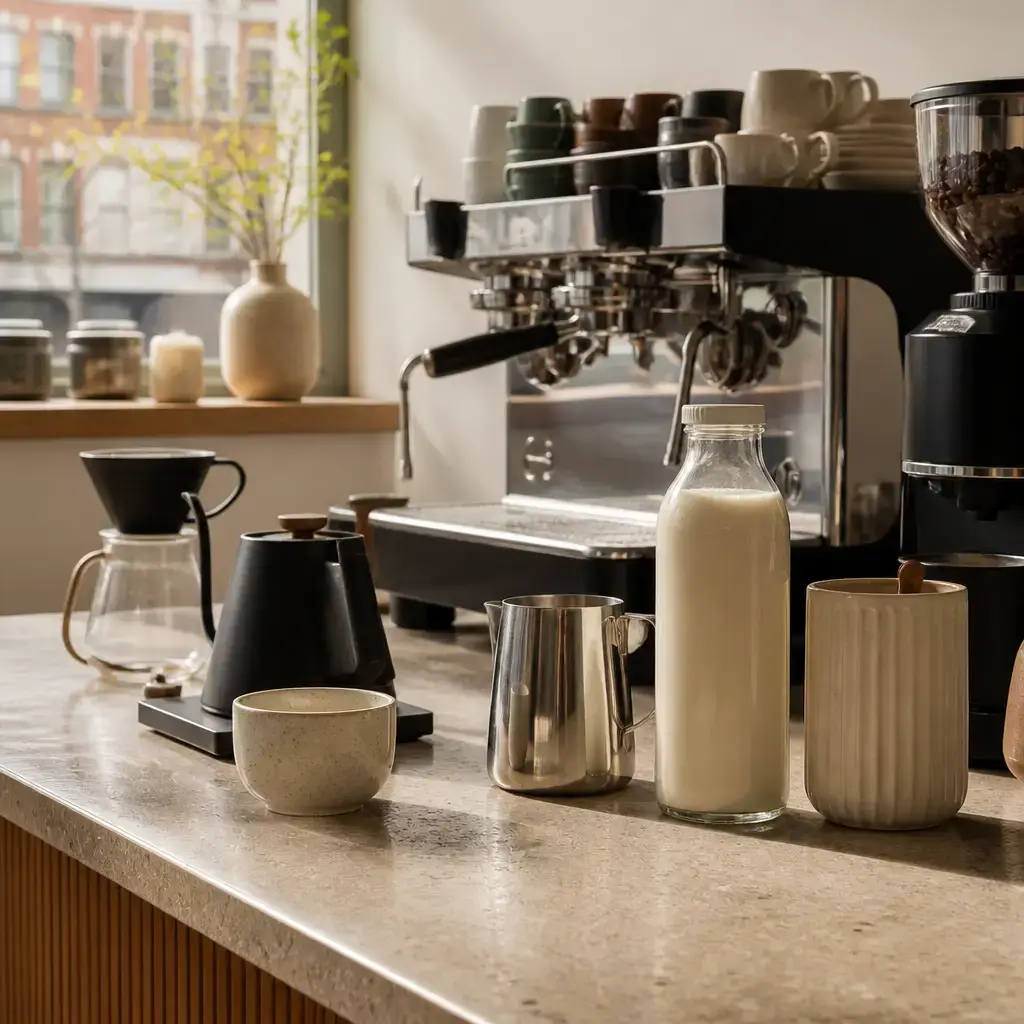
Use Ordering a latte and checking milk options to practice Danish conversation, pronunciation, vocabulary, grammar, and quizzes.
Dialogue
Må jeg få en latte med havremælk, hvis du har det?
moh yai foh en LAH-deh meh HOW-reh-melk, ves doo hah deh? Could I have a latte with oat milk if you have it?Det har vi. Vil du have den sædvanlige mængde skum?
deh hah vee. vel doo HAY-vah den SED-vahn-lee MENG-uh skoom? We do. Would you like the usual amount of foam?Mindre skum ville være bedre. Jeg undgår almindelig mælk i dag.
MEN-druh skoom VEL-uh VAIR BED-uh. yai oon-GOH AL-men-lee melk ee DAI. Less foam would be better. I'm avoiding regular milk today.Jeg laver den med mindre skum.
yai LAY-vuh den meh MEN-druh skoom. I'll make it with less foam.Det er alt, hvad jeg har brug for.
deh air ALT, vah yai hah broo for. That's all I need.Jeg laver den nu og tjekker etiketten, før jeg giver dig den.
yai LAY-vuh den NOO oh CHEK-uh eh-TEE-duh, fur yai GEE-vuh dai den. I'll prepare it now and check the label before I hand it over.Sentence explanations
Må jeg få en latte med havremælk, hvis du har det?
Could I have a latte with oat milk if you have it?
- Må jeg
- May I
- få
- have; get
- latte
- latte
- havremælk
- oat milk
- hvis du har det
- if you have it
More detail
Må jeg is a reusable Danish way to ask for permission or make a polite request: “May I …?” Here, må is the present form of the modal verb måtte, and jeg is the first-person singular pronoun. The phrase itself does not specify what is being requested; the following få completes the request. få means “get” or “receive” here, and in a café request it naturally gives the meaning “have” or “be given.” After a modal such as må, Danish uses the infinitive directly, without at: Må jeg få ...? = “May I have ...?” latte is the noun naming the drink. The preceding en forms an indefinite common-gender noun phrase, corresponding here to “a latte.” The article itself is not a separate statement of numerical quantity. havremælk is the compound noun havre (“oat”) + mælk (“milk”), meaning “oat milk.” In med havremælk, the preposition med means “with,” so this specifies the milk option requested. The observed form havremælk is one compound noun. hvis du har det is the conditional clause “if you have it.” hvis introduces a condition, du is the second-person singular pronoun “you,” and har is the present form of have (“to have”). det is a neuter singular pronoun meaning “it.” In this exchange, the clause asks whether the requested option is available; the pronoun's specific referent is not independently identified by its grammatical form. Together, Må jeg få en latte med havremælk asks politely for a latte with oat milk. hvis du har det makes the request conditional on the addressee having that requested option available. The complete meaning is: “Could I have a latte with oat milk if you have it?”
Det har vi. Vil du have den sædvanlige mængde skum?
We do. Would you like the usual amount of foam?
- Det har vi
- We do; we have that
- Vil du have
- would you like
- sædvanlige
- usual
- mængde
- amount
- skum
- foam
More detail
Det har vi means “We do; we have that” here. har is the present-tense form of have (“to have”), and vi means “we.” Det is a neutral pronoun meaning “it” or “that”; in this exchange, it refers to the requested oat milk, as established by the preceding question. Danish can place an object such as det first while keeping the finite verb in the second position: Det har vi literally has the order “That have we.” A reusable example is Det har jeg — “I do; I have that.” Vil du have is a question pattern meaning “would you like” in this service context. vil is the present form of ville, commonly used for wanting or for a modal-like question about what someone would like. du means “you,” and have is the infinitive “to have.” After vil, Danish uses the infinitive directly, without at: Vil du have kaffe? — “Would you like coffee?” The verb comes before the subject in this yes/no question. Sædvanlige means “usual” here. Its base form is sædvanlig; sædvanlige is the definite-form adjective used with the definite noun phrase den sædvanlige mængde. The -e belongs to the adjective, not to the noun. In a simple indefinite phrase, the adjective is en sædvanlig mængde — “a usual amount.” Mængde means “amount” or “quantity.” It is a noun for an amount of something, especially something treated as a mass or substance. A useful contrast is mængde “amount” versus antal “number,” which is used for countable items: en stor mængde mælk — “a large amount of milk.” Skum means “foam.” In this utterance it refers to foam as a substance, and it follows mængde to specify what the amount consists of. The phrase den sædvanlige mængde skum therefore means “the usual amount of foam.” Together, Vil du have asks what the listener would like, while den sædvanlige mængde skum identifies the quantity being offered. The complete question is “Would you like the usual amount of foam?” The preceding Det har vi answers the earlier availability question: “We do; we have that.”
Mindre skum ville være bedre. Jeg undgår almindelig mælk i dag.
Less foam would be better. I'm avoiding regular milk today.
- Mindre
- less
- skum
- foam
- ville være
- would be
- bedre
- better
- undgår
- avoid
- almindelig
- regular
- mælk
- milk
- i dag
- today
More detail
Mindre is the comparative form of lille: lille = small, mindre = smaller or less, and mindst = smallest or least. With a mass noun such as skum, it expresses a smaller amount: “less foam.” The comparative does not itself specify an exact quantity. Skum means foam. In this sentence it is the material whose amount is being compared. Example: Mindre skum, tak. — “Less foam, please.” Ville være combines ville with the infinitive være. Here ville marks a hypothetical or conditional result, while være means “be”: “would be.” Example: Det ville være bedre. — “That would be better.” Bedre is the comparative form of god: god = good, bedre = better, bedst = best. It describes the proposed amount of foam as preferable, without stating exactly what standard is being used. Undgår is the present-tense form of undgå, “avoid.” With the subject Jeg (“I”), undgår means “avoid” or “am avoiding” here. The form is not a past tense: Jeg undgår ... describes the speaker’s current choice or practice. Example: Jeg undgår sukker. — “I avoid sugar.” Almindelig means “regular” or “ordinary” here. It modifies mælk in the singular common-gender form. Danish adjective forms can change with the noun: almindelig with a common-gender singular noun, almindeligt with a neuter singular noun, and almindelige in plural or definite contexts. The adjective itself, not mælk, carries this form distinction. Mælk means milk. The phrase almindelig mælk identifies the regular kind of milk rather than a specially characterized kind. Example: Jeg køber mælk. — “I buy milk.” I dag is the fixed time expression “today.” It places the avoiding in the current day and does not by itself indicate whether the action began earlier or will continue later. Together, Mindre skum ville være bedre says that a smaller amount of foam would be preferable. Jeg undgår almindelig mælk i dag says that the speaker is avoiding regular milk today. The complete meaning is: “Less foam would be better. I’m avoiding regular milk today.”
Jeg laver den med mindre skum.
I'll make it with less foam.
- Jeg
- I
- laver
- make
- den
- it
- med
- with
- mindre
- less
- skum
- foam
More detail
Jeg means “I” and is the first-person singular subject pronoun. It does not show the speaker’s gender. For example, Jeg kommer nu. means “I’m coming now.” laver is the present-tense form of lave, “to make” or “to do.” Here, with the drink-related context, it means “make.” Danish present tense commonly uses the same form with different subjects: jeg laver = “I make/am making,” while hun laver = “she makes/is making.” den means “it” here. It is the singular common-gender form used for a definite noun or thing; the exact referent is supplied by the situation, while the translation confirms the intended meaning “it.” Do not treat den as a general replacement for every noun: Danish also uses det with neuter nouns and in other grammatical functions. med means “with” and introduces what something is accompanied by or contains. In this sentence it introduces the amount of foam used in making the drink. For example, kaffe med mælk means “coffee with milk.” mindre means “less” here. It is the comparative form associated with lidt (“a little”) and is used with an uncountable amount such as skum (“foam”). A useful contrast is mere skum = “more foam.” With countable items, Danish commonly uses færre (“fewer”) instead: færre kopper = “fewer cups.” skum means “foam.” It is a mass noun in this use, so mindre skum describes a smaller amount rather than a counted number of separate pieces. The noun itself has not been changed by mindre. Together, Jeg laver den means “I’ll make it” in the fixed translation; Danish present tense can express a current or immediately intended action. med mindre skum adds the method or specification “with less foam.” The complete utterance is therefore “I’ll make it with less foam.”
Det er alt, hvad jeg har brug for.
That's all I need.
- Det er
- It is
- alt
- all; everything
- hvad
- what
- jeg
- I
- har brug for
- need
More detail
Det er means “it is” here. er is the present-tense form of være (“to be”); the subject is Det, a pronoun whose specific referent is supplied by the situation rather than identified by this sentence alone. alt means “all” in the sense of the whole amount or entirety. In alt, hvad ..., it introduces the idea “everything/all that ...”; it is not a statement that a particular numerical count is involved. hvad introduces the content of alt: “what” or “that which.” Although hvad can also appear in direct questions, here it connects a subordinate clause to alt; it is not asking a question. The pattern alt, hvad + clause is reusable for “all that ...”. jeg is the first-person singular pronoun, “I.” Danish uses jeg for the speaker as the subject; its form does not change for grammatical gender. har brug for is the reusable Danish construction “to need,” literally organized around having a need for something. It is the present form of have brug for; har is the form of have used with jeg here. The needed thing follows in the construction, and in this sentence it is represented by hvad: hvad jeg har brug for = “what I need.” Together, alt, hvad jeg har brug for means “all that I need” or, naturally, “everything I need.” With Det er at the beginning, the complete utterance is “That’s all I need.”
Jeg laver den nu og tjekker etiketten, før jeg giver dig den.
I'll prepare it now and check the label before I hand it over.
- laver
- prepare; make
- den
- it
- nu
- now
- tjekker
- check
- etiketten
- the label
- før
- before
- giver
- give; hand over
- dig
- you
More detail
laver is the present-tense form of lave, “to make” or “to prepare.” Here the intended meaning is “prepare,” as in Jeg laver mad. — “I’m making food.” The present form is the same with different subjects: jeg laver and du laver. The first den is a singular object pronoun meaning “it.” Its form does not identify the referent by itself; the fixed translation supports this intended reading. The same form appears again later as the object of giver. Danish den can also occur in other grammatical roles, so its function here comes from its position as an object. nu means “now” and places the preparation and checking in the present situation. For example, Jeg kommer nu. means “I’m coming now.” og tjekker joins another action: tjekker is the present form of tjekke, “to check.” The subject remains jeg from the preceding clause, so Danish does not need to repeat it here. For example, Jeg tjekker døren. means “I check the door.” etiketten means “the label.” It is the definite singular form of the noun etiket: en etiket means “a label,” while etiketten means “the label.” The ending -en marks definite singular for this noun. Example: Jeg læser etiketten. — “I read the label.” før means “before” and introduces the action that must occur later in the sequence. It is followed here by the clause jeg giver dig den. Example: Jeg ringer, før jeg går. — “I call before I leave.” giver is the present form of give, “to give” or, in this context, “to hand over.” A useful Danish pattern is give nogen noget, literally “give someone something”; the person receiving something comes before the thing in this clause. Present-tense forms generally do not change for the subject: jeg giver and du giver. dig means “you” as an object. The subject form is du, as in Du hjælper mig. — “You help me”; after a verb, Danish uses dig, as in Jeg hjælper dig. — “I help you.” Here dig is the person receiving the item. Taken together, Jeg laver den says “I’ll prepare it,” nu adds “now,” and og tjekker etiketten adds “and check the label.” The clause after før gives the later step: jeg giver dig den, “I hand it over to you.” Thus the whole utterance means: “I’ll prepare it now and check the label before I hand it over.”
Grammar Points
have brug for + substantiv
har brug for havremælk
hah broo for HOW-reh-melkneed oat milk
Danish expresses “need” with the fixed phrase have brug for, followed by the thing needed.
Danish Vocabulary
Quiz
Word Order
Arrange the words in the correct order.
I'll make it with less foam.
Show Answer
Jeg laver den med mindre skum.Spelling
Tap the letters to spell the word.
amount
Show Answer
mængdeusual
Show Answer
sædvanligeless
Show Answer
Mindrefoam