10 minutes free every day
Continue audio lessons in the app
Word explanations appear automatically in sync with the audio.
No login required · synced translations · playback with the screen locked
Choose your learning language and open this lesson in the app.

About This Lesson
Use Timing a Dinner Party to practice Danish conversation, pronunciation, vocabulary, grammar, and quizzes.
Dialogue
Gæsterne kan måske komme, mens hovedretten stadig er ved at blive tilberedt.
KES-tuh-nuh ken MAW-skuh KUM-uh, mens HOH-thuh-reh-den STAY-thee air vayth aht blee-vuh TEL-buh-REH-th. The guests may arrive while the main course is still cooking.Så kan du servere en enkel forret, så folk kan finde sig til rette.
Soh ken doo seh-VAIR-uh en ENG-kuhl FOH-reth, soh fuhl ken FEH-nuh sigh tuh REH-thuh. Then serve a simple starter so people can settle in.Jeg kan have salat og brød klar, før de kommer.
Yai ken HAY-vuh suh-LAD uh BRUR-th klair, fur dee KUM-uh. I can have salad and bread ready before they get here.Det giver hovedretten lidt ekstra tid, uden at det får middagen til at virke forsinket.
Deh GEE-vuh HOH-thuh-reh-den leht EHK-strah TEE-th, OO-thun aht deh for ME-tha-un tuh veer-kuh foh-SENG-uth. That gives the main course a little extra time without making dinner seem delayed.Skal jeg tilberede grøntsagerne, når alle er kommet?
SGELL yai tel-buh-REH-thuh GRURN-seh-nuh, nor AL-uh air KUM-uhd? Should I cook the vegetables once everyone has arrived?De smager bedre, når de er frisklavede, så vent med at lave dem, til du næsten skal servere dem.
Dee SMAY-uh BED-thruh, nor dee air FRESK-LAH-vuh-thuh, soh vent meh aht LAY-vuh dem, te doo NESS-den sgell seh-VAIR-uh dem. They taste better freshly cooked, so wait until you are close to serving.Det føles stressende at have gæster, fordi det er sværere at få styr på tiden for det hele end at lave mad.
Deh FURL-us STRESS-uh-nuh aht HAY-vuh KES-tuh, foh-THEE deh air SVAIR-uh aht foh STUR paw TEE-thun foh deh HAY-luh en aht LAY-vuh MAY-th. Hosting feels stressful because timing everything is harder than cooking.Lav en enkel plan for serveringen: drikkevarer, forret og så hovedret.
Lah en ENG-kuhl plan foh seh-VAIR-eng-un: DREH-guh-vair, FOH-reth, uh soh HOH-thuh-reth. Make a simple serving plan: drinks, starter, then the main course.Jeg kan have den tjekliste liggende ved komfuret.
Yai ken HAY-vuh den CHEK-leh-thuh LENG-uh-nuh vay kum-FOO-ruhth. I can keep that checklist near the stove.Den burde hjælpe dig med at holde fokus, mens folk kommer.
Den BOOR-thuh YEL-buh die meh aht HUL-uh FOH-goos, mens fuhl KUM-uh. It should help you stay focused while people arrive.Sentence explanations
Gæsterne kan måske komme, mens hovedretten stadig er ved at blive tilberedt.
The guests may arrive while the main course is still cooking.
- Gæsterne
- the guests
- kan
- may; can
- måske
- perhaps
- komme
- come; arrive
- mens
- while
- hovedretten
- the main course
- stadig
- still
- er ved at blive tilberedt
- is still being cooked
More detail
Gæsterne means “the guests” here. It is the definite plural of gæst (“guest”): gæst → gæster (“guests”) → gæsterne (“the guests”). Danish marks both number and definiteness in this ending. kan is the present form of kunne, used here with the meaning “may” or “might”: it presents arriving as possible, not certain. With a following infinitive, the pattern is kan + infinitive: Hun kan komme means “She may/can come.” The subject Gæsterne is plural, but kan does not change for person or number. måske means “perhaps” or “maybe.” Together, kan måske makes the possibility more tentative: “may perhaps” or, naturally, “may.” komme is the infinitive of komme, “to come” or, in this context, “to arrive.” After the modal kan, Danish uses the infinitive without an infinitive marker: kan komme (“may come/arrive”). mens introduces a time clause meaning “while.” It connects an event with an action or state happening during the same period. For example, Læs, mens du venter means “Read while you wait.” hovedretten means “the main course.” It is the definite singular of the compound noun hovedret: hovedret (“main course”) → hovedretten (“the main course”). The definite ending belongs to this noun; it is not an adjective ending. stadig means “still.” It says that the cooking process continues at the relevant time. For example, Maden er stadig varm means “The food is still hot.” er ved at blive tilberedt describes an ongoing process in the passive voice. er is the present form of være (“to be”). ved at marks something currently in progress, while blive tilberedt is the passive infinitive of tilberede (“prepare/cook”): literally, “become prepared,” but naturally “be cooked/prepared.” The pattern er ved at blive + past participle can describe something that is in the process of being done: Maden er ved at blive varmet means “The food is being heated.” The whole sentence combines Gæsterne kan måske komme (“The guests may arrive”) with mens and the time clause hovedretten stadig er ved at blive tilberedt (“while the main course is still being cooked”). Thus it means: “The guests may arrive while the main course is still cooking.”
Så kan du servere en enkel forret, så folk kan finde sig til rette.
Then serve a simple starter so people can settle in.
- Så
- Then
- kan du
- you can
- servere
- serve
- enkel
- simple
- forret
- starter
- så
- so that
- folk
- people
- finde sig til rette
- settle in
More detail
Så means “then” here. It refers forward from the situation in the preceding context and introduces the next step. Danish så can also mean “so,” but that is the meaning of the later så in this sentence. kan du combines kan (“can/be able to”) with the subject pronoun du (“you”). kan is the present-tense form of kunne; it is followed here by the infinitive servere: du kan servere = “you can serve.” In this context, the construction functions as a suggestion or instruction, which is why the fixed translation uses “serve” rather than the more literal “you can serve.” servere is the infinitive “to serve.” After a modal such as kan, Danish uses the infinitive without an English-style infinitive marker: kan servere = “can serve.” Example: Jeg kan hjælpe. — “I can help.” enkel means “simple” here. It is the adjective modifying forret, and its form agrees with that noun: en enkel forret. The adjective’s base form is enkel; for a common-gender singular indefinite noun, this form is used here. Example: en enkel ret — “a simple dish.” forret means “starter” or “appetizer,” the first course of a meal. It is a common-gender singular noun, shown with the indefinite article en: en forret. The article marks an indefinite noun; it does not by itself state a numerical count. Example: Vi serverer en forret. — “We are serving a starter.” The second så means “so that” and introduces the purpose of serving the starter. It is therefore different in function from the first Så, which means “then.” The pattern så ... kan ... can express a purpose: Jeg åbner vinduet, så du kan se. — “I open the window so that you can see.” folk means “people.” In this sentence it is the subject of the following clause, folk kan .... Danish folk is a collective noun whose form does not simply correspond to an English plural ending; the intended meaning here is people in general. Example: Folk kommer tidligt. — “People arrive early.” finde sig til rette is a fixed reflexive expression meaning “settle in” or “make oneself comfortable.” finde is the infinitive of “find,” but in this construction the whole expression has the idiomatic meaning; sig is the reflexive pronoun, and til rette completes the expression. After kan, the infinitive appears again: kan finde sig til rette. Example: Hun finder sig hurtigt til rette. — “She settles in quickly.” Together, Så kan du servere en enkel forret gives “Then you can serve a simple starter.” The purpose clause så folk kan finde sig til rette adds “so that people can settle in.” Thus the complete utterance is: “Then serve a simple starter so people can settle in.”
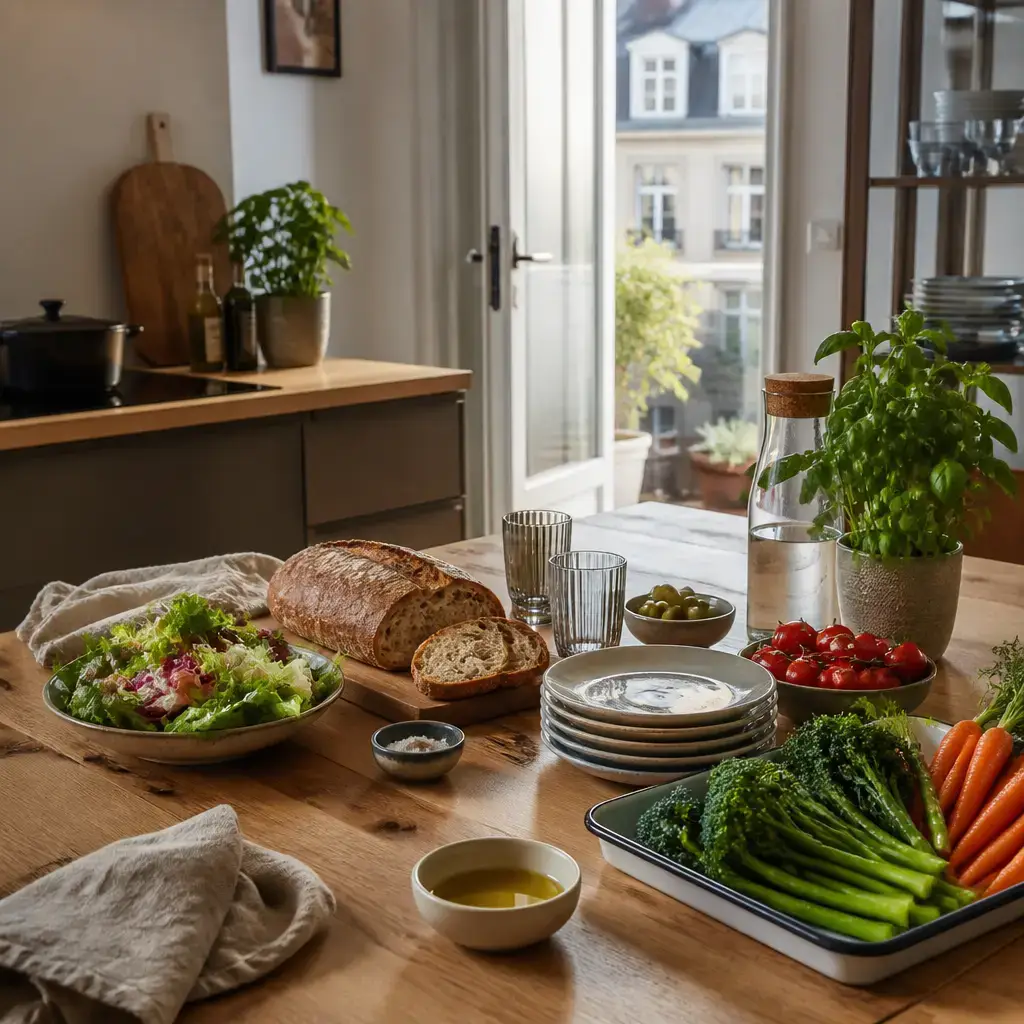
Jeg kan have salat og brød klar, før de kommer.
I can have salad and bread ready before they get here.
- Jeg kan
- I can
- have
- have
- salat
- salad
- brød
- bread
- klar
- ready
- før
- before
- de
- they
- kommer
- come / arrive
More detail
Jeg kan means “I can.” Jeg is the first-person singular pronoun “I”. kan is the present form of the modal verb kunne, “can/be able to”. A modal is followed by an infinitive: Jeg kan komme means “I can come.” have is the infinitive “have”. After the modal kan, Danish uses the infinitive without an infinitive marker: kan have means “can have”. Here, have is part of the reusable pattern have noget klar, “have something ready”. salat means “salad”. It is a noun used here as food, without an article. brød means “bread” and is likewise used here as a food noun without an article. The coordinated phrase salat og brød means “salad and bread”; og is “and”. klar means “ready”. In have salat og brød klar, it describes the food as being ready or prepared. This is an object-complement pattern: have + something + klar. For example, Jeg har kaffen klar means “I have the coffee ready.” The observed form is klar; it is not the noun salat or brød serving as its base form. før means “before” and introduces the time clause that follows. It connects the preparation with a later event: før vi spiser means “before we eat.” de means “they”. It is a third-person plural pronoun and is the subject of the following clause. The supplied sentence does not identify more specifically whom it refers to, so the important reusable point is its plural “they” role. kommer is the present form of komme, “come” or “arrive”. In this time clause, present kommer refers to the event that will occur after the preparation; Danish commonly uses the present form for such future time-clause events. For example, Ring, før du kommer means “Call before you come.” Together, Jeg kan have salat og brød klar says that the speaker is able to have the salad and bread ready. før de kommer places that state before their coming or arrival. The complete meaning is: “I can have salad and bread ready before they get here.”
Det giver hovedretten lidt ekstra tid, uden at det får middagen til at virke forsinket.
That gives the main course a little extra time without making dinner seem delayed.
- giver
- gives
- hovedretten
- the main course
- lidt
- a little
- ekstra
- extra
- tid
- time
- uden at
- without …ing
- får … til at
- makes …
- middagen
- dinner
- virke
- seem
- forsinket
- delayed
More detail
giver is the present-tense form of give (give → giver). Here the subject is Det, so the clause means that it gives something time. Danish present tense does not add a separate ending for each subject: jeg giver and det giver both use giver. hovedretten means “the main course.” It is the definite singular form of hovedret (“main course”): hovedret → hovedretten. The ending -en marks common-gender definiteness in this noun. Example: Hovedretten er klar. — “The main course is ready.” lidt means “a little” and indicates a small amount. It can modify an uncountable amount or a mass-like quantity, as in lidt tid (“a little time”). It is different from få, which is used with a small number of countable things. ekstra means “extra” or “additional.” In lidt ekstra tid, it describes additional time rather than a separate type of time. ekstra has the same form here regardless of the noun’s gender or number. tid means “time.” In this sentence it is an uncountable amount being given to the main course, so lidt tid means “a little time.” Example: Vi har brug for mere tid. — “We need more time.” uden at introduces an action that does not happen as a result or accompanying circumstance: “without …ing.” The verb after uden at is normally in the infinitive, so this pattern can be reused with another verb: uden at sige noget — “without saying anything.” The separated construction får ... til at means “makes ...” or “causes ... to.” Its parts are får and til at, with the affected participant and the infinitive between them. får is the present form of få (“get; make/cause”); in this causative pattern, the structure is få + object + til at + infinitive. middagen means “the dinner” or, in this context, “dinner.” It is the definite singular form of middag (“dinner”): middag → middagen. The definite form identifies the dinner intended in the situation; it does not by itself specify how many dinners there are. virke means “seem” or “appear.” It is an infinitive here because it follows til at in the causative construction. In får middagen til at virke, the meaning is “makes dinner seem,” not “makes dinner become” in every possible sense. Example: Det virker mærkeligt. — “It seems strange.” forsinket means “delayed.” Here it describes the apparent state of middagen after virke: the dinner is made to seem delayed. The form forsinket is used for both common-gender and neuter singular in this context, so it does not by itself distinguish those genders. In the plural, the form is forsinkede. Together, Det giver hovedretten lidt ekstra tid means “That gives the main course a little extra time.” uden at then introduces the avoided effect: det får middagen til at virke forsinket means “without making dinner seem delayed.” The complete utterance therefore means: “That gives the main course a little extra time without making dinner seem delayed.”
Skal jeg tilberede grøntsagerne, når alle er kommet?
Should I cook the vegetables once everyone has arrived?
- Skal jeg
- Should I …?
- tilberede
- cook; prepare
- grøntsagerne
- the vegetables
- når
- when
- alle
- everyone; all
- er kommet
- has arrived
More detail
Skal jeg asks whether the speaker should do something. skal is a modal verb; in this question it expresses a proposed or expected action, and the subject jeg comes after it. Danish places the infinitive directly after this modal, without at: Skal jeg vente? — “Should I wait?” tilberede is the infinitive meaning “to prepare or cook,” with a slightly more formal tone than some everyday cooking verbs. After skal, it stays in the infinitive: Jeg skal tilberede maden. — “I am going to prepare the food.” grøntsagerne means “the vegetables.” Its base noun is grøntsag (“vegetable”); grøntsager is the plural, and grøntsagerne is the definite plural. The ending -ne marks “the” for this plural noun. The noun phrase is the object of tilberede. når introduces a time clause meaning “when” or, here, “once.” It connects the action in the main clause with the time condition in the following clause: Jeg ringer, når jeg er hjemme. — “I will call when I am home.” alle means “everyone” in this sentence, referring to the people who are expected to arrive. It can also mean “all” when it stands with or refers to plural things or people, but the fixed translation supports the people-reading here. er kommet means “has arrived” in the clause alle er kommet. kommet is the past participle of komme (“come, arrive”), and er is the present form of være (“be”), used here as the auxiliary for a completed arrival. Danish verbs do not change for person or number, so er has the same form with alle as with another subject. A reusable example is Hun er kommet. — “She has arrived.” Together, Skal jeg tilberede grøntsagerne? asks, “Should I cook the vegetables?” The time clause når alle er kommet adds the condition “once everyone has arrived.” Thus the complete utterance means: “Should I cook the vegetables once everyone has arrived?”
De smager bedre, når de er frisklavede, så vent med at lave dem, til du næsten skal servere dem.
They taste better freshly cooked, so wait until you are close to serving.
- De
- they
- smager
- taste
- bedre
- better
- når
- when
- frisklavede
- freshly made
- så
- so
- vent med at
- wait to
- lave
- make
- dem
- them
- til
- until
- næsten
- almost
- skal
- are to
- servere
- serve
More detail
De is the plural subject pronoun “they.” In this exchange, it refers to the vegetables mentioned in the preceding question. Its object form is dem, which appears later; de and dem distinguish subject and object roles. smager means “taste” here. It is the present-tense form of smage: de smager = “they taste.” bedre means “better” and is a comparative form related to godt in this use: godt = well or good-tasting, bedre = better, bedst = best. Here it describes the tasting result. når introduces a time clause meaning “when.” Here it introduces the condition in which the vegetables taste better. frisklavede means “freshly made” here and agrees in plural with de in de er frisklavede. The ending belongs to this adjective, not to the pronoun. With food, “made” can naturally be understood as cooked or prepared in this context. så links the preceding statement to its consequence: “so.” vent med at is a reusable construction meaning “wait to do something” or “hold off on doing something.” In vent med at lave, vent is the imperative form of vente, so this is a direct instruction. The pattern is vente med at + infinitive. lave is the infinitive of lave, meaning “make” or, with food, “cook/prepare.” Here it names the action being postponed. Example: Jeg vil lave mad. — “I want to cook.” dem means “them” as the plural object of lave and later of servere. It is the object form corresponding to subject de; the form itself does not specify gender. In this exchange, it refers back to the vegetables. til means “until” here and introduces the endpoint of the waiting. The pattern is vente ... til + a clause. næsten means “almost,” indicating that the relevant point has not quite been reached. du næsten skal servere therefore describes being close to the time of serving. skal is the present form of the modal verb skulle. With the infinitive servere, it expresses an expected or planned action: du skal servere dem = “you are to serve them” or “you are going to serve them.” servere is the infinitive “serve.” It follows the modal in skal servere. Example: Vi skal servere maden nu. — “We are going to serve the food now.” Together, De smager bedre says that the vegetables taste better, and når de er frisklavede specifies when: when they are freshly made. så vent med at lave dem gives the instruction to wait before making them. til du næsten skal servere dem sets the endpoint: until you are almost due to serve them. The whole utterance means: “They taste better freshly cooked, so wait until you are close to serving.”
Det føles stressende at have gæster, fordi det er sværere at få styr på tiden for det hele end at lave mad.
Hosting feels stressful because timing everything is harder than cooking.
- føles
- feels
- stressende
- stressful
- have
- have
- gæster
- guests
- sværere
- harder
- få styr på
- get a handle on
- tiden
- the time
- det hele
- everything
- lave
- make or do
- mad
- food
More detail
føles means “feels” here. Its base form is føle. In det føles ..., the form presents an experience or impression; Danish verbs do not change for the subject’s person or number. Example: Det føles godt. — “It feels good.” stressende describes something that causes stress: “stressful.” It is an adjective in this sentence and describes the situation introduced by det. Example: Det er stressende. — “It is stressful.” have is the infinitive “to have.” The preceding at marks the infinitive in at have gæster, meaning “to have guests” or, in this context, “to host guests.” Example: Jeg kan lide at have gæster. — “I like having guests.” gæster is the plural of gæst, “guest.” The plural form is used because the sentence speaks about guests generally, without stating a particular number. Example: Vi har gæster i aften. — “We have guests tonight.” sværere is the comparative form of svær, “difficult” or “hard”: svær → sværere → sværest (“hard” → “harder” → “hardest”). The comparative compares getting the timing under control with cooking. Example: Det er sværere end forventet. — “It is harder than expected.” få styr på is a reusable expression meaning “get a handle on” or “get under control.” It is made from få (“get”), styr (“control”), and på, but the combination should be learned as a fixed pattern. Example: Jeg skal have styr på planen. — “I need to get the plan under control.” tiden means “the time” here. It is the definite form of tid (“time”): tid → tiden. The definite form presents the relevant time as identifiable in the situation, rather than as an unspecified amount of time. Example: Vi skal passe på tiden. — “We need to keep an eye on the time.” det hele means “everything” or “the whole thing.” det is a neuter form, while hele means “whole” and agrees with it. Here the phrase refers broadly to all the timing involved, not to one specifically named item. Example: Jeg har pakket det hele. — “I have packed everything.” lave is the infinitive of lave, “to make” or “to do.” In lave mad, it means “cook” or literally “make food.” Example: Jeg skal lave mad. — “I am going to cook.” mad means “food” and is also commonly used in the expression lave mad, “cook.” It is a mass noun here, so the sentence does not present it as one countable item. Example: Maden er klar. — “The food is ready.” Putting the parts together: Det føles stressende says that the situation feels stressful. at have gæster identifies the situation as hosting guests. fordi introduces the reason: det er sværere at få styr på tiden for det hele end at lave mad means that organizing the timing of everything is harder than cooking. The pattern sværere ... end ... is a reusable way to compare two activities or situations. The complete meaning is: “Hosting feels stressful because timing everything is harder than cooking.”
Lav en enkel plan for serveringen: drikkevarer, forret og så hovedret.
Make a simple serving plan: drinks, starter, then the main course.
- Lav
- make
- enkel
- simple
- plan
- plan
- serveringen
- the serving
- drikkevarer
- drinks
- forret
- starter
- så
- then
- hovedret
- main course
More detail
Lav is the imperative of lave, “to make/do.” It gives a direct instruction: “Make …” The present form is laver (“make/do” in the present), while lav is the form used for a command. enkel means “simple.” It is an adjective describing plan. In this sentence it has the common-gender singular form; for a neuter singular noun, Danish commonly uses enkelt, as in et enkelt spørgsmål (“a simple question”). plan means “plan.” It is a common-gender noun: en plan is indefinite singular, planen is definite singular, and planer is plural. Here en marks an unspecified plan, not a stated numerical count. serveringen means “the serving” or “the serving arrangement.” It is the definite singular form of servering: servering is indefinite singular, while serveringen means “the serving.” The noun refers here to the organization of serving the meal, as shown by the items that follow. drikkevarer means “drinks” or “beverages.” It is plural; the singular is drikkevare (“beverage”). In the list, it names the first category to include in the plan. forret means “starter” or “appetizer.” It is a common-gender noun. The indefinite singular is en forret, the definite singular is forretten, and the plural is forretter. så means “then” here. It marks the next item in the sequence, rather than describing how something is done. Danish can use så in other contexts too, but its role in this utterance is to order the listed courses. hovedret means “main course.” It is a common-gender noun: en hovedret is indefinite singular, hovedretten is definite singular, and hovedretter is plural. The word is used here as the final item in the meal sequence. Together, Lav en enkel plan for serveringen means “Make a simple plan for the serving.” The colon introduces the contents of that plan: drikkevarer, forret og så hovedret — “drinks, starter, then the main course.” og joins the last part of the list, and så makes the order explicit. The whole utterance is therefore: “Make a simple serving plan: drinks, starter, then the main course.”
Jeg kan have den tjekliste liggende ved komfuret.
I can keep that checklist near the stove.
- Jeg kan
- I can
- have
- keep / have
- den
- that
- tjekliste
- checklist
- liggende
- lying / kept
- ved
- near / by
- komfuret
- the stove
More detail
Jeg kan means “I can.” Jeg is the first-person singular pronoun “I”. Kan is the present form of kunne, “can/be able to”; it is followed directly by the infinitive have, without at in this modal construction. Example: Jeg kan komme. — “I can come.” have means “have” here, but with den tjekliste as its object and liggende describing its position, the combination means “keep/have lying” somewhere. The infinitive is have; the form does not change for the subject in this construction. This pattern is reusable for maintaining an object in a place: Jeg vil have bogen liggende her. — “I want to keep the book lying here.” den means “that” here and is the determiner modifying tjekliste. It is the common-gender singular form; Danish also uses det with neuter singular nouns and de for plural nouns. In this sentence, the fixed translation identifies the item as “that checklist.” tjekliste means “checklist.” It is a compound noun: tjek refers to checking, and liste means “list,” but the complete word is the ordinary noun for a checklist. Its indefinite form is en tjekliste, while the definite form is tjeklisten (“the checklist”). liggende means “lying” and describes the checklist’s maintained position. It is related to the verb ligge, “lie/be situated”; liggende is the present participle used here after have to describe the resulting state. Compare ligge (“be lying/be located”) with lægge (“lay/place”): Bogen ligger her. — “The book is lying here”; Jeg lægger bogen her. — “I put the book here.” ved means “near/by” in this location phrase. It introduces the place associated with the checklist: ved komfuret means “near the stove.” komfuret means “the stove.” The base noun is komfur; its definite singular form is komfuret. The ending -et marks definiteness for this neuter noun, while the indefinite form is et komfur (“a stove”). Together, Jeg kan have expresses the ability or possibility to maintain possession or placement, den tjekliste identifies the object, liggende presents it as remaining in a lying/located state, and ved komfuret gives its location. The whole utterance therefore means: “I can keep that checklist near the stove.”
Den burde hjælpe dig med at holde fokus, mens folk kommer.
It should help you stay focused while people arrive.
- Den
- it
- burde
- should
- hjælpe
- help
- dig
- you
- holde
- keep; maintain
- fokus
- focus
- mens
- while
- folk
- people
- kommer
- arrive; come
More detail
Den means “it” here. It is a Danish third-person singular pronoun for a common-gender noun or thing; the supplied translation identifies its intended referent only as “it,” without specifying what that thing is. Its form is not a marker of English-style grammatical gender. burde expresses “should” or “ought to” in this sentence. It is the modal form used to present the help as expected or advisable, rather than as a simple fact. A useful contrast is bør “should/ought to” in a more direct present-tense form; burde can sound less forceful or more tentative depending on context. hjælpe is the infinitive “help.” After the modal burde, Danish uses the infinitive without at: burde hjælpe = “should help.” The same verb can be used with a person as the recipient of help: hjælpe dig = “help you.” dig is the second-person singular object form, “you.” Danish uses dig for both direct and indirect object roles; the form does not show a distinction like English “you” versus an older separate object form. holde means “keep” or “maintain” in its infinitive form. In holde fokus, it forms a useful expression meaning “stay focused” or “maintain concentration.” After med at, Danish uses the infinitive: med at holde = “with keeping” or, more naturally here, “to help you stay.” fokus is the noun “focus.” In this utterance it refers to maintaining concentration, not to a physical focal point. Together, holde fokus is a reusable pattern for “stay focused” or “keep one’s focus.” mens is a conjunction meaning “while.” It introduces the simultaneous situation in the following clause. For example, Hun læser, mens han laver mad. means “She reads while he cooks.” folk means “people.” It is a plural noun, although its form does not take a plural ending here. Danish verb forms generally do not change according to subject number, so the following kommer has the same present-tense form it would have with a singular subject. kommer is the present form of komme, “come” or “arrive.” Here the translation selects the sense “arrive”: folk kommer = “people arrive.” The present form can describe an event happening now or a repeated/expected event, with the context determining the time perspective. The sentence is assembled as Den burde hjælpe dig (“It should help you”) + med at holde fokus (“to stay focused”) + mens folk kommer (“while people arrive”). Thus the complete meaning is: “It should help you stay focused while people arrive.”
Grammar Points
uden at + infinitiv
uden at vente
OO-thun aht VEN-tuhwithout waiting
Use uden at before an infinitive to express an action that does not happen.
få styr på + substantiv
få styr på serveringen
foh STUR paw seh-VAIR-eng-unget control of the serving
This fixed expression means to organize or gain control of something.
Danish Vocabulary
- Gender
- neuter
Jeg kan have salat og brød klar.
en enkel forret
så folk kan finde sig til rette
- Gender
- common
en enkel forret
- Gender
- common
The guests may arrive.
- Gender
- common
mens hovedretten stadig er ved at blive tilberedt
Gæsterne kan måske komme.
Gæsterne kan måske komme.
- Gender
- common
Jeg kan have salat klar.
kan du servere en enkel forret
Hovedretten er stadig ved at blive tilberedt.
ved at blive tilberedt
Quiz
Spelling
Tap the letters to spell the word.
the guests
Show Answer
Gæsternestill
Show Answer
stadigperhaps; maybe
Show Answer
måskeserve