10 minutes free every day
Continue audio lessons in the app
Word explanations appear automatically in sync with the audio.
No login required · synced translations · playback with the screen locked
Choose your learning language and open this lesson in the app.

About This Lesson
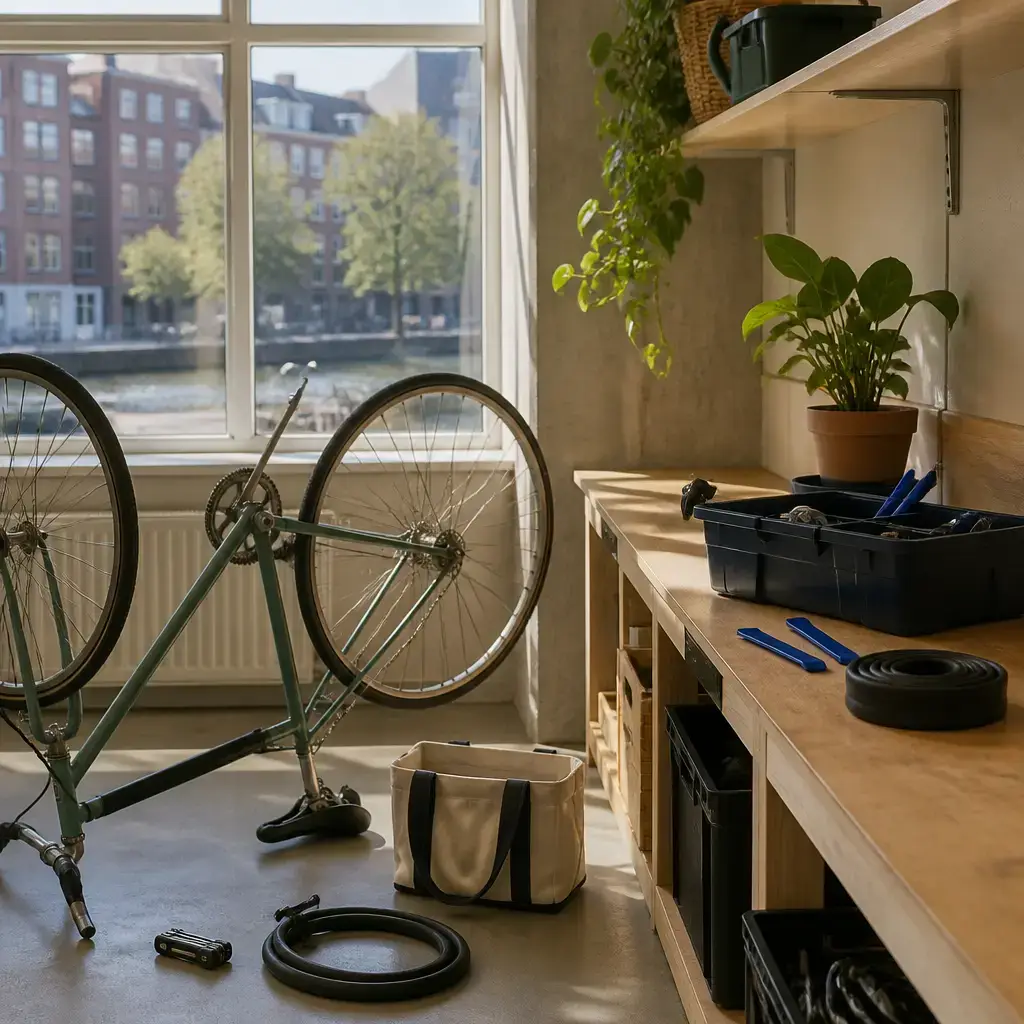
Use Borrowing bicycle repair tools to practice Danish conversation, pronunciation, vocabulary, grammar, and quizzes.
Dialogue
Mit cykeldæk er punkteret, og jeg har brug for et reparationssæt.
mit SÜ-guhl-deg air poong-tuh-RAYD, oh yai har BROO for et ray-pah-rah-SHOWN-set. My bicycle tire is flat, and I need a repair kit.Jeg har et sæt med dækjern og en ekstra slange.
yai har et set med DEG-yairn oh en EK-strah SLANG-uh. I have a kit with tire levers and a spare inner tube.Kan du vise mig, hvordan jeg tager hjulet af på den rigtige måde?
kan doo VEE-suh my, VOH-dan yai TAY-uh YOO-luhd af poh den RIG-duh MOH-uh? Could you show me how to remove the wheel correctly?Start med forsigtigt at vende cyklen på hovedet.
SDART med foh-SIG-duh at VEN-uh SÜ-guhl-n poh HOO-uhd. Start by turning the bike upside down carefully.Jeg har aldrig skiftet en cykelslange selv før.
yai har AL-dree SGEF-duh en SÜ-guhl-SLANG-uh selv fur. I have never changed an inner tube by myself before.Følg instruktionerne omhyggeligt, og tving ikke nogen del til at flytte sig.
FURL en-strook-SHOWN-uh-nuh om-HÜG-uh-lee, oh tving IK-kuh NOH-un dayl tel at FLYT-uh sai. Follow the instructions carefully, and do not force any part to move.Skal jeg kontrollere trykket, efter jeg har skiftet den?
skal yai kon-troh-LAIR-uh TRÜG-uhd, EF-tuh yai har SGEF-duh den? After I replace it, should I check the pressure?Dækket skal føles fast, men ikke for hårdt.
DEG-uhd skal FUR-luhs fast, men IK-kuh for HOR-dt. The tire should feel firm, but not too hard.Kan du blive i nærheden, mens jeg prøver det første trin?
kan doo BLEE-vuh ee NAIR-hay-thn, mens yai PROOR-vuh deh FUR-stuh treen? Could you stay nearby while I try the first step?Jeg kan guide dig gennem den første del, mens du bruger sættet.
yai kan GHEE-uh dai GEN-um den FUR-stuh dayl, mens doo BROO-uh SET-uh. I can talk you through the first part while you use the kit.Sentence explanations
Mit cykeldæk er punkteret, og jeg har brug for et reparationssæt.
My bicycle tire is flat, and I need a repair kit.
- Mit
- my
- cykeldæk
- bicycle tire
- punkteret
- flat
- har brug for
- need
- reparationssæt
- repair kit
More detail
Mit means “my” here and is the possessive form used with a singular neuter noun. The form changes with the noun’s grammatical gender and number: min is used with common-gender singular nouns, mit with neuter singular nouns, and mine with plural nouns. Example: mit hus means “my house,” while min cykel means “my bicycle.” cykeldæk means “bicycle tire.” It is a compound noun: cykel (“bicycle”) specifies the type of dæk (“tire”). Danish compounds are normally written as one word, and the final element determines the compound’s grammatical gender; here dæk is neuter, so the compound takes mit. punkteret describes the tire’s condition: it is punctured or flat because of a puncture. This is the past participle of punktere (“to puncture”) used adjectivally. With this neuter singular noun, the form is punkteret; an adjective may have other forms in other grammatical environments. Example: Dækket er punkteret. — “The tire is punctured.” har brug for is the Danish construction for “need” or “be in need of.” The verb is har, the present-tense form of have; brug for is the fixed part of the construction. The needed item follows for, as in Jeg har brug for hjælp. — “I need help.” This is different from simply using have to express possession. reparationssæt means “repair kit.” It is a compound noun built from reparation (“repair”) and sæt (“set” or “kit”), with a linking -s- in the compound form. In the sentence, the preceding article et marks this singular noun as neuter and indefinite; it does not by itself assert a numerical count as a separate fact. Together, Mit cykeldæk er punkteret means “My bicycle tire is flat,” literally describing the tire as punctured. og connects this clause to jeg har brug for et reparationssæt, “and I need a repair kit.” The full utterance therefore states that the speaker’s bicycle tire is punctured and that the speaker needs a repair kit.
Jeg har et sæt med dækjern og en ekstra slange.
I have a kit with tire levers and a spare inner tube.
- Jeg har
- I have
- sæt
- kit; set
- med
- with
- dækjern
- tire levers
- ekstra
- extra; spare
- slange
- inner tube
More detail
Jeg har means “I have” here. har is the present-tense form of have, used with jeg (“I”). The reusable pattern Jeg har ... states possession or what you have available. sæt means “kit” here. The noun is sæt, used with the neuter indefinite article et: et sæt. The article marks the noun’s grammatical gender, not a specific numeric count. In other contexts, sæt can also mean “set” of matching items; here the repair context supports “kit.” med means “with.” In et sæt med ..., it introduces the items included with or in the kit. dækjern means “tire levers” here. It is a Danish noun for the tool used to lever a tire off a rim. The observed form does not visibly distinguish singular from plural; in this sentence, the fixed translation identifies it as plural. A useful example is et dækjern — “a tire lever.” ekstra means “extra” or “spare” here and describes slange, indicating an additional inner tube. In this use, ekstra does not change form for the noun it describes. Example: en ekstra slange — “an extra inner tube.” slange means “inner tube” in this bicycle-repair context. It is a common-gender noun, shown with the indefinite article en: en slange. The fixed translation and context support this repair-related meaning. Together, et sæt med dækjern og en ekstra slange means “a kit with tire levers and a spare inner tube.” The conjunction og joins the two included items. The complete utterance, Jeg har et sæt med dækjern og en ekstra slange., means “I have a kit with tire levers and a spare inner tube.”
Kan du vise mig, hvordan jeg tager hjulet af på den rigtige måde?
Could you show me how to remove the wheel correctly?
- Kan du
- could you
- vise
- show
- hvordan
- how
- tager
- take
- hjulet
- the wheel
- rigtige
- correct; right
- måde
- way; manner
More detail
Kan du combines present-tense kan (“can”) with du (“you”) to make a direct but polite request: “Can you …?” Kan is the present form of kunne; after it, the next verb normally appears in the infinitive. This wording asks about the listener’s ability or willingness without stating that they must do it. vise is the infinitive of vise, “to show”. After kan, it remains in the infinitive: kan du vise … = “can you show …”. A reusable pattern is Kan du vise mig …? (“Could you show me …?”). Here mig means “me” and is the person who is to receive the showing. hvordan means “how” and introduces a clause explaining the method. In vise mig, hvordan …, it corresponds to “show me how …”, not simply “show me that …”. Example: Kan du forklare, hvordan det virker? — “Can you explain how it works?” tager is the present form of tage, “take”. In this sentence it works with the later particle af as the separable verb pattern tage … af, meaning “take … off” or “remove …”. The object comes between the verb and af: jeg tager hjulet af = “I take the wheel off”. Danish present-tense verbs do not change form according to the subject’s person or number, so tager is the same form with jeg, du, or another subject; its infinitive is tage. hjulet is the definite singular form of hjul, “wheel”: et hjul = “a wheel”, hjulet = “the wheel”. The definite form presents one wheel as identifiable in the situation, while hjul itself does not specify that it is definite. Example: Jeg renser hjulet. — “I clean the wheel.” rigtige is the form of rigtig, “correct” or “right”, used with the definite noun phrase den rigtige måde. Danish adjectives take forms according to the noun phrase they modify: with a common-gender singular indefinite noun, en rigtig måde; with a definite noun phrase, den rigtige måde. The adjective is based on rigtig, not on måde. måde means “way” or “manner”. The phrase på den rigtige måde means “in the correct way” or “correctly”. In this sentence, på links the manner phrase to the removal action; the selected word måde itself names the way, while rigtige describes it. Together, hvordan jeg tager hjulet af means “how I remove the wheel”, with tager … af expressing removal. på den rigtige måde adds the manner “correctly”. The full utterance is therefore: “Could you show me how to remove the wheel correctly?”
Start med forsigtigt at vende cyklen på hovedet.
Start by turning the bike upside down carefully.
- Start med
- start with
- forsigtigt
- carefully
- at vende
- to turn
- cyklen
- the bike
- på hovedet
- upside down
More detail
Start med introduces an activity that should begin first. Start is the imperative of starte (“to start”); the imperative is used for a direct instruction. In this pattern, med is followed by the activity being started. With a noun, the same pattern can mean “start with …”, as in Start med det lille hjul. — “Start with the small wheel.” forsigtigt describes how the action is carried out: “carefully” or “gently”. It is an adverb, so it modifies the action rather than the bike. The related adjective is forsigtig (“careful”): Vær forsigtig. — “Be careful.” at vende is the infinitive “to turn” or “to turn over”. Danish uses at before this infinitive. The verb vende can describe changing an object’s orientation; the exact result here is supplied by på hovedet. cyklen means “the bike”. It is the definite singular form of cykel (“bike”): cykel → cyklen. The ending -en marks the definite form for this noun; it does not itself mean a numerical count. på hovedet is a fixed expression meaning “upside down”. Literally, it refers to being on one’s head, but in this sentence it describes the bike’s orientation. For example, Billedet hænger på hovedet. means “The picture is hanging upside down.” Together, Start med tells the listener what to begin with, at vende cyklen på hovedet names that activity, and forsigtigt specifies its manner. The complete instruction is therefore: “Start by turning the bike upside down carefully.”
Jeg har aldrig skiftet en cykelslange selv før.
I have never changed an inner tube by myself before.
- Jeg har
- I have
- aldrig
- never
- skiftet
- changed
- cykelslange
- inner tube
- selv
- by myself
- før
- before
More detail
Jeg har combines Jeg (“I”) with har (“have”). Here har is the present-tense form of have and acts as the auxiliary in the perfect construction. A reusable pattern is Jeg har + past participle: Jeg har læst bogen means “I have read the book.” aldrig means “never.” With the perfect construction, it says that the experience has not occurred at any time up to the relevant point. Jeg har aldrig ... means “I have never ...”. It differs from ikke (“not”), which normally negates an action or statement without itself meaning “never.” skiftet is the past participle of skifte, meaning “to change” or “to replace.” With har, it forms the perfect: Jeg har skiftet ... means “I have changed/replaced ...”. cykelslange is a noun meaning “inner tube,” specifically the tube used in a bicycle tire. The full noun phrase here, en cykelslange, is indefinite singular; the article en, not the noun stem alone, marks that phrase as indefinite. The definite singular form is cykelslangen, “the inner tube.” selv emphasizes that the speaker personally did the action, without someone else doing it for them. In skiftet ... selv, it corresponds to “by myself” or “myself.” It can also emphasize another subject: Hun gjorde det selv means “She did it herself.” før means “before.” At the end of this utterance, together with aldrig, it forms the time expression “never before.” In another context it can introduce an earlier event: før arbejdet means “before the work.” Together, Jeg har aldrig skiftet en cykelslange selv før means “I have never changed an inner tube by myself before.” The structure is subject + have + aldrig + past participle + object + selv + før: the speaker says that, up to now, they have no previous personal experience of replacing a bicycle inner tube.
Følg instruktionerne omhyggeligt, og tving ikke nogen del til at flytte sig.
Follow the instructions carefully, and do not force any part to move.
- Følg
- follow
- instruktionerne
- the instructions
- omhyggeligt
- carefully
- tving
- force
- ikke
- not
- nogen
- any
- del
- part
- flytte sig
- move
More detail
Følg is the imperative of følge (“to follow”). Danish imperatives commonly give a direct instruction; here it addresses the listener without stating a subject. Example: Følg mig. — “Follow me.” instruktionerne means “the instructions.” It is the definite plural of instruktion: instruktioner is the plural, and -ne marks the definite plural here. Together, Følg instruktionerne means “Follow the instructions.” omhyggeligt is the adverb “carefully.” It describes how the following is done. The related adjective is omhyggelig (“careful”); omhyggeligt is also the form used with an adjective/adverb pattern for “carefully,” rather than describing the instructions as a noun. tving is the imperative of tvinge (“to force”). The construction tvinge noget til at means “force something to”; the thing being forced is placed between the verb and til at. Example: Tving ikke døren til at åbne sig. — “Do not force the door to open.” ikke marks negation. In this sentence it negates the instruction to force, so tving ikke means “do not force.” nogen means “any” in this negative context. It introduces an unspecified member of the following category, not a stated number. Example: Rør ikke nogen knap. — “Do not touch any button.” del means “part.” In nogen del it refers to any part, without identifying which part. The noun is commonly used as en del; its definite singular is delen and its plural is dele. flytte sig means “move” in this sentence. flytte is the infinitive “to move,” and sig is the reflexive pronoun, used when the moving entity is understood as moving itself. In til at flytte sig, til at introduces the infinitive after tvinge: “to move.” The sentence first gives the imperative Følg instruktionerne omhyggeligt (“Follow the instructions carefully”). It then adds the coordinated negative imperative tving ikke nogen del til at flytte sig (“do not force any part to move”). Together: “Follow the instructions carefully, and do not force any part to move.” The direct imperatives make this a clear instruction.
Skal jeg kontrollere trykket, efter jeg har skiftet den?
After I replace it, should I check the pressure?
- Skal jeg
- should I
- kontrollere
- check
- trykket
- the pressure
- efter
- after
- skiftet
- replaced
- den
- it
More detail
Skal jeg combines the modal verb skal with the subject pronoun jeg. Here skal asks whether the speaker ought to do something, so the reusable pattern is Skal jeg + infinitive? — “Should I ...?” In a main-clause question, the modal comes before the subject: Skal jeg vente? means “Should I wait?” kontrollere is the infinitive “to check.” It follows skal without an infinitive marker. The same verb can be reused after other modal verbs: Jeg kan kontrollere det. means “I can check it.” trykket means “the pressure” here. Its base form is the noun tryk, “pressure”; trykket is its definite singular form, marked by the ending -et. The ending belongs to this noun, not to the verb. Example: Mål trykket. — “Measure the pressure.” efter introduces the time relation “after” when it is followed by a clause. The pattern efter + clause can connect two events: Efter vi er færdige, lukker vi døren. — “After we are finished, we close the door.” skiftet is the past participle of skifte, “to replace” or “to change,” in the perfect construction har skiftet. In this sentence, har skiftet means “have replaced.” The auxiliary har carries the present-tense form, while skiftet remains the participle. Example: Jeg har skiftet delen. — “I have replaced the part.” den is a third-person singular object pronoun meaning “it” in this use. It refers to the item being replaced, without the supplied sentence specifying that item by name. The pronoun is placed after the verb in har skiftet den: “have replaced it.” Together, efter jeg har skiftet den means “after I have replaced it.” The complete structure is the main question Skal jeg kontrollere trykket? followed by the time clause efter jeg har skiftet den. Thus the utterance asks whether the speaker should check the pressure after replacing the item.
Dækket skal føles fast, men ikke for hårdt.
The tire should feel firm, but not too hard.
- Dækket
- the tire
- skal
- should
- føles
- feel
- fast
- firm
- men ikke
- but not
- for hårdt
- too hard
More detail
Dækket means “the tire” here. It is the definite singular form of dæk (“tire”): the ending marks a specific tire rather than an unspecified one. Danish often puts definiteness on the noun itself, so dæk and dækket are useful forms to compare. skal expresses what is required, expected, or recommended in this sentence: the tire should have the stated feel. Its infinitive form is skulle; skal is the present form. In other contexts, skal can also express a planned or future action, so the surrounding predicate determines the meaning here. føles means “feels” in the sense of having a particular sensation or character. It is the s-form of føle, used here with the tire as subject and an adjective describing how it should feel. The reusable pattern is X føles Y (“X feels Y”), for example: Stolen føles behagelig. — “The chair feels comfortable.” fast describes the tire’s firmness. The adjective is fast; in this form it has no visible ending. Danish adjectives can show forms such as fast and faste, but the exact form depends on the noun phrase and construction, not simply on the English word “firm.” men ikke combines contrast with negation: “but not.” men introduces the second, limiting part of the statement, while ikke negates what follows. The phrase therefore limits the first condition rather than introducing an unrelated condition. for hårdt means “too hard.” for is the degree word “too,” and hårdt is the neuter singular form of the adjective hård (“hard”). Here it agrees with the neuter noun dæk in the predicative construction. The useful adjective chain is hård (“hard”), hårdere (“harder”), hårdest (“hardest”); hårdt is the neuter form, not the base form. For example, Det føles hårdt. means “It feels hard.” Together, the sentence presents a target condition: the tire is expected to feel firm, while the firmness must stay below the excessive level expressed by “too hard.” The pattern is reusable as X skal føles A, men ikke for B when describing a desired sensory or physical condition.
Kan du blive i nærheden, mens jeg prøver det første trin?
Could you stay nearby while I try the first step?
- Kan du
- Can you…? / Could you…?
- blive
- stay; remain
- i nærheden
- nearby
- mens
- while
- prøver
- try
- det
- the (in this noun phrase)
- første
- first
- trin
- step
More detail
Kan du combines kan (“can”) with du (“you”) in a question. kan is the present form of kunne, “can/be able to”; with a following infinitive, it asks whether someone is able or willing to do something. Danish questions often place the finite verb before the subject: Kan du ...? = “Can/Could you ...?” blive is the infinitive of blive, meaning “stay” or “remain” here. After the modal kan, the following verb stays in the infinitive. A useful pattern is kan + subject + infinitive: Kan du vente? — “Can you wait?” i nærheden is a prepositional expression meaning “nearby” or “in the vicinity.” It describes the place where someone stays; it does not itself specify exactly what place is nearby. mens introduces a clause for an action happening at the same time: “while.” The clause after it is jeg prøver det første trin. prøver is the present-tense form of prøve, “try” or “attempt.” Its subject is jeg (“I”), so the meaning here is “I try.” Danish present-tense verbs generally do not change form according to the subject: jeg prøver means “I try,” while du prøver means “you try.” In det første trin, det is the neuter singular definite article used before an adjective and noun, so it contributes “the” rather than the object-pronoun meaning “it.” The whole noun phrase means “the first step.” Danish det can also be a pronoun meaning “it” in other constructions, but that is not its role here. første means “first.” It is an ordinal form identifying position in an order rather than quantity. In det første trin, it describes the noun trin; it is not the noun’s base form. trin means “step.” In this sentence it is the singular noun referring to one step in a sequence. trin can also be the plural form in other contexts, but det første makes the singular reading clear here. Together, Kan du blive i nærheden asks someone to stay nearby, and mens jeg prøver det første trin gives the simultaneous action: the speaker will try the first step while that person stays nearby. The complete meaning is: “Could you stay nearby while I try the first step?”
Jeg kan guide dig gennem den første del, mens du bruger sættet.
I can talk you through the first part while you use the kit.
- Jeg kan
- I can
- guide
- guide; talk someone through
- dig
- you
- gennem
- through
- første
- first
- del
- part
- mens
- while
- bruger
- use
- sættet
- the kit
More detail
Jeg kan means “I can.” kan is the present form of kunne, used here for ability or willingness to do something. The pattern jeg kan + verb is reusable: Jeg kan hjælpe. — “I can help.” The subject is Jeg (“I”); kan does not change for the subject. guide means “guide” or “talk someone through.” It is an English-origin verb used in Danish; the observed form is the infinitive after kan. In the pattern guide nogen gennem noget, the person being guided is marked by an object form and gennem introduces what they are guided through. Example: Hun guider ham gennem øvelsen. — “She talks him through the exercise.” dig means “you” as an object. It is the object form corresponding to the subject form du: Du hjælper mig — “You help me”; Jeg hjælper dig — “I help you.” Here, dig is the person receiving the guidance. gennem means “through.” It can introduce a route or a sequence, as in gennem tunnelen (“through the tunnel”) and gennem første del (“through the first part”). Here it connects guide dig with the part being explained. første means “first.” It is an ordinal adjective, not a statement about quantity. Its base idea is position in an order: første, anden, tredje — “first, second, third.” In den første del, første describes which part comes first in the relevant sequence. The form første is also used with common-gender, neuter, and plural nouns; the surrounding noun phrase and article provide the other grammatical information. del means “part.” It is a common-gender noun: en del (“a part”), delen (“the part”). In this sentence it appears in the definite phrase den første del, meaning “the first part.” Example: Vi tager en del ad gangen. — “We take one part at a time.” mens means “while” and introduces a clause describing an action occurring at the same time as the main action. The pattern mens + subject + verb is reusable: Læs instruktionen, mens du venter. — “Read the instructions while you wait.” bruger means “use” here. It is the present-tense form of bruge: jeg bruger, du bruger, de bruger. Danish present tense generally has the same verb form across these subjects. Example: Du bruger telefonen. — “You use the phone.” sættet means “the kit.” It is the definite singular form of the neuter noun sæt: et sæt (“a kit/set”), sættet (“the kit/set”). The -et ending marks definiteness here; it is not itself a separate word for “the.” Together, Jeg kan guide dig gennem den første del means “I can talk you through the first part.” mens du bruger sættet adds the simultaneous action “while you use the kit.” The complete utterance therefore means: “I can talk you through the first part while you use the kit.”
Grammar Points
Imperativ: verbets stamme uden subjekt
Start forsigtigt.
SDART foh-SIG-duh.Start carefully.
Danish commands often use the verb stem alone, without a subject.
have brug for + substantiv
Jeg har brug for et reparationssæt.
yai har BROO for et ray-pah-rah-SHOWN-set.I need a repair kit.
The fixed expression har brug for means “need” and is followed by the thing needed.
Danish Vocabulary
- Gender
- neuter
- Gender
- common
- Gender
- neuter
- Gender
- neuter
- Gender
- neuter
Quiz
Spelling
Tap the letters to spell the word.
tire lever
Show Answer
dækjernto puncture; to get a flat tire
Show Answer
punkteretto show
Show Answer
visebicycle tire