10 minutes free every day
Continue audio lessons in the app
Word explanations appear automatically in sync with the audio.
No login required · synced translations · playback with the screen locked
Choose your learning language and open this lesson in the app.

About This Lesson
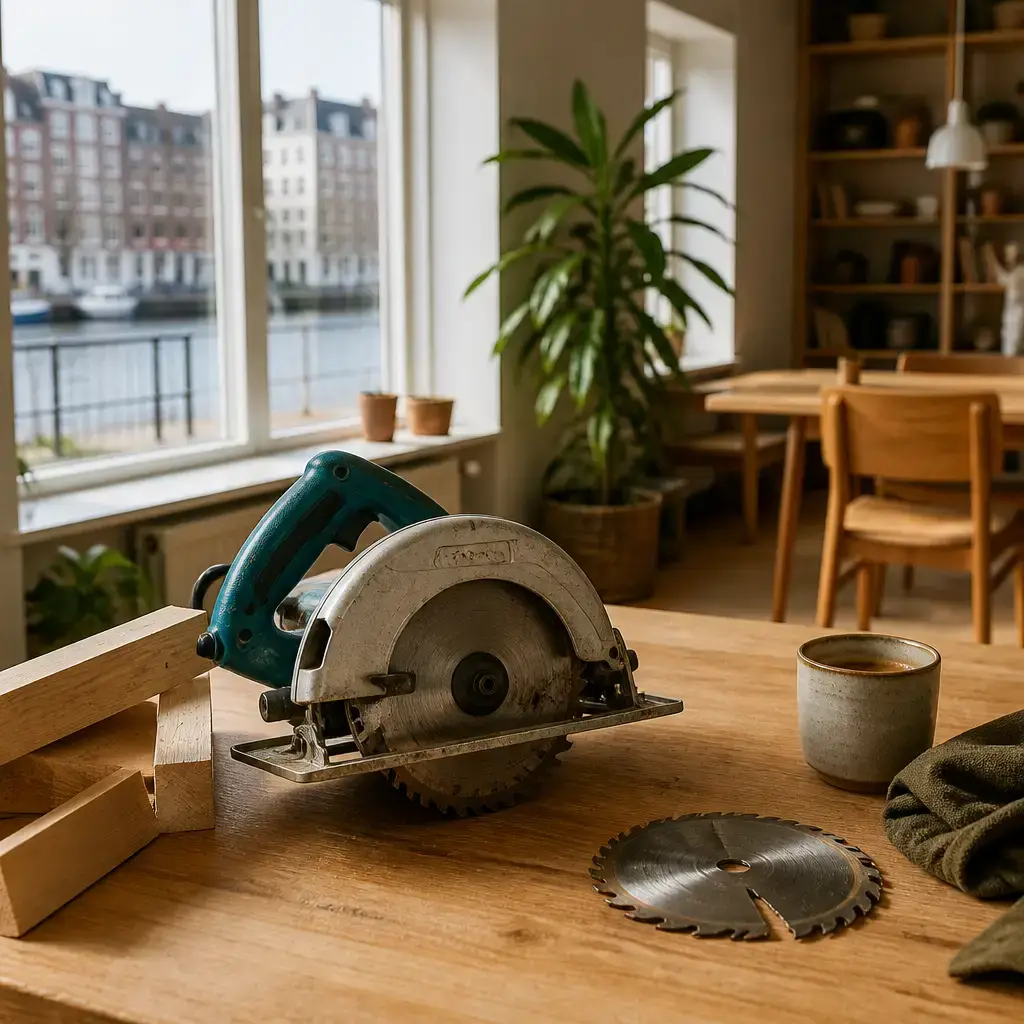
Use Taking responsibility for a damaged borrowed tool to practice Danish conversation, pronunciation, vocabulary, grammar, and quizzes.
Dialogue
Jeg er nødt til at være ærlig om den sav, jeg lånte.
yai air NURT til eh VAIR-uh AIR-lee ohm den SOW, yai LON-uh I need to be honest about the saw I borrowed.Kan du forklare, hvad der skete?
kan doo foh-KLAIR-uh, va dair SGAY-thuh? Can you explain what happened?Klingen blev beskadiget, mens jeg skar i tykt træ.
KLEE-ngen blee-uh beh-SGA-thi-eh, mens yai skahr ee tuhkt tray The blade got damaged while I was cutting thick wood.Var træet for tykt til den sav?
vahr tray-uh fohr tuhkt til den SOW? Was the wood too thick for that saw?Det var det nok, og jeg burde have spurgt, før jeg prøvede.
deh vahr deh NOK, oh yai BOOR-thuh hah SPOORT, fohr yai PRUH-vuh-thuh Probably, and I should have asked before trying.Jeg sætter pris på, at du siger det ligeud i stedet for at skjule det.
yai SET-uh prees poh, deh doo SEE-er deh LEE-uh-oo ee steh-den fohr eh SKYOOL-uh deh I appreciate you being upfront instead of hiding it.Jeg kan sørge for en reparation eller udskifte klingen.
yai kan SOOR-uh fohr eh ray-pa-ra-SHOWN, eh-ler ood-SGIF-tuh KLEE-ngen I can arrange a repair or replace the blade.Det burde være nok at udskifte klingen.
deh BOOR-thuh VAIR-uh nok eh ood-SGIF-tuh KLEE-ngen Replacing the blade should be enough.Jeg tager mig af det i dag.
yai TAIR-uh may ah deh ee DAH I will take care of that today.Sig til mig, når den er blevet udskiftet, før du kommer tilbage med saven.
say til may, nor den air BLAY-vuh-th ood-SGIF-t, fohr doo KOM-uh te-BAIR-uh med SOW-en Tell me when it is replaced before you bring the saw back.Sentence explanations
Jeg er nødt til at være ærlig om den sav, jeg lånte.
I need to be honest about the saw I borrowed.
- Jeg
- I
- er nødt til at
- need to
- være
- be
- ærlig
- honest
- om
- about
- den
- the specific
- sav
- saw
- lånte
- borrowed
More detail
Jeg means “I” here: the speaker is the subject of the main clause. Danish uses jeg for the first-person singular subject; it does not change for gender. er nødt til at is a reusable construction meaning that the subject has to do something or needs to do it. er is the present form of være (“be”), while nødt til contributes the idea of necessity. The following verb is introduced by at and stays in the infinitive: Jeg er nødt til at vente means “I have to wait.” This is a necessity construction, not simply a statement that the speaker is willing to act. være is the infinitive “to be.” In this sentence it follows at as part of er nødt til at være. Its present form is er, and its past form is var. ærlig means “honest.” It is a descriptive adjective applied to the speaker through være: at være ærlig means “to be honest.” The adjective has the common-gender form ærlig; its neuter form is ærligt, as in et ærligt svar (“an honest answer”). om means “about” in this use. It introduces the topic of being honest: være ærlig om noget means “be honest about something.” It is different from med, which commonly means “with” or “by” and does not express this topic relation here. den is a demonstrative determiner for a specific singular common-gender noun. In the fixed translation, it is rendered as “the” in den sav; its more literal demonstrative value can be “that.” The common-gender form is den, while the neuter counterpart is det. Here den helps identify the particular saw being discussed; it does not itself state a numeric quantity. sav is the noun “saw,” the tool. Its indefinite form is en sav, and its ordinary definite form is saven (“the saw”). In den sav, the noun remains in its indefinite-looking form because den is the separate demonstrative determiner. lånte is the past-tense form of låne, “borrow.” In jeg lånte it means “I borrowed.” The past form presents the borrowing as completed before the speaker’s current need to be honest. Danish uses the same past form lånte with a first-person singular subject and a third-person singular subject; the subject tells us who borrowed the saw. The chunk den sav, jeg lånte is a noun phrase followed by a relative clause. jeg lånte specifies which saw is meant: literally, “the saw [that] I borrowed.” Danish can omit the relative pronoun in this kind of clause, so no separate word corresponding to “that” appears in the source. Putting the parts together, Jeg er nødt til at være ærlig means “I need to be honest,” and om den sav, jeg lånte adds the topic, “about the saw I borrowed.” The whole utterance therefore means “I need to be honest about the saw I borrowed.”
Kan du forklare, hvad der skete?
Can you explain what happened?
- Kan du
- Can you
- forklare
- explain
- hvad
- what
- skete
- happened
More detail
Kan du is the Danish question pattern for asking whether someone can or is willing to do something. kan is the present form of kunne (“can, be able to”); du is the second-person singular pronoun “you.” Danish places the verb before the subject in this direct question: Kan du ...? (“Can you ...?”). The question itself does not specify why the explanation is wanted. forklare means “to explain.” It is the infinitive used after the modal verb kan, and Danish uses this infinitive without at after kan: Kan du forklare ...? means “Can you explain ...?” For comparison, at forklare is the infinitive form when at is required in another construction. hvad means “what” and introduces the content of the explanation. Here it is not asking for a separate object called “what”; it introduces an embedded question about an event: hvad ... = “what ...”. skete means “happened” here. It is the past-tense form of ske (“happen”), so ske → skete expresses a completed event in the past. Example: Hvad skete? — “What happened?” Together, hvad der skete is the embedded question “what happened.” The word der is part of this Danish construction and links the question word hvad to the event clause; it does not need to be translated as a separate English word. The full structure is Kan du + infinitive forklare + embedded question hvad der skete: “Can you explain what happened?”
Klingen blev beskadiget, mens jeg skar i tykt træ.
The blade got damaged while I was cutting thick wood.
- Klingen
- the blade
- blev beskadiget
- got damaged
- skar
- cut
- tykt
- thick
- træ
- wood
More detail
Klingen means “the blade.” klinge is the indefinite form, while klingen is the definite singular form. Danish commonly marks definiteness this way rather than with a separate word before the noun. Example: en klinge = “a blade”; klingen = “the blade.” blev beskadiget means “got damaged.” blev is a past-tense form of blive (“become/get”), and beskadiget is the past participle of beskadige (“damage”). Together, blive plus a past participle forms a passive construction: the blade is presented as the thing affected by the damage. The wording focuses on the event or resulting condition, without stating who caused the damage. Example: Døren blev åbnet. = “The door was opened.” skar means “cut” here. It is the past-tense form of skære (“cut”), so it describes an action that was in progress or occurring at that past time. Example: Jeg skar brødet. = “I cut the bread.” tykt means “thick” here. Its form agrees with the neuter singular noun træ; the adjective is not based on that noun. The basic form is tyk, with the neuter singular form tykt. Example: et tykt reb = “a thick rope.” træ means “wood” in this sentence. It can also mean “tree” in other contexts, but the fixed translation and the cutting context support “wood” here. træ is a neuter noun, as shown by the form et træ; that is why the adjective appears as tykt. The connective mens introduces the simultaneous background action “while.” jeg is the first-person singular pronoun “I.” Thus, mens jeg skar i tykt træ means “while I was cutting thick wood”: jeg is the person performing skar, and i marks what the cutting was into or in. The past form skar supplies the past-time meaning; mens presents that activity as ongoing or simultaneous with the blade’s damage. Assembled, Klingen blev beskadiget says “The blade got damaged,” and mens jeg skar i tykt træ adds when it happened: “while I was cutting thick wood.” The complete utterance therefore means: “The blade got damaged while I was cutting thick wood.”
Var træet for tykt til den sav?
Was the wood too thick for that saw?
- Var
- was
- træet
- the wood
- for tykt
- too thick
- til
- for
- den
- that
- sav
- saw
More detail
Var is the past-tense form of være (“to be”). In a yes/no question, Danish places this verb before the subject: Var træet ...? means “Was the wood ...?” The present form is er, as in Er træet tykt? (“Is the wood thick?”). træet means “the wood” here. It is the definite singular form of træ (“wood” or “tree,” depending on context): et træ → træet. The fixed translation and context support the material meaning “wood” here. Danish uses the suffix -et for this neuter definite form; this is separate from the adjective’s form. for tykt means “too thick.” tykt is the neuter singular form of tyk (“thick”), agreeing with the neuter noun træet; for adds the meaning “to an excessive degree.” The comparison pattern is tyk (“thick”), tykkere (“thicker”), tykkest (“thickest”). For example, Træet er for tykt. means “The wood is too thick.” til introduces what something is unsuitable for or exceeds the capacity of: here, “for” the saw. In the reusable pattern for + adjective + til + noun, for tykt til ... means “too thick for ...”. den is the common-gender singular form meaning “that” before the noun it identifies. It contrasts with det, used with neuter nouns in the same demonstrative function. Here den matches the common-gender noun sav. sav means “saw.” It is a common-gender noun: en sav (“a saw”). With the demonstrative den, Danish uses the noun in its nonsuffixed form: den sav (“that saw”), rather than the definite suffix form saven. Together, Var træet asks whether the wood was in the stated condition. for tykt til den sav specifies that the wood exceeded what that saw could suitably handle. The complete meaning is: “Was the wood too thick for that saw?”
Det var det nok, og jeg burde have spurgt, før jeg prøvede.
Probably, and I should have asked before trying.
- Det var det nok
- probably so
- jeg burde
- I should
- have spurgt
- have asked
- før
- before
- jeg prøvede
- I tried
More detail
Det var det nok is a compact way to say “that was probably so” or, in this context, simply “probably.” Here it gives a tentative confirmation of the preceding idea. det is the pronoun used for the situation or proposition being discussed, while nok expresses probability rather than certainty. jeg burde combines jeg (“I”) with burde, the form corresponding to “should” here. burde is related to bør, but it does not by itself establish that the obligation was in the past; Danish can also use burde for advice about a present or future action. In this sentence, the earlier-time meaning comes from the following have spurgt construction. have spurgt is a perfect infinitive meaning “have asked.” spurgt is the past participle of spørge (“ask”), not an inflected form of burde. The pattern burde have + past participle expresses that asking would have been the right action before the relevant past situation: Jeg burde have ventet means “I should have waited.” før introduces a time clause meaning “before.” It is followed here by a complete clause: før jeg prøvede (“before I tried”). In jeg prøvede, prøvede is the past-tense form of prøve (“try” or “test”), with jeg (“I”) as its subject. The clause says that the trying occurred after the point by which asking should have happened. Danish uses this finite clause after før; English can express the same relation more compactly as “before trying.” Together, the utterance means: “Probably so, and I should have asked before trying.” The first part tentatively confirms the preceding idea. og (“and”) links it to the retrospective statement that asking was the action that should have come before the attempt.
Jeg sætter pris på, at du siger det ligeud i stedet for at skjule det.
I appreciate you being upfront instead of hiding it.
- Jeg sætter pris på
- I appreciate
- du
- you
- siger
- say
- det
- it
- ligeud
- upfront
- i stedet for at
- instead of
- skjule
- hide
- det
- it
More detail
Jeg sætter pris på is the fixed Danish expression “I appreciate” or “I value.” Its literal parts are not best learned as a word-for-word translation: sætter is the present form of sætte, but in this expression the whole pattern is sætte pris på + noget/nogen (“appreciate/value something or someone”). du means “you” for one person. It is the subject of the following clause. Danish du does not change for grammatical gender. siger means “say” here. It is the present form of sige; Danish present-tense verbs generally do not change according to the subject, so both jeg siger and du siger use siger. The at immediately after the comma introduces the clause at du siger det ..., meaning “that you say it ...”. This at is a clause marker, distinct from the infinitive marker in i stedet for at skjule later in the sentence. det means “it” here. It is a pronoun referring to something understood from the situation; the supplied sentence does not identify that thing more specifically. Danish det is the form used for a neuter singular referent, but the form itself does not identify the referent. ligeud is an adverb meaning “directly” or “upfront.” In sige det ligeud, it describes the manner of speaking: saying something plainly rather than indirectly. A useful pattern is sige noget ligeud (“say something directly”). i stedet for at means “instead of” before an infinitive clause. The pattern is i stedet for at + infinitive, as in i stedet for at vente (“instead of waiting”). skjule means “hide” or “conceal.” It is the infinitive form of skjule, and it follows at in the infinitive construction at skjule. This is a different use from the present form skjuler, as in hun skjuler det (“she hides it”). The final det again means “it,” referring to the same understood thing as the earlier det in this utterance. The phrase skjule det therefore means “hide it.” Together, Jeg sætter pris på (“I appreciate”) takes the clause at du siger det ligeud (“that you say it directly”). The contrast i stedet for at skjule det adds “instead of hiding it.” The complete meaning is: “I appreciate you being upfront instead of hiding it.”
Jeg kan sørge for en reparation eller udskifte klingen.
I can arrange a repair or replace the blade.
- Jeg kan
- I can
- sørge for
- arrange; take care of
- en reparation
- a repair
- udskifte
- replace
- klingen
- the blade
More detail
Jeg kan means “I can.” kan is the present-tense form of kunne and expresses ability or possibility here. It is followed by an infinitive without at: Jeg kan udskifte ... = “I can replace ...”. The form kan does not show a separate ending for this subject. Example: Hun kan hjælpe. — “She can help.” sørge for means “arrange” or “take care of” something. This is a reusable verb-plus-preposition construction: sørge for + noun can mean making arrangements for that thing. The verb is sørge; in the fixed utterance, sørge for follows kan, so it is in the infinitive. Example: Vi kan sørge for transport. — “We can arrange transportation.” en reparation means “a repair.” The noun is reparation, and en marks it as an indefinite singular noun in this expression. The article does not by itself assert a numerical count; it presents a repair as an unspecified item or service. Its definite form is reparationen, “the repair.” Example: De bestiller en reparation. — “They order a repair.” udskifte means “replace.” It is an infinitive, coordinated with sørge for after kan, so the sentence presents two things the speaker is able to do. The verb udskifte describes putting a new or another item in place of an existing one. Example: Teknikeren kan udskifte delen. — “The technician can replace the part.” klingen means “the blade.” The base noun is klinge; klingen is its definite singular form, marking a specific blade understood in the situation. The ending belongs to the noun, not to udskifte. The indefinite form is en klinge, “a blade.” Example: Jeg renser klingen. — “I clean the blade.” The conjunction eller links the two alternatives. The sentence first gives sørge for en reparation (“arrange a repair”) and then udskifte klingen (“replace the blade”). Together with Jeg kan, the structure is Jeg kan [verb phrase] eller [verb phrase]: “I can arrange a repair or replace the blade.”
Det burde være nok at udskifte klingen.
Replacing the blade should be enough.
- Det burde
- it should
- være nok
- be enough
- udskifte
- replace
- klingen
- the blade
More detail
Det burde means “it should” here. Det is an anticipatory subject: it does not identify a separate thing, because the content of what should be enough appears later as at udskifte klingen. Burde is a modal form expressing an expectation or reasonable conclusion, and it is followed by an infinitive: burde være = “should be.” Være nok means “be enough.” Være is the infinitive of at være (“to be”); after the modal burde, Danish uses this infinitive without another at. Nok means “enough” in this construction, indicating sufficiency rather than certainty. Udskifte means “replace.” It is an infinitive, introduced here by at: at udskifte = “to replace.” The same verb appears in the previous sentence in udskifte klingen, where it is coordinated with sørge for; the infinitive form is therefore useful for expressing the proposed action. Klingen means “the blade.” Its base form is klinge, and the ending -en marks singular definite form: en klinge = “a blade,” klingen = “the blade.” The fixed translation identifies this as the blade being replaced; it does not assert that more than one blade is involved. The structure is Det burde være nok + at + infinitive clause. Literally, the anticipatory det frames the later action, while at udskifte klingen supplies what is expected to be sufficient. Together, Det burde være nok at udskifte klingen means “Replacing the blade should be enough.”
Jeg tager mig af det i dag.
I will take care of that today.
- Jeg
- I
- tager mig af
- take care of
- det
- that
- i dag
- today
More detail
Jeg means “I” and is the first-person singular subject pronoun. It identifies the speaker as the person carrying out the action. Compare du (“you,” singular) and vi (“we”) when the subject changes. tager mig af is a fixed reflexive construction meaning “take care of” or “deal with.” The lexical verb is tager, the present-tense form of tage (“take”); mig is the first-person singular reflexive/object form required here because it refers back to Jeg. With another subject, the reflexive form changes: Han tager sig af det means “He takes care of it.” The following af is part of this construction, so the whole expression should be learned as tage sig af noget (“take care of something”), not as a literal use of “take” alone. det is a neuter singular pronoun meaning “that” here. Its specific referent is not stated in the fixed utterance, so it is best learned as the thing or matter being taken care of. Danish also uses den for an en-word singular referent, but the choice between det and den depends on the relevant noun or pronoun function, not simply on English “that.” i dag means “today.” It is a time expression made from i (“in/on”) and dag (“day”); together it refers to the current day. Example: Jeg arbejder i dag. — “I am working today.” Putting the parts together, Jeg supplies the subject, tager mig af says that the speaker will handle or take care of something, det identifies that thing or matter, and i dag places the action today. The complete meaning is: “I will take care of that today.” Although tager is morphologically present tense, Danish can use the present with a future-time expression such as i dag to express a planned or intended future action.
Sig til mig, når den er blevet udskiftet, før du kommer tilbage med saven.
Tell me when it is replaced before you bring the saw back.
- Sig
- tell
- til mig
- to me
- når
- when
- den
- it
- er blevet udskiftet
- has been replaced
- før
- before
- du
- you
- kommer tilbage
- come back
- med
- with
- saven
- the saw
More detail
Sig is the imperative of sige (“to say/tell”). It gives a direct instruction to one person. For example, Sig sandheden. means “Tell the truth.” til mig means “to me”: til marks the recipient, and mig is the first-person singular object form of jeg (“I”). The same pattern is reusable in Skriv til mig (“Write to me”). når introduces the time at which something happens: “when.” Here it introduces the condition for telling: tell me at the time when the replacement has happened. A useful contrast is hvis (“if”), which presents a condition rather than specifically locating an event in time. den is a third-person singular pronoun meaning “it” here. Its grammatical form is used for a common-gender singular referent; the sentence and translation do not identify that referent more specifically. er blevet udskiftet means “has been replaced.” This is a perfect passive construction: er (“is/has”) + blevet, the past participle of blive (“become/be”), + udskiftet, the past participle of udskifte (“replace”). The construction presents the replacement as completed, without naming who performed it. Compare active De har udskiftet den (“They have replaced it”), where the performer is stated. før means “before” and introduces the later time boundary in the sentence. du is the second-person singular subject pronoun, “you.” Danish uses du for the person being addressed here; its form does not change for grammatical gender. kommer tilbage means “come back” or “return.” kommer is the present form of komme (“come”), and tilbage adds the return direction. In Danish, a present-tense verb can describe a future event when the time is clear from context. For example, Jeg kommer tilbage i morgen. means “I will come back tomorrow.” med means “with” and introduces what accompanies the person who returns. saven means “the saw.” Its base noun is sav (“saw”); the ending -en marks the definite singular form, “the saw.” For example, en sav means “a saw,” while saven means “the saw.” Together, Sig til mig gives the instruction “Tell me.” når den er blevet udskiftet specifies when to do it: “when it has been replaced.” før du kommer tilbage med saven sets that event before the addressee returns with the saw. The whole utterance therefore means: “Tell me when it is replaced before you bring the saw back.”
Grammar Points
i stedet for at + infinitiv
I stedet for at udskifte saven.
ee STEH-den fohr eh ood-SGIF-tuh SOW-enInstead of replacing the saw.
Efter "i stedet for at" står verbet i infinitiv, ligesom efter det engelske "instead of".
blive + perfektum participium
Saven bliver udskiftet.
SOW-en BLEE-er ood-SGIF-tThe saw is being replaced.
Denne konstruktion danner passiv: fokus er på det, der bliver udskiftet, ikke på hvem der gør det.
Danish Vocabulary
The blade got damaged.
Can you explain what happened?
- Gender
- common
The blade got damaged.
The saw I borrowed.
It probably was; replacing the blade should be enough.
I need to be honest.
- Gender
- common
Before you bring the saw back.
What happened?
While I was cutting thick wood.
- Gender
- neuter
Was the wood too thick?
- Gender
- neuter
Thick wood.
I need to be honest about the saw.
Quiz
Word Order
Arrange the words in the correct order.
Can you explain what happened?
Show Answer
Kan du forklare, hvad der skete?Spelling
Tap the letters to spell the word.
explain
Show Answer
forklarecut
Show Answer
skardamage
Show Answer
beskadigetblade