10 minutes free every day
Continue audio lessons in the app
Word explanations appear automatically in sync with the audio.
No login required · synced translations · playback with the screen locked
Choose your learning language and open this lesson in the app.

About This Lesson
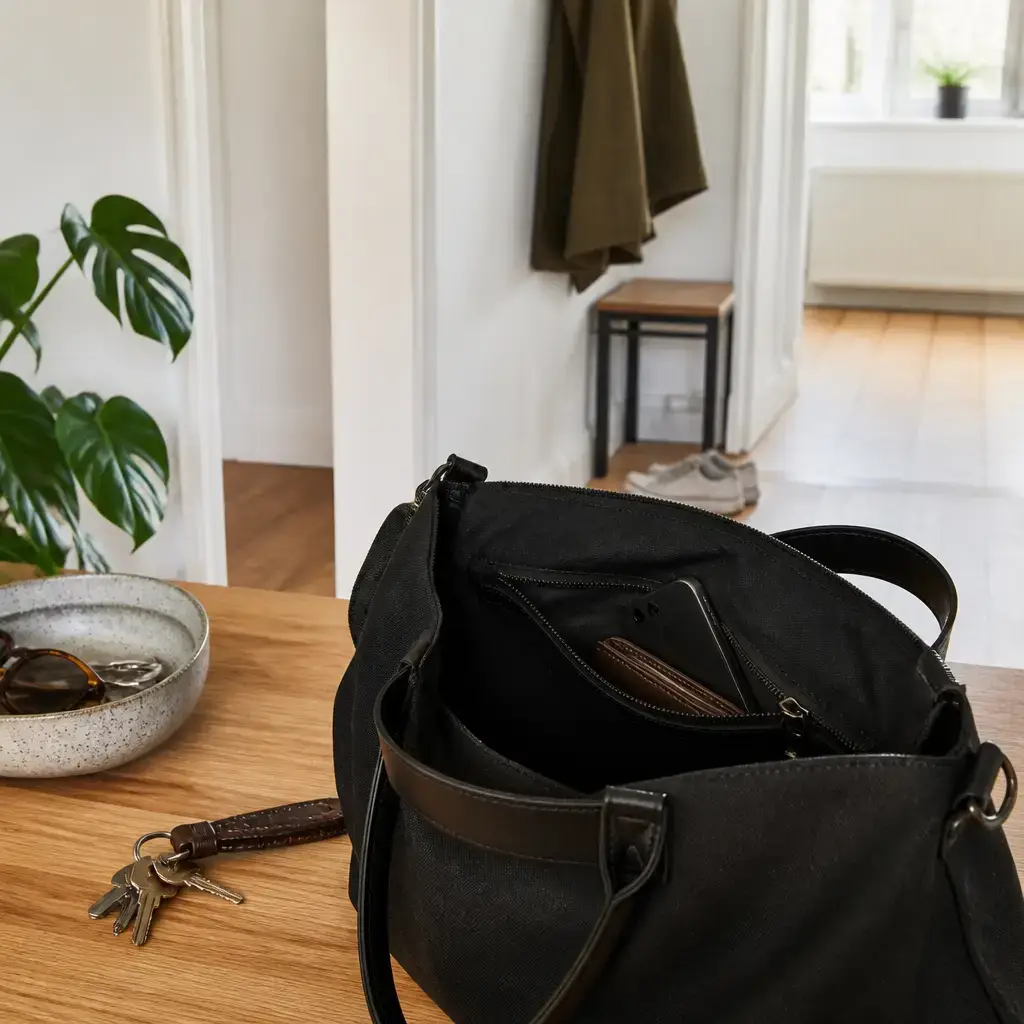
Use Keeping valuables safe in a bag to practice German conversation, pronunciation, vocabulary, grammar, and quizzes.
Dialogue
Wo soll ich mein Portemonnaie hinlegen?
voh zohl ikh mine port-moh-NAY hin-LAY-gen? Where should I put my wallet?Steck es in die Innentasche.
shtek ess in dee IN-en-tash-uh. Keep it in the inside pocket.Ist die Vordertasche sicher?
ist dee FOR-der-tash-uh ZIKH-er? Is the front pocket safe?Die Innentasche ist sicherer.
dee IN-en-tash-uh ist ZIKH-er-er. The inside one is safer.Ich kann den Reißverschluss schließen.
ikh kan dane RICE-fair-shlooss SHLEE-sen. I can close the zipper.Damit sollte es sicher sein.
DAH-mit ZOL-tuh ess ZIKH-er zine. That should keep it secure.Mein Handy ist auch darin.
mine HEN-dee ist owkh dah-RIN. My phone is in there too.Schau in die Tasche, bevor du gehst.
show in dee TASH-uh, beh-FOR doo gayst. Check the pocket before you go.Sentence explanations
Wo soll ich mein Portemonnaie hinlegen?
Where should I put my wallet?
- Wo
- where
- soll ich
- should I
- mein
- my
- Portemonnaie
- wallet
- hinlegen
- put down
More detail
Wo means “where” and asks for the place involved in the action. It is a question word for location; compare wo? “where?” with wohin? “where to?” when the destination or direction is the focus. soll ich combines sollen with ich. soll is the present-tense first-person singular form of sollen; here it asks what is advisable or expected for the speaker to do, matching “should I?” A reusable pattern is Wo soll ich ...? = “Where should I ...?” mein means “my.” It is the possessive form agreeing with the possessed noun in this phrase. Portemonnaie is neuter, and the neuter nominative and accusative forms of this possessive are both mein; the form therefore does not by itself show the case distinction here. For example, mein Buch can mean “my book” in either of those two cases, with the surrounding grammar showing the role. Portemonnaie means “wallet.” It is a noun and is capitalized in German. The spelling with -onnaie is a normal German form for this word; Geldbörse is another word for “wallet,” but it is not the form used in the sentence. hinlegen means “to put or lay something down.” It is a separable verb: in a main clause without a following infinitive, the directional part commonly separates, as in Ich lege das Buch hin (“I put the book down”). Here it remains together as the infinitive after the modal verb soll: soll ... hinlegen. The verb legen is used for placing something in a lying or flat position; stellen is commonly used for placing something upright. Together, Wo soll ich mein Portemonnaie hinlegen? asks for the place where the speaker should put down their wallet: “Where should I put my wallet?”
Steck es in die Innentasche.
Keep it in the inside pocket.
- Steck
- put
- es
- it
- in
- into
- Innentasche
- inside pocket
More detail
Steck is the imperative of stecken, used here as an instruction to place something somewhere. The implied subject is du (“you”); German normally leaves this subject out in a singular informal imperative. The useful pattern is Steck ...! = “Put ...!” or “Place ...!” Example: Steck das Buch in die Tasche. — “Put the book in the bag.” es is the accusative form of the neuter personal pronoun, “it,” and it is the direct object of steck. In the supplied exchange, the item being referred to is the wallet mentioned in the preceding question. The form es itself does not change for nominative and accusative: es can mean “it” as subject or object; its role here is shown by its position and by the verb’s meaning. in introduces the destination here. With movement into a destination, German uses the accusative: in die Innentasche. This contrasts with a static location, which uses the dative: Das Portemonnaie ist in der Innentasche. — “The wallet is in the inside pocket.” Innentasche is a feminine singular noun meaning “inside pocket.” It is a compound of innen (“inside”) and Tasche (“pocket” or “bag”), but the whole compound is the noun used here. Its definite article is die; in the accusative feminine singular, that article remains die: in die Innentasche. The noun itself is capitalized because German nouns are capitalized. Together, Steck es in die Innentasche gives the instruction to put or keep the item in the inside pocket: “Keep it in the inside pocket.”
Ist die Vordertasche sicher?
Is the front pocket safe?
- Ist
- is
- Vordertasche
- front pocket
- sicher
- safe
More detail
Ist is the third-person singular present form of sein (“to be”): sein → ist. In a yes/no question, the finite verb comes first, so Ist ...? corresponds to “Is ...?” This form agrees with a singular subject; it is not a separate question word. Vordertasche is a compound noun meaning “front pocket”: Vorder- identifies the front position, and Tasche means “pocket” or “bag,” depending on context. The compound is feminine because its head noun is Tasche; with an article, it would be die Vordertasche. German compounds are written as one word. Example: Die Vordertasche ist leer. — “The front pocket is empty.” Sicher means “safe” here. It is an adjective describing the pocket. Its comparative form is sicherer, as in the next sentence: Die Innentasche ist sicherer. — “The inside one is safer.” The base form is sicher; the comparative says that one thing is safer than another, while sicher alone does not make that comparison. Together, the question pattern Ist + singular subject + adjective? gives Ist die Vordertasche sicher? — “Is the front pocket safe?” The finite verb is placed first because this is a yes/no question, and sicher describes the safety of Vordertasche.
Die Innentasche ist sicherer.
The inside one is safer.
- Innentasche
- inside pocket
- sicherer
- safer
More detail
Innentasche means “inside pocket” here. It is a compound noun: Innen identifies the inside position, and Tasche means “pocket” or “bag” depending on context. The compound is feminine, so the definite article is die in Die Innentasche. As a noun, it is capitalized. Example: Die Innentasche ist groß. — “The inside pocket is large.” Die is the definite article for a singular feminine noun in the nominative role. Here it marks Innentasche as the subject of the statement. The article itself does not express the comparison; the comparison is carried by sicherer. sicherer means “safer” here. It is the comparative form of the adjective sicher: sicher — “safe/secure,” sicherer — “safer/more secure,” am sichersten — “safest/most secure.” Because sicherer is used after ist as a predicate adjective, it has no adjective ending in this sentence. Example: Diese Tasche ist sicherer. — “This pocket is safer.” The pattern is Die [noun] ist [comparative adjective]: “The [noun] is [comparative].” Die Innentasche supplies the subject, ist is the present-tense form of sein (“to be”) for a singular subject, and sicherer compares the inside pocket with an understood alternative. Together, Die Innentasche ist sicherer. means “The inside one is safer,” with Innentasche identifying what “the inside one” refers to.
Ich kann den Reißverschluss schließen.
I can close the zipper.
- Ich kann
- I can
- Reißverschluss
- zipper
- schließen
- close
More detail
Ich kann means “I can” here. können is the modal verb for ability or possibility; kann is its present-tense form for ich. With a modal verb, the other verb normally appears as an infinitive at the end: Ich kann ... schließen = “I can close ...”. Reißverschluss means “zipper”. It is a masculine noun: der Reißverschluss in the basic form. Here it appears as den Reißverschluss because it is the direct object of schließen; the masculine definite article changes from der to accusative den. The noun itself does not change in this phrase. schließen means “to close”. This is the infinitive form used after kann. Its useful present-tense forms include ich schließe (“I close”) and er/sie schließt (“he/she closes”); its past participle is geschlossen, as in hat geschlossen (“has closed”). Do not confuse schließen with öffnen (“to open”). Example: Ich schließe die Tür. — “I close the door.” Together, Ich kann + den Reißverschluss + schließen gives “I can close the zipper.” The modal kann expresses the speaker’s ability, den Reißverschluss is the thing being closed, and schließen remains at the end as the infinitive.
Damit sollte es sicher sein.
That should keep it secure.
- Damit
- with that
- sollte es
- it should
- sicher
- secure
- sein
- be
More detail
Damit means “with that” or “by doing that” here. It points back to closing the zipper. German also uses damit as a connector meaning “so that,” but that is a different use. In sollte es, sollte is a form of sollen that expresses an expected or tentative result here: “should.” sollen is the infinitive, soll is a present-tense form, and sollte is the form used in this sentence. es is a neuter third-person singular subject corresponding to “it” in the fixed translation; the sentence does not need to specify the noun again. Example: Das sollte funktionieren. — “That should work.” sicher is an adjective meaning “secure” in this sentence. It can also mean “safe” or “certain” in other contexts. A useful opposite is unsicher, meaning “insecure” or “uncertain,” depending on the context. sein is the infinitive “to be.” With a modal verb such as sollen, the modal verb is finite and the other verb remains in the infinitive. Here, sollte is in the second position of the main clause, while sein comes at the end: ... sollte ... sein. Together, Damit sollte es sicher sein means “With that, it should be secure” or, in the fixed natural translation, “That should keep it secure.” The utterance presents closing the zipper as the action expected to leave the relevant thing secure.
Mein Handy ist auch darin.
My phone is in there too.
- Mein
- my
- Handy
- mobile phone
- ist
- is
- auch
- too
- darin
- in there
More detail
Mein means “my” here and is the possessive determiner modifying Handy. Its form is tied to the noun’s grammatical features: Handy is neuter singular (das Handy), so the nominative form is mein. Compare meine Tasche (“my pocket/bag”), where the determiner has a different form. This does not itself state how many phones there are. Handy is the German noun for a mobile phone. Its base form is das Handy; the plural is die Handys. German nouns are capitalized. Example: Mein Handy ist neu. — “My phone is new.” ist is the third-person singular present form of sein (“to be”). The same form is used with singular er, sie, and es; the form changes with other subjects, for example Sie sind (“they are” or formal “you are”). auch adds “too” or “also” to the statement. Here it says that the phone shares the location expressed by darin with something already relevant in the context. Example: Ich bin auch dort. — “I am there too.” darin is a location word meaning “in there” or “inside it/that place.” It is formed from da plus in and avoids repeating the container or place when that location is understood. The fixed sentence identifies the location only as “there”; the following reference to checking the pocket supports a nearby-location reading, but the word itself does not name the container. Together, Mein Handy (“my phone”) is the subject, ist (“is”) states its location, auch (“too”) adds it to an already relevant set of things in that location, and darin (“in there”) supplies the location. The complete meaning is: “My phone is in there too.”
Schau in die Tasche, bevor du gehst.
Check the pocket before you go.
- Schau
- check; look
- Tasche
- bevor
- before
- gehst
- go
More detail
Schau is the informal singular imperative of schauen (“to look” or “to check”). It addresses one person as du; the subject is understood rather than stated. The form schau is useful for a direct instruction: Schau hier! means “Look here!” In this sentence, the intended action is checking, as confirmed by the translation. Tasche means “pocket” here. The fixed translation confirms this intended meaning. Its base form is die Tasche; Tasche is singular. In in die Tasche, the noun phrase is accusative because in expresses a direction or target. For this feminine noun, die Tasche looks the same in the nominative and accusative; the dative form is der Tasche: Das Handy ist in der Tasche. means “The phone is in the pocket.” bevor introduces a subordinate clause that places one event before another: “before …”. In the clause after bevor, German places the conjugated verb at the end. The reusable pattern is bevor + subject + ... + verb: Ruf mich an, bevor du gehst. means “Call me before you go.” gehst is the second-person singular present form of gehen (“to go”): du gehst. It is used with the subject du, which is stated in the subordinate clause. The present form can refer to a future action when the time is clear from context, as it is here. The related form du gehst differs from the imperative Geh!, which means “Go!” Together, Schau in die Tasche gives the instruction “Check the pocket,” with in die Tasche expressing looking or checking into that place. bevor du gehst adds the time relation “before you go.” The complete meaning is: “Check the pocket before you go.”
Grammar Points
sicher → sicherer
Die Innentasche ist sicherer.
dee IN-en-tash-uh ist ZIKH-er-er.The inside pocket is safer.
German forms the comparative by adding -er to many short adjectives: sicher → sicherer.
bevor + Nebensatz: Verb am Ende
Bevor du gehst, schau in die Tasche.
beh-FOR doo gayst, show in dee TASH-uh.Before you go, look in the bag.
In a clause with bevor, the conjugated verb goes to the end: du gehst.
German Vocabulary
Quiz
Word Order
Arrange the words in the correct order.
Where should I put my wallet?
Show Answer
Wo soll ich mein Portemonnaie hinlegen?Keep it in the inside pocket.
Show Answer
Steck es in die Innentasche.Is the front pocket safe?
Show Answer
Ist die Vordertasche sicher?Spelling
Tap the letters to spell the word.
to put down
Show Answer
hinlegensafer
Show Answer
sichererto put; to stick
Show Answer
Steckfront pocket