10 minutes free every day
Continue audio lessons in the app
Word explanations appear automatically in sync with the audio.
No login required · synced translations · playback with the screen locked
Choose your learning language and open this lesson in the app.

About This Lesson
Use Taking a short break to practice German conversation, pronunciation, vocabulary, grammar, and quizzes.
Dialogue
Ich bin müde.
ikh bin MUE-duh. I feel tired.Machen wir eine kurze Pause.
MAKH-en veer EYE-nuh KOORTS-uh POW-zuh. Let's take a short break.Ist dieser Stuhl frei?
ist DEE-zər shtool fry? Is this chair free?Du kannst hier sitzen.
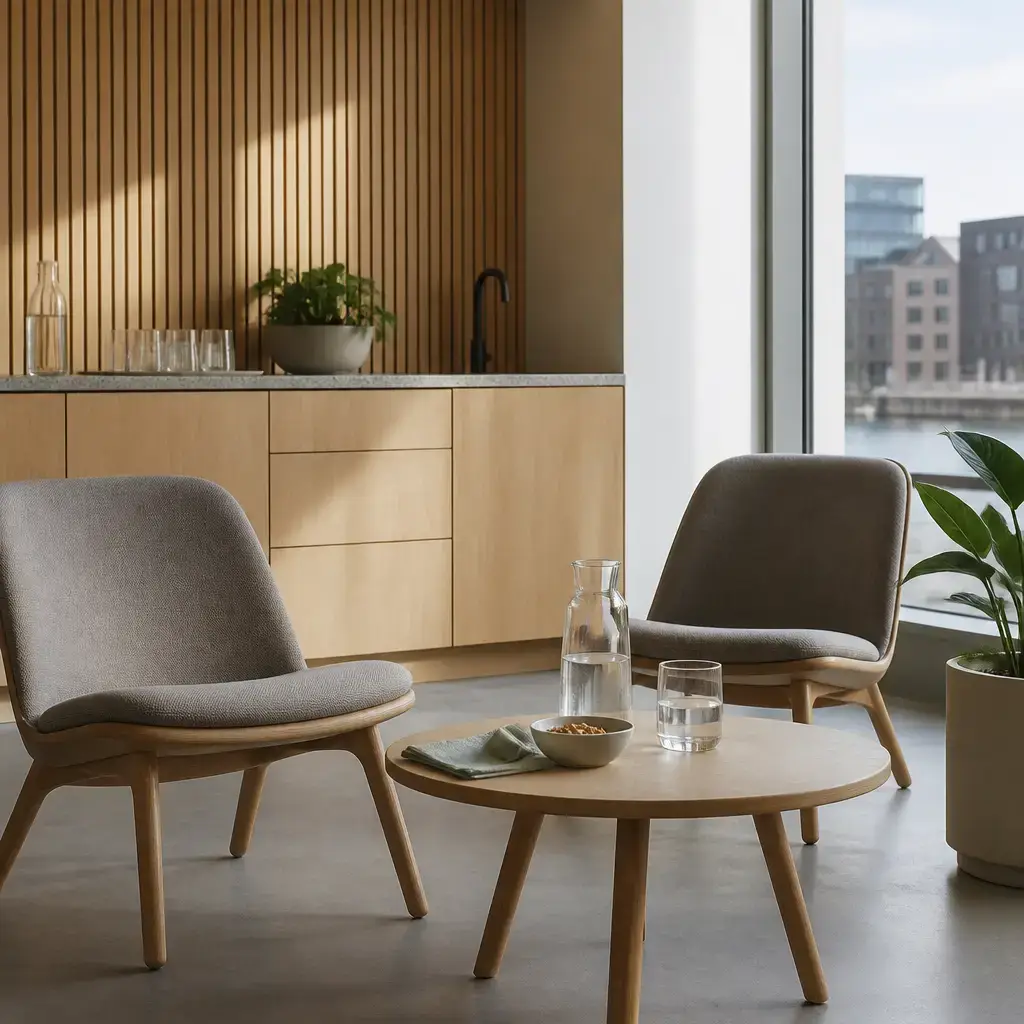
doo kanst heer SIT-tsen. You can sit here.Ich habe einen kleinen Snack für die Pause mitgebracht.
ikh HAH-buh EYE-nun KLYNE-nun snak fyoor dee POW-zuh MIT-guh-BRAKHt. I brought a small snack for the break.Ich hole etwas Wasser.
ikh HOH-luh ET-vahs VAH-ser. I'll get some water.Hier ist es ruhig.
heer ist es ROO-ikh. This place feels quiet.Dann können wir uns hier kurz ausruhen.
dahn KEU-nun veer oons heer koorts OWS-roo-en. Then we can rest here for a bit.Sentence explanations
Ich bin müde.
I feel tired.
- Ich bin
- I am
- müde
- tired
More detail
Ich bin means “I am.” Ich is the first-person singular subject pronoun, “I.” bin is the present-tense first-person singular form of sein (“to be”): ich bin, du bist, er/sie/es ist. German uses sein with a predicate adjective to describe a current state. müde means “tired.” It is an adjective. After sein, a predicate adjective such as müde does not take a gender or case ending: Ich bin müde is “I am tired.” Compare the useful opposite wach (“awake”): Ich bin wach means “I am awake.” Together, Ich bin + müde forms a present-tense statement about the speaker’s current state: literally “I am tired,” naturally translated here as “I feel tired.”
Machen wir eine kurze Pause.
Let's take a short break.
- Machen
- do or make
- wir
- we
- kurze
- short
- Pause
- break
More detail
Machen is a form of machen, “to do” or “to make”. In Machen wir ..., it is used in the first-person plural imperative, also called a hortative, to suggest an action: “Let’s ...”. With Pause, the whole expression eine Pause machen means “to take a break”. In an ordinary statement, the order changes: Wir machen eine Pause. — “We are taking a break.” wir means “we” and is the first-person plural subject. In Machen wir ..., the verb comes before the subject because this is the suggestion pattern. The sentence itself does not specify exactly who is included in “we”. kurze comes from the adjective kurz, “short”, and describes Pause. Its -e ending fits the feminine singular noun phrase eine kurze Pause in the accusative case. Useful comparison forms are kürzer (“shorter”) and am kürzesten (“shortest”). Example: Wir brauchen eine kurze Antwort. — “We need a short answer.” Pause means “break”. It is a feminine noun: die Pause; its plural is die Pausen. Here it is the noun in the expression eine kurze Pause machen. Example: Die Pause beginnt jetzt. — “The break starts now.” Together, Machen wir forms the reusable suggestion pattern “Let’s ...”, while eine kurze Pause names the proposed break. The complete utterance means “Let’s take a short break.”
Ist dieser Stuhl frei?
Is this chair free?
- Ist
- is
- dieser
- this
- Stuhl
- chair
- frei
- free / available
More detail
Ist is the third-person singular present form of sein (“to be”). In this utterance it appears first because German forms a yes/no question by placing the conjugated verb before the subject: Ist ...? means “Is ...?” The same form is used with er, sie, or es; the question structure, not the form alone, identifies the utterance as a question. dieser means “this” and points to one nearby or otherwise identifiable masculine singular noun. Here it agrees with Stuhl: der Stuhl is masculine singular, and dieser is the masculine singular nominative form used for the subject of the question. The related forms are diese for feminine singular and plural, and dieses for neuter singular. Example: Dieser Tisch ist frei. — “This table is available.” Stuhl means “chair.” Its base form is the singular noun Stuhl; its plural is Stühle (“chairs”), with an umlaut and the ending -e. In this sentence, Stuhl is the subject: the question asks about the chair’s status. Example: Der Stuhl ist bequem. — “The chair is comfortable.” frei means “free” here in the sense of “available” or “not occupied,” rather than necessarily “liberated.” As an adjective after sein, it does not receive an ending in this sentence: Der Stuhl ist frei. — “The chair is available.” Together, Ist places the verb first to make a yes/no question, dieser Stuhl identifies one particular chair, and frei asks about its availability. The complete meaning is “Is this chair free?”
Du kannst hier sitzen.
You can sit here.
- Du kannst
- you can
- hier
- here
- sitzen
- sit
More detail
Du kannst combines the informal singular subject du (“you”) with kannst, the second-person singular present form of können (“can; be able to”). In this sentence, kannst is the conjugated modal verb, while the other verb stays in the infinitive. Example: Du kannst kommen. — “You can come.” hier is a local adverb meaning “here,” referring to the place relevant in the situation. It can be moved for emphasis, for example Hier kannst du sitzen. — “Here you can sit.” sitzen is the infinitive meaning “to sit” or “to be seated.” German uses it after a modal such as können; the modal carries the person and tense, and sitzen remains unchanged. Example: Ich sitze hier. — “I am sitting here.” Together, Du kannst + hier + sitzen means “You can sit here.” The sentence presents sitting in this place as possible or allowed, without specifying which of those readings is intended beyond the fixed translation.
Ich habe einen kleinen Snack für die Pause mitgebracht.
I brought a small snack for the break.
- Ich habe
- I have
- einen
- a/an
- kleinen
- small
- Snack
- snack
- für
- for
- Pause
- break
- mitgebracht
- brought along
More detail
Ich habe begins a perfect-tense construction. Here habe is the first-person singular present form of haben, used as the auxiliary with mitgebracht; together with the final participle, it expresses a completed past action: “I brought …”. The subject is Ich (“I”). einen is the masculine accusative form of the indefinite article. It marks Snack as the direct object of bringing; it does not by itself assert a numerical count. The basic article forms include ein (masculine nominative or neuter nominative/accusative) and einen (masculine accusative). kleinen means “small” here. Its base form is the adjective klein; the ending -en appears because the adjective describes the masculine accusative noun phrase einen kleinen Snack. Example: Ich kaufe einen kleinen Kuchen. — “I am buying a small cake.” Snack is a masculine noun meaning a snack. German nouns are capitalized, and its masculine gender is reflected by einen and kleinen in this direct-object phrase. Example: Der Snack ist lecker. — “The snack is tasty.” für introduces what something is intended for and requires the accusative case. Example: Das Geschenk ist für meinen Bruder. — “The gift is for my brother.” Pause means “break” in this context. It is a feminine noun: die Pause; after accusative-marking für, the article would be die, so für die Pause means “for the break.” The noun itself has the same visible form in nominative and accusative singular. mitgebracht is the past participle of the separable verb mitbringen, “to bring along.” In the perfect, mitbringen combines with haben: Ich habe ... mitgebracht. The prefix mit- contributes the idea of bringing something along or with oneself. Example: Sie hat Kaffee mitgebracht. — “She brought coffee along.” The sentence is assembled as Ich habe + the direct object einen kleinen Snack + the purpose phrase für die Pause + the perfect participle mitgebracht. In this German perfect construction, the auxiliary appears early and the participle appears at the end, producing: “I brought a small snack for the break.”
Ich hole etwas Wasser.
I'll get some water.
- Ich
- I
- hole
- get
- etwas
- some
- Wasser
- water
More detail
Ich is the first-person singular pronoun meaning “I.” It is the subject here, so it is in the nominative case. The corresponding object form is mich, as in Sie sieht mich (“She sees me”); use ich for the person performing the action. hole is the first-person singular present-tense form of holen (“to get” or “to fetch”). The ending -e marks the ich form: ich hole, du holst, er/sie holt. In this sentence, the present form expresses the speaker’s intended immediate action, matching “I’ll get.” Example: Ich hole Kaffee. — “I’ll get coffee.” etwas means “some” here, referring to an unspecified amount. It can also mean “something” in other contexts, so its exact English rendering depends on what follows or on its role in the sentence. With a mass noun such as Wasser, it indicates an unspecified quantity rather than a precise amount. Example: Ich möchte etwas Brot. — “I’d like some bread.” Wasser means “water.” It is a neuter noun: das Wasser. German nouns are capitalized, and Wasser is normally treated as a mass noun when referring to water generally or to an unspecified amount. Example: Das Wasser ist kalt. — “The water is cold.” Together, Ich hole identifies the speaker as the person who will get something, while etwas Wasser names an unspecified amount of water. The complete utterance means “I’ll get some water.”
Hier ist es ruhig.
This place feels quiet.
- Hier
- here
- ist
- is
- es
- it
- ruhig
- quiet
More detail
Hier means “here” and locates the situation at the relevant place. It is an adverb, so it does not change for number or gender. Example: Hier ist Wasser. — “There is water here.” ist is the third-person singular present form of sein, “to be”: sein → ist. In this sentence it links the situation to the description that follows. Example: Der Raum ist ruhig. — “The room is quiet.” es is the impersonal subject in the pattern Hier ist es .... Here it does not identify a particular person or object as “it”; together with hier and ruhig, the pattern describes the conditions at this place. German uses this form even when no concrete noun is named as the subject. ruhig means “quiet” here. It is a predicative adjective after ist, so it has no adjective ending in this sentence. Its comparative is ruhiger, “quieter” or “calmer”: Hier ist es ruhiger. — “It is quieter here.” Together, Hier ist es ruhig. says that the conditions at this place are quiet, naturally rendered as “This place feels quiet.” The following context can refer back to this place with hier, but the sentence itself does not specify a more particular location.
Dann können wir uns hier kurz ausruhen.
Then we can rest here for a bit.
- Dann
- then
- können wir
- we can
- uns … ausruhen
- rest
- hier
- here
- kurz
- briefly; for a short while
More detail
Dann means “then” and links this sentence to a time or condition already understood: “Then …”. It is also useful in patterns such as Dann gehen wir. — “Then we’ll go.” können wir combines können (“can; be able to”) with wir (“we”). können is the modal verb; its present-tense forms include ich kann, du kannst, er/sie/es kann, wir können, and sie/Sie können. In this sentence, wir können expresses that the speakers have the possibility or are able to do something. With a modal verb, the other verb normally appears as an infinitive at the end: Wir können warten. — “We can wait.” uns belongs to the reflexive verb sich ausruhen, “to rest”. Here uns is the first-person plural reflexive pronoun referring back to wir; it shows that the group rests itself. The pronoun changes with the subject: ich ruhe mich aus, but wir ruhen uns aus. hier means “here”, referring to the place relevant in the conversation. It can be moved for emphasis without changing its basic location meaning: Hier können wir uns ausruhen. — “Here we can rest.” kurz modifies the resting activity here by limiting its duration: “for a short while”. It is the same adjective/adverb form as the adjective in eine kurze Pause (“a short break”); in this sentence it is used adverbially, without an ending. Compare Wir bleiben kurz. — “We’ll stay for a short while.” ausruhen is the infinitive of the separable reflexive verb sich ausruhen, “to rest”. In a finite clause without a modal, the prefix separates: Wir ruhen uns aus. — “We are resting.” After können, the complete infinitive stays together at the end: Wir können uns ausruhen. — “We can rest.” Together, Dann (“then”) + können wir (“we can”) + uns ... ausruhen (“rest”) + hier (“here”) + kurz (“for a short while”) gives: “Then we can rest here for a bit.” The modal construction places können in the ordinary finite-verb position and sends the complete infinitive ausruhen to the end.
Grammar Points
kurze Pause
kurze Pause
KOORTS-uh POW-zuhshort break
The adjective takes the ending -e before the feminine noun Pause.
sich ausruhen
ausruhen
OWS-roo-ento rest
This verb is reflexive: the pronoun changes with the subject, and the prefix remains part of the verb.
German Vocabulary
Ist dieser Stuhl frei?
Du kannst hier sitzen.
Ist dieser Stuhl frei?
Du kannst hier sitzen.
Ich habe einen kleinen Snack für die Pause mitgebracht.
Machen wir eine kurze Pause.
Machen wir eine kurze Pause.
Ich bin müde.
Machen wir eine kurze Pause.
Du kannst hier sitzen.
Ich habe einen kleinen Snack für die Pause mitgebracht.
Ist dieser Stuhl frei?
Quiz
Word Order
Arrange the words in the correct order.
I feel tired.
Show Answer
Ich bin müde.Let's take a short break.
Show Answer
Machen wir eine kurze Pause.Is this chair free?
Show Answer
Ist dieser Stuhl frei?Spelling
Tap the letters to spell the word.
this
Show Answer
dieserfree or available
Show Answer
freito take or make
Show Answer
Machenchair