10 minutes free every day
Continue audio lessons in the app
Word explanations appear automatically in sync with the audio.
No login required · synced translations · playback with the screen locked
Choose your learning language and open this lesson in the app.

About This Lesson
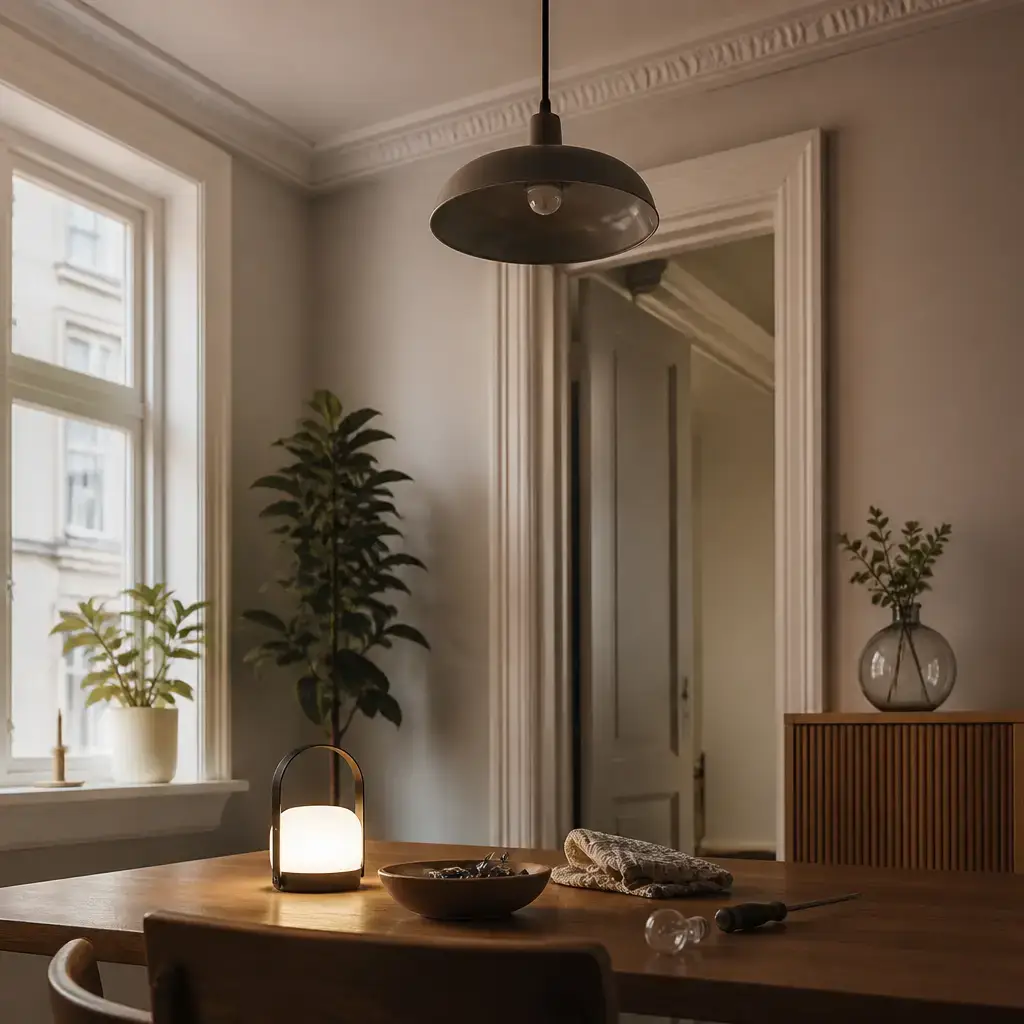
Use Fixing a Light Problem to practice German conversation, pronunciation, vocabulary, grammar, and quizzes.
Dialogue
Das Licht funktioniert nicht.
DAHS LIHkht foonk-tsee-oh-NEERT NIHkht. The light does not work.Hast du den Schalter überprüft?
HAHST doo dehn SHAL-ter oo-ber-PRUEFT? Did you check the switch?Ich habe ihn überprüft, und es funktioniert immer noch nicht.
ikh HAH-buh een oo-ber-PRUEFT, oont ess foonk-tsee-oh-NEERT IM-er nohkh NIHkht. I checked it, and it still does not work.Vielleicht ist die Glühbirne alt.
FEE-LIE-kht ihst dee GLUE-bir-nuh ahlt. Maybe the bulb is old.Der Raum ist jetzt zu dunkel.
dayr ROWM ihst YETST tsoo DOON-kuhl. The room is too dark now.Ich kann eine kleine Lampe holen.
ikh kahn EYE-nuh KLY-nuh LAHM-puh HOH-len. I can bring a small lamp.Wir sollten die Glühbirne später wechseln.
veer SHOLL-ten dee GLUE-bir-nuh SHPAY-ter VEK-seln. We should change the bulb later.Benutze die Lampe, bis wir die Glühbirne ersetzen.
beh-NOOT-suh dee LAHM-puh, bihs veer dee GLUE-bir-nuh ehr-SET-sen. Use the lamp until we replace it.Sentence explanations
Das Licht funktioniert nicht.
The light does not work.
- Das
- the
- Licht
- light
- funktioniert
- works
- nicht
- not
More detail
Das is the definite article meaning “the” here. It is nominative singular neuter because it accompanies Licht, a neuter noun. The article must match the noun’s gender, number, and case; for example, Das Fenster means “the window.” Licht means “light.” Its base form is Licht; the plural is Lichter when referring to separate lights. In this sentence it is the subject: the light is the thing whose functioning is being described. funktioniert means “works” or “functions” here. It is the third-person singular present form of funktionieren: ich funktioniere, du funktionierst, es funktioniert. The present form can describe a current condition, so Das Licht funktioniert means “The light works.” nicht negates the statement. Placed after funktioniert here, it changes “works” into “does not work.” In a different sentence, its position can vary depending on what is being negated, but here the whole statement about the light’s functioning is negated. Together, Das Licht (“the light”) is the subject, funktioniert says that it functions, and nicht reverses that statement. The complete meaning is: “The light does not work.”
Hast du den Schalter überprüft?
Did you check the switch?
- Hast du
- did you
- Schalter
- switch
- überprüft
- checked
More detail
Hast du combines the present-tense form hast of haben with the subject pronoun du. In this question, haben is used as the auxiliary for the perfect tense; the past participle appears at the end. Compare the reusable pattern Hast du ...? — “Did you ...?” or, more literally, “Have you ...?” depending on context. Example: Hast du das gesehen? — “Did you see that?” Schalter means “switch” here. It is a masculine noun: der Schalter in the basic form, and den Schalter in this sentence because it is the direct object of the checking. The article, rather than the noun itself, clearly shows the masculine accusative form here. Example: Ich kaufe den Schalter. — “I am buying the switch.” überprüft is the past participle of überprüfen, “to check” or “to inspect.” With hast du, it forms the German perfect: du hast überprüft — “you checked” or “you have checked.” The form überprüft is used with haben in this sentence; it does not itself show the person. Example: Sie hat die Tür überprüft. — “She checked the door.” Together, Hast du den Schalter überprüft? asks whether the listener checked the switch. The question uses the perfect construction hast ... überprüft, with hast du at the beginning and the participle at the end, while den Schalter identifies what was checked.
Ich habe ihn überprüft, und es funktioniert immer noch nicht.
I checked it, and it still does not work.
- Ich habe
- I have
- ihn
- it
- überprüft
- checked
- funktioniert
- works
- immer noch
- still
- nicht
- not
More detail
Ich habe contains the subject Ich (“I”) and habe, the first-person singular present form of haben. Here habe is an auxiliary: together with the later participle überprüft, it forms the German perfect tense for a completed past action. ihn is the masculine accusative form of er (“he/it” for a masculine noun). In this context, the preceding question identifies the checked item as der Schalter (“the switch”), so ihn refers to that item. German pronoun form reflects the noun’s grammatical gender and its role as the direct object; it does not mean that the item is male. überprüft is the participle of überprüfen (“to check” or “to inspect”). With haben, it expresses the completed checking action: Ich habe den Schalter überprüft. — “I checked the switch.” funktioniert comes from funktionieren (“to work” or “to function”). It is the present-tense third-person singular form, matching the subject es. The present tense presents the state as current. Example: Der Motor funktioniert. — “The engine works.” immer noch means that a situation continues despite the expectation or possibility of change. Es funktioniert immer noch. means “It still works,” while in this sentence the later negation makes the combined meaning “It still does not work.” Example: Es regnet immer noch. — “It is still raining.” nicht is the negation word. Here it negates the clause headed by funktioniert, so es funktioniert nicht means “it does not work.” Es is the grammatical subject of this second clause; the supplied translation supports an inanimate “it,” but does not require identifying that referent more specifically. The first clause assembles as Ich habe ihn überprüft: “I checked it,” with the perfect-tense auxiliary near the beginning and the participle at the end. The conjunction und links it to the second clause, es funktioniert immer noch nicht: “it still does not work.” Together, the utterance means “I checked it, and it still does not work.” The wording is neutral and suitable for ordinary troubleshooting.
Vielleicht ist die Glühbirne alt.
Maybe the bulb is old.
- Vielleicht
- maybe
- ist
- is
- die Glühbirne
- the bulb
- alt
- old
More detail
Vielleicht means “maybe” and marks the whole statement as uncertain. It commonly appears at the beginning, as here, but can also occur in other positions depending on what is being highlighted. Example: Vielleicht kommt er morgen. — “Maybe he is coming tomorrow.” ist is the present-tense third-person singular form of sein, “to be.” The useful present-tense pattern is ich bin, du bist, er/sie/es ist, wir/sie/Sie sind, and ihr seid; the form is chosen here because die Glühbirne is singular and is the subject. Sein is irregular, so these forms cannot be formed by adding a regular ending. die Glühbirne means “the bulb,” specifically a light bulb. Glühbirne is a feminine noun, so its singular definite article is die; its plural is die Glühbirnen. The article identifies the noun as definite, while the noun itself supplies the meaning “bulb.” alt means “old.” Its base form is already alt; in this sentence it is a predicative adjective after sein, so it has no adjective ending: Die Glühbirne ist alt. In an attributive phrase, the ending changes according to the surrounding grammar: eine alte Glühbirne — “an old bulb.” The opposite is neu, “new.” Together, die Glühbirne ist alt says “the bulb is old,” and Vielleicht makes that assessment tentative. Thus the complete utterance means “Maybe the bulb is old.”
Der Raum ist jetzt zu dunkel.
The room is too dark now.
- Raum
- room
- ist
- is
- jetzt
- now
- zu dunkel
- too dark
More detail
Raum means “room” here. The noun’s base form is Raum; der Raum is its masculine singular citation form. In this sentence, der marks masculine singular nominative because Raum is the subject. The plural is die Räume. Example: Der Raum ist groß. — “The room is large.” ist is the third-person singular present form of sein (“to be”). It agrees with the singular subject Der Raum. Useful present-tense forms include ich bin, du bist, and er/sie/es ist. Example: Die Lampe ist alt. — “The lamp is old.” jetzt means “now” and places the situation at the present time. Example: Jetzt ist es hell. — “Now it is bright.” zu dunkel describes excessive darkness. dunkel means “dark,” and zu before an adjective means “too,” indicating that the degree exceeds what is suitable or wanted here. The adjective dunkel has the comparative dunkler (“darker”) and the superlative am dunkelsten (“darkest”). Example: Der Raum ist zu klein. — “The room is too small.” Together, Der Raum is the subject, ist states its condition, jetzt specifies the time, and zu dunkel describes an excessive degree of darkness. The whole utterance means: “The room is too dark now.”
Ich kann eine kleine Lampe holen.
I can bring a small lamp.
- Ich kann
- I can
- kleine
- small
- Lampe
- lamp
- holen
- bring
More detail
Ich kann combines the subject Ich (“I”) with the first-person singular present form kann of können (“can, be able to”). In this sentence, kann expresses ability or possibility. A useful pattern is Ich kann + infinitive: Ich kann warten. — “I can wait.” The modal verb is followed by the other verb in its infinitive form at the end of the clause. kleine means “small” here. It is the adjective klein with an ending required by its position: it describes the feminine singular noun Lampe in the accusative noun phrase eine kleine Lampe. Compare eine kleine Lampe (“a small lamp”) with eine große Lampe (“a large lamp”). The adjective’s base form is klein; kleine is not a form of the noun. Lampe means “lamp.” It is a feminine noun: die Lampe (“the lamp”). After eine in this sentence, the noun phrase is accusative because it is the thing being brought, but the noun itself has no visible ending change here: eine Lampe can mean “a lamp” in this form. Example: Die Lampe ist klein. — “The lamp is small.” holen means “to fetch” or “to get and bring.” It is the infinitive used after the modal verb kann. In Ich kann eine kleine Lampe holen, the intended meaning is that the speaker can bring a small lamp. Example: Ich hole Wasser. — “I fetch water” or “I get water.” Together, Ich kann gives the speaker’s ability, eine kleine Lampe identifies the object, and holen supplies the action. The German sentence therefore means “I can bring a small lamp.”
Wir sollten die Glühbirne später wechseln.
We should change the bulb later.
- Wir sollten
- we should
- Glühbirne
- bulb
- später
- later
- wechseln
- change; replace
More detail
Wir sollten means “we should.” Wir is the first-person plural pronoun, referring here to the speaker together with at least one other person. sollten is the form of sollen used with wir; in this sentence it expresses a recommendation or expected action, not a firm command. With a modal verb such as sollen, the other verb stays in the infinitive and comes later in the clause. Example: Wir sollten gehen. — “We should go.” Glühbirne means “bulb,” specifically the light bulb being discussed. It is a feminine noun: die Glühbirne; the article and other surrounding forms can show this gender in contexts where they inflect. The plural is Glühbirnen. Example: Die Glühbirne ist kaputt. — “The bulb is broken.” später is the temporal adverb “later.” It places the suggested action after the current time without specifying exactly when. Example: Wir sprechen später. — “We’ll talk later.” wechseln is the infinitive “to change” or “to replace.” With a bulb as its object, it means replacing the old bulb with another one. The form after sollten is the infinitive; a finite present-tense form would be wir wechseln (“we change” / “we are changing”). Example: Wir wechseln die Batterie. — “We replace the battery.” Together, Wir sollten expresses the recommendation, die Glühbirne identifies the object, später gives the time, and wechseln supplies the recommended action. The whole utterance therefore means: “We should change the bulb later.”
Benutze die Lampe, bis wir die Glühbirne ersetzen.
Use the lamp until we replace it.
- Benutze
- use
- Lampe
- lamp
- bis wir
- until we
- Glühbirne
- light bulb
- ersetzen
- replace
More detail
Benutze is the imperative form of benutzen (“to use”) for one person addressed informally with du. The infinitive is benutzen; the present-tense du form is also benutzt, but the imperative uses Benutze here. Example: Benutze den Schlüssel. — “Use the key.” Lampe means “lamp.” Its definite article in the utterance is die: die Lampe means “the lamp.” The noun is feminine in German, so this article form is required in the nominative and accusative singular. Here it is the object being used. bis wir introduces the endpoint “until we …”. bis starts a subordinate clause, and wir is the first-person plural pronoun “we.” In that clause, the finite verb normally goes to the end. Example: Warte, bis wir kommen. — “Wait until we come.” Glühbirne means “light bulb” or “bulb.” With die, die Glühbirne is the accusative singular object of ersetzen; the noun is feminine, and its form does not change here between nominative and accusative singular. The previous context also mentions this bulb, supporting the fixed translation’s “it.” ersetzen means “to replace.” It is the infinitive form, placed at the end of the subordinate clause after bis: bis wir die Glühbirne ersetzen. The subject is wir, so the finite present form would be wir ersetzen; the infinitive has the same visible form here. Example: Wir ersetzen die Batterie. — “We replace the battery.” Together, Benutze die Lampe gives the informal command “Use the lamp.” bis wir die Glühbirne ersetzen adds the time limit: continue doing so until we replace the bulb. The complete meaning is “Use the lamp until we replace it.”
Grammar Points
Verb + nicht
Das Licht funktioniert nicht.
DAHS LIHkht foonk-tsee-oh-NEERT NIHkht.The light does not work.
In a German main clause, nicht usually comes after the conjugated verb when negating the verb.
Imperativ für du: Benutze!
Benutze die kleine Lampe.
beh-NOOT-suh dee KLY-nuh LAHM-puh.Use the small lamp.
The informal singular imperative often drops -st: benutzen becomes Benutze.
German Vocabulary
Quiz
Word Order
Arrange the words in the correct order.
The light does not work.
Show Answer
Das Licht funktioniert nicht.Did you check the switch?
Show Answer
Hast du den Schalter überprüft?Maybe the bulb is old.
Show Answer
Vielleicht ist die Glühbirne alt.Spelling
Tap the letters to spell the word.
not
Show Answer
nichtto check
Show Answer
überprüftswitch
Show Answer
Schaltermaybe