10 minutes free every day
Continue audio lessons in the app
Word explanations appear automatically in sync with the audio.
No login required · synced translations · playback with the screen locked
Choose your learning language and open this lesson in the app.

About This Lesson
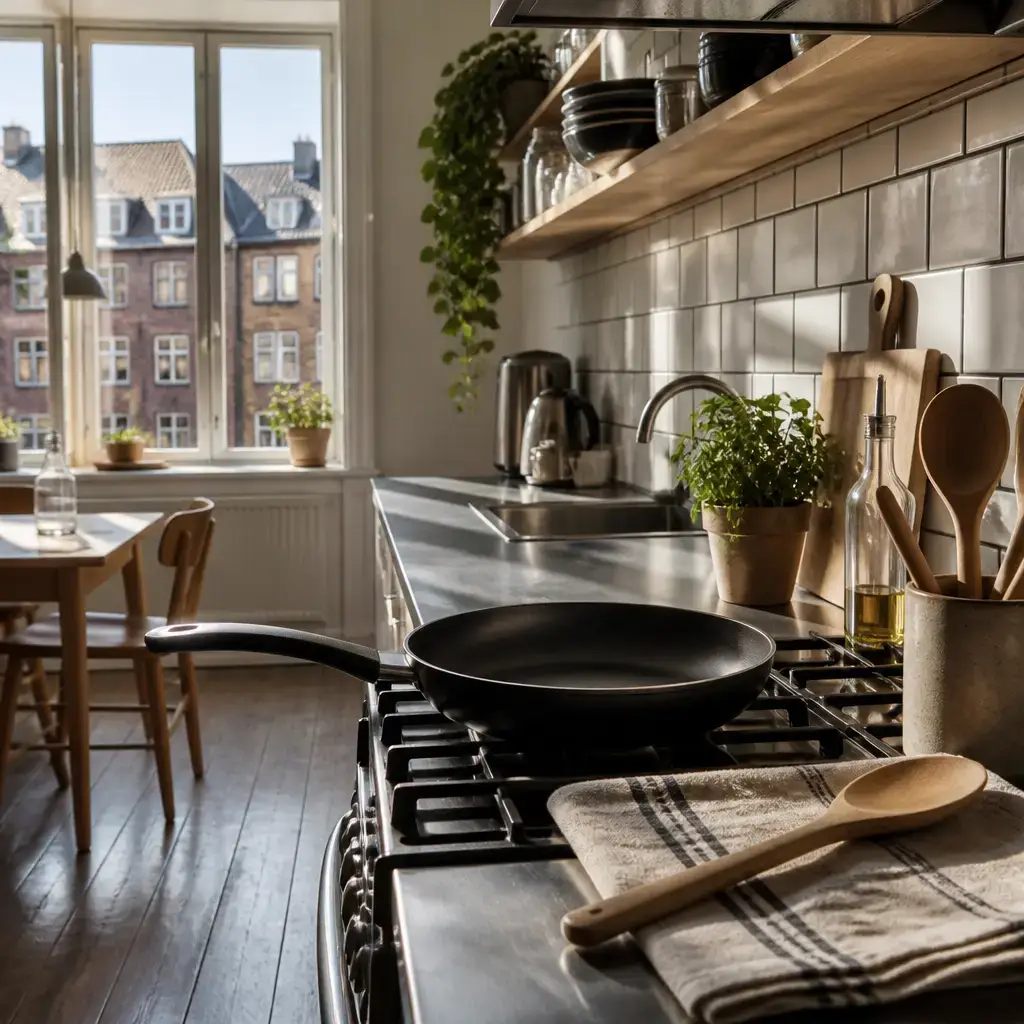
Use Borrowing and caring for a non-stick pan to practice German conversation, pronunciation, vocabulary, grammar, and quizzes.
Dialogue
Kann ich mir deine beschichtete Pfanne für etwas leihen, das ich gerade koche?
KAHN ikh meer DYE-nuh beh-SHIKH-tuh-tuh PFAH-nuh fyoor ET-vahs LYE-en, dahs ikh guh-RAH-duh KOKH-uh? Can I borrow your non-stick pan for something I am cooking?Ja, aber bitte benutze keine Metallutensilien darin.
YAH, AH-ber BIT-tuh beh-NOOT-suh KYE-nuh meh-TAHL-oo-ten-ZEE-lee-en dah-RIN. You can, but please do not use metal utensils on it.Ich werde einen Holzlöffel benutzen, damit ich die Oberfläche nicht zerkratze.
ikh VAIR-duh AYE-nen HOLTS-luh-fuhl beh-NOOT-tsen, dah-MIT ikh dee OH-ber-FLEH-khuh nikht tsair-KRATS-uh. I will use a wooden spoon so I do not scratch the surface.Halte die Hitze auch auf mittlerer Stufe, denn hohe Hitze kann die Beschichtung beschädigen.
HAL-tuh dee HIT-suh owkh owf MIT-luh-rer SHTOO-fuh, den HOH-uh HIT-suh kahn dee beh-SHIKH-toong beh-SHAY-dee-gen. Keep the heat at medium too, because high heat can damage the coating.Ich frage lieber jetzt, als zu raten und die Pfanne zu ruinieren.
ikh FRAH-guh LEE-ber YETST, als tsoo RAH-ten oont dee PFAH-nuh tsoo roo-ee-NEE-ren. I would rather ask now than guess and ruin it.Das hilft. Sie sollte länger halten, wenn man vorsichtig mit ihr umgeht.
dahs hilft. zee ZOL-tuh LENG-er HAL-ten, ven mahn FOR-zikh-tikh mit eer OOM-gayt. That helps. It should last longer if it is handled carefully.Soll ich sie von Hand abwaschen, statt sie in die Spülmaschine zu tun?
ZOL ikh zee fon HAHNT AHP-vah-shen, shtat zee in dee SHPOOL-mah-SHEE-nuh tsoo toon? Should I wash it by hand instead of putting it in the dishwasher?Wasch sie vorsichtig von Hand und trockne sie ab, bevor du sie zurückbringst.
VAHSH zee FOR-zikh-tikh fon HAHNT oont TROK-nuh zee AHP, beh-FOHR doo zee tsoo-ROOK-bringst. Wash it gently by hand and dry it before you bring it back.Ich bringe sie sauber zurück, nachdem ich mit dem Kochen fertig bin.
ikh BRING-uh zee ZOW-ber tsoo-ROOK, nahkh-DAYM ikh mit daym KOKH-en FERT-ikh bin. I will return it clean after I finish cooking.Sag mir, wie das Gericht geworden ist.
zahk meer, vee dahs guh-RIKHT guh-VOR-den ist. Let me know how the dish turns out.Sentence explanations
Kann ich mir deine beschichtete Pfanne für etwas leihen, das ich gerade koche?
Can I borrow your non-stick pan for something I am cooking?
- Kann ich
- Can I
- beschichtete
- non-stick, coated
- Pfanne
- pan
- leihen
- borrow
- etwas
- something
- koche
- am cooking
More detail
Kann ich starts a yes/no question: the conjugated verb kann comes before the subject ich, giving “can I…?”. können is the base form; kann is its present-tense form for ich and also for er/sie/es. In the complete question, the infinitive leihen goes to the end because it depends on kann. beschichtete describes the pan as coated, here meaning non-stick. Its base form is beschichtet. It is an adjective placed before the noun and has the ending -e in this phrase because it accompanies the feminine singular noun Pfanne after the possessive determiner deine. This ending is part of the adjective’s inflection, not of the noun. Pfanne means “pan” and is a feminine noun: die Pfanne. In this sentence it is the thing being borrowed. Example: Die Pfanne ist heiß. — “The pan is hot.” leihen is the infinitive meaning “borrow” in the construction sich etwas leihen, literally borrowing something for oneself. The dative reflexive form mir in the full sentence shows the borrower: ich leihe mir eine Pfanne — “I borrow a pan.” leihen can also mean “lend” in a different construction, such as Ich leihe dir die Pfanne — “I lend you the pan.” etwas is an indefinite pronoun meaning “something” here. It introduces an unspecified thing, which is described by the relative clause das ich gerade koche. Here das refers back to that unspecified thing and means “that/which.” koche is the first-person singular present form of kochen, “to cook.” The present tense can describe an activity happening now, so ich koche can mean “I cook” or “I am cooking,” depending on context. gerade adds “currently/right now.” Because das ich gerade koche is a relative clause, its conjugated verb koche appears at the end. Together, Kann ich mir deine beschichtete Pfanne ... leihen? asks whether the speaker may borrow the listener’s non-stick pan. für etwas, das ich gerade koche specifies the purpose: the pan is wanted for something the speaker is currently cooking. A reusable pattern is Kann ich mir deine/deinen/dein [thing] für [purpose] leihen? — “Can I borrow your [thing] for [purpose]?” The choice among deine, deinen, and dein depends on the borrowed noun’s grammatical gender and its accusative form: feminine, masculine, and neuter respectively.
Ja, aber bitte benutze keine Metallutensilien darin.
You can, but please do not use metal utensils on it.
- Ja
- yes
- aber
- but
- bitte
- please
- benutze
- use
- keine
- no
- Metallutensilien
- metal utensils
- darin
- in it; here, on it
More detail
Ja agrees to the preceding request. In this context, the agreement means that the other person may borrow and use the pan; it is not merely an isolated yes/no vocabulary item. aber introduces a restriction or contrast: permission is followed by a restriction. A reusable pattern is Ja, aber ... — “Yes, but ...”. bitte makes the following request polite. It can occur with an imperative, as here, without changing who is being addressed. benutze is the informal singular imperative of benutzen (“to use”), addressed to one person. The imperative directly requests an action. For example: Benutze den Holzlöffel. — “Use the wooden spoon.” keine is the negative determiner used here with the plural noun Metallutensilien. Here it is the accusative plural form, which has the same shape as the nominative plural. Compare keine Metallutensilien (“no metal utensils”) with keinen Metalllöffel (“no metal spoon”), where the determiner form changes because the noun phrase is masculine singular accusative. Metallutensilien is a plural noun meaning “metal utensils.” The compound combines Metall (“metal”) with Utensilien (“utensils”); the whole compound, not benutze, names the things being used. The singular is das Metallutensil (“the metal utensil”). darin is a pronominal adverb whose literal meaning is “in it.” In this fixed sentence, the translation renders the practical location as “on it,” referring to the non-stick pan from the preceding sentence. Thus, do not learn darin itself as a general equivalent of English “on it”; its observed form contains da(r)- plus in and points to an understood object without naming it again. Together, Ja, aber grants permission while adding a restriction; bitte benutze keine Metallutensilien politely tells one person not to use metal utensils; and darin locates that restriction with respect to the pan. The complete meaning is: “You can, but please do not use metal utensils on it.”
Ich werde einen Holzlöffel benutzen, damit ich die Oberfläche nicht zerkratze.
I will use a wooden spoon so I do not scratch the surface.
- Ich werde
- I will
- Holzlöffel
- wooden spoon
- benutzen
- use
- damit ich
- so that I
- Oberfläche
- surface
- nicht
- not
- zerkratze
- scratch
More detail
Ich werde means “I will” here. werde is the first-person singular present form of werden, used with an infinitive to express a future action: Ich werde ... benutzen = “I will use ...”. The subject form ich is for the speaker; other persons use forms such as du wirst and sie wird. Holzlöffel means “wooden spoon.” It is a compound noun: Holz means “wood” and Löffel means “spoon.” In German, the final part of a compound is the main noun, so der Löffel determines its masculine gender. In the sentence, einen Holzlöffel is the object of benutzen; the indefinite article has the masculine accusative form einen. benutzen means “to use.” This is the infinitive after werde; the finite verb werde carries the person and tense, while benutzen remains in its infinitive form. Example: Ich benutze einen Löffel. — “I use a spoon.” damit ich introduces a purpose clause, “so that I” or “in order that I.” The clause has its own subject, ich, and its finite verb moves to the end: damit ich ... zerkratze. This construction states the intended purpose of using the wooden spoon. Oberfläche means “surface.” The noun is feminine: die Oberfläche; in this sentence, die Oberfläche is the thing that could be scratched. The word can refer to the outer surface of an object, not only to a flat area. nicht means “not.” Here it negates the verb phrase in the purpose clause, so the intended result is that the speaker does not scratch the surface. Its exact scope comes from the surrounding clause: damit ich die Oberfläche nicht zerkratze. zerkratze means “scratch” in this sentence, specifically “scratch” as the first-person singular present form of zerkratzen. Its base form is zerkratzen; the prefix zer- is part of the verb. In the damit clause, the verb is finite and appears at the end: ich zerkratze. Example: Ich zerkratze den Tisch nicht. — “I do not scratch the table.” Together, Ich werde einen Holzlöffel benutzen says “I will use a wooden spoon.” The purpose clause damit ich die Oberfläche nicht zerkratze says “so that I do not scratch the surface.” The complete utterance therefore means: “I will use a wooden spoon so I do not scratch the surface.”
Halte die Hitze auch auf mittlerer Stufe, denn hohe Hitze kann die Beschichtung beschädigen.
Keep the heat at medium too, because high heat can damage the coating.
- Halte
- keep; maintain
- die Hitze
- the heat
- auch
- also; too
- mittlerer
- medium
- Stufe
- setting; level
- denn
- because
- hohe
- high
- kann
- can
- die Beschichtung
- the coating
- beschädigen
- damage
More detail
Halte is the singular informal imperative of halten (“to keep/hold”). The subject du is understood rather than spoken. This form gives a direct instruction: Halte die Tür geschlossen. — “Keep the door closed.” die Hitze means “the heat.” Hitze is a feminine noun, and die is its definite article here. The phrase refers to the heat level being maintained, not to a separate action of heating. auch adds “too” or “also.” Here it adds this instruction to the surrounding advice; it does not mean “even” in the sense of an unexpected extreme. mittlerer is the adjective mittel (“medium”) with a feminine dative singular ending. The ending is visible because Stufe is feminine and auf mittlerer Stufe describes a state or setting. Compare the basic forms mittel, mittlere, and mittlerer: the ending changes with the grammatical conditions, not because the meaning changes. Stufe means “setting” or “level.” In auf mittlerer Stufe, it names the level at which the heat should remain. Example: Der Herd läuft auf niedriger Stufe. — “The stove is on a low setting.” denn means “because” and introduces the reason for the instruction. Unlike a subordinating conjunction such as weil, denn connects two main-clause-like structures, so the following clause keeps ordinary main-clause word order. hohe is the inflected form of hoch (“high”). It describes Hitze and has a feminine nominative singular ending because hohe Hitze is the subject of the clause. The comparison chain is hoch — “high,” höher — “higher,” am höchsten — “highest.” kann is the third-person singular present form of the modal verb können (“can; be able to”). With a non-human subject such as hohe Hitze, it expresses possibility or potential: the high heat can cause damage, without asserting that damage will certainly occur. die Beschichtung means “the coating.” It is a feminine noun with the definite article die. The related verb beschichten means “to coat,” while Beschichtung names the coating itself; the observed sentence uses the noun as the object of the damage. beschädigen is the infinitive “to damage.” After the modal kann, the lexical verb remains in the infinitive and appears at the end of the clause. Example: Scharfe Kanten können die Beschichtung beschädigen. — “Sharp edges can damage the coating.” Together, the instruction tells the listener to keep the heat at a medium setting. denn then gives the reason: high heat has the potential to damage the coating.
Ich frage lieber jetzt, als zu raten und die Pfanne zu ruinieren.
I would rather ask now than guess and ruin it.
- frage
- ask
- lieber
- rather
- jetzt
- now
- zu raten
- to guess
- die Pfanne
- the frying pan
- zu ruinieren
- to ruin
More detail
frage is the first-person singular present form of fragen (“to ask”). With Ich, it means “I ask” here. Example: Ich frage den Lehrer. — “I ask the teacher.” lieber means “rather” and expresses preference. In this use, it is the comparative form of gern, not of lieb; the useful preference chain is gern (“gladly”), lieber (“rather”), and am liebsten (“most preferably”). The pattern lieber ... als ... means “rather ... than ...”. jetzt means “now” and places the asking at the present time. Example: Ich beginne jetzt. — “I am starting now.” zu raten is the infinitive of raten, used here with the meaning “to guess.” The form zu raten is an infinitive with zu; in this sentence it names the less-preferred alternative to asking. raten can have other meanings in other contexts, including “to advise,” but the fixed translation supports “guess” here. die Pfanne means “the frying pan.” Pfanne is a feminine noun, and die is its feminine singular definite article here. In die Pfanne zu ruinieren, the noun is the object of ruinieren, so the phrase is accusative; for this feminine singular noun, nominative and accusative both use die. Example: Ich benutze die Pfanne. — “I use the frying pan.” zu ruinieren is the infinitive of ruinieren, “to ruin.” It is another zu-infinitive and is coordinated with zu raten by und. The understood subject of both infinitives is Ich: the speaker would rather ask than guess and ruin the frying pan. The structure is Ich frage lieber jetzt, als zu raten und die Pfanne zu ruinieren. The main clause says “I would rather ask now.” The comparison introduced by als gives the less-preferred alternative: guessing and ruining the frying pan. Together, the sentence means: “I would rather ask now than guess and ruin it,” with “it” corresponding to the frying pan identified in the German sentence.
Das hilft. Sie sollte länger halten, wenn man vorsichtig mit ihr umgeht.
That helps. It should last longer if it is handled carefully.
- Das
- That
- hilft
- helps
- Sie
- it
- sollte
- should
- länger
- longer
- halten
- last
- wenn
- if
- man
- one
- vorsichtig
- carefully
- mit ihr
- with it
- umgeht
- handles
More detail
Das is a demonstrative pronoun meaning “that” here. Its grammatical form is neuter singular; the sentence uses it to point to the matter being discussed, without naming that matter again. hilft comes from helfen (“to help”). It is the present-tense form for a singular subject: Das hilft = “That helps.” Sie means “it” here and is a feminine singular pronoun. In the supplied context, it refers to the frying pan (die Pfanne), and the translation confirms this intended reading. Sentence-initial capitalization does not change its grammatical role; in other contexts, Sie can also be the formal “you.” sollte is the form of sollen used here for “should.” In this sentence it expresses an expectation or recommendation, not a firm guarantee: Sie sollte ... = “It should ...”. The same form can have other readings in different contexts, such as “was supposed to.” länger is the comparative form of lang: lang → länger → am längsten. Here it modifies how long something lasts, so it means “for longer,” not physically “longer” in size. Example: Der Akku hält länger. — “The battery lasts longer.” halten means “to last” in this use. After the modal verb sollte, the lexical verb stays in the infinitive: Sie sollte länger halten = “It should last longer.” The same verb can also mean “to hold” in other constructions, so the surrounding idea determines the sense. wenn introduces a condition and means “if” here. In a wenn subordinate clause, the finite verb normally moves to the end, as in wenn man vorsichtig mit ihr umgeht. man is an impersonal pronoun meaning “one” or, naturally in English, “you” in a general sense. It does not identify a particular person. The verb form with man is third-person singular, which is why the clause has umgeht. vorsichtig means “careful” as an adjective or “carefully” when used adverbially. Here it describes how the handling is done. Example: Gehen Sie vorsichtig damit um. — “Handle it carefully.” mit ihr means “with it.” mit takes the dative case, and ihr is the dative form of the feminine singular pronoun corresponding to sie. Here ihr refers to the pan, matching the intended “it” in the translation. umgeht comes from the verb umgehen in the sense “to handle” or “to deal with.” It is the present-tense third-person singular form used with man. In the wenn clause, the complete finite form appears at the end: wenn man vorsichtig mit ihr umgeht. The construction mit etwas umgehen is a useful pattern meaning “to handle something.” Together, Sie sollte länger halten says “It should last longer,” and wenn man vorsichtig mit ihr umgeht gives the condition “if it is handled carefully.” The complete utterance therefore means: “That helps. It should last longer if it is handled carefully.”
Soll ich sie von Hand abwaschen, statt sie in die Spülmaschine zu tun?
Should I wash it by hand instead of putting it in the dishwasher?
- Soll ich
- should I
- sie
- it
- von Hand
- by hand
- abwaschen
- wash
- statt
- instead of
- Spülmaschine
- dishwasher
- tun
- put
More detail
Soll ich combines sollen with ich in a yes/no question. Here it asks whether the speaker ought to do something, rather than stating that the action is necessary. The infinitive sollen becomes soll with ich in the present tense. Example: Soll ich warten? — “Should I wait?” sie is an accusative pronoun here, functioning as the object of both actions. In the supplied translation, it refers to the item being washed and put in the dishwasher. Its feminine grammatical form is also visible in the contextual form mit ihr; the English pronoun “it” does not itself show that German grammatical gender. The form sie can have other grammatical roles in German, so its role here comes from the sentence structure. von Hand is a reusable expression meaning that an action is done manually rather than with a machine. Example: Ich wasche das Glas von Hand. — “I wash the glass by hand.” abwaschen is the infinitive “to wash” in the sense of washing an object, often dishes or another item. The observed form is the base infinitive; its separable-prefix verb has the present form ich wasche ... ab when the prefix moves to the end of a main clause. Example: Ich wasche den Teller ab. — “I wash the plate.” statt introduces an alternative: one action is chosen in place of another. With an infinitive, the reusable pattern is statt ... zu + infinitive, as in Statt zu fahren, gehe ich. — “Instead of driving, I walk.” In this utterance, the alternative is expressed by statt sie in die Spülmaschine zu tun. Spülmaschine is the noun “dishwasher.” It is feminine: die Spülmaschine. In in die Spülmaschine, die is accusative because in describes movement or placement into the dishwasher; the phrase means “into the dishwasher,” not merely “in the dishwasher.” Example: Ich stelle den Teller in die Spülmaschine. — “I put the plate in the dishwasher.” tun is a broad verb meaning “to do” or “to put/place,” depending on context. Here, the construction sie in die Spülmaschine zu tun uses it as “to put it into the dishwasher.” The form zu tun is the infinitive with zu, required in this statt ... zu alternative. Example: Ich tue das Buch in die Tasche. — “I put the book in the bag.” Together, Soll ich sie von Hand abwaschen asks whether the speaker should wash the item manually. statt sie in die Spülmaschine zu tun gives the alternative action: putting the same item into the dishwasher. Thus the complete utterance means, “Should I wash it by hand instead of putting it in the dishwasher?”
Wasch sie vorsichtig von Hand und trockne sie ab, bevor du sie zurückbringst.
Wash it gently by hand and dry it before you bring it back.
- Wasch
- wash
- sie
- it
- vorsichtig
- gently; carefully
- von Hand
- by hand
- trockne … ab
- dry off
- bevor
- before
- zurückbringst
- bring back
More detail
Wasch is the informal singular imperative of waschen (“to wash”). It addresses one person with du; the subject is understood rather than stated. The polite or plural command uses Wascht with ihr, while a formal command uses Waschen Sie. Example: Wasch das Geschirr. — “Wash the dishes.” sie is the object pronoun meaning “it” here, as established by the fixed translation. In this use it stands for the item being washed; German pronoun form also reflects the grammatical properties of its referent, but those properties are not necessary to identify further here. As an object, sie follows the verb in this command. vorsichtig means “gently” or “carefully.” It describes how the washing and drying should be done. The adjective itself has no special comparative form in this sentence; its ordinary comparison is vorsichtig (careful), vorsichtiger (more careful), am vorsichtigsten (most careful). von Hand is a reusable phrase meaning “by hand,” contrasting with using a machine. It is a fixed manner expression here, not a statement about whose hand is involved. trockne is another informal singular imperative, this time from trocknen (“to dry”). ab belongs with it to form the separable verb abtrocknen, “to dry off” or “to dry something.” In a main-clause imperative, the finite part and the separable prefix are apart: Trockne sie ab. — “Dry it off.” The object sie is shared in meaning with the drying action here. bevor introduces a subordinate clause meaning “before.” It places the event in that clause later than the washing-and-drying command in the intended sequence. In a German subordinate clause introduced by bevor, the finite verb goes to the end. zurückbringst is the second-person singular present form of the separable verb zurückbringen (“to bring back”): du bringst ... zurück in a main clause, but du ... zurückbringst after bevor. The ending -st marks the du form; the prefix zurück- contributes the meaning “back.” Example: Bevor du das Buch zurückbringst, lies es. — “Before you bring the book back, read it.” This example illustrates the same subordinate-clause word order, not an additional fact about the supplied situation. Together, Wasch sie vorsichtig von Hand und trockne sie ab gives the two linked informal commands: wash the item gently by hand and dry it. bevor du sie zurückbringst adds the time condition “before you bring it back.” The complete meaning is therefore: “Wash it gently by hand and dry it before you bring it back.”
Ich bringe sie sauber zurück, nachdem ich mit dem Kochen fertig bin.
I will return it clean after I finish cooking.
- bringe … zurück
- return / bring back
- sie
- it
- sauber
- clean
- nachdem
- after
- Kochen
- cooking
- fertig bin
- am finished
More detail
bringe ... zurück is the separated form of zurückbringen, “to bring back” or “to return.” bringe is the first-person singular present form of bringen, matching Ich; the prefix zurück appears at the end of the main clause. German present tense can refer to a future action when the time is clear from context, as here. sie is the accusative pronoun meaning “it” in the supplied translation. Its exact referent is not identified here beyond that intended reading. The form sie can reflect different grammatical possibilities in German, so the pronoun alone does not establish a specific noun’s gender or number. sauber means “clean” here. It describes the condition in which the object is returned: “return it clean.” nachdem introduces an “after” clause. In a clause beginning with nachdem, the finite verb normally goes to the end. Kochen is the capitalized nominalized infinitive of kochen, “to cook.” Nominalized infinitives are nouns in German and are therefore capitalized. For example: Nach dem Kochen räume ich auf. — “After cooking, I tidy up.” fertig bin expresses being finished with something. bin is the first-person singular present form of sein, agreeing with the subject ich; fertig is the adjective. The pattern mit + dative + fertig sein means “to be finished with something,” so mit dem Kochen fertig bin means “am finished cooking.” Together, nachdem ich mit dem Kochen fertig bin means “after I finish cooking.” The full structure is Ich + bringe sie ... zurück (“I return it”) + sauber (“clean”) + the time clause (“after I finish cooking”). Thus the utterance means: “I will return it clean after I finish cooking.”
Sag mir, wie das Gericht geworden ist.
Let me know how the dish turns out.
- Sag mir
- tell me / let me know
- wie
- how
- Gericht
- dish
- geworden ist
- turns out
More detail
Sag mir is an informal singular imperative of sagen (“to tell”). The form Sag addresses one person; the dative pronoun mir means “to me.” Together, this is a reusable request pattern: Sag mir, ... = “Tell me ...” or, in this context, “Let me know ...”. Example: Sag mir, wann du kommst. — “Tell me when you are coming.” wie introduces information about the manner, condition, or result of something. Here it means “how,” as in “how the dish turned out.” It starts the embedded question wie das Gericht geworden ist. Gericht is a neuter noun, so the article is das Gericht. In this sentence it means “dish,” the prepared food. The same noun can also mean “court” in another context, but that is not the intended meaning here. Example: Das Gericht ist lecker. — “The dish is delicious.” geworden ist expresses the result: “has turned out” or, naturally here, “turns out.” geworden is the past participle of werden (“to become”); ist is the present-tense form of sein used as the auxiliary. In the embedded clause, the auxiliary comes at the end: wie das Gericht geworden ist. The combination refers to the dish’s resulting state, not simply to an ongoing process of becoming. Example: Wie ist der Kuchen geworden? — “How did the cake turn out?” The complete structure is Sag mir, wie ... ist: “Tell me how ... is/turns out.” In the embedded clause, das Gericht is the subject, and geworden ist places the result at the end in accordance with German subordinate-clause word order. Thus the whole utterance means: “Let me know how the dish turns out.”
Grammar Points
sich etwas leihen
Ich leihe mir die Pfanne.
ikh LYE-uh meer dee PFAH-nuh.I borrow the pan.
The person borrowing is expressed with a reflexive dative pronoun: mir, dir, sich, and so on.
Trennbare Verben: ab- + Verb
Ich wasche die Pfanne von Hand ab.
ikh VAH-shuh dee PFAH-nuh fon HAHNT AHP.I wash the pan by hand.
In a main clause, the separable prefix moves to the end: abwaschen → wasche ... ab.
German Vocabulary
deine beschichtete Pfanne
Kann ich mir deine beschichtete Pfanne ... leihen?
Quiz
Spelling
Tap the letters to spell the word.
surface
Show Answer
Oberflächewooden spoon
Show Answer
Holzlöffelcoated; non-stick
Show Answer
beschichteteto use