10 minutes free every day
Continue audio lessons in the app
Word explanations appear automatically in sync with the audio.
No login required · synced translations · playback with the screen locked
Choose your learning language and open this lesson in the app.

About This Lesson
Use Borrowing a Ladder Safely to practice German conversation, pronunciation, vocabulary, grammar, and quizzes.
Dialogue
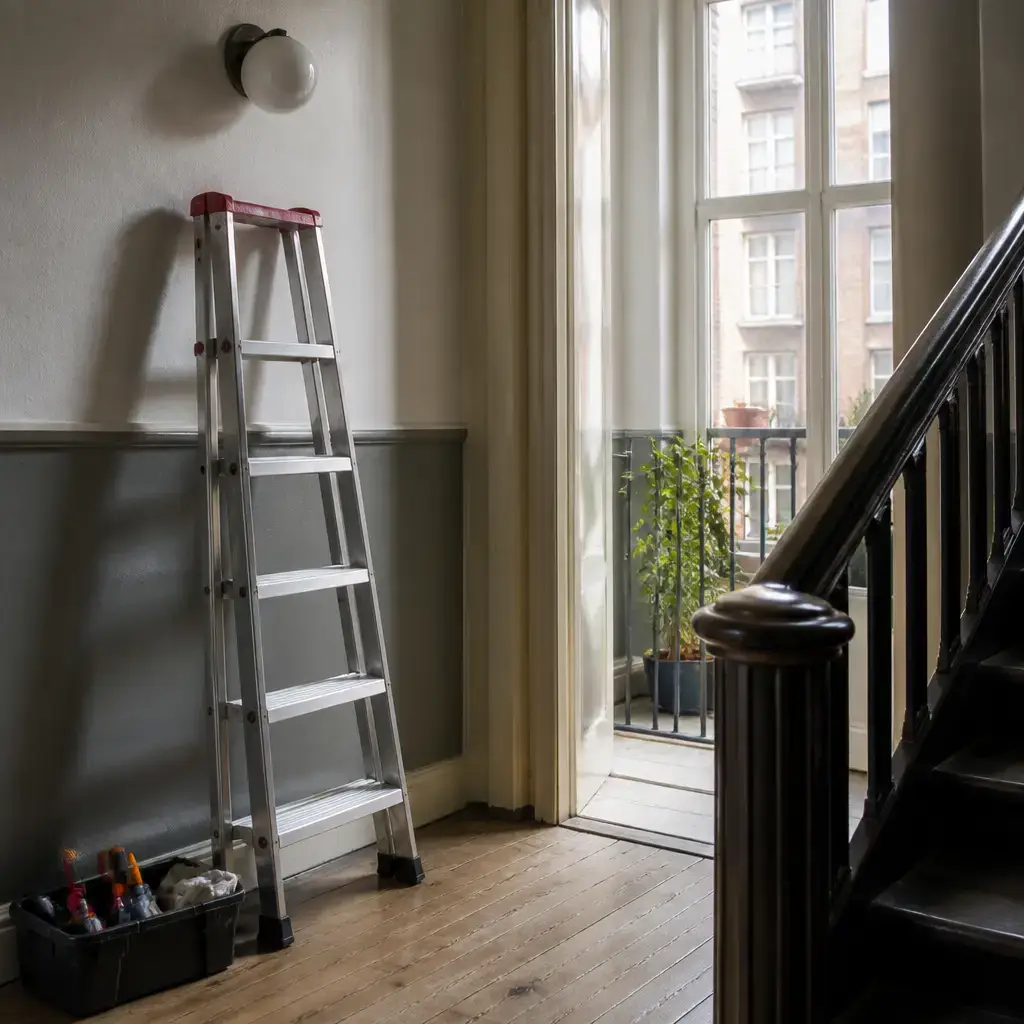
Kann ich deine Leiter benutzen, um eine Deckenlampe zu wechseln?
kahn ikh DYE-nuh LY-tuh beh-NOOT-sen, oom EYE-nuh DEK-en-lam-puh tsoo VEK-seln? Can I use your ladder to change a ceiling light?Du kannst sie benutzen, aber lass währenddessen jemanden in der Nähe bleiben.
doo kahnst zee beh-NOOT-sen, AH-ber lahss VAY-rent-dess-en YAY-man-den in dair NAY-uh BLY-ben. You can, but have someone stay nearby while you use it.Mein Bruder kann das untere Ende festhalten, damit die Leiter stabil bleibt.
mine BROO-der kahn dahs OON-ter-uh EN-duh FEST-hahl-ten, dah-MIT dee LY-tuh shtah-BEEL blypt. My brother can hold the bottom so it stays stable.Das sollte helfen.
dahs SHAWL-tuh HEL-fen. That should help.Die Leiter ist stabil, aber du musst trotzdem vorsichtig sein.
dee LY-tuh ist shtah-BEEL, AH-ber doo moest TROTS-dem FOR-zikh-tikh zine. The ladder is sturdy, but you still need to be careful.Ich brauche sie nur für kurze Zeit, und ich werde vorsichtig sein.
ikh BROW-khuh zee noor fyoor KOOR-tsuh tsight, oont ikh VAIR-duh FOR-zikh-tikh zine. I only need it for a short time, and I'll be careful.Nimm dir die Zeit, die du brauchst.
nim dair dee tsight, dee doo browkhst. Take the time you need.Benutze sie draußen nicht, wenn der Boden nass ist.
beh-NOOT-suh zee DROW-sen nikht, ven dair BOH-den nahss ist. Avoid using it outside if the ground is wet.Ich werde sie drinnen benutzen und zurückbringen, wenn ich fertig bin.
ikh VAIR-duh zee DRIN-en beh-NOOT-sen oont tsoo-RUEK-bring-en, ven ikh FER-tikh bin. I will use it indoors and bring it back when I am finished.Wenn ich nicht zu Hause bin, stell sie neben meine Tür.
ven ikh nikht tsoo HOW-zuh bin, shtell zee NAY-ben MY-nuh tyoor. If I am not home, leave it beside my door.Okay, ich stelle sie neben deine Tür, wenn du nicht da bist.
oh-KAY, ikh SHTEL-luh zee NAY-ben DYE-nuh tyoor, ven doo nikht dah bist. Okay, I'll leave it beside your door if you're out.Achte auf Sicherheit, auch wenn es länger dauert.
AHKH-tuh owf ZIKH-er-hite, owkh ven ess LENG-er DOW-ert. Focus on safety, even if it takes longer.Sentence explanations
Kann ich deine Leiter benutzen, um eine Deckenlampe zu wechseln?
Can I use your ladder to change a ceiling light?
- Kann ich
- Can I …?
- Leiter
- ladder
- benutzen
- use
- Deckenlampe
- ceiling light
- wechseln
- change
More detail
Kann ich combines the present-tense form kann of können with the subject pronoun ich. In this question, it asks for permission: “May/Can I …?” German yes/no questions place the finite verb first, unlike the usual statement order: Ich kann ... → Kann ich ...? The form changes with the subject: ich kann, du kannst. deine Leiter means “your ladder.” Leiter is the feminine noun die Leiter; here it is the object of benutzen, so it is in the accusative, although this noun’s visible form stays Leiter. deine is the possessive determiner agreeing with this feminine singular noun in this case. The translation identifies the intended sense as “ladder”; the same written German noun can have another sense in other contexts, but that is not the meaning here. benutzen means “to use.” It is an infinitive here, following the finite verb kann: Ich kann deine Leiter benutzen means “I can use your ladder.” With a modal verb such as können, the modal is conjugated and the other verb remains an infinitive at the end of the clause. eine Deckenlampe means “a ceiling light.” Deckenlampe is a compound noun: Decke identifies the ceiling and Lampe is the head noun, “lamp/light.” The compound is feminine (die Deckenlampe), and eine is its feminine indefinite determiner in the accusative; it does not by itself assert a numerical count beyond introducing an unspecified item. Example: Ich kaufe eine Lampe. — “I am buying a lamp.” zu wechseln uses the infinitive wechseln with zu. Here wechseln means “to change/replace” the ceiling light. The pattern um ... zu + infinitive expresses purpose: um eine Deckenlampe zu wechseln means “in order to change a ceiling light.” The verb wechseln can also describe changing other things, such as den Termin wechseln in an appropriate context, but here its object is the ceiling light. Putting the parts together, Kann ich asks for permission, deine Leiter benutzen identifies the requested use of the other person’s ladder, and um eine Deckenlampe zu wechseln gives the purpose. The whole utterance therefore means: “Can I use your ladder to change a ceiling light?”
Du kannst sie benutzen, aber lass währenddessen jemanden in der Nähe bleiben.
You can, but have someone stay nearby while you use it.
- Du kannst
- you can
- sie
- it
- benutzen
- use
- lass
- have/let
- währenddessen
- while doing so
- jemanden
- someone
- in der Nähe
- nearby
- bleiben
- stay
More detail
Du kannst: This is the second-person singular form of können (“can, be able to”). The subject is du; kannst carries the person and number marking, while the lexical action appears later as the infinitive benutzen. With a modal verb, the infinitive normally goes to the end of the clause: Du kannst ... benutzen = “You can use ...”. sie: Here this is the accusative singular feminine pronoun meaning “it”, referring to the ladder identified in the preceding question. German pronouns change form according to their grammatical role: feminine singular nominative is sie, and feminine singular accusative is also sie; the form therefore does not visibly change in this case. This sie is not the plural “they” reading in this sentence. benutzen: The base form is benutzen, “to use”. It remains an infinitive after können; the conjugated verb is kannst. Example: Ich kann den Schlüssel benutzen. — “I can use the key.” lass: This is the informal singular imperative of lassen, used here in the causative sense “let/have someone do something”. The pattern Lass jemanden ... tells someone to arrange for that person to carry out the following action. It is not the ordinary present-tense form for “you let”; the imperative addresses one person informally. währenddessen: This is an adverb meaning “while that is happening” or “in the meantime”. Here it links the requested staying to the activity of using the ladder: the person should remain nearby during that activity. It does not itself contain a separate subject or verb. jemanden: This is the accusative form of the indefinite pronoun jemand, meaning “someone” when that person is the object of an action. The form jemand is commonly used for a person in subject position, while jemanden marks the person affected by lassen: Lass jemanden bleiben = “Have someone stay.” in der Nähe: This prepositional phrase means “nearby” or “in the vicinity”. in takes the dative here because the phrase describes a stationary location rather than movement into a location; der is the dative feminine form of the definite article in this expression. The phrase modifies where the person should remain. bleiben: The base form is bleiben, “to stay, remain”. It is an infinitive after lassen, giving the reusable pattern Lass jemanden + infinitive: Lass ihn warten. — “Have him wait.” In the fixed sentence, bleiben describes remaining nearby rather than arriving there. Together, Du kannst sie benutzen means “You can use it.” aber contrasts that permission with the instruction that follows. Lass jemanden in der Nähe bleiben means “have someone stay nearby”, and währenddessen specifies that this should happen while the ladder is being used. The complete utterance is therefore: “You can, but have someone stay nearby while you use it.”
Mein Bruder kann das untere Ende festhalten, damit die Leiter stabil bleibt.
My brother can hold the bottom so it stays stable.
- Bruder
- brother
- kann
- can
- untere
- lower
- Ende
- end
- festhalten
- hold firmly
- damit
- so that
- Leiter
- ladder
- stabil
- stable
- bleibt
- stays
More detail
Bruder means “brother” here. Its base form is Bruder; the plural is Brüder, with a vowel change. In the sentence, Mein Bruder is the subject: mein marks the masculine singular form of “my” before this nominative noun. kann is the present-tense form of können for er/sie/es and means “can” or “is able to” here. The modal verb is followed by the infinitive: kann ... festhalten. For example, Sie kann die Tür öffnen. means “She can open the door.” untere describes Ende as the lower or bottom one. Its base form is the adjective unter; untere is the inflected form used before the neuter singular noun Ende with the definite article das: das untere Ende. The comparative is unterer (“lower,” in a comparison) and the superlative is unterste (“lowest”). Here, the translation’s “bottom” gives the intended meaning of untere in this noun phrase. Ende means “end” and is neuter: das Ende. Its plural is Enden. In das untere Ende, the noun phrase is the direct object of festhalten; das is the neuter accusative form of the definite article, and it refers to the lower end described in the sentence. festhalten means “to hold firmly” or “to keep hold of.” It is a separable verb in finite clauses, but after the modal kann it remains as the infinitive at the end of the main clause: kann ... festhalten. Its stem contains halten (“hold”), but festhalten is the complete verb used here. Example: Bitte halte die Stange fest. means “Please hold the bar firmly.” damit introduces a subordinate purpose clause, meaning “so that” or “so.” The clause explains the intended result of holding the lower end. In a damit clause, the finite verb goes to the end: damit ... stabil bleibt. Leiter means “ladder.” It is feminine: die Leiter; its plural is Leitern. In die Leiter, it is the subject of the subordinate clause, and the definite article die identifies the ladder relevant to the sentence. stabil means “stable” or “steady.” It is an adjective used here after bleibt, so it describes the ladder’s resulting state and is not inflected. Example: Der Tisch bleibt stabil. means “The table stays stable.” bleibt is the present-tense third-person singular form of bleiben, “to stay” or “remain.” The base/current chain is bleiben → er/sie/es bleibt; the form agrees with singular die Leiter. Because it is inside the damit clause, it appears at the end: damit die Leiter stabil bleibt. Together, Mein Bruder kann says that the brother is able to do something; das untere Ende festhalten identifies the object and the action; and damit die Leiter stabil bleibt gives the purpose or intended result. The whole utterance means: “My brother can hold the bottom end so that the ladder stays stable.”
Das sollte helfen.
That should help.
- Das
- that
- sollte
- should
- helfen
- help
More detail
Das is a demonstrative pronoun meaning “that” here. It is the subject of the sentence, and its exact referent is not stated in this sentence; the surrounding context supports a situation or thing related to the ladder, but does not require naming one specific referent. As a pronoun, das is neuter in form; this does not by itself identify what it refers to. sollte is the third-person singular form of sollen in the subjunctive II (Konjunktiv II). Here it expresses an expectation or likely result: “should.” Compare sollen for the ordinary present-tense modal use and sollte for a softer expectation or recommendation. Example: Das sollte funktionieren. — “That should work.” helfen is the infinitive, “to help.” Its present-tense third-person singular form is hilft: Das hilft. — “That helps.” A person receiving help is commonly marked with the dative, as in Ich helfe ihm. — “I help him.” In the fixed sentence, the thing that helps is Das, while the person or thing helped is left unmentioned. Together, Das + sollte + helfen means “That should help.” The modal sollte combines with the infinitive helfen, which stays at the end of this short main clause. The sentence presents helping as an expected result, without stating that the result is certain.
Die Leiter ist stabil, aber du musst trotzdem vorsichtig sein.
The ladder is sturdy, but you still need to be careful.
- Die Leiter
- the ladder
- stabil
- sturdy; stable
- du musst
- you have to
- trotzdem
- still; nevertheless
- vorsichtig
- careful; cautiously
- sein
- be
More detail
Die Leiter means “the ladder” here. Leiter is a feminine noun, so its definite singular nominative form is die Leiter. The same spelling can have other context-dependent meanings, but the fixed translation identifies the intended meaning here. Example: Die Leiter ist alt. — “The ladder is old.” stabil describes the ladder as sturdy or stable. It is an adjective, and in ist stabil it appears after the linking verb without an ending. Its comparative is stabiler (“more stable”), and its superlative is am stabilsten (“most stable”). Example: Der Tisch ist stabil. — “The table is sturdy.” du musst expresses that the addressee needs to do something. musst is the second-person singular present form of the modal verb müssen; its subject is du. The modal is followed by an infinitive: Du musst warten. — “You have to wait.” The infinitive sein appears at the end of this clause. trotzdem means “still” or “nevertheless” and marks a contrast: the ladder’s being sturdy does not remove the need for care. It is an adverb and does not inflect. Example: Es regnet, aber ich gehe trotzdem. — “It is raining, but I am going anyway.” vorsichtig means “careful” in this sentence. After sein, it describes the subject with no adjective ending: Du bist vorsichtig. — “You are careful.” It can also be used adverbially before an action, as in Fahr vorsichtig! — “Drive carefully!” sein is the infinitive “to be.” Here it follows the modal musst, as required by this German modal-verb pattern. The same infinitive is also used after other forms of müssen, for example Ich muss vorsichtig sein. — “I have to be careful.” Together, Die Leiter ist stabil says “The ladder is sturdy.” aber introduces a contrast, and du musst trotzdem vorsichtig sein says that, despite that sturdy condition, the addressee still needs to be careful. The complete utterance is therefore: “The ladder is sturdy, but you still need to be careful.”
Ich brauche sie nur für kurze Zeit, und ich werde vorsichtig sein.
I only need it for a short time, and I'll be careful.
- Ich
- I
- brauche
- need
- sie
- it
- nur für
- only for
- kurze
- short
- Zeit
- time
- werde … sein
- will be
- vorsichtig
- careful
More detail
Ich is the first-person singular pronoun, “I.” German pronouns change form according to their grammatical role; this form is the subject here. ich brauche is the first-person singular present form of brauchen, “to need.” The present tense can describe a current need: Ich brauche Hilfe. — “I need help.” sie is the object of brauche and means “it” here, matching the fixed translation. In this use it is the accusative feminine singular pronoun. Its exact real-world referent is not named in the utterance, so the useful pattern is Ich brauche sie — “I need it.” Do not confuse this form with Sie, the formal “you,” which is capitalized, or with plural sie, whose meaning depends on its grammatical role and context. nur für introduces a restriction: “only for.” nur limits the following duration, while für is the preposition “for.” With a duration, für commonly expresses how long something is needed or applies: für zwei Tage — “for two days.” kurze is the adjective “short” in the phrase kurze Zeit. Its base form is kurz; here it has the feminine accusative form kurze because für governs the accusative and Zeit is feminine. kurz can describe physical length or duration; in this sentence it describes duration. Zeit is the feminine noun “time.” In für kurze Zeit, it refers to a short period, not to a clock time specifically. A reusable contrast is lange Zeit — “a long time”; lang is the opposite of kurz in this duration sense. werde ... sein is the first-person singular future construction “will be.” werde is the first-person singular present form of werden, and sein is the infinitive “to be,” placed at the end of this clause. The pattern is Ich werde + adjective + sein: Ich werde bereit sein. — “I will be ready.” vorsichtig is the adjective “careful” or “cautious.” It describes the speaker's manner or state in vorsichtig sein; it does not carry a special ending here because it follows sein as a predicate adjective. Vorsicht! is a related warning expression meaning “Caution!” but it is a noun, not the adjective used in this sentence. Together, Ich brauche sie nur für kurze Zeit means “I only need it for a short time.” The conjunction und links this with ich werde vorsichtig sein, “I will be careful.” Thus the whole utterance means: “I only need it for a short time, and I’ll be careful.”
Nimm dir die Zeit, die du brauchst.
Take the time you need.
- Nimm dir
- take for yourself
- Zeit
- time
- brauchst
- need
More detail
Nimm dir is the informal singular imperative of nehmen (“to take”), addressed to one person using du. dir is the dative form of du; here it marks the person for whom the time is taken, giving the reusable pattern Nimm dir ... (“Take ... for yourself”). The imperative addresses the listener directly, so the subject is understood rather than stated. Zeit is a feminine noun meaning “time.” Here, die Zeit refers to the time needed for the relevant activity. The first die is the feminine singular definite article modifying Zeit. brauchst is the second-person singular present form of brauchen (“to need”): du brauchst. In die du brauchst, the first word die is a relative pronoun meaning “that/which” and refers back to Zeit; du is the person who needs it. The relative pronoun is feminine singular to agree with Zeit, and its accusative role comes from brauchen. Compare ich brauche, du brauchst, and sie braucht. Together, Nimm dir die Zeit, die du brauchst. means “Take the time you need.” The imperative Nimm dir gives the advice, die Zeit names what should be taken, and die du brauchst specifies which time: the amount needed by the listener. A reusable pattern is Nimm dir [noun], [relative pronoun] du brauchst; the relative pronoun must agree in gender and number with the noun, so it is not always die.
Benutze sie draußen nicht, wenn der Boden nass ist.
Avoid using it outside if the ground is wet.
- Benutze
- use
- sie
- it
- draußen
- outside
- nicht
- not
- wenn
- if
- der Boden
- the ground
- nass
- wet
- ist
- is
More detail
Benutze is the informal singular imperative of benutzen (“to use”). The subject is an understood du, so this is an instruction to one person. For example: Benutze den Schlüssel. — “Use the key.” sie is the accusative pronoun meaning “it” in this sentence. On the intended singular reading, it is the feminine singular form; German grammatical gender does not mean that the object is biologically female. The same written form can also represent plural they/them in other contexts, but the fixed translation identifies a singular object here. draußen is the adverb “outside.” It contrasts with drinnen, “indoors.” Example: Wir essen draußen. — “We eat outside.” nicht negates the instruction. Together, Benutze sie draußen nicht means “Do not use it outside,” or naturally, “Avoid using it outside.” wenn introduces the condition “if” here. It can also mean “when” when referring to a repeated or expected situation; the fixed translation gives the conditional reading. Example: Komm herein, wenn es regnet. — “Come inside if it rains.” der Boden means “the ground.” Boden is a masculine noun, so its nominative definite article is der in this clause. Depending on context, Boden can also mean “floor,” but “ground” is the intended meaning here. nass means “wet.” It is a predicative adjective after sein, so it has no adjective ending in this position. Example: Der Boden ist nass. — “The ground is wet.” ist is the third-person singular present form of sein (“to be”): sein → ist. In the subordinate clause introduced by wenn, the finite verb comes at the end: wenn der Boden nass ist — “if the ground is wet.” The whole structure is Benutze [sie] [draußen] nicht, wenn [der Boden nass ist]: an informal singular instruction not to use the object outside, with the condition that the ground is wet. The wording is suitable for a direct everyday instruction.
Ich werde sie drinnen benutzen und zurückbringen, wenn ich fertig bin.
I will use it indoors and bring it back when I am finished.
- Ich werde
- I will
- sie
- it
- drinnen
- indoors
- benutzen
- use
- und
- and
- zurückbringen
- bring back
- fertig
- finished
More detail
Ich werde combines the first-person pronoun ich with werde, the first-person singular form of werden. With a following infinitive, werden forms the future: Ich werde ... benutzen = “I will use ...”. In this construction, the main lexical verb stays in the infinitive. sie is the object pronoun meaning “it” here, as fixed by the translation. Its form is also used for some other grammatical roles in German, so the intended referent comes from the sentence context rather than from the form alone. drinnen means “indoors” or “inside,” describing where the action takes place. It is an adverb, so it does not change to agree with a noun. Example: Die Kinder spielen drinnen. — “The children are playing indoors.” benutzen is the infinitive “to use.” Its present-tense forms include ich benutze (“I use”) and du benutzt (“you use”). After werde, the infinitive benutzen is used unchanged. und joins two coordinated actions. Here, benutzen and zurückbringen share the subject ich and the future construction introduced by Ich werde. zurückbringen means “to bring back” or “to return” something. It is a separable verb in finite clauses: Ich bringe es zurück. — “I bring it back.” After werde, however, the complete infinitive zurückbringen remains together at the end of its clause. wenn introduces a condition or time clause. Here it means “when,” introducing the time at which the speaker will be finished. In a wenn subordinate clause, the finite verb goes to the end. ich is again the first-person singular subject, and bin is the first-person singular form of sein (“to be”). Together, ich ... bin means “I am”; in this subordinate clause, bin appears at the end: wenn ich fertig bin. fertig means “finished” or “done.” With sein, it describes the speaker’s state: Ich bin fertig. — “I am finished.” The phrase wenn ich fertig bin therefore means “when I am finished.” Putting the parts together, Ich werde sie drinnen benutzen means “I will use it indoors,” and und zurückbringen adds the second action, “and bring it back.” The final clause wenn ich fertig bin specifies when these actions are to be completed: “when I am finished.” The whole utterance is: “I will use it indoors and bring it back when I am finished.”
Wenn ich nicht zu Hause bin, stell sie neben meine Tür.
If I am not home, leave it beside my door.
- Wenn ich nicht zu Hause bin
- if I am not at home
- stell
- leave; place
- sie
- it
- neben
- beside; next to
- meine
- my
- Tür
- door
More detail
Wenn ich nicht zu Hause bin means “if I am not at home.” Wenn introduces a condition, and the conjugated verb goes to the end of this subordinate clause. bin is the first-person singular present form of sein (“to be”): ich bin. zu Hause is the established expression for being at home; nicht negates that condition. Example: Wenn ich zu Hause bin, ruf mich an. — “If I am at home, call me.” stell is the informal singular imperative of stellen (“to place” or “to put”). It tells one person to place something. In this sentence, “leave it” is the natural translation because the object is being placed beside the door. The object comes directly after the imperative: Stell das Glas dort ab. — “Put the glass down there.” sie is the feminine singular accusative pronoun meaning “it” here. It is the direct object of stell; the fixed translation identifies the object as “it.” The form sie can have other functions in German, but its role here is determined by its position as the thing being placed and by the fixed meaning. neben means “beside” or “next to.” It is a two-way preposition: with a static location, it commonly takes the dative, while placement toward a location takes the accusative. Because stellen describes putting the object into a position beside the door, the following noun phrase is accusative: neben meine Tür. Compare: Das Glas steht neben meiner Tür. — “The glass is beside my door.” Here the position is static, so meiner Tür is dative. meine Tür means “my door.” Tür is the feminine noun die Tür. In meine Tür, meine is the possessive determiner in the accusative feminine singular form required after neben for this placement. The possessive form agrees with Tür in gender and number, while the case is determined by the preposition and the placement meaning. Together, the conditional clause Wenn ich nicht zu Hause bin sets the condition, and stell sie neben meine Tür gives the informal instruction to place the object beside the speaker’s door. The complete meaning is: “If I am not home, leave it beside my door.”
Okay, ich stelle sie neben deine Tür, wenn du nicht da bist.
Okay, I'll leave it beside your door if you're out.
- stelle
- leave; put
- sie
- it
- neben
- beside; next to
- deine
- your
- Tür
- door
- wenn
- if; when
- du
- you
- nicht da bist
- are not there; are out
More detail
stelle is the first-person singular present form of stellen, “to put” or “to place.” Here ich stelle means “I’ll put/leave,” with the future meaning supplied by the context; German present tense can refer to a planned future action. Stellen normally describes placing something somewhere, unlike stehen, which describes something already being positioned there. Example: Ich stelle das Glas auf den Tisch. — “I put the glass on the table.” sie is an accusative singular feminine pronoun here, meaning “it.” The fixed translation identifies the object as “it”; the form itself can have other meanings in German, but those are not intended here. The pronoun is the direct object of stelle. neben means “beside” or “next to.” With a two-way preposition such as neben, German uses the accusative for movement or placement toward a location and the dative for a stationary location. Because the utterance describes putting something beside the door, the following noun phrase is accusative: neben deine Tür. Compare Das Glas steht neben deiner Tür. — “The glass is beside your door,” where the stationary meaning takes dative deiner. deine is the possessive determiner meaning “your.” It agrees with the noun phrase’s feminine singular form and is accusative here: deine Tür. The corresponding dative form in the stationary example is deiner Tür; the change is carried by deine, not by Tür. Tür is a feminine noun meaning “door.” Its plural is Türen. In this sentence, Tür is the object of the preposition neben in a placement expression, so the noun phrase is accusative, even though the noun itself has no visible case ending here. wenn introduces a subordinate conditional clause, meaning “if” here. It can also mean “when” when the clause describes a time or recurring situation. In a wenn clause, the finite verb goes to the end: wenn du nicht da bist. du is the informal singular “you” subject of the subordinate clause. It contrasts with the formal singular Sie and plural ihr; the correct choice depends on the addressee and number, not on the action being described. nicht da bist means “are not there” or, in this context, “are out.” Bist is the second-person singular present form of sein (“to be”): du bist. Da means “there,” and nicht negates the phrase. The negative element therefore says that you are not present at the relevant place; it does not negate the placing action. Together, ich stelle sie gives “I’ll put/leave it,” neben deine Tür specifies the destination “beside your door,” and wenn du nicht da bist gives the condition “if you’re out.” The complete utterance is therefore: “Okay, I’ll leave it beside your door if you’re out.”
Achte auf Sicherheit, auch wenn es länger dauert.
Focus on safety, even if it takes longer.
- Achte auf
- pay attention to
- Sicherheit
- safety
- auch wenn
- even if
- länger
- longer
- dauert
- takes time
More detail
Achte auf is the second-person singular imperative of achten auf (“to pay attention to / take care with”). The imperative addresses one person directly: Achte auf ... means “Pay attention to ...”. The preposition auf takes the accusative in this meaning, although the noun’s article is not shown here. Example: Achte auf den Verkehr. — “Pay attention to the traffic.” Sicherheit means “safety” here. Its base form is the noun Sicherheit, a feminine noun (die Sicherheit). The sentence uses it without an article, referring to safety as a general concern rather than presenting a stated countable item. Example: Sicherheit ist wichtig. — “Safety is important.” auch wenn introduces a subordinate clause meaning “even if” or “even when”. It marks a condition that does not change the main instruction. In German, the finite verb normally goes to the end of a clause introduced by wenn: auch wenn es länger dauert. länger is the comparative form of the adjective lang (“long”): lang → länger (“longer”). The umlaut belongs to the adjective’s comparative form. Here it describes a longer duration, not a physically longer object. Example: Der Weg ist länger. — “The route is longer.” dauert is the third-person singular present form of dauern (“to last / take [time]”). Its subject is es; in this sentence, es refers generally to the situation or process taking more time, without identifying a separate concrete actor. Example: Es dauert zehn Minuten. — “It takes ten minutes.” Together, Achte auf Sicherheit gives the instruction “Pay attention to safety.” auch wenn es länger dauert adds the concession “even if it takes longer.” The complete utterance is therefore: “Focus on safety, even if it takes longer.”
Grammar Points
auch wenn + Nebensatz
Auch wenn es länger dauert, nimm dir die Zeit.
owkh ven ess LENG-er DOW-ert, nim dair dee tsight.Even if it takes longer, take the time.
Nach „auch wenn“ steht das konjugierte Verb am Ende des Nebensatzes.
sich die Zeit nehmen
Nimm dir die Zeit.
nim dair dee tsight.Take the time.
Diese feste Wendung verwendet ein Reflexivpronomen: „dir“ passt zu „du“.
German Vocabulary
eine Deckenlampe
das untere Ende
deine Leiter
in der Nähe
das untere Ende
Quiz
Word Order
Arrange the words in the correct order.
That should help.
Show Answer
Das sollte helfen.Spelling
Tap the letters to spell the word.
vicinity
Show Answer
Näheceiling light
Show Answer
Deckenlampesomeone
Show Answer
jemandento change