10 minutes free every day
Continue audio lessons in the app
Word explanations appear automatically in sync with the audio.
No login required · synced translations · playback with the screen locked
Choose your learning language and open this lesson in the app.

About This Lesson
Use Borrowing a Bicycle Repair Kit to practice German conversation, pronunciation, vocabulary, grammar, and quizzes.
Dialogue
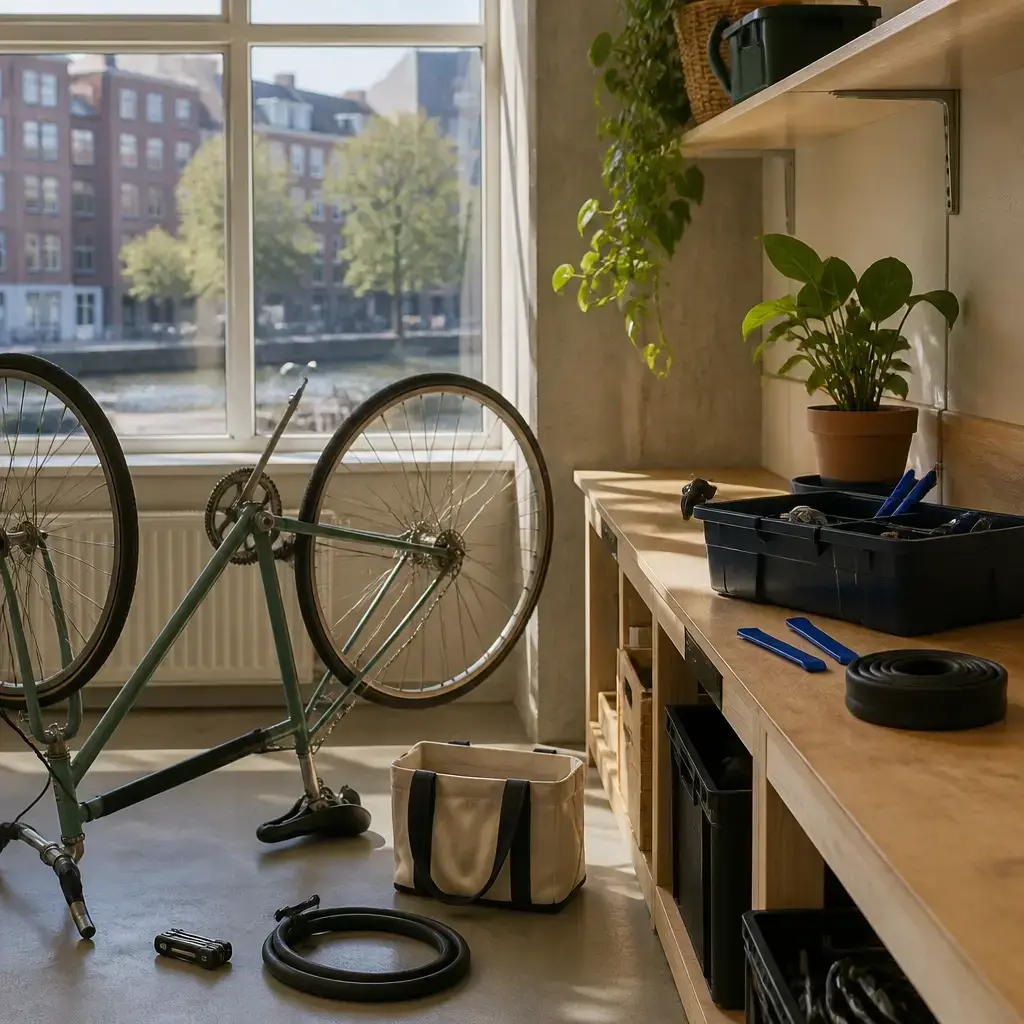
Mein Fahrradreifen ist platt, und ich brauche ein Reparaturset.
mine FAHR-raht-RYE-fen ist plaht, oont ikh BROW-khuh ine reh-pa-ra-TOOR-zet. My bicycle tire is flat, and I need a repair kit.Ich habe ein Set mit Reifenhebern und einem Ersatzschlauch.
ikh HAH-buh ine zet mit RYE-fen-HAY-bern oont EYE-nem air-ZAHTS-shlowkh. I have a kit with tire levers and a spare inner tube.Könntest du mir zeigen, wie man das Rad richtig ausbaut?
KURN-tist doo meer TSOY-gen, vee mahn dahs raht RIKH-tikh OWS-bowt? Could you show me how to remove the wheel correctly?Dreh das Fahrrad vorsichtig um.
DRAY dahs FAHR-raht FOR-zikh-tikh oom. Start by turning the bike upside down carefully.Ich habe noch nie allein einen Schlauch gewechselt.
ikh HAH-buh nokh nee ah-LINE EYE-nen shlowkh geh-VEK-selt. I have never changed an inner tube by myself before.Befolge die Anleitung genau und versuche nicht, ein Teil mit Gewalt zu bewegen.
beh-FOL-guh dee AHN-lie-toong guh-NOW oont fer-ZOO-khuh nikht, ine tile mit geh-VAHLT tsoo beh-VAY-gen. Follow the instructions carefully, and do not force any part to move.Nachdem ich ihn ersetzt habe, sollte ich den Reifendruck prüfen?
NAHKH-daym ikh een AIR-zetst HAH-buh, ZOL-tuh ikh dayn RYE-fen-drook PRYOO-fen? After I replace it, should I check the pressure?Der Reifen sollte sich fest anfühlen, aber nicht zu hart sein.
dair RYE-fen ZOL-tuh zikh fest ahn-FYOO-len, AH-ber nikht tsoo hart zine. The tire should feel firm, but not too hard.Könntest du in der Nähe bleiben, während ich den ersten Schritt ausprobiere?
KURN-tist doo in dair NAY-uh BLY-ben, VAY-rent ikh dayn AIR-sten shrit OWS-proh-BEE-ruh? Could you stay nearby while I try the first step?Ich kann dir den ersten Teil erklären, während du das Set benutzt.
ikh kahn deer dayn AIR-sten tile air-KLEH-ren, VAY-rent doo dahs zet beh-NOOTST. I can talk you through the first part while you use the kit.Sentence explanations
Mein Fahrradreifen ist platt, und ich brauche ein Reparaturset.
My bicycle tire is flat, and I need a repair kit.
- Mein
- my
- Fahrradreifen
- bicycle tire
- platt
- flat
- ich
- I
- brauche
- need
- Reparaturset
- repair kit
More detail
Mein means “my” here and agrees with the noun it accompanies. Fahrradreifen is masculine singular (der Fahrradreifen), and in this nominative subject phrase the masculine possessive form is mein, without an ending. Possessives change with the noun phrase’s grammatical case, number, and—where relevant—gender; for example, meine Reifen means “my tires.” Fahrradreifen is a compound noun: Fahrrad (“bicycle”) + Reifen (“tire”), together meaning “bicycle tire.” The compound is masculine, so its article is der: der Fahrradreifen. The plural is die Fahrradreifen. platt means “flat” in this sentence. It is a descriptive adjective used after ist, so it is predicative and has no adjective ending here: Der Reifen ist platt (“The tire is flat”). This form describes the tire’s condition; it is not the attributive form in a phrase such as ein platter Reifen, where the adjective has an ending. ich is the first-person singular pronoun “I.” Its form does not change for grammatical gender. A useful contrast is du (“you,” singular informal) and wir (“we”). brauche is the first-person singular present form of brauchen, “to need”: ich brauche. The same verb has du brauchst for “you need” and er/sie braucht for “he/she needs.” Here brauche states a present need; it is not an imperative. Reparaturset means “repair kit.” It is a compound of Reparatur (“repair”) and Set (“kit/set”), and it is neuter: das Reparaturset. After brauchen, the needed object is in the accusative. For this neuter singular noun, the indefinite article remains ein: Ich brauche ein Reparaturset (“I need a repair kit”). The article identifies an unspecified kit, but does not by itself assert a numerical count as a teaching point. The first clause is Mein Fahrradreifen ist platt: Mein Fahrradreifen is the subject, ist is the present form of “is,” and platt describes its condition. und links this clause to ich brauche ein Reparaturset, which says that the speaker needs a repair kit. Together, the utterance means: “My bicycle tire is flat, and I need a repair kit.”
Ich habe ein Set mit Reifenhebern und einem Ersatzschlauch.
I have a kit with tire levers and a spare inner tube.
- Ich habe
- I have
- Set
- kit
- Reifenhebern
- tire levers
- Ersatzschlauch
- spare inner tube
More detail
Ich habe uses haben in the present tense, first-person singular: ich habe = “I have.” It expresses possession here. The same pattern is reusable with another possessed item: Ich habe ein Fahrrad. = “I have a bicycle.” Set means “kit” or “set.” It is a neuter noun: das Set. In this sentence, ein Set is the object of habe, so it is in the accusative; for a neuter noun, the indefinite article remains ein in the nominative and accusative. The plural is Sets. Reifenhebern means “tire levers.” The singular noun is der Reifenheber; its plural is die Reifenheber. After mit, the noun phrase is dative. In the dative plural, the noun takes -n: mit Reifenhebern. The compound combines Reifen (“tires”) and Heber (“lifter”), but the reusable vocabulary item here is the noun Reifenheber. Ersatzschlauch means “spare inner tube.” It is a masculine compound noun: der Ersatzschlauch; Ersatz- indicates a replacement or spare item, and Schlauch means “tube.” After mit, it is dative singular, shown by einem: mit einem Ersatzschlauch. Example: Ich fahre mit einem Ersatzschlauch. = “I ride with a spare inner tube.” Together, Ich habe ein Set states possession of a kit. mit Reifenhebern und einem Ersatzschlauch specifies what the kit contains: tire levers and a spare inner tube. Thus the complete utterance means, “I have a kit with tire levers and a spare inner tube.”
Könntest du mir zeigen, wie man das Rad richtig ausbaut?
Could you show me how to remove the wheel correctly?
- Könntest du
- Could you
- zeigen
- show
- wie man
- how to
- Rad
- wheel
- richtig
- correctly
- ausbaut
- removes
More detail
Könntest du uses the second-person singular form of können in the Konjunktiv II: können → könntest. Here it makes the request polite: “Could you…?” The subject is du; mir is the first-person singular dative pronoun, meaning “to me,” so the full request asks someone to show something to the speaker. zeigen means “to show.” It stays in the infinitive because it follows the modal verb könntest: Du könntest mir das zeigen. (“You could show me that.”) With a person as the thing shown, German commonly uses jemandem etwas zeigen—show someone something. wie man introduces a method clause: “how one” or, naturally here, “how to.” man is an impersonal singular pronoun for people in general; it is not the informal pronoun Mann (“man” as an adult male). The verb in this clause appears later, as is normal in a German subordinate clause introduced by wie. Rad is the noun “wheel” here. Its base form is das Rad; in das Rad, the article and noun form are also compatible with the accusative, which marks the thing being removed. The surrounding context identifies this as the wheel involved in the bicycle repair, but the noun itself means “wheel.” richtig is an adverb here, modifying the removal procedure: “correctly” or “properly.” The related adjective is also richtig, as in die richtige Methode (“the correct method”); in the fixed sentence it does not describe Rad directly. ausbaut comes from the separable verb ausbauen, “to remove” or “dismantle” a fitted part. Its form is third-person singular present: ausbauen → er/sie/man baut aus; inside this wie clause, the prefix joins the verb again, giving man ... ausbaut. For example: Man baut den Sattel aus. — “One removes the saddle.” Together, Könntest du mir zeigen asks politely for a demonstration, and wie man das Rad richtig ausbaut specifies the procedure to be demonstrated. The complete meaning is: “Could you show me how to remove the wheel correctly?”
Dreh das Fahrrad vorsichtig um.
Start by turning the bike upside down carefully.
- Dreh … um
- turn ... upside down
- Fahrrad
- bike
- vorsichtig
- carefully
More detail
Dreh ... um is the separable verb umdrehen in the informal singular imperative. The prefix um moves to the end of the clause: Du drehst das Fahrrad um becomes Dreh das Fahrrad um! The fixed translation specifies the relevant meaning here: turn the bicycle upside down. In other contexts, umdrehen can also mean turn something around, so the object and situation help determine the exact sense. Fahrrad means “bicycle” or “bike.” Its useful plural is Fahrräder. In this sentence, das Fahrrad is the object being turned; das is the accusative form of the neuter noun here. Example: Das Fahrrad steht draußen. — “The bicycle is outside.” vorsichtig means “careful” or “carefully.” Here it is an adverb modifying the action, so it tells the person how to turn the bicycle. The related adjective use is also vorsichtig: Sei vorsichtig! — “Be careful!” Together, Dreh das Fahrrad ... um gives the instruction “turn the bicycle upside down,” and vorsichtig adds the manner: “carefully.” Thus the complete utterance is: “Start by turning the bike upside down carefully.”
Ich habe noch nie allein einen Schlauch gewechselt.
I have never changed an inner tube by myself before.
- Ich habe
- I have
- noch nie
- never before
- allein
- by myself
- Schlauch
- inner tube
- gewechselt
- changed
More detail
Ich habe is the first-person singular present form of haben: “I have.” Here it is the auxiliary in the German perfect tense. The pattern ich habe + ... + participle commonly describes a completed past event from the speaker’s perspective. For example: Ich habe gearbeitet. — “I have worked” or “I worked.” noch nie means “never before” in this sentence. nie means “never,” while noch nie emphasizes that this has not happened at any time up to now. It commonly appears with the perfect tense: Ich habe noch nie gekocht. — “I have never cooked before.” allein means “by myself” here: the speaker performed the action without another person’s help. It can also mean “alone” in a spatial sense, but the fixed translation supports the self-reliance meaning here. Example: Sie repariert das Fahrrad allein. — “She repairs the bicycle by herself.” Schlauch is a masculine noun meaning “inner tube” in this context. The form in the sentence is preceded by the masculine accusative article einen, because it is the object being changed: einen Schlauch. The noun’s plural is Schläuche; the vowel changes as well as the ending. Example: Ich brauche einen neuen Schlauch. — “I need a new inner tube.” gewechselt is the past participle of wechseln, “to change” or “to replace.” With haben, it forms the perfect: habe gewechselt. The participle is placed at the end of this main clause. Example: Er hat das Kabel gewechselt. — “He changed the cable.” Together, Ich habe ... gewechselt forms “I have changed ...,” noch nie adds “never before,” and allein specifies that the speaker did it without help. Thus the complete utterance means: “I have never changed an inner tube by myself before.”
Befolge die Anleitung genau und versuche nicht, ein Teil mit Gewalt zu bewegen.
Follow the instructions carefully, and do not force any part to move.
- Befolge
- follow; comply with
- Anleitung
- instructions; manual
- genau
- carefully; exactly
- versuche
- try; attempt
- Teil
- part
- mit Gewalt
- by force
- bewegen
- move
More detail
Befolge is the second-person singular imperative of befolgen (“to follow” or “to comply with”). It gives a direct instruction to one person. The present-tense form for “you follow” is du befolgst, while the imperative is Befolge; the subject pronoun is normally omitted in this command. Anleitung means “instructions” or “manual” here. Its base form is singular: die Anleitung; the plural is die Anleitungen. In this sentence, die Anleitung is the thing being followed, marked by the accusative form, which looks the same as the nominative feminine form. genau is an adverb meaning “carefully” or “exactly” in this context. It specifies how the instructions should be followed. The adjective genau can also describe a noun, as in eine genaue Anleitung (“precise instructions”), but here it modifies the action Befolge. versuche is another second-person singular imperative, from versuchen (“to try” or “to attempt”). The negative command Versuche nicht, ... means “Do not try to ...”. German commonly uses versuchen, etwas zu tun for “try to do something”; in this sentence, the infinitive construction begins with zu bewegen. Teil means “part” or “component.” Here, ein Teil refers to an individual part in the general sense conveyed by the fixed translation “any part.” The indefinite article does not by itself state a numerical count. The plural is Teile. mit Gewalt means “by force” or “forcibly.” mit takes the dative case, and Gewalt is feminine, so the phrase is mit Gewalt. It describes the manner of moving the part, not the part itself. bewegen is the infinitive “to move.” In zu bewegen, zu marks the infinitive required by versuchen: versuchen, etwas zu bewegen means “try to move something.” The same verb can be transitive (“move something”) or intransitive (“move”), and here ein Teil is the object being moved. Together, Befolge die Anleitung genau means “Follow the instructions carefully.” Versuche nicht, ein Teil mit Gewalt zu bewegen adds the negative instruction “and do not try to force any part to move.” The two imperative clauses address one person; the first requires careful adherence to the instructions, and the second forbids using force to move a part. The complete utterance is therefore: “Follow the instructions carefully, and do not force any part to move.”
Nachdem ich ihn ersetzt habe, sollte ich den Reifendruck prüfen?
After I replace it, should I check the pressure?
- Nachdem
- after
- ich
- I
- ihn
- it
- ersetzt
- replaced
- habe
- have
- sollte ich
- should I
- den Reifendruck
- the tire pressure
- prüfen
- check
More detail
Nachdem introduces a time clause meaning “after.” In German, the finite verb in this subordinate clause goes to the end: Nachdem ich ihn ersetzt habe = “After I have replaced it.” A reusable pattern is Nachdem + subject + … + finite verb: Nachdem sie angekommen ist, rufen wir an. — “After she has arrived, we’ll call.” ich is the first-person singular pronoun, “I.” It identifies the person carrying out ersetzt and habe here. The corresponding plural form is wir (“we”), but the verb forms must also change: ich habe versus wir haben. ihn is the accusative masculine singular form of er (“he” or “it” for a masculine noun). Here it means “it,” referring to the object being replaced; the supplied translation does not identify that object more specifically. German pronouns show case and grammatical gender: ihn is used when the masculine referent is the direct object, while ihm is the corresponding dative form (“to/for it/him”). ersetzt is the past participle of ersetzen, “to replace.” With the auxiliary habe, it forms the perfect: ich habe … ersetzt = “I have replaced … .” The verb’s separable-prefix pattern is not involved here; ersetzen remains one verb. Example: Sie hat den Filter ersetzt. — “She has replaced the filter.” habe is the first-person singular present form of haben, “to have.” In this sentence it is an auxiliary, not possession: ich habe ersetzt forms the perfect tense. In the subordinate clause, it appears at the end, after the participle: Nachdem ich ihn ersetzt habe. sollte ich asks whether the speaker ought to do something: “should I …?” sollte is the form of sollen used for a tentative question or recommendation here, and ich is its subject. The infinitive governed by sollte comes at the end of the main clause: Sollte ich den Druck prüfen? — “Should I check the pressure?” den Reifendruck means “the tire pressure.” Reifendruck is a masculine compound noun: der Reifen (“tire”) + der Druck (“pressure”), with the compound’s gender determined by its final element, Druck. den marks masculine accusative singular because Reifendruck is the direct object of prüfen. The phrase is not a quantity expression; den is the definite article here. prüfen is the infinitive “to check” or “to inspect.” After a modal verb such as sollen, the infinitive remains unchanged and goes to the end of the clause: Ich sollte den Reifendruck prüfen. — “I should check the tire pressure.” Together, Nachdem ich ihn ersetzt habe sets the condition in time: “After I have replaced it.” The main clause sollte ich den Reifendruck prüfen? asks whether checking the tire pressure is the appropriate next action. German therefore places the finite verb habe at the end of the nachdem clause, while the modal sollte is followed by the subject ich and sends its infinitive prüfen to the end of the main clause. The whole utterance means: “After I replace it, should I check the pressure?”
Der Reifen sollte sich fest anfühlen, aber nicht zu hart sein.
The tire should feel firm, but not too hard.
- Reifen
- tire
- sollte
- should; is expected to
- sich … anfühlen
- feel
- fest
- firm
- hart
- hard
More detail
Reifen means “tire” here. Its plural is Reifen as well; the singular and plural are distinguished by context and accompanying forms, not by a changed noun ending. Example: Der Reifen ist neu. — “The tire is new.” sollte is the form of sollen used here for “should” or an expected condition. In this sentence it expresses the recommended or expected way the tire is supposed to feel, not a firm statement that it already feels that way. With a modal verb, the other verb stays in the infinitive at the end: Der Reifen sollte ... anfühlen is not the complete structure, because the reflexive verb is sich anfühlen and the sentence uses the infinitive anfühlen together with sich. sich anfühlen means “to feel” in the sense of having a particular perceived quality. The verb is separable when it is finite: Der Reifen fühlt sich fest an. — “The tire feels firm.” With sollte, the infinitive remains together at the end: Der Reifen sollte sich fest anfühlen. The reflexive form is part of this verb’s construction; sich refers grammatically to the subject being experienced, here the tire. fest means “firm” or “solid” in this context. It describes the intended tactile quality. It is different from hart, “hard”: something can be firm without being excessively hard. Example: Das Kissen fühlt sich fest an. — “The cushion feels firm.” hart means “hard.” In zu hart, zu means “too,” so the phrase describes an excessive degree of hardness. The adjective itself is not comparative here; härter would mean “harder,” while am härtesten means “hardest.” Example: Der Reifen ist zu hart. — “The tire is too hard.” The sentence first gives the desired quality with sollte sich fest anfühlen: the tire is expected to feel firm. aber nicht zu hart sein adds a contrast: it should not be excessively hard. Together, the utterance means: “The tire should feel firm, but not too hard.”
Könntest du in der Nähe bleiben, während ich den ersten Schritt ausprobiere?
Could you stay nearby while I try the first step?
- Könntest du
- Could you
- in der Nähe
- nearby
- bleiben
- stay
- während
- while
- ich
- I
- den
- the
- ersten
- first
- Schritt
- step
- ausprobiere
- try
More detail
Könntest du means “Could you…?” here. könntest is the second-person singular subjunctive II form of können (“can, be able to”); with du, it makes a polite request rather than stating ability directly. German also uses Kannst du …? for a more direct “Can you …?” request. The subject is du, and the requested action appears as the infinitive bleiben after the modal verb, before the following während clause. in der Nähe means “nearby” or “in the vicinity.” The noun Nähe is feminine, and der here is the feminine dative form of the definite article after the preposition in in this location expression. This phrase describes where someone should remain; it does not itself specify whose location or a particular distance. bleiben means “stay” or “remain.” Its base form is the infinitive bleiben; after könntest du, German uses this infinitive rather than a conjugated form. Example: Bleib hier. — “Stay here.” während introduces a subordinate clause meaning “while.” In the clause während ich den ersten Schritt ausprobiere, the finite verb comes at the end, a standard German subordinate-clause pattern. It connects the requested staying with the action happening during that time. ich means “I.” It is the first-person singular nominative pronoun and is the subject of ausprobiere, not of bleiben. The subject changes inside the während clause: the person being asked to stay is du, while the speaker is the person trying the step. den is the masculine accusative singular form of the definite article, “the.” It marks Schritt as the direct object of ausprobiere. Compare der Schritt as the nominative form and den Schritt as the accusative form. ersten means “first.” It is the ordinal adjective based on eins (“one”), used here before the masculine accusative singular noun Schritt. After the definite article den, the adjective takes the ending -en: den ersten Schritt. The noun, not the adjective, is the item being described; ersten identifies its order in a sequence. Schritt means “step.” It is a masculine noun: der Schritt in the basic form and den Schritt here because it is the direct object. Example: Der erste Schritt ist einfach. — “The first step is easy.” ausprobiere means “try out” or “test.” It is the first-person singular present form of the separable verb ausprobieren: ich probiere ... aus in a main clause, but ich ... ausprobiere in this subordinate clause, where the finite verb is placed at the end and the prefix is joined to the verb. Example: Ich probiere den neuen Ablauf aus. — “I am trying out the new procedure.” Together, Könntest du ... bleiben forms the polite request “Could you stay …?” in der Nähe gives the location, and während ich den ersten Schritt ausprobiere means “while I try the first step.” The whole utterance therefore means: “Could you stay nearby while I try the first step?”
Ich kann dir den ersten Teil erklären, während du das Set benutzt.
I can talk you through the first part while you use the kit.
- Ich kann
- I can
- dir
- to you
- ersten
- first
- Teil
- part
- erklären
- explain; talk through
- während
- while
- du
- you
- Set
- kit; set
- benutzt
- use
More detail
Ich kann: können means “can” or “be able to.” Here kann is the present-tense first-person singular form, matching Ich. A modal verb is followed by an infinitive: Ich kann ... erklären = “I can explain ...”; the infinitive erklären comes at the end of the main clause. dir: This is the dative singular form of the informal second-person pronoun du. It marks the person who receives the explanation: “to you.” The matching forms are du (subject), dich (accusative object), and dir (dative object). Example: Ich helfe dir. — “I help you.” den ersten Teil: Teil is a masculine noun meaning “part” or “section”; its usual singular forms include der Teil (nominative) and den Teil (accusative). ersten is the ordinal adjective from erst (“first”). Here it has the masculine accusative ending because it describes Teil after den: den ersten Teil = “the first part.” Example: Ich lese den ersten Abschnitt. — “I am reading the first section.” erklären: This infinitive means “to explain.” In this sentence, the fixed translation conveys guiding someone through the part, so “talk through” is a natural English rendering. Its forms include erklären (infinitive), ich erkläre (I explain), and er erklärt (he/she explains). The verb takes the thing explained as an accusative object: Ich erkläre den Plan. — “I explain the plan.” während: This introduces a time clause meaning “while.” In a clause introduced by während, the conjugated verb normally goes to the end. It can also introduce a noun phrase in other uses, but here it connects two actions: explaining and using the kit. du: This is the informal singular “you” as the subject of the subordinate clause. It is the nominative form; its object forms are dich (accusative) and dir (dative). Here du is the person carrying out the action benutzt. das Set: Set is a neuter loan noun meaning “set” or, in this context, “kit.” The definite article is das in both nominative and accusative singular, so the form does not reveal the case by itself. Example: Ich benutze das Set. — “I use the kit.” benutzt: This is the present-tense second-person singular form of benutzen (“to use”), agreeing with du: du benutzt. The verb has no separable prefix here. Because it follows während, it appears at the end of the subordinate clause: während du das Set benutzt — “while you use the kit.” Together, Ich kann dir den ersten Teil erklären means “I can explain the first part to you,” and während du das Set benutzt adds the simultaneous activity “while you use the kit.” The complete utterance therefore means: “I can talk you through the first part while you use the kit.”
Grammar Points
wie + Nebensatz: Das konjugierte Verb steht am Ende.
wie man das Rad richtig ausbaut
vee mahn dahs raht RIKH-tikh OWS-bowthow to remove the wheel correctly
In a clause with „wie“, the conjugated verb moves to the end.
Trennbare Verben: aus- steht im Hauptsatz am Ende.
Ich probiere das Reparaturset aus.
ikh proh-BEE-ruh dahs reh-pa-ra-TOOR-zet owsI try out the repair kit.
In a main clause, the prefix „aus“ separates and moves to the end.
German Vocabulary
wie man das Rad richtig ausbaut
Ich brauche ein Reparaturset.
mit einem Ersatzschlauch
Mein Fahrradreifen ist platt.
Mein Fahrradreifen ist platt.
das Rad
mit Reifenhebern
Ich brauche ein Reparaturset.
das Rad richtig ausbauen
Ich habe ein Set.
wie man das Rad richtig ausbaut
Könntest du mir zeigen?
Quiz
Word Order
Arrange the words in the correct order.
Start by turning the bike upside down carefully.
Show Answer
Dreh das Fahrrad vorsichtig um.Spelling
Tap the letters to spell the word.
repair kit
Show Answer
Reparatursetto show
Show Answer
zeigentire lever
Show Answer
Reifenhebernto need